
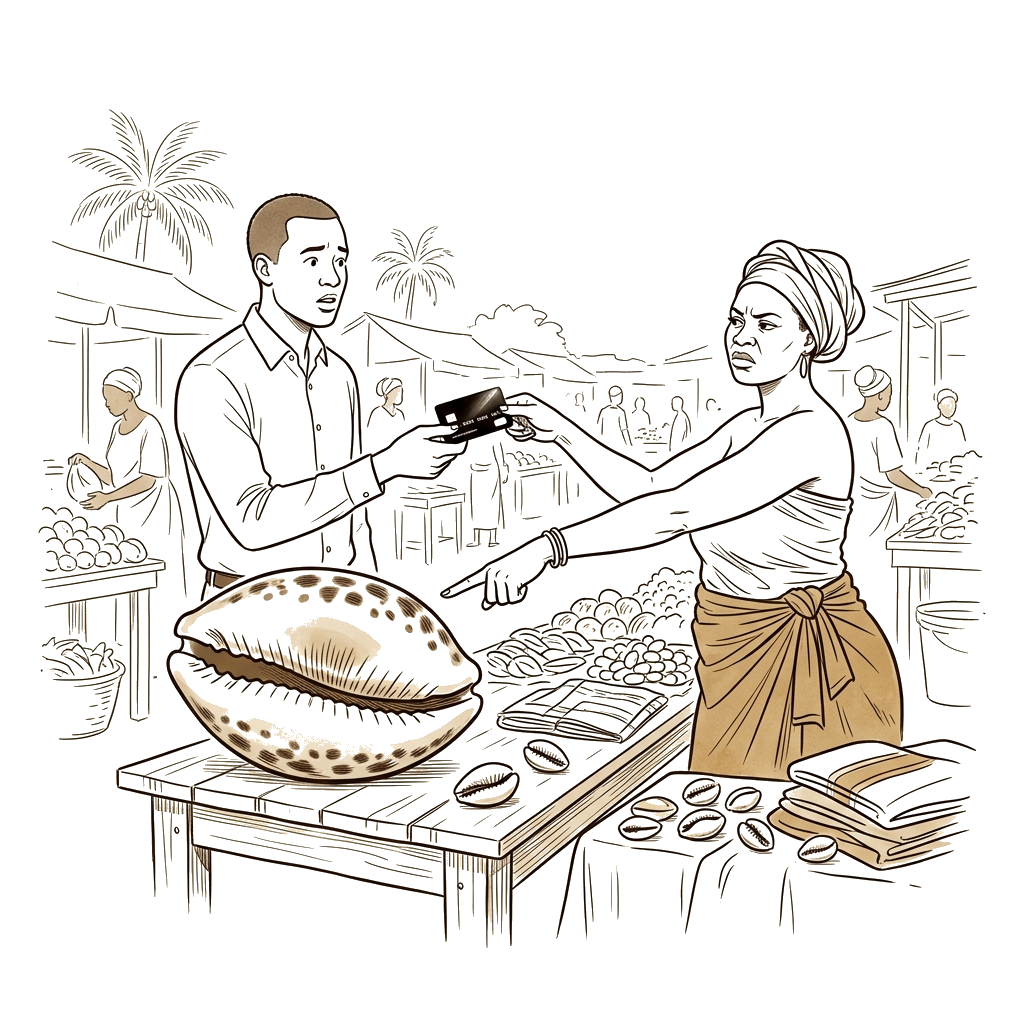
Money in Benin runs on cash, in West African CFA francs. ATMs exist, Ouidah included. Cards work in a handful of hotels and shops. And mobile money has quietly become the way most people pay for everyday things. The rest is preparation.
What catches visitors off guard is not a shortage of money. It is a shortage of change.
A moto-taxi driver looks at your 10,000-franc note, looks at you, then walks to the next stall to find change. You will see that scene ten times a day. This guide shows you how to avoid it, and how to handle cash, cards and phones with confidence during your stay.
The CFA franc, pegged to the euro
Benin uses the West African CFA franc (currency code XOF), shared by the eight countries of the West African monetary union. It is pegged to the euro at a fixed rate: 1 euro = 655.957 CFA francs.
Against the US dollar, the rate floats. Check it the day before you fly. A rough mental shortcut many travelers use: 1,000 francs is a little under two dollars, but confirm with the current rate.
Banknotes come in 500, 1,000, 2,000, 5,000 and 10,000 francs. Coins go up to 500. Treat the 500, 1,000 and 2,000 notes as precious. They are what you will need most.
Cash comes first
Almost everything in Ouidah is paid in cash. The moto-taxi (called a zem) to the beach, lunch at a maquis (a local open-air eatery), temple entrance fees, bottled water from a kiosk, fabric at the market. According to recent travel guides, a short zem ride in town costs 300 to 500 francs, and a simple meal 1,000 to 2,000.
Three habits will save you a lot of waiting:
- Break big notes where the till is full. Gas stations, supermarkets and your hotel front desk almost always have change.
- Pay small amounts with small notes. Handing a 10,000 note to a zem driver for a 500-franc ride guarantees a delay.
- Split your cash. Keep the day's money in one pocket and your reserve somewhere else, so you never pull out a stack in public.
For what things actually cost (rooms, meals, entrance fees, guides), see our Ouidah budget guide.
Withdrawing cash in Ouidah
Yes, you can withdraw cash in Ouidah. Ecobank and UBA have ATMs in town, notably in the central Sogbadji neighborhood, and they accept international cards. They can run dry on weekends, though, or go offline when the network drops.
The safe approach: withdraw in Cotonou before heading to Ouidah, at the airport or in the city, and use Ouidah's ATMs to top up.
Before you insert your card:
- Limits are low. Depending on the bank, a single withdrawal is often capped around 100,000 to 150,000 francs (roughly $160 to $250). Plan several withdrawals for a longer stay.
- Fees stack up. The local bank charges per withdrawal, and your own bank adds its share. A few large withdrawals beat many small ones.
- Visa is more reliable than Mastercard. Travelers consistently report that some ATMs reject Mastercard. Bring one card from each network if you can.
- Tell your bank you are traveling, and keep its lost-card phone number somewhere other than your phone.
If you bank in the US, check your card's foreign transaction and ATM fees before leaving. Some checking accounts refund ATM fees worldwide, which adds up fast on a long trip.
Cards: useful, but rarely
In Ouidah, cards mostly work at mid-range and upscale hotels and a few restaurants. In Cotonou, you can also use them in supermarkets and some shops. Beyond that, do not count on them.
Even where a terminal exists, it depends on the network. When the connection goes down, so does your payment. Always carry enough cash to settle the bill.
Wise, Revolut and similar cards work at ATMs like any Visa or Mastercard. They reduce exchange fees on your side, but not the local ATM fee.
Exchanging euros or dollars
Euros are the easiest currency to exchange, thanks to the fixed peg. Dollars work too, at a less favorable rate, and crisp, recent bills get the best treatment.
Where to exchange:
- At banks (Ecobank, UBA, BOA and others) and licensed exchange offices, mainly in Cotonou.
- At Cotonou airport, convenient on arrival, but the rate is usually worse than in town.
Avoid street money changers, even when their rate looks better. Counterfeit notes and quick-hand miscounts are not worth the few francs you might gain.
Mobile money: Benin's real wallet
In Benin, a lot of people pay with their phones. Three services share the market: MTN MoMo, Moov Money and Celtiis Cash. People use them to pay shops, send money to family and pay drivers.
To use it, you need a Beninese SIM card registered in your name, which requires your passport. Operator booths are at Cotonou airport and all over town. You then activate the service with a short code: *880# for MTN, *855# for Moov, *889# for Celtiis. The menus are in French, so ask the agent who sells you the SIM to walk you through the setup.
Since July 2026, Benin's telecom regulator (ARCEP) lets you link all three services to a single phone number, whatever your carrier. One SIM is now enough to pay merchants on different networks.
Do you need it? For a one-week trip, cash and a card are enough. For stays of several weeks, or if you are staying with family, mobile money makes life much easier: no hunting for change, and you can cash out at any neighborhood agent.
When family is part of the picture
For many diaspora travelers, and especially for those coming home to Benin for the first time, money is not just a travel budget. There is the relative who hosts you, the cousins who show you around, the ceremony you are invited to. And often, expectations nobody states out loud.
None of this is a trap. It is a way of sharing support that existed long before you arrived. It is simply better to think about it before you leave than to discover it on site.
Set aside a separate envelope for family, distinct from your travel budget. And if you plan to help after you return home, mobile money is the most direct route: your relatives receive the money straight on their phone, with no bank counter involved.
Tipping and bargaining
Tipping is not required, but it is appreciated. In restaurants, rounding up or leaving 5 to 10 percent is common. For a guide or driver who spent the whole day with you, a few thousand francs is a welcome gesture.
Bargaining depends on where you are. At the market, with fabric sellers or souvenir stalls, it is part of the exchange: you talk, you smile, you land on a price. At a maquis with posted prices, at the pharmacy or the supermarket, you do not negotiate. With an artisan in their workshop, prices are firmer: you are paying for hours of skilled work, not for stock.
Frequently asked questions
Should I get CFA francs before traveling to Benin? It is not necessary. You can withdraw CFA francs at Cotonou airport or in town. Carrying a small amount of euros or dollars is still a good backup in case your card fails.
Are there ATMs in Ouidah? Yes, including Ecobank and UBA in the town center. They can occasionally be empty or offline, so make a first withdrawal in Cotonou.
Can I pay in US dollars in Benin? Rarely. A few hotels may accept dollars or euros, but day to day, everything is paid in CFA francs.
Can a tourist use MTN MoMo or Moov Money? Yes, with a Beninese SIM card registered in your name using your passport. It is most useful for stays of several weeks.
How much cash should I carry in Ouidah? About one day's spending, in small notes. Leave the rest at your hotel or in a separate pocket. Our safety guide covers the sensible precautions.
Should I bring Visa or Mastercard to Benin? Visa first. Mastercard works too but gets declined more often. Ideally, bring one of each.