The garden was not what I expected.
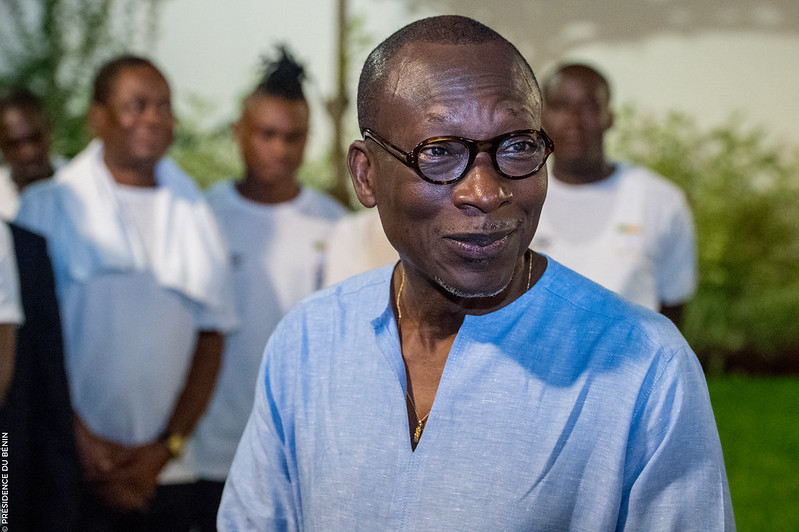
It was 2022. I was responsible for communications at Effet Graff, the street art collective I had been part of for years. The Fondation Claudine Talon was our sponsor that year, and at the end of the festival, the presidential couple invited the artists, the staff, the people who had made the thing work, to their private residence in Cotonou for dinner. I took my phone out at some point and photographed the garden. Not for any strategic reason. Just because it surprised me.
It was quiet, considered, arranged with the patience of someone who actually looks at things. Not the garden of a man performing power. The garden of a collector.
Inside, President Patrice Talon spoke about art. Not in the language of a patron checking a box, but with the focus of someone who has spent years looking. He spoke about what artists do, why it matters, what gets lost when a society stops paying attention to beauty. I remember thinking: this man understands something that most politicians never bother to learn.
Patrice Talon's legacy in Ouidah cannot be measured in kilometers of road or square meters of museum. It has to be measured the way you measure a garden: by what was planted, what was neglected, and what grew anyway where nobody intended.
Effet Graff and Beninese street art: a government that finally looked at artists
Before I write anything else, I want to say this plainly, because I lived it: Effet Graff was the first time a Beninese government backed a street art project at that scale, and I was there for it. I helped build that partnership from the inside, and I watched something rare happen - a head of state's family deciding that murals, that public art made by young hands, deserved real institutional weight rather than a photo opportunity.
The wall at the Port Autonome de Cotonou is still standing. I worked on it. Every time I pass it, I remember what it took to get government backing for something that ambitious, that public, that unapologetically made by street artists rather than commissioned from abroad. It was not a small thing. For a country where art had rarely been treated as a serious state priority, it was a door opening.
It did not stop there. Lionel Talon, the president's son, built on that same conviction with the Eya community center and the annual We Love Eya festival - a family, not just an administration, choosing to keep showing up for culture year after year. The MIME and Vodoun Days, covered later in this account with all their complications, exist inside that same current: an unprecedented decade in which the presidency, the presidential family, and the machinery of the state - through the ADAC, the Agence de Développement des Arts et de la Culture, created to give the sector structure and funding it had never had - all moved in the same direction at once.
I do not know of another period in Benin's history when a presidential couple and a presidential family were this involved, this consistently, in art and culture. That is not a footnote to the Patrice Talon legacy in Ouidah. For those of us who worked inside it, it is close to the center of it.
Patrice Talon's roots in Ouidah: a son of the city, and everything it carries
Born in Ouidah on the first of May, 1958. Father from Ouidah, mother from the Guédégbé family of Abomey. The Fon. The largest ethnic group in Benin, the group that built the Kingdom of Dahomey, the same kingdom that raided neighboring peoples, marched captives down to the coast, and handed them over to European traders at the gate of this very city.
His family, by his own genealogy, had ancestors involved in the trade.
This is not an accusation. In Ouidah, almost everyone who traces their lineage far enough arrives at some complicity with what happened on this shore. The Houéda people who lived here first. The Fon who conquered them and took over the port. The Agoudas who came back from Brazil as free men and built their Afro-Brazilian villas while the trade was still running. Francisco Félix de Souza, the Brazilian merchant who operated from Ouidah and whose descendants still carry his name in the streets of the city. The families whose great-great-grandfathers sat under the Arbre du retour and watched the ships leave.
There is a Togolese proverb that says the sins of the parents are always paid by the children.
There is a King Mensah song that says: if the father does wrong, it does not lead his children to the grave.
Both things are true at once. That is what Ouidah has always been: a place where contradictions do not resolve. They accumulate. They become part of the ground.
Patrice Talon grew up in this ground. Left it - studies in Dakar, a failed pilot exam in Paris, the return in 1983, the cotton empire, the port of Cotonou, the Forbes ranking, the exile, the return again, the presidency in 2016. And then, for ten years, he poured concrete and symbolism back into the city that made him.
Whether what he built is restitution or rewriting - that is not a question with a clean answer. The only honest measure of the Patrice Talon legacy in Ouidah is what it means for the people living here today.
The 26 royal treasures restitution: how the king's treasures came home
On the 9th of November 2021, at the Élysée Palace, President Patrice Talon and President Emmanuel Macron signed the transfer of 26 royal treasures that France had held for 130 years. Three thrones. Three statues. Four royal doors. The Assein - the portable altars that carry the spirits of Dahomey's kings. The recades, the royal sceptres. The uniform of an Agojié warrior. Objects that had been taken by General Dodds's soldiers when they burned the palace of Abomey in 1892.
Ouidah waited.
The plan, as announced by Minister of Culture Jean-Michel Abimbola, was for the objects to go to the Portuguese Fort in Ouidah for a three-year temporary exhibition, while the Museum of the Kings and Amazons of Dahomey - the MuRAD - was being completed in Abomey. The 26 treasures made their way toward that future, one part of a much larger restitution effort still unfolding across the region.
The retornados community - the Agoudas, the descendants of freed enslaved Africans who returned from Brazil to settle in Ouidah and build their pink and blue townhouses in the Quartier Brésil - had been waiting too. The MIME slavery museum in Ouidah, being built inside the walls of the Portuguese fort, would tell their story. Would tell the story of everyone who passed through this port.
A significant part of my own family are of Agouda descent. They no longer live in Ouidah. That fact, small and private, carries more information about the state of this community than any official report. The descendants of those who returned are leaving again. Talon was building a museum to welcome the diaspora back - a real and considerable effort - even as the actual Agoudas of Ouidah continue to find their own paths, in Cotonou and beyond.
The treasures came home. Where they settle next is still being written.
The Route des Pêches and Ouidah's coastal transformation: concrete and sacred clay
Stand at the junction where the Route des Pêches meets the old track to Djègbadji and you understand, physically, what the Patrice Talon legacy in Ouidah looks like when it lands on a coastline.
What was built
The road itself: 40 kilometers of tarmac running from Cotonou to Ouidah along the Atlantic, where in 2019 there was only a sandy track, became the physical axis of the Talon cultural reforms in Benin. The government projected 23,000 direct jobs, 95,000 visitors per day, 6,000 hotel rooms along this stretch of coast. The Dhawa Ouidah, a Banyan Group property, opened near the Gate of No Return. A golf course - the first championship course in Benin - took shape a few kilometers inland. Resorts followed, forming the backbone of the Bénin Révélé Ouidah tourism strategy.
The Bateau du Départ - a full-scale replica of a slave ship - was built in an artificial lagoon, part of the coastal memorial complex. The Gate of No Return was renovated. The Arène Vodoun was constructed for performances and ceremonies. The Mami Wata temples along the shore were restored.
Who it displaced, and who it still serves
From above, or from a press release, this reads as transformation.
From Djègbadji, it reads differently.
The fishing communities that lived along this coast for generations found their access to the water disrupted. The Route des Pêches required clearing the shoreline. Families that had pulled nets from the Atlantic every morning found themselves on the wrong side of a development project. The word "relocation" appeared in environmental studies. What it meant in practice was that people who did not own land in the formal sense - who owned it in the older sense of having always been there - lost their ground.
This is not a reason to dismiss the infrastructure. The MIME slavery museum in Ouidah alone, when it opens fully, will be one of the most important memorials in the world. The route of enslaved people from the Maison des Esclaves at the Fort to the Gate of No Return on the beach, restored and signed and walkable: that matters. For the two million people who were marched down this path and never came back, it matters that someone chose to mark what happened.
But here is the question that nobody in the official tourism literature answers: who captures the value when a visitor pays 200 euros for a night at the Dhawa, eats at the hotel restaurant, and takes a guided tour bought through an international platform?
Not always the families who fished this coast for generations.
Bénin Révélé built an impressive stage - the training programs, the artisan markets, the road itself are real investments in who gets to perform on it next. But the question of timing, of who benefits first, is still being worked out.
Ouidah heritage tourism: memory or merchandise?
There is a replica slave ship in a lagoon. There is a spa hotel 300 meters from the Gate of No Return. There is a vodoun performance arena designed for tourists.
Anthropologists have asked the obvious question directly: can a place of memory also welcome visitors without losing its meaning?
The answer Ouidah is testing, imperfectly but seriously, is that it can - and that tension is exactly what makes Ouidah in 2026 one of the most thoughtful heritage projects on the continent to watch.
A tension shared with every site of memory
Slave heritage tourism exists elsewhere - Gorée Island in Senegal, the slave castles of Ghana, Stone Town in Tanzania. It always carries this friction. The site of extreme suffering becomes a destination. The horror is curated, signed, given opening hours. Visitors take photographs. Some cry. Some post on Instagram. The revenue from the entry ticket funds the site's maintenance. There is no clean exit from that arrangement.
What Ouidah does differently, and what Talon's program attempted, is to frame the suffering inside a living culture. Which is more honest than the alternative. The Kingdom of Dahomey did not disappear when the French arrived. Its spiritual infrastructure survived colonialism, survived the Marxist-Leninist revolution of the 1970s that renamed the country and banned traditional religions. The Vodoun did not need Talon to survive. But Talon's program gave it an international platform.
The cost of that platform is legibility. To make Ouidah readable for a visitor who lands in Cotonou on a Thursday and leaves on a Sunday, you have to simplify. You have to choose which story gets told first, which entrance is widest, which ceremony gets scheduled on a day that fits the festival calendar.
What tourism has not learned to package
The Zangbeto - the night watchmen, the masked guardians whose circular dances sweep through the streets to purify the city - have not been scheduled. You do not book a Zangbeto passage. It happens when it happens, at hours that are theirs to decide, and its meaning is not something a brochure can carry. They exist in a register that tourism has not yet learned how to package.
That is the test. Not the MIME, not the Gate of No Return, not the Dhawa hotel. The test of what Talon's legacy actually preserved is whether the things that cannot be commodified - the unscheduled, the unticketed, the things that move through Ouidah at night without asking anyone's permission - are still moving.
The risk of Bénin Révélé is not that it tried to make Ouidah beautiful and accessible. It is that in trying to make the city legible to outsiders, it risked making it illegible to the people who live inside it.
Vodoun Days and the limits of institutionalizing the sacred
The 10th of January used to be a day that belonged to the couvents.
It still does, officially. But the Talon administration transformed what had been a localized spiritual observance into the global Vodoun Days festival, positioning Vodoun as a philosophy of nature, an ecological guardian, a living system that protects the sacred forests of Kpassè and the coastal waters and the entire web of relationship between the living and the dead that holds this city together.
A deliberate rebranding, and why it worked
The rebranding was deliberate and sophisticated. Rather than defending Vodoun against Hollywood caricature - the zombies, the dolls with pins, the images from Live and Let Die and a hundred other films that reduced a complex theological system to a horror prop - Talon's government simply changed the conversation. Vodoun as ecology. Vodoun as philosophy. Vodoun as the West African root of Haitian Vodou, of Brazilian Candomblé, of Louisiana traditions that enslaved people carried in their memories across the Atlantic. The reframing targeted the African diaspora directly.
It worked. Vodoun Days now draws international visitors, diaspora communities from the Americas and Europe, journalists, researchers, artists. The festival generates revenue. The city fills. Something real happens on the 10th of January.
Friction the festival calendar does not mention
It also generated friction that the festival calendar does not mention.
The traditional couvents - the places where initiation happens, where the spirits are housed, where the priests and priestesses hold the actual knowledge - did not uniformly welcome the institutionalization of the sacred. The lineages around the Dagbo Hounon, the supreme chief of Vodoun in Ouidah, have their own hierarchy, their own calendar, their own understanding of what is and is not appropriate to share with a camera crew.
When the state builds a performance arena for Vodoun ceremonies and sells festival passes, it takes on a real responsibility: making sure the public version - accessible, photogenic, timed to the schedule - stays a doorway into the tradition rather than a substitute for the version that exists in the couvents, in the dark, in the initiated knowledge that has survived every previous attempt to suppress or simplify it.
The Zangbeto are not on the program. They move when they move.
Talon's government understood Vodoun as an asset. What the next administration must understand is that the deepest layer of Ouidah's spiritual life has survived colonialism, survived the 1975 revolution, survived decades of Christian missionary pressure. It did not survive by being legible. It survived by being deeper than whatever was happening on the surface.
Youth, diaspora, and Ouidah's tourism economy: the shadow under the lighthouse
Ouidah has world-class infrastructure now. The road works. The museum is almost ready. The hotels are open. The Gate of No Return has been renovated so many times that the original scale of it - three meters wide, barely taller than a man, designed for bodies pressed together in chains - has given way to a monument built for photographs.
The young men selling cold drinks on the beach at Djègbadji are not benefiting from the billion euros.
This is not unique to Benin. It is the structural failure of heritage tourism everywhere: the value is captured at the top and trickling down is slower than any government plan ever admits. The training programs for local guides exist. The artisan markets were built. But the gap between the Bénin Révélé Ouidah tourism infrastructure that was created and the economic mobility it was supposed to generate is visible to anyone who spends a week in Ouidah rather than a day trip from Cotonou.
The governance reforms Talon introduced - modernizing public finance, cleaning up the port - were real. The Glo-Djigbé special economic zone generated more than 14,000 jobs. The school feeding program reached 1.2 million pupils. These things happened, and they are part of the ledger too.
There is also the question of who comes now.
The Blaxit movement - African-Americans and members of the African diaspora choosing to relocate to the continent - has been looking at West Africa for years. Ghana had its Year of Return in 2019. Ouidah, with its direct connection to the transatlantic trade, with its Vodoun roots alive in Haiti and Brazil and the American South, should be one of the most charged destinations for this movement. Some have come. The infrastructure that Talon built exists partly for them.
But for a young man from Ouidah watching visitors from Atlanta walk the Route des Esclaves, the connection Talon's program was built to create - diaspora meeting descendant, brother meeting brother - is still, for many, a work in progress. Whether the economic structure of the tourism sector grows to make him a full participant in that connection is the question the years ahead will have to answer.
Patrice Talon's legacy after the presidency: the tide returns
Easter Monday, 2026. Ouidah Blue Festival, Djègbadji beach.
President Patrice Talon came down without protocol. Mingled with the crowd. The Atlantic was loud. At some point, simply, he said it:
"At the end of my mandate, I intend to come and settle in Ouidah."
Three weeks later, on the 24th of May, he handed power to Romuald Wadagni and the presidency was over.
Wadagni brings his own strengths: ten years as finance minister, trained at Grenoble and Harvard, the man who cut the budget deficit by a third and attracted Asian and European investors to the GDIZ. The infrastructure Talon built will remain his to manage, and the question is whether anyone who did not grow up in this city can feel the same pull toward it that a son of Ouidah does.
The MIME is not yet fully open, but it stands as the architectural core of the Patrice Talon legacy in Ouidah. Its long-term funding structure depends on decisions that now belong to someone else. The Route des Pêches, built to carry 23,000 direct jobs along this coast, is still finding its full stride. The 26 royal treasures have moved on toward Abomey, where the MuRAD awaits them.
Talon, for his part, will sit in the new Senate, created by the constitutional revision of November 2025.
Whether he actually settles in Ouidah is still open.
A promise Ouidah will remember
Ouidah is a city that takes declarations seriously. Words pronounced at the edge of the Atlantic, in front of the same water that swallowed millions of lives, carry a specific weight here. People will remember what he said.
The garden in his Cotonou residence was quiet and considered. If he builds one in Ouidah, I hope it faces the sea. A man who grew up in a city shaped by departures choosing to stay, choosing to arrive, choosing to remain - that is its own kind of monument.
Not in stone. In presence.
And presence, in Ouidah, is the rarest thing a powerful man can offer.
Restitution 2.0
Ouidah Origins is more than a travel resource; it is an infrastructure for memory. Read our manifesto on why we believe the Slave Route is not a tourist attraction.
Read the Manifesto- The first Beninese government to back street art at scale, witnessed from inside Effet Graff and the Port Autonome de Cotonou mural
- An intimate meeting with the presidential couple during the Effet Graff festival
- The return of the 26 royal treasures from France and the question of their final resting place
- The physical reshaping of the coast, from the Route des Pêches to the renovated Gate of No Return
- A constructive critique of how the local youth benefit from the massive tourism investments