Key Takeaways
- Mami Wata means "Mother Water" in the English-based pidgins of the West African coast. She is linked to wealth, fertility, healing and beauty.
- In Ouidah she is honored at the Mami-Plage temple on the beach and at the Mami Toligbé convent in town.
- Her most famous image comes from a chromolithograph printed in Hamburg around 1885, showing a European snake charmer.
- Art historian Henry John Drewal traced five centuries of Mami Wata imagery in a major exhibition that opened in Los Angeles in 2008.
- Sister figures live on in the Americas: Lasirèn in Haiti, Mãe d'Água in Brazil, Watra Mama in Suriname.
On the beach at Ouidah, during Vodun Days, an altar faces the sea. People leave bottles of perfume on it, lengths of cloth, jewelry, liquor, mirrors. Singing rises over the surf. The devotees are dressed in white. Everything points toward the ocean.
This is where Mami Wata, "Mother Water," is honored. She is one of the best-known spirits in West Africa and one of the most misunderstood. Her image, a woman with long hair and a snake coiled around her, turns up everywhere: on walls, on altars, on posters. Where that image came from is something few visitors would guess.
This pillar covers who Mami Wata is, how she is honored in Ouidah, where her picture comes from, and how she crossed the Atlantic.
Who is Mami Wata?
The name comes from the English-based creoles spoken along the African coast, such as Krio in Sierra Leone or Nigerian Pidgin: mami, mother, and wata, water. Mother Water.
Mami Wata is a water spirit, a spirit of seas, lagoons and rivers. She is said to grant wealth, fertility, healing and beauty. She is generous, and she is demanding.
According to the accounts summarized on Wikipedia, she often reaches people through dreams. In some traditions her favors, wealth above all, come with conditions, such as a kind of exclusive devotion to her; breaking those commitments can mean losing the fortune or falling ill.
The mirror is one of her most constant symbols. She is said to love her own beauty, and mirrors are among the most common gifts on her altars, along with perfume, jewelry and fine cloth.
Two faces
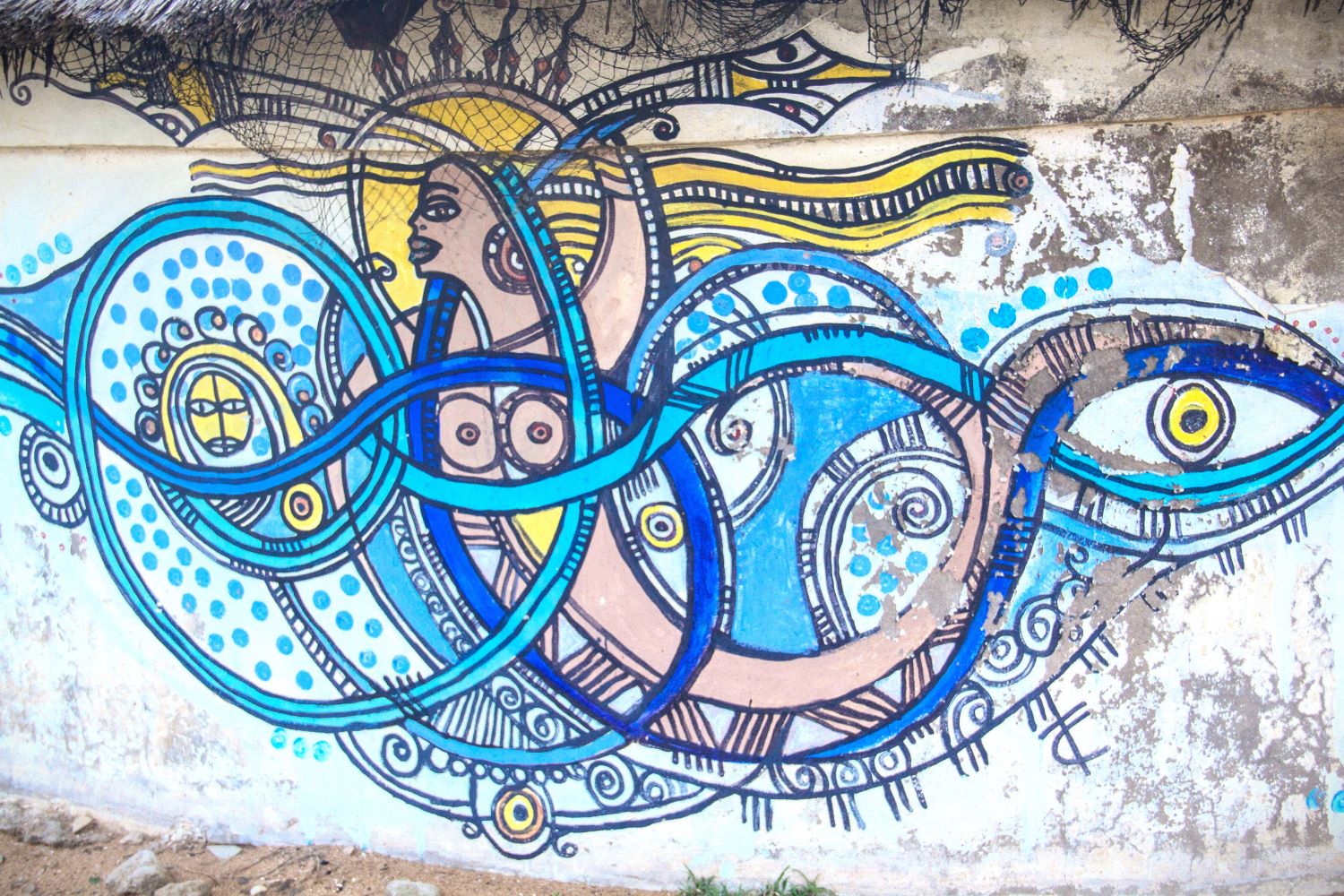
Mami Wata appears mainly in two forms. One is a mermaid, half woman and half fish, sometimes holding a mirror or a comb. The other is a woman with long hair and a large snake draped over her shoulders. Either way, she is beautiful, adorned, drawn to luxury.
That taste for luxury matters. Mami Wata likes things from far away: perfume, powder, jewelry, factory-made goods. Her altars often look more like a dressing table than a stern shrine. She is a modern spirit in her manner, tied to money and trade, which goes some way toward explaining her success in coastal cities.
She is also feared. Many stories tell of people taken under the water who come back years later with the power to heal, or of swimmers who never come back. The sea that gives is also the sea that takes.
A spirit of the whole coast
Mami Wata does not belong to one people. She is honored across much of West and Central Africa, from Senegal to Congo, among many different peoples, including the Ewe and Fon of Togo and Benin, the Igbo of Nigeria, and peoples of Ghana and Cameroon.
In Benin and Togo she has become part of the world of Vodun. She sits alongside other water and sea spirits, and sometimes alongside Dan, the rainbow serpent honored in Ouidah at the Python Temple. Her followers, often called mamisi, "wives of Mami," go through initiation like the followers of other vodun.
Crossing borders is part of who she is. Mami Wata is a spirit of trade, of ports, of exchange and of wealth that arrives from outside. In a sense, she was born from the sea and from everything the sea brings in.
Mami Wata in Ouidah
The Mami-Plage temple
On the Ouidah shoreline, near the Vodun Days arena, stands the Mami-Plage temple. According to Benin's government, it is a temporary temple, raised for the ceremonies and devoted to the water spirits, Mami Wata above all. During Vodun Days 2025 it also honored the vodun Dan.
People come here for healing, protection, prosperity and purification. Ceremonies combine songs, dances, offerings and sacrifices. The symbolic gifts are jewelry, perfume, cloth and liquor. The temple is decorated with sculptures, paintings and symbols representing Mami Wata.
The government describes it as a place of pilgrimage for practitioners from around the world.
The Mami Toligbé convent
In town, the Mami Toligbé convent is one of Ouidah's places of Mami Wata worship. According to the Beninese daily Le Matinal, it is one of three new Ouidah sites, along with the Python Temple and Zô Houé, selected for the planned "Vodun convents route," a restoration program run by Benin's national agency for tourist heritage.
A Vodun convent is not a monument open to the public. It is a place of initiation and worship, with its own rules. If you want to visit, go with a guide who knows the community and can ask permission.
Elsewhere on the coast
The same convents route includes another Mami Wata site: the Mami Wata convent of Hêvê in Grand-Popo, near the Togolese border. With the mouth of the Mono River and its long beach, Grand-Popo is one of the places in Benin where water worship is strongest. Our partner site Visit Grand-Popo covers the area.
An image from far away
This is the most surprising part of Mami Wata's story: her best-known portrait was not drawn in Africa.
American art historian Henry John Drewal spent decades tracing the history of Mami Wata imagery. His work shows that it was built up in layers, over five centuries of encounters.
From mermaids to ivories
The earliest traces go back to contact between Africans and Europeans from the fifteenth century on. Sapi carvers on the coast of what is now Sierra Leone made ivories for Portuguese clients in the late fifteenth and early sixteenth centuries, and mermaid figures appear on some of them. European mermaid images, with fish tail and mirror, circulated along the coast for centuries.
The Hamburg snake charmer
The turning point came around 1885. In Hamburg, the printing firm of Adolph Friedländer, which specialized in circus and show posters, produced a chromolithograph: a woman with long black hair and light skin, surrounded by snakes.
The poster showed a snake charmer who performed under the stage name Maladamatjaute (or Nala Damajanti) in the show run by the animal dealer Carl Hagenbeck in Hamburg. According to research reported by Drewal, she was in fact a Frenchwoman, Émilie Poupon. Her act traded on exoticism: she was billed as a charmer from the East.
Trade carried the image to West Africa, and there it was reread. By 1901, according to Drewal, the snake charmer had been interpreted as a water spirit, turned into a carved headdress and used in a water-spirit ceremony at Bonny, in the Niger Delta.
The poster had a second life. In 1955, the Shree Ram Calendar Company of Bombay reprinted it from a copy sent by traders in Kumasi, Ghana. The new copies spread along the coast.
The Indian influence
In the 1940s and 1950s another influence arrived. Indian merchants settled in West Africa, along with Indian films that were hugely popular on the coast, brought images of Hindu deities with many arms, surrounded by snakes or animals. On the coast between Ghana and Nigeria, some of those images were folded into depictions of Mami Wata and other water spirits.
What this history means
It would be easy to read all this as a European or Indian "invention" of Mami Wata. That gets it backwards. The spirit and her worship already existed; what her followers chose were foreign images, which they read and reshaped to give her a face. A circus poster became a religious icon because Africans recognized their own spirit in it.
That is exactly what Mami Wata stands for: taking what comes in from the sea and making it powerful.
The temple painters
The story of Mami Wata's image is still being written, on temple walls. The painter Joseph Kossivi Ahiator, born in 1956, is one of the best known. He has painted temple murals in Benin, Ghana and Togo.
His main subject is the ocean, with Mami Wata, the "Indian spirits" and other sea deities. According to Wikipedia, he has been in high demand in the twenty-first century as a painter of temples devoted to the Indian spirits. When a priest commissions a mural, he draws on his collection of chromolithographs, on his own dreams and on those of the temple's owner.
The Indian and European images that shaped Mami Wata over the past century all show up in his paintings. Look closely at the walls of a Mami Wata temple and you are reading the whole history this pillar describes.
The Drewal exhibition
Drewal's research became a major exhibition, "Mami Wata: Arts for Water Spirits in Africa and Its Diasporas," which opened on April 6, 2008, at the Fowler Museum at the University of California, Los Angeles.
It covered five hundred years of visual culture around Mami Wata: sculpture, painting, masks and altars from West and Central Africa, the Caribbean, Brazil and the United States. The catalog, published the same year, remains the standard work on the subject. For American readers, it is a reminder that this history is not only African: the United States is part of the Mami Wata story too.
Mami Wata and the memory of slavery
There is a lesser-known link between Mami Wata and the slave trade. In southern Togo and in Benin, a cult called Tchamba (or Mama Tchamba) honors the spirits of slaves bought by the devotees' ancestors, captives from the north kept in households as wives, mothers or laborers.
During ceremonies, the spirits of those slaves take possession of devotees who are often, strikingly, descendants of the former masters. Italian anthropologist Alessandra Brivio gave her article on the cult a telling title: "Our grandparents had bought people." Anthropologists Eric Montgomery and Christian Vannier studied it at a shrine in southern Togo.
According to this research, Tchamba is increasingly associated with Mami Wata. Some see a link between the wealth Mami Wata grants and the prestige of families that could once afford to buy slaves. Other Mami Wata devotees who honor Tchamba say the opposite: that their own ancestors were sold into the Atlantic trade.
The cult points to something public memory often leaves out: slavery did not only send people to the Americas, it also existed on African soil. Our pillar on the Slave Route looks at that darker side.
Mami Wata in the diaspora
Enslaved Africans carried their beliefs about water spirits with them. Several sister figures of Mami Wata live on in the Americas:
- in Haiti, Lasirèn, the mermaid of Vodou, linked to the mirror and the comb, often tied to the sea and to wealth;
- in Brazil, the Mãe d'Água, "Mother of Water";
- in Suriname and Guyana, Watra Mama, "Mother Water" in Sranan Tongo.
In Brazil, the great sea deity is above all Iemanjá, the Yoruba orixá of salt water. Her feast on February 2 draws crowds to the beaches of Salvador da Bahia every year, where people leave flowers, perfume and mirrors. Iemanjá comes from a different tradition than Mami Wata, but the offerings are strikingly alike.
These figures are not copies of Mami Wata. Like her, they came out of encounters between African beliefs and other images, in other settings. But the family resemblance is plain: the sea, beauty, the mirror, wealth.
Closer to home for American visitors
You do not have to fly to Benin to meet Mami Wata's relatives. Haitian communities in New York, Miami and elsewhere in the United States keep Vodou alive, and Lasirèn is part of it, with her mirror, her comb and her place under the waves. In the U.S., Mami Wata herself has become a familiar figure in contemporary art, fashion and music, often as a symbol of Black femininity, beauty and power.
That popularity has a flip side. Online, Mami Wata is often reduced to a mermaid aesthetic, cut off from the people who actually honor her. In Ouidah, she is not a trend. She has priests, initiates, convents and obligations. Coming here is a chance to see the living practice behind the image, and to approach it with the same respect you would bring to any other religion.
For many African American travelers, the trip has one more layer. Ouidah was one of the main slave ports of the Bight of Benin, and a share of the captives shipped to the Americas passed through this coast. Standing on the sand where the water spirits are honored means standing where that history began.
For many visitors from the diaspora, honoring Mami Wata on the beach at Ouidah, a few hundred meters from the Door of No Return, carries special weight. It is a way of paying respect to the sea that carried their ancestors away, and to the spirit who lives in it.
Mami Wata on screen
Mami Wata has also reached the big screen. In 2023, Nigerian filmmaker C. J. "Fiery" Obasi released Mami Wata, a black-and-white film drawn from West African folklore. It tells the story of Iyi, a fictional village holding on to its traditions while the world around it changes.
The film premiered at the Sundance Film Festival in 2023, where it won the Special Jury Award for Cinematography in the World Cinema Dramatic competition. The award went to its Brazilian cinematographer, Lílis Soares. The film was then selected as Nigeria's entry for Best International Feature at the 2024 Academy Awards.
A spirit cast as a demon
Not everyone honors Mami Wata. Since the missionaries of the nineteenth century, and even more with the growth of Pentecostal churches in the twentieth, Vodun spirits, water spirits included, have often been described as demons.
Dutch anthropologist Birgit Meyer studied this among the Ewe of Ghana in her book Translating the Devil. She shows how Christians in the region "translated" the world of local spirits into the Christian language of demons. The paradox is that this demonization confirms, in believers' eyes, that the spirits are real: nobody fights what does not exist.
In Benin as elsewhere on the coast, Mami Wata holds an ambiguous place: honored by some, feared or fought by others. That tension is part of her story.
Mami Wata and Vodun Days
Every year, around the second Friday of January, Vodun Days bring hundreds of thousands of people to Ouidah: 740,668 participants in 2026, according to Benin's national statistics institute (INStaD). The beach is one of the festival's main stages, and the Mami-Plage temple one of the sites where ceremonies draw the biggest crowds.
It is the best time to see Mami Wata worship at full scale. It is also the hardest time to watch it in peace. Outside the festival, ceremonies are more private and reserved for the faithful.
If you can, do both. Come for the festival to feel the scale of it, the drums, the crowds, the white clothes along the shore. Then come back another time, on a quiet weekday, with a guide who can introduce you to a priest. The second visit is usually the one people remember, because it is the one where someone takes the time to explain what they are doing and why.
Visiting with respect
- The Mami-Plage temple is an active place of worship. Watch from a distance unless you are invited closer.
- Ask before taking photos, especially during ceremonies and trance. Some people will say no, and that answer must be respected.
- The Mami Toligbé convent and other convents can only be visited with the agreement of those in charge. Go with a guide.
- Offerings are not a show. If you want to make one, ask a priest or your guide for advice.
- Swimming is dangerous in Ouidah: the currents are violent. Do not swim in the ocean here.
Getting to the beach
Ouidah's beach is about four kilometers from the town center, at the end of the Slave Route. It is easy to reach by motorcycle taxi (zémidjan) or by car. The trip combines well with the Slave Route and its stations, including the Tree of Forgetfulness and the Zoungbodji memorial, then the Door of No Return, for a half day that runs from town to sea.
Come in the morning or late afternoon, when the heat is easier. Bring water, a hat and modest clothing: even outside ceremonies, you are at a place of worship.
If you come for Vodun Days, book your lodging well ahead: Ouidah is a small town and rooms go quickly. Get to the beach early on the day of the festival, because access roads are jammed by mid-morning. And keep in mind that most of the ceremonies that truly matter to the faithful do not happen in front of the grandstands.
For how to behave at sacred sites, see our guide to experiencing Vodun respectfully.
Plan a visit with a local guide →
Sources
- Mami Wata, Wikipedia: etymology, attributes, diaspora, Indian influences.
- Fowler Museum at UCLA, "Mami Wata: Arts for Water Spirits in Africa and Its Diasporas" and the exhibition press release.
- Henry John Drewal (ed.), Mami Wata: Arts for Water Spirits in Africa and Its Diasporas, Fowler Museum at UCLA, 2008.
- Adolph Friedländer, Wikipedia and the snake charmer poster, Wikimedia Commons.
- Government of Benin, "Vodun Days 2025: Temple Mami-Plage, un lieu sacré dédié aux divinités des eaux".
- Le Matinal, "Route des couvents vodun : 5 nouveaux sites bientôt réhabilités à Ouidah et Bohicon".
- Alessandra Brivio, "'Our grandparents had bought people': The Tchamba Cult in Togo and Bénin" and "In Remembrance of Slavery: Tchamba Vodun Arts".
- Eric J. Montgomery and Christian N. Vannier, An Ethnography of a Vodu Shrine in Southern Togo: Of Spirit, Slave and Sea, Brill, 2017.
- Joseph Kossivi Ahiator, Wikipedia and Vodun art, Wikipedia.
- Mami Wata (film), Wikipedia.
- Birgit Meyer, Wikipedia and Birgit Meyer, Translating the Devil: Religion and Modernity Among the Ewe in Ghana (Edinburgh University Press, 1999).
- SRTB (Benin public broadcaster), "Vodun days 2026 : près de 2 millions de visiteurs avec un fort impact économique" (French) (January 26, 2026, INStaD figures).