Key Takeaways
- The Egungun are Yoruba ancestor masquerades. In Benin they are also called "revenants" (the returning dead) or "kouvito."
- Tradition says the cult comes from the Oyo region and was founded by Sango (Xangô), the thunder deity and legendary king.
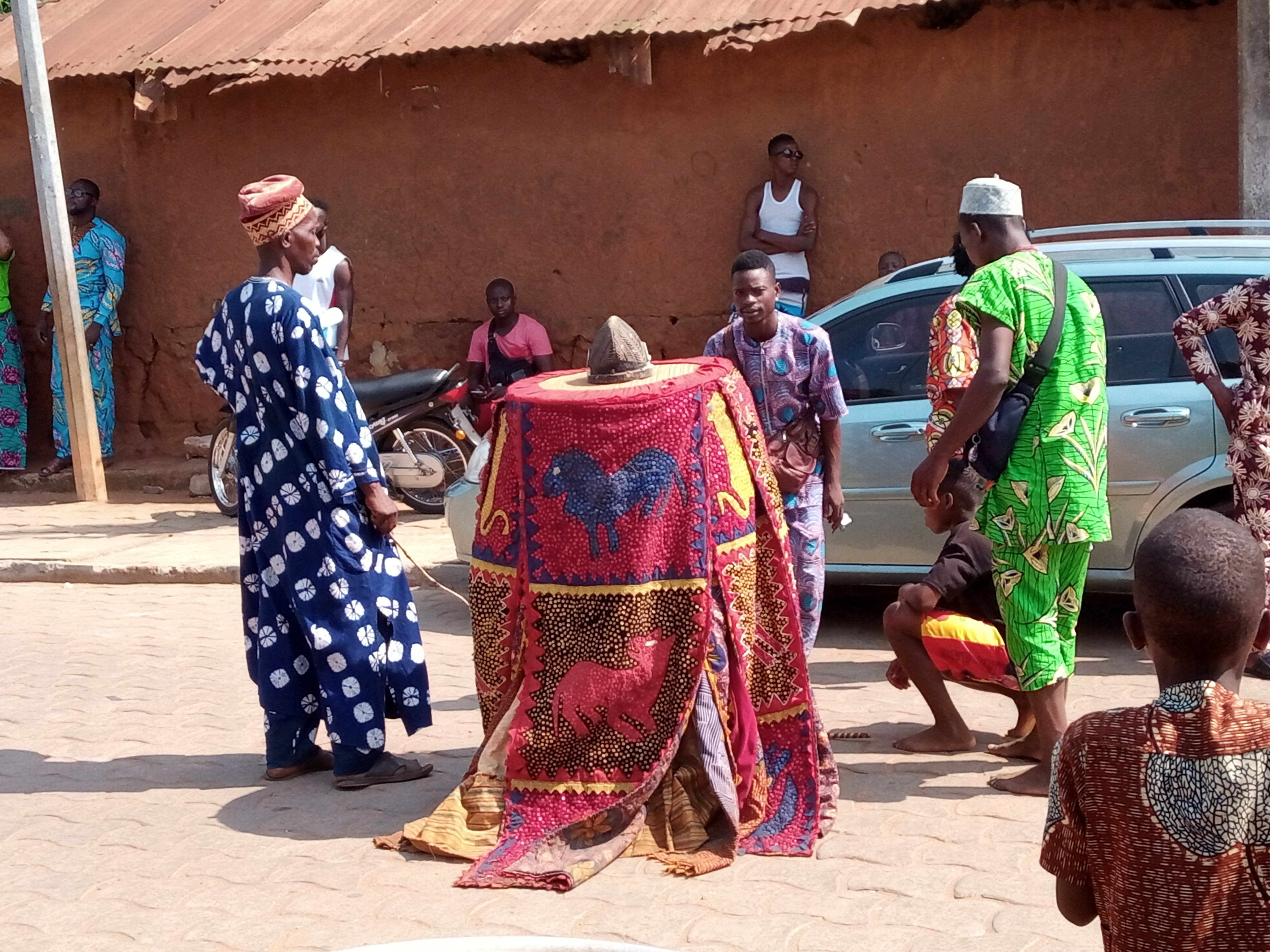
- The costume is made of layered cloth, netting and amulets that fully hide the wearer. Spectators must never touch it.
- Only men wear the mask, but women have a place in the cult. Gelede, a Yoruba masking tradition honoring mothers, is on the UNESCO list.
- In Brazil the Egungun cult survives on the island of Itaparica, Bahia. Its best-known house, Ilê Agboulá, became Brazilian cultural heritage in 2015.
In the Vodun Days crowd in Ouidah, something starts to move. Men holding long switches push the spectators back. Then it appears: a tall, faceless figure covered in dozens of panels of cloth, velvet, embroidery, sequins, amulets. When it spins, the panels fly out into a ring of color. When it comes near, people step aside.
This is an Egungun. To those who know it, it is not a costumed dancer. It is an ancestor who has come back among the living.
This pillar explains who the Egungun are, where the cult comes from, how it reached Ouidah, what the costume means, and how the cult survived across the Atlantic on an island in Bahia.
Who are the Egungun?
The word Egungun (also written Egúngún, Egun-gun or Eégún) is Yoruba. It refers to any masquerade or masked figure that makes the spirits of the ancestors visible. The Yoruba also speak of Ará Ọ̀run, "those of the beyond," meaning the dead as a whole.
In Benin they are often called revenants, "those who return," or kouvito. The word says it all: these are the dead coming back.
In Yoruba thought, the dead are not gone. They remain active forces in the lives of their descendants. They must be honored, consulted and called back to earth regularly. The Egungun is how that return happens. The mask is not a picture of the ancestor: for believers, it is the ancestor, present for the length of an outing.
Where does the cult come from?
Oyo and Sango
The Egungun cult belongs first to the Yoruba world of what is now southwestern Nigeria. Wikipedia describes local variants in towns such as Ogbomoso, Ibadan and Ilobu.
According to the tradition reported on Portuguese Wikipedia, it arose in the region of Oyo, the great Yoruba empire that long dominated its neighbors, Dahomey among them. The same tradition names Sango (Xangô in Brazil), thunder deity and legendary king of Oyo, as the founder of the Egungun cult, the only one with authority over these spirits.
A story about gender
Tradition also says something surprising. According to stories linked to Ifá, women originally controlled the ritual, before men tricked them out of it. Nigerian scholar Oyeronke Olajubu has written about the historical place of women in the Yoruba religious system.
Today only men wear the mask. Women never put on the costume. That does not mean they are absent from outings: they sing, walk alongside and take part in the life of the lineages that honor their ancestors.
How the Egungun reached Ouidah
Benin has a large Yoruba population, often called Nago, mostly in the east of the country around Porto-Novo, Kétou and Pobè. The Egungun are very present there.
In Ouidah, the story runs through Dahomey. According to the Beninese daily La Nouvelle Tribune, a tradition credits King Ghezo (1818-1858) with bringing Yoruba captives from present-day Nigeria into Dahomey, and they are said to have introduced the cult. The same account says Ouidah was the town where the first promoters of the Egungun were sent to spread it.
That story should be taken for what it is: a tradition reported by the press, not a fact documented in archives. But it fits a well-known reality: wars between Dahomey and the Yoruba brought many Yoruba captives into Dahomey, and their religions came with them. Ouidah, a cosmopolitan port where Fon, Yoruba, Mina, Europeans and Afro-Brazilians lived side by side, was a natural place for them to settle.
Ghezo and the Yoruba
Some context helps. From 1730, Dahomey paid tribute to the Yoruba empire of Oyo. According to Wikipedia, Ghezo, who came to power in 1818, ended it: in the early 1820s he refused to pay, and in 1823 the conflict turned in his favor.
Ghezo then fought other Yoruba states. In March 1851 he attacked Abeokuta, the Egba city, to control the palm oil trade routes. The attack failed: the Egba, backed by the British, drove back Dahomey's army. Ghezo, who had long defended the slave trade, signed an agreement in 1852 to end it under British pressure.
Those wars brought Yoruba captives into Dahomey. Some were sold to the Americas through Ouidah; others stayed. They and their descendants kept Yoruba religion alive in the kingdom.
The Nagô who came back from Brazil
Another route ran across the Atlantic. After the Malê revolt in Salvador in 1835, the authorities in Bahia expelled many freed Africans. Many were Yoruba, known in Brazil as Nagô. Some settled on this coast, in Lagos, Porto-Novo or Ouidah, and joined the Aguda community.
These returnees brought the Portuguese language, Catholicism and Brazilian architecture with them, and some also brought an intimate knowledge of Yoruba religion, preserved and reshaped in Bahia. Ouidah's Egungun stand at the crossroads of these histories.
Today the Egungun appear across southern Benin, especially in Ouidah, Porto-Novo and Cotonou.
The costume, a living archive
Layer upon layer
The Egungun costume is a complex construction. Wikipedia lists its parts:
- a base of aso-oke, hand-woven indigo-and-white strip cloth that recalls burial shrouds;
- netting that completely seals the wearer's identity, face included;
- layered cloth panels decorated with patchwork, braids, sequins, tassels and amulets;
- medicinal elements that give the mask its ase, its power to act.
In Benin the costumes are often made of lavish fabrics: velvet, embroidery, beads, shells, mirrors. According to La Nouvelle Tribune, the ornaments reflect the status and qualities of the ancestor represented.
Why an archive
Each costume is added to over the generations. New cloth, amulets and objects are sewn on. An old Egungun carries the history of its lineage on its body. It is both a sacred object and a family's memory.
Hands off
Spectators are forbidden to touch an Egungun. Attendants, often holding switches, keep people back during outings. This is not theater: contact with the world of the dead is believed to be dangerous for the living. If an Egungun comes toward you, step back calmly and follow the attendants' lead.
What an Egungun does
Blessing and warning
During outings, the Egungun bless families and children. They can also warn: recall a forgotten duty, rebuke a wrong, announce a danger. They speak in an altered voice, which attendants translate when needed.
Accompanying the dead
The Egungun are tied to funerals and to the memory of the dead. In several Yoruba traditions, an Egungun may appear after a death to show that the deceased has joined the ancestors and is still watching over the family. Outings also mark death anniversaries and major lineage festivals.
That is why the Egungun matters so much to families: it is not a show for others, but a moment of reunion with their own.
Dancing
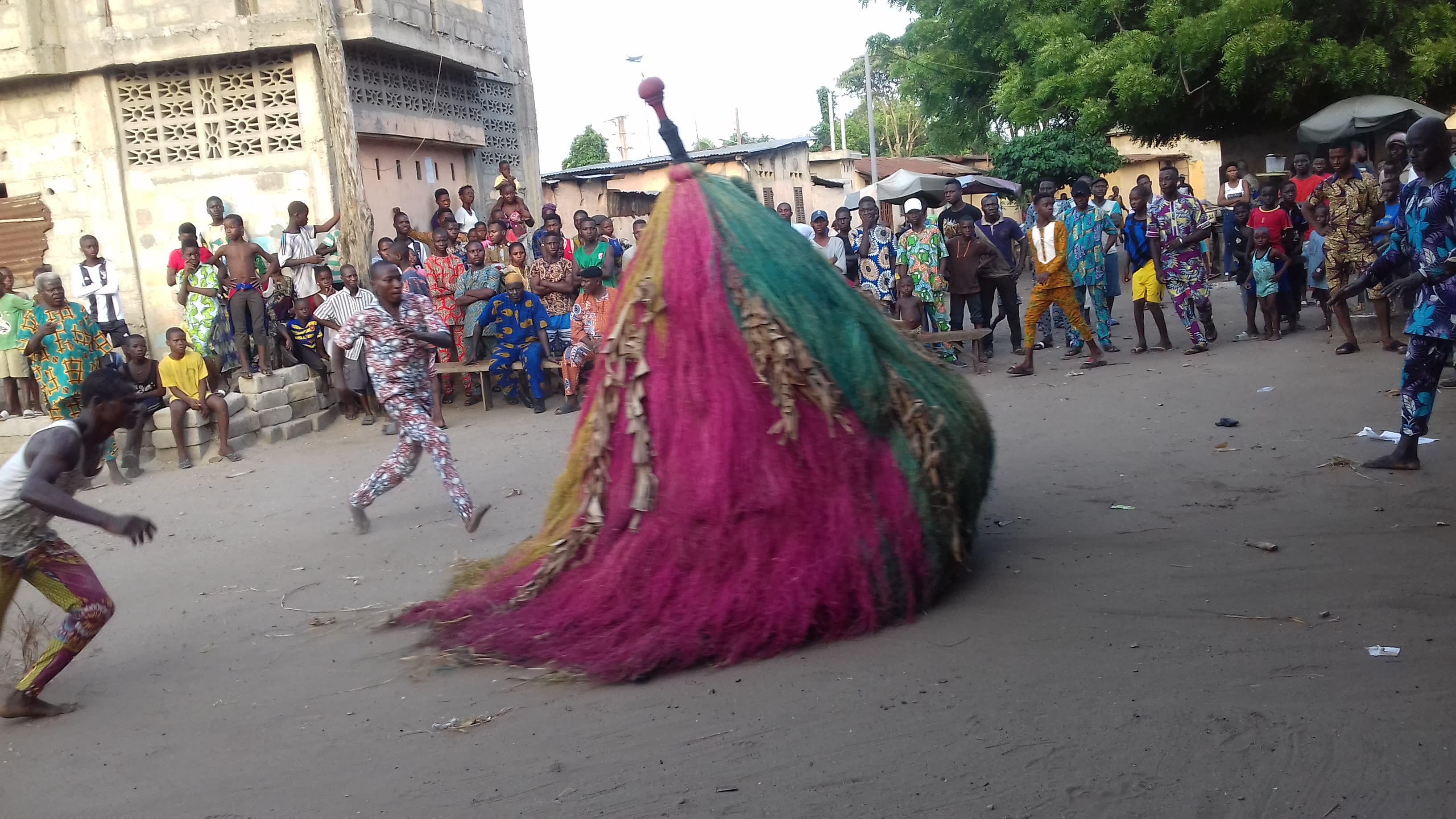
Dance is at the heart of every outing. The Egungun spins and its panels open like a flower. It runs, stops, charges the crowd, moves on. The drums follow its every move.
Bringing people together
Odun Egungun, the yearly Egungun festival, has several functions according to Wikipedia. It strengthens the bonds between families and their ancestors. It boosts trade, since it draws people from across the region. And it brings together communities of different faiths around a shared moment. Each lineage gets its own day to appear during the festivities, which can last several days.
An outing, step by step
Every community has its own ways, but an Egungun outing often follows the same thread.
You hear it before you see it. Drums announce the masks; in the Yoruba world, the bàtá drums, linked to Sango, are associated with the Egungun. Then the attendants clear a path and push the crowd back with their switches.
The Egungun enters. It dances, spins, stops in front of a house, a family, a group of children. It greets, blesses, sometimes calls someone out. Attendants and relatives answer, sing, and leave small offerings or money.
At times the mask lunges at the crowd. Everyone scatters, shrieking, then laughs. That tension is part of the ritual: the ancestor is close, but belongs to another world, and no one touches it.
Finally the Egungun withdraw to their shrine. An outing can last a few hours, or stretch over several days during a big festival.
What the Egungun says about death
For a Western visitor, the Egungun can be unsettling. You see an imposing, sometimes frightening mask. For those receiving it, it is first of all a joy: the joy of meeting departed relatives again.
This way of living with the dead, bringing them back, talking to them, letting them bless the children, says something simple: death does not end the relationship. Ancestors remain part of the family, with rights and duties. Many visitors from the diaspora, who arrive in Ouidah carrying questions about ancestors they cannot name, find that idea moving. The Egungun does not answer those questions, but it offers a way of thinking about them: the dead are not only lost, they can also be welcomed back.
How the cult is organized
The Egungun cult is organized by lineage and by community.
Within a family, an elder called the Alagba presides over ancestral rites. At community level, priests and initiates trained in communicating with the ancestors lead the outings.
In Brazil, according to Portuguese Wikipedia, the hierarchy is highly structured: the Alapini is the high priest, assisted by the Ojé. Initiates use ixan, long ritual staffs, to invoke the spirits and keep the Egungun in check. The same kind of staffs are in the hands of the attendants in Benin.
Egungun, Gelede and Zangbeto
Benin has several great masking institutions. It helps to tell them apart.
Gelede, the mask of the mothers
Gelede is another Yoruba masking tradition, practiced by Yoruba-Nago communities in Benin, Nigeria and Togo. It honors the primordial mother, Iyà Nlà, and the role of women in society. Dancers wear carved wooden masks, often topped with scenes, animals or figures.
UNESCO proclaimed the Oral Heritage of Gelede in 2001 and inscribed it on its Representative List in 2008. It describes Gelede as the only known masked society that is also governed by women.
Egungun and Gelede answer each other: one brings back the ancestors, the other celebrates the mothers.
Zangbeto, guardian of the night
The Zangbeto are raffia masks of the Gun people, guardians of the night and of public order. They represent night spirits, not ancestors. Their costume is raffia with no human shape, and their stronghold is Porto-Novo.
All three share one rule: you do not touch the mask, and you do not try to find out who is underneath.
The Egungun in Brazil
Itaparica, island of the ancestors
The Egungun cult crossed the Atlantic with enslaved Yoruba. According to Portuguese Wikipedia, it reached Brazil in the early nineteenth century and took root on the island of Itaparica, across the bay from Salvador da Bahia. Several terreiros (houses of worship) were founded there: Vera Cruz around 1820, then Mocambo around 1830.
The best known today is Ilê Agboulá (Ilê Babá Agboulá), at Ponta de Areia on the island. Founded in the first quarter of the twentieth century, it is described by Wikipedia as the first terreiro in Brazil devoted to the Egungun brought from Africa, and one of the few places in the country dedicated solely to this cult. The community that keeps it going has lived on the island for about two centuries and numbers some hundred families, many of whom live from fishing.
In 2015, IPHAN, Brazil's national historic and artistic heritage institute, recognized it as Brazilian cultural heritage.
Babá Egum
In Brazil the masked ancestors are called Babá Egum. The cult there is exclusively male: according to Portuguese Wikipedia, a woman will never be initiated into its priesthood. It honors male ancestors, while other traditions, heirs to Gelede, honor the power of the mothers.
The famous Bahian babalawo Martiniano Eliseu do Bonfim (1859-1943), whom we discuss in our pillar on the Fa Oracle, was himself active in the cult of male ancestors, the babá egum.
A living link
For American travelers, the Egungun offer a clear lesson in how African religion survived slavery. The United States banned the import of enslaved Africans in 1808, and African religious institutions had far less room to survive there intact. Brazil and Cuba kept receiving captives for decades longer, and whole institutions like the Egungun came through. Watching an Egungun in Ouidah, then learning that the same ancestors dance on Itaparica, shows how differently the diaspora held on to its past.
For a visitor from Bahia, seeing an Egungun in Ouidah means recognizing something familiar. For a Beninese person discovering Itaparica, it is proof that the ancestors were honored on the far side of the ocean, during and after slavery. That back-and-forth between the two shores sits at the heart of the story of Ouidah and its Agudas.
Seeing the Egungun in Ouidah
At Vodun Days
The easiest time is Vodun Days, around the second Friday of January. At the 2026 edition, January 8 to 10, festival-goers watched ritual parades of sacred masks, Egungun and Zangbeto among them, according to press reports.
The mood is festive, but the rules do not change. Attendants escort the masks and the public is kept back.
A few practical tips. Arrive early to get a spot where you can see without being pushed to the front. Wear closed shoes: when a mask charges, the crowd moves fast. Keep bags close and children within reach. And if you want photos, stay behind the attendants' line and use a zoom rather than moving closer. The best pictures of an Egungun are the ones taken from a respectful distance, with the panels spinning in the light.
The rest of the year
Outside the festival, Egungun outings follow family and community calendars: funerals, death anniversaries, lineage festivals. They are not staged for visitors. If you happen upon one, stay back and follow the locals' lead. A local guide can tell you whether your presence is welcome.
Porto-Novo and beyond
To go further, Porto-Novo, Benin's capital and home to a large Yoruba community, is one of the great Egungun centers. A day trip from Ouidah also takes in the Musée Honmè, in the former royal palace, and the Great Mosque built by Agudas who returned from Brazil.
Farther east, near the Nigerian border, Kétou is the old capital of a Yoruba kingdom. The Kétou and Pobè area is one of the heartlands of Nago culture in Benin, with its Egungun and Gelede. It is a longer trip, best arranged with a guide, but it lets you see these traditions in their home setting.
Rules to follow
- Never touch an Egungun or its costume, even if it brushes past you.
- Follow the attendants. The people holding the switches know where you should stand.
- Step back, do not run, if an Egungun charges the crowd. It is a planned part of the ritual.
- Photos. At public parades they are usually tolerated. At a family outing or a rite, always ask your guide or someone in charge. A no means no.
- Do not ask who is under the mask. It is a serious offense.
- Be discreet if the Egungun speaks to someone: the words may concern family matters.
For how to behave at sacred sites, see our guide to experiencing Vodun respectfully.
Arrange an encounter with Ouidah's Yoruba culture →
Sources
- Egúngún, Wikipedia: definition, Ará Ọ̀run, costume (aso-oke, netting, panels, amulets, ase), touching taboo, Alagba, men-only masking, Odun Egungun, Itaparica; references: Adepegba (1984), Drewal (1978), Olajubu (2004).
- Culto aos egunguns, Wikipédia: Oyo, Xangô as founder in tradition, Vera Cruz (c. 1820), Mocambo (c. 1830), Alapini, Ojé, ixan.
- Ilê Babá Aboulá, Wikipédia and IPHAN, Terreiro Omo Ilê Agbôula.
- La Nouvelle Tribune, "Le masque Egungun au Bénin : un symbole des liens entre vivants et morts," December 2024.
- UNESCO, "Oral heritage of Gelede".
- Afrik.com, "Bénin : à Ouidah, les Vodun Days 2026 battent leur plein".
- Malê Revolt, Wikipedia: 1835 revolt in Salvador and expulsions of freed Africans.
- Ghezo, Wikipedia: end of tribute to Oyo (1823), attack on Abeokuta (March 1851), 1852 agreement.
- Martiniano Eliseu do Bonfim, Wikipédia.