

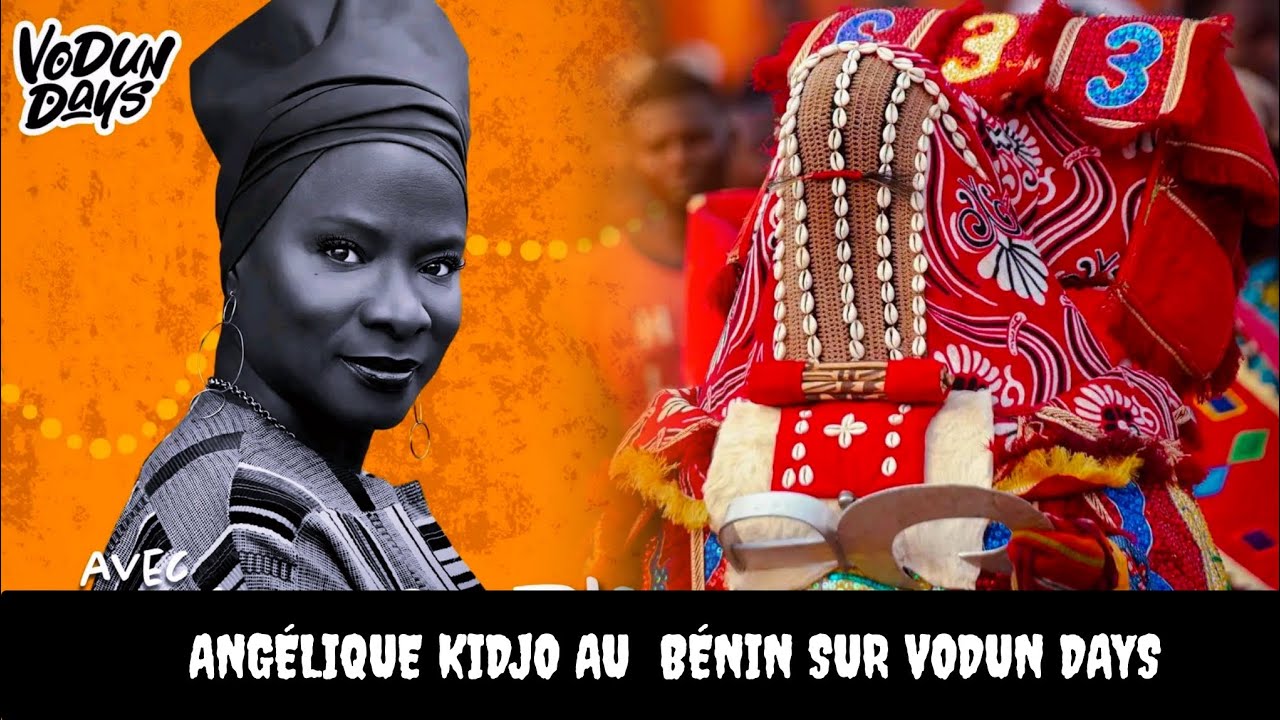
She arrived at Vodun Days 2026 and the city received her like a daughter.
Which, in the most literal sense, she is. Angélique Kidjo was born in Ouidah in 1960. She grew up in the city that has defined her entire artistic life — the city where the Slave Route runs to the ocean, where the Python Temple houses its sacred reptiles, where the convents of the Vodun deities produce the ceremonies that became, filtered through the Atlantic, the spiritual foundations of the Americas.
She has spent fifty years making music that, at its core, is a long conversation with the place she left and never fully left.
The geography of her music
Kidjo's catalogue is explicitly geographic. Her 1996 album Fifa incorporates the musical vocabulary of Beninese Vodun ceremonies directly — the rhythmic patterns, the call-and-response structures, the relationship between voice and percussion that in the convent context functions as communication with the divine. She has never presented this as ethnographic documentation. It is living musical material that she uses as a composer uses keys and scales.
Her 2007 tribute album Djin Djin goes further: it names the connections between Beninese musical tradition and its descendants in jazz, gospel, and R&B explicitly, bringing in American collaborators — Alicia Keys, Josh Groban, Peter Gabriel — to demonstrate that these are not separate traditions but branches of the same root system.
But it is Celia (2019) — her tribute to Celia Cruz, the Cuban salsa icon — that makes the geographic argument most completely. Kidjo did not simply cover Cruz's songs. She reframed them, through Beninese Afrobeat production and vocal technique, as the music returning to its point of origin. Cruz's salsa is descended, through a chain of Atlantic crossings, from the musical traditions of the Fon and Ewe peoples. Kidjo brought it home — literally, by recording parts of the album in Benin, and conceptually, by treating it as a homecoming rather than a tribute.
The critical reception was enormous. It won the Grammy for Best World Music Album. But the critical conversation mostly missed the geographic point.
What Vodun Days means to her
Kidjo has spoken about Vodun Days as a personal reunion — not with a place but with a cosmological system that she absorbed in childhood and that her music has been processing ever since.
The Vodun ceremonies she witnessed as a child in Ouidah — the masked dances, the possession ceremonies, the specific rhythmic structures that signal communication with particular deities — appear throughout her music in transformed but recognizable forms. When she performs at Vodun Days, she is not an international artist visiting a local festival. She is returning the music to the community that originated it.
The 2026 edition, which drew over 700,000 visitors, featured a closing concert on the beach that included Kidjo alongside Davido and Meiway. The pairing is deliberate on the part of the festival organizers: traditional Vodun ceremony and contemporary Afropop are placed in the same space, making visible the continuum between them.
The diaspora connection
Kidjo's work is perhaps the most sustained artistic argument that the African diaspora is not a departure from Africa but an extension of it.
Her cover of Jimi Hendrix's "Little Wing," recorded with Hendrix's original guitarist Noel Redding, begins from the premise that Hendrix — born in Seattle, raised in Nashville, shaped by the Black musical tradition of the American South — is in some deep sense part of the same musical lineage as a Beninese Vodun drummer. The argument is not metaphorical. The rhythmic structures of the American blues, which shaped Hendrix, are descended from the musical traditions of enslaved West Africans.
Her 2022 album Mother Nature makes the environmental dimension of this explicit: the relationship between the living and the spiritual world that defines Vodun practice — the understanding that nature is inhabited by forces that must be respected — maps directly onto contemporary environmental thinking. She is not drawing an analogy. She is pointing to a continuity.
For the diaspora visitor to Ouidah, Kidjo's music offers a kind of soundtrack — not for the visit itself, but for the emotional processing that comes after. Her albums are a guide to how the connections between Ouidah and the Americas can be heard, traced, and felt across two centuries of separation.
Listening guide: Kidjo's albums most connected to Ouidah's themes
- Fifa (1996) — Vodun ceremonial rhythms, most directly connected to Ouidah's spiritual life
- Black Ivory Soul (2002) — the Ouidah-Brazil connection, recorded partly in Salvador da Bahia
- Djin Djin (2007) — the Atlantic musical continuum made explicit
- Celia (2019) — the Cuba connection, music returning to its origin
- Mother Nature (2022) — the Vodun cosmological relationship with the natural world
Restitution 2.0
Ouidah Origins is more than a travel resource; it is an infrastructure for memory. Read our manifesto on why we believe the Slave Route is not a tourist attraction.
Read the Manifesto- Angélique Kidjo performed at Vodun Days 2026 in Ouidah
- Her music — from Celia to Remain in Light — is a decades-long conversation with the spiritual geography of this city
- Here's why it matters