Whispers from the Sanctuary
Foundation, apogee, Atlantic trade, resistance to colonization: the full history of the Kingdom of Dahomey so you can understand what you will see in Ouidah and Abomey.
A full history of the Dahomey Amazons: origins, recruitment, training, battles, and living heritage in Ouidah and Abomey.
Discover Zô Houé and Mami Toligbé, two sacred Vodoun convents in Ouidah undergoing rehabilitation. History, rituals, diaspora connections, and practical advice for respectful visits.
Vodun Days 2027 in Ouidah: programme, tickets, camping, visa, accommodation, codes of conduct. The complete guide for the diaspora and cultural travellers who want to truly experience the event.
What to eat in Ouidah? Dakouin, grilled fish, fechouada, the Agouda culinary tradition. A complete guide to local dishes and real addresses, from maquis to lakeside restaurants. Updated 2026.
Mami Wata, the Vodoun water deity venerated in Ouidah, is the spiritual mother of 50 million followers worldwide. History, worship, January 10th ceremony, and visitor's guide.
Dagbo Hounon is the Supreme Leader of Vodun worship — a living authority for 50 million followers across Benin, Haiti, Brazil, Cuba, and the Caribbean. Profile, role, Houxwe Palace Ouidah, and how to approach him during your visit.
The Agoudas are descendants of enslaved people and slave traders who returned from Brazil in the 19th century. In Ouidah, they founded the Brazil neighbourhood and left a unique architectural, culinary, and cultural imprint. Complete guide.
The future International Museum of Memory and Slavery cannot be just another museum. In Ouidah, it must hold research, reflection, teaching, and the dignity of a past that still crosses the ocean.
On 25 March 2026, the UN declared the transatlantic slave trade the gravest crime against humanity. Ghana led. Benin — the country with the Slave Route, the Door of No Return, and the Bateau du Départ — was absent from the vote. Here is the full story, from Durban 2001 to New York 2026.
The Sacred Forest of Kpassè is a living map of Ouidah's cosmology — a place where history, myth, and the presence of the Vodun deities intersect.
The Zangbéto are Ouidah's traditional night watchmen — hay-covered spirits who maintain social order and perform extraordinary feats during public ceremonies.
Mami Wata is the most global of West African deities — a spirit of water, beauty, and danger who connects Ouidah's coast to the entire African diaspora. Her worship spans Benin, Haiti, Brazil, Cuba, and the Americas.
Ouidah is a site of profound historical trauma and living spirituality. Here is how to navigate your visit with respect, sensitivity, and awareness.
If you have 72 hours in Ouidah, here is how to structure your time for the most profound experience of history, spirituality, and modern Benin.
The Route des Pêches runs 40km along Benin's Atlantic coast from Cotonou to Ouidah — past fishing villages, coconut palms, and lagoons. Here's why you should take the long way.
Ouidah Golf Club is Benin's first 18-hole championship golf course — a 90-hectare site between the Atlantic and the Agouin lagoon, opening in 2027. Here's everything you need to know.
The MIME museum, the Ouidah Golf Club, Club Med, and a new coastal road — Ouidah is in the middle of its biggest transformation in decades.
The International Museum of Memory and Slavery (MIME) is one of Africa's most significant cultural projects. Under construction inside the historic Portuguese Fort, it is expected to open in 2027.
Avlékété, a small fishing village near Ouidah, is at the center of Benin's biggest tourism development: a championship golf club and a Club Med resort.
Ouidah's Vodun convents are at the heart of the city's spiritual life — not tourist attractions. Here's what they are and how to approach them with genuine respect.
Vodun Days returns to Ouidah in January 2027. Everything you need to know: dates, program, what to expect, and how to attend respectfully.
A complete guide to tracing your African ancestry to Benin and Ouidah — DNA tests, local archives, Aguda family records, and what to realistically expect from a roots research visit.
In Ouidah, the sea is not scenery. It is archive, wound, and promise. Through Mami Wata, Avlekete, and the Atlantic coast, this story explores how the sacred continues to shape the shoreline, memory, and the city's future.
600 metres of coastline lost in 40 years. The Door of No Return is now approximately 100 metres from the ocean. A cross-analysis of WACA and Digital Earth Africa data maps the urgency for six key sites.
The four-kilometer path from Ouidah's historic center to the beach is no longer a neglected road. It is a space of ochre and gold, where the memory of the millions who walked it is finally given the physical weight it deserves.
An unexpected declaration on the beach of Djègbadji. During the Ouidah Blue Festival, the Beninese President confided that he wants to make his home in the sacred city when his term ends. A choice that, if confirmed, carries deep symbolic weight.
The Dhawa Ouidah by Banyan Group has just opened—132 rooms, four stars, just meters from the Door of No Return. What it is, what it's worth, and the question no one is asking.
For many in the diaspora, Ouidah is where the story begins. Genealogical research, emotional return, and ancestral ceremonies are becoming bridges to healing and identity for Afro-descendants visiting Benin.
How do you preserve the soul of a millennial city in the age of total connectivity? Ouidah Origins is a living archive, a bridge between centuries, and a radical technological answer to the fragility of African cultural memory.
Vodun is not what Western culture taught you. It is a living ethical, ecological, and social system. A guide to experiencing it authentically in Ouidah — with the depth it deserves.
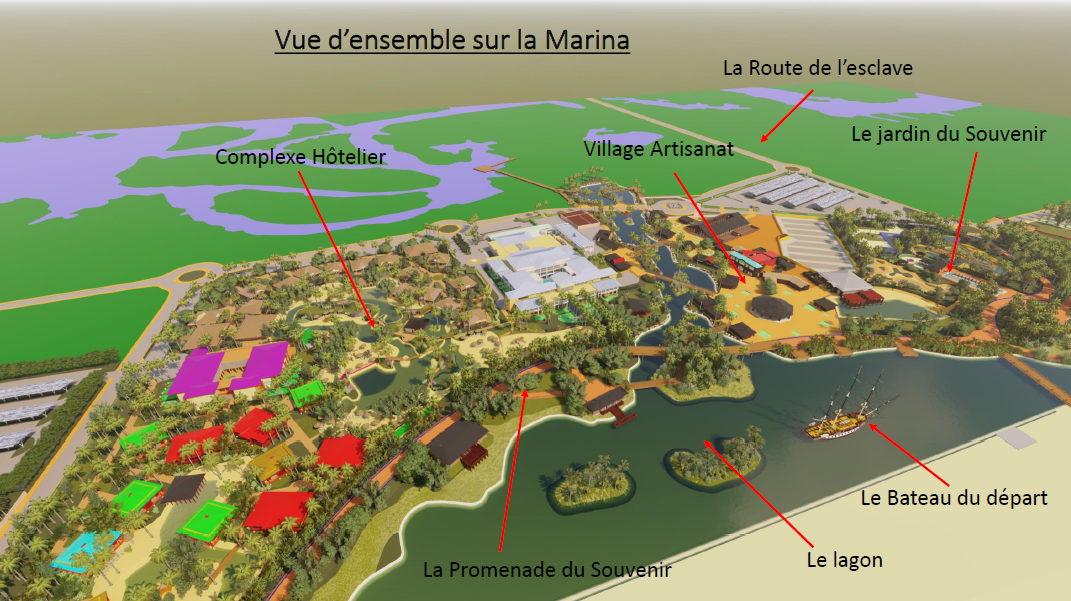
A life-sized replica of the slave ship L'Aurore, the Bateau du Départ has just opened in Ouidah. This immersive museum is the first of its kind in West Africa. What it is, and what it signifies.
From Haiti's Vodou to Brazil's Candomblé and Louisiana's traditions — discover how Ouidah, Benin's coastal city, shaped the spiritual and cultural life of the Americas.
For the third time, Benin has granted Beninese nationality to descendants of the slave trade. A powerful symbolic gesture, gradually transforming Ouidah into a place of return as much as memory.
Benin has built the most coherent diaspora-focused cultural tourism model in Africa. Here's how it compares to Ghana, Senegal, and Haiti — and what makes it structurally different.
With President Talon's term ending, Benin heads into its most consequential election in a decade. For the diaspora, the heritage projects, citizenship programme, and Ouidah's transformation are all on the line.
On 3 March 2026, the mayors of Ouidah and Abomey met to build a shared tourism axis. Two cities, two legacies, one ambition: to create Benin's unmissable cultural circuit.
Since Law No. 2024-31, Benin offers citizenship to any person of African descent deported during the slave trade. Here's how it works, who qualifies, and what the process actually looks like.
The Zangbeto appear after dark, spin without logic, and carry the night on their backs. Among the most sacred — and most misunderstood — manifestations of Vodun, they are Ouidah's ancient community guardians. A complete portrait.
Patrice Talon leaves the Beninese presidency in 2026. All the cultural investment of the last decade—MIME, restitutions, Vodun Days, golf, Club Med—is linked to his vision. What happens now?
At the edge of Ouidah, where the Slave Route ends, the beach of Avlekete is the domain of Mami Wata — goddess of waters, boundaries and crossings. A place where memory and the sacred merge into the waves.
The slave route from Ouidah to Cuba produced one of the least-documented branches of the African diaspora. The Arará nation, the Lucumí tradition, the music of the Cuban coast — it all begins here.
Modeste Zinsou has been guiding visitors through the Python Temple in Ouidah for over 35 years. Here's what it means to do that work — and why your guide choice defines your experience.
A comprehensive retrospective on the historic 2026 edition of Vodoun Days. From the sacred processions to the electrifying concerts, we explore how Ouidah cemented its status as the spiritual capital of the Afro-descendant world.
Djègbadji is a small village near Ouidah where women have extracted salt from the lagoon for generations. Here's what it is, how to get there, and why it's the most unexpectedly moving stop on the coast.
The women of Ouidah have always been at the center of power — as merchants in the historic market, as Vodun priestesses, as the Agojie warriors of the Dahomey kingdom. Here's their story.
Ouidah is visually extraordinary. It is also a city of sacred spaces and living communities. Here's how to photograph it in a way that doesn't reduce it to content.
From 8 to 10 January 2026, Ouidah hosted the third edition of Vodun Days. 740,000 participants from 56 countries, Ciara and Davido on stage — and at the heart of it all: the Grand Ceremony on the sacred beach of Avlekete.
Vodun Days 2026: 700,000 visitors. Club Med, Dhawa, Golf Club, MIME. Ouidah is becoming a major international destination. Here's the honest question: is the city ready for what's coming?
Angélique Kidjo performed at Vodun Days 2026 in Ouidah. Her music — from Celia to Remain in Light — is a decades-long conversation with the spiritual geography of this city. Here's why it matters.
Unveiled in December 2025, the new Door of No Return rises seven stories above the Atlantic. It replaces the 1995 arch and sets a new scale for the duty of memory.
The MIME opens. The Bateau du Départ is there. The Door of No Return has been renovated. Vodun Days is at historic scale. 2026 and 2027 are the most significant years to be in Ouidah. Here's why.
The January 2025 edition of Vodun Days drew tens of thousands of pilgrims to Ouidah — from Bahia to Brooklyn, from Lagos to Lisbon. A complete retrospective of three days that redefined the festival's place in the world.