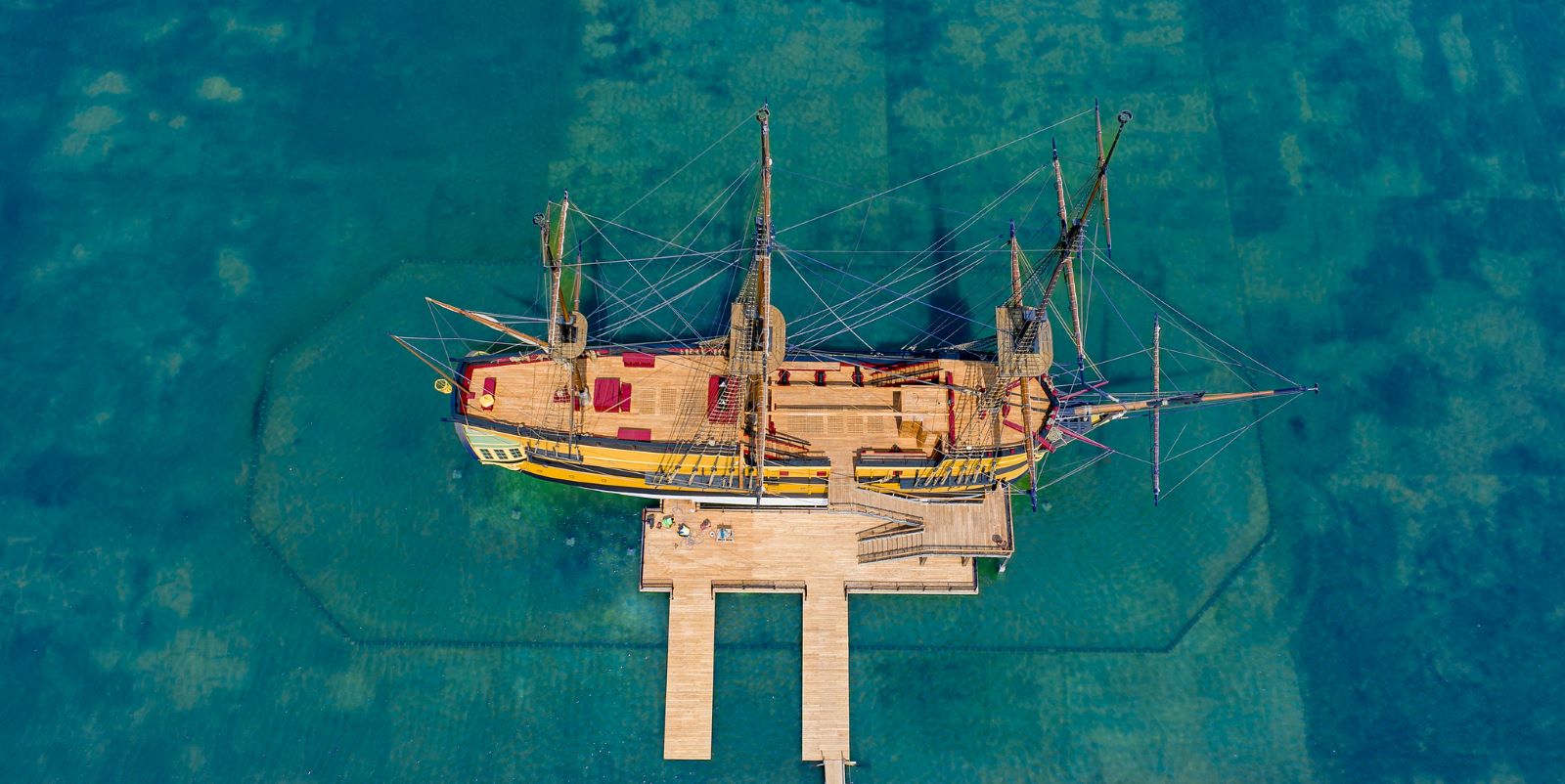
It is there. On the beach of Djègbadji, a few dozen meters from the Door of No Return, a three-masted ship stands facing the Atlantic.
It will never sail. It is not made for that. It is made for people to enter. To go down into the holds. To understand, physically, in one's own body, what it meant to be packed into this space for weeks of crossing toward a continent from which there was no return.
The Bateau du Départ (Ship of Departure)—a life-sized replica of the slave ship L'Aurore, the last French ship to leave Ouidah loaded with captives for Cuba around 1860—is now open to the public. It is a first in West Africa. And it is, very likely, the most difficult experience you will have in this city.
What is L'Aurore?
L'Aurore was an 18th-century three-masted ship built for the triangular trade. Like hundreds of ships of its time, it had three functions: transporting European goods to African coasts, embarking African captives for the Americas, and returning loaded with sugar, cotton, or coffee produced by enslaved labor.
Its particularity: it is one of the last documented slave ships to have set sail from Ouidah. In 1860, the Atlantic slave trade had been officially banned for decades. It continued clandestinely. L'Aurore was part of these final voyages—after it, the port of Ouidah would no longer send captives to the Americas.
The replica built at Djègbadji measures 42 meters in length. Its masts, rigging, and 1,500 m² of sails have been restored with documentary precision. The lower foremast alone weighs five tons.
What the Visitor Sees—and Feels
The experience is organized as an immersive journey. You enter through the upper deck. You descend.
First, the holds: the space where goods were stored on the outbound journey, then where captives were packed on the return. The space is low, narrow, and dark. The reconstruction does not seek to soften what this place was. It seeks to make it understood.
Next, the 'tween-deck: the intermediate level, the living space of the captives during the crossing. Immersive scenographies reconstruct real conditions—the proximity, the darkness, the duration. A crossing to Brazil took between thirty and forty days. A crossing to the Caribbean, two to three weeks. During all this time, the captives lived here.
The officers' quarters: the cabins of the officers, the kitchens. The same ship, the same crossing, radically different conditions depending on whether you were the enslaver or the enslaved. The juxtaposition is deliberate and just.
Guided tours accompany the path. Sound and visual scenographies complete the experience in certain spaces. The museum is not a show. It is a "mise en présence"—a bringing into presence.
The Project Context: La Marina
The Bateau du Départ is not an isolated facility. It is part of a larger complex named La Marina—a memorial, cultural, and tourist site anchored in Djègbadji, in the immediate vicinity of the Door of No Return.
Besides the ship-museum, La Marina includes: a Vodun arena for ceremonies and cultural manifestations, memory gardens, a tourist esplanade with restaurants and bars, a craft village, and a 130-room hotel zone. The Dhawa Ouidah by Banyan Group—132 rooms, four stars—completes the accommodation offer a few hundred meters away.
The overall idea is that of an integrated memorial journey: you can now start the Slave Route in the historic city, walk the four kilometers to the Door of No Return, board the Bateau du Départ to understand the crossing, and stay on-site as long as needed for the experience to sink in.
What This Means for the Cuban and Caribbean Diaspora
The choice of L'Aurore as the reference ship is significant.
The final slave voyages from Ouidah were primarily destined for Cuba. The Ouidah-Cuba route in the 1840s-1860s is the least documented and least known of the major Atlantic slave trade routes—less than the route to Brazil, less than the route to Haiti or Santo Domingo. And yet, tens of thousands of people were deported via this path to Cuban plantations in the last third of the 19th century.
Afro-Cuban traditions of Dahomeyan origin—the Arará nation in Cuban Santería, directly descended from the Fon and Ewe of present-day Benin—bear the trace of these late arrivals. The music of Cuba, certain spiritual practices, certain families with Spanish names that correspond to no Iberian genealogy—all of this begins somewhere on this coast.
For the Cuban diaspora, for Afro-Cuban communities in Florida, Madrid, or New York, the Bateau du Départ is not an abstract museum. It is the place where their ancestors' crossing began.
A Question the Museum Poses Without Solving
There is a tension in the Bateau du Départ that would be dishonest not to name.
This ship-museum is built with remarkable care and precision. It is anchored in a tourist complex that includes hotels, restaurants, and bars. It is one of the pieces of a government strategy aiming for two million visitors per year by 2030.
Does this change what it is? Is a paid entry ticket to descend into the holds of a reconstructed slave ship an act of memory, an act of commerce, or both at once—and if both, in what proportion?
There is no simple answer. What is certain is that the question arises here with more force than in any other slavery museum in the world. Because this museum is built on the very beach from which the boats departed. Because it is managed by the descendants of those who stayed. And because it is visited, increasingly, by the descendants of those who left.
Descending into the holds of this ship is entering a story that is not over. Which will probably never be over.
That is why you must go.
Practical Information Location: Djègbadji Beach, Ouidah—in the immediate vicinity of the Door of No Return Access: from Ouidah's historic center, follow the Slave Route to the sea (4 km) Status: open to the public since summer 2026 Hours and rates: inquire with ANPT Benin or the Ouidah Origins team
Sanctuaries & Refuges
Curated stays in Ouidah
Le Jardin Secret
A colonial guesthouse with a lush garden and a timeless, melancholic atmosphere. Perfect for historians and quiet seekers.
Casa Del Papa Resort
The premier seaside resort in Benin, nestled between the lagoon and the Atlantic. Eco-chic bungalows and a world-class spa.
Djegba Hôtel
Located 100m from the Door of No Return. A peaceful sanctuary with a pool, ideal for reflecting after visiting historic sites.
Partnering with Booking.com to support heritage preservation. (Affiliate)
Restitution 2.0
Ouidah Origins is more than a travel resource; it is an infrastructure for memory. Read our manifesto on why we believe the Slave Route is not a tourist attraction.
Read the Manifesto- A life-sized replica of the slave ship L'Aurore, the Bateau du Départ has just opened in Ouidah
- This immersive museum is the first of its kind in West Africa
- What it is, and what it signifies