Three days in Ouidah. Not enough to see everything. Enough to feel what matters — if the itinerary is built around intention rather than a list of sites.
This itinerary is designed for the diaspora traveler — the person for whom Ouidah is not a tourist destination but a place of origin. It assumes you have not come to tick boxes. You have come to walk the Slave Route, to listen, to stand still when stillness is what the place demands. (If your trip includes family research, pair it with the Ouidah genealogy guide.)
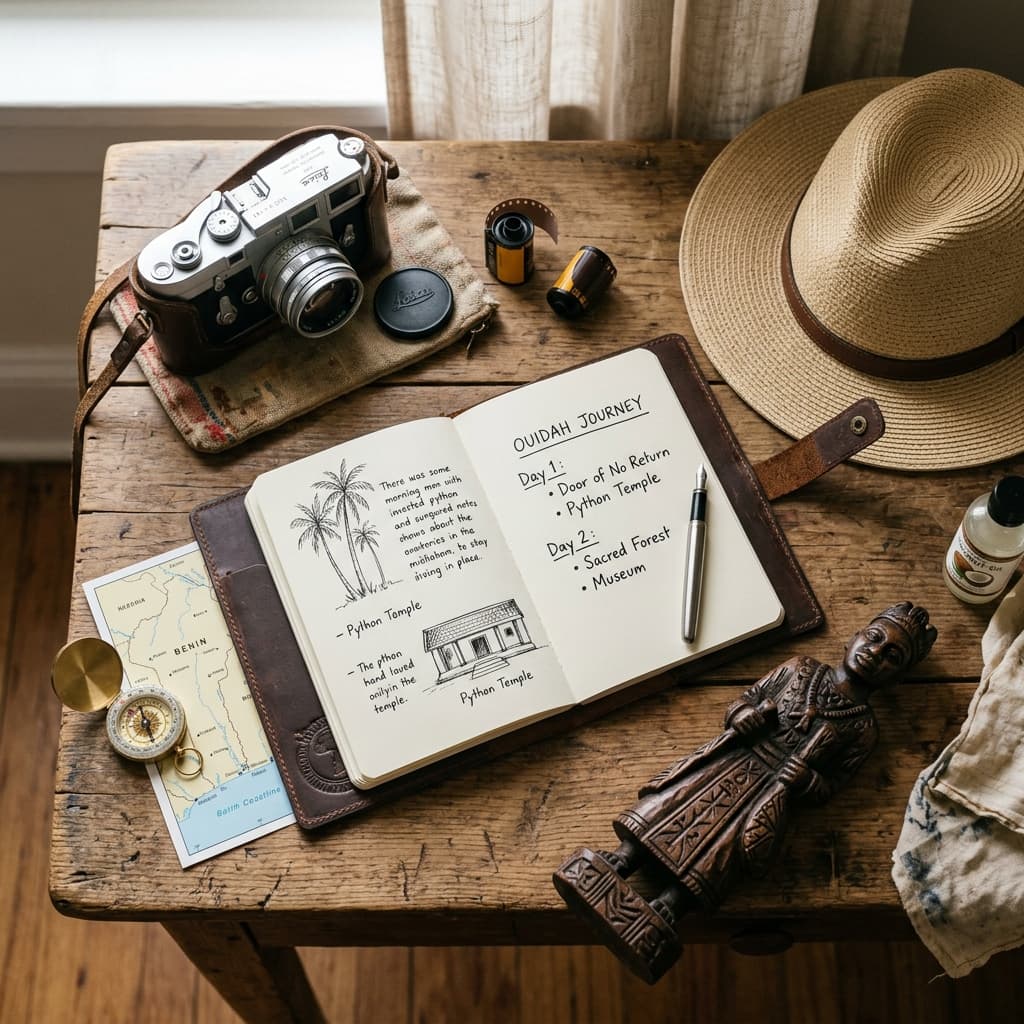
Day 1: The Route — On Foot, Early Morning
The first day belongs to the Slave Route. It is the foundational experience of any stay in Ouidah, and it should be lived before everything else — before the museums, before the temples, before the neighborhoods. The Route sets the tone.
6:30 AM — Place Chacha. Start here, in the square named for the slave trader Francisco Félix de Souza. Look at the ordinary commerce setting up around you. Try to hold both realities — the market that is and the market that was.
7:00 AM — Begin walking. The 3.5 kilometers take 90 minutes to two hours at a meditative pace. Do not rush. The transition — from the noise of the city to the sound of the ocean — is the experience the route was designed to produce.
The six stations. Tree of Forgetfulness: walk around it in reverse if the gesture speaks to you. Barracoons: slow down. Zomai Enclosure: enter the shade. Tree of Return: tie white cloth if you brought it. Door of No Return: stand on both sides. Face the continent. Face the ocean.
10:00 AM — The Door of No Return. Stay. Sit in the sand if you want. Watch the ocean. The offerings at the base — cloth, shells, bottles, flowers — are correspondence with the dead. Do not disturb them.
Afternoon — Return through the city. Walk back or take a zemidjan. Simple lunch at a local maquis. The afternoon is free — the emotional weight of the walk needs space to settle.
Evening — The beach at sunset. Return to the beach, but this time without memorial intent. Watch the fishermen. Listen to the waves. Day 1 ends where it peaked.
Day 2: Spiritual and Living Ouidah
On your second day, shift from the history of the trade to the spiritual systems that survived it — and to the living city those systems continue to shape.
Morning — Sacred Forest of Kpassè. Arrive early, before the heat. The forest is an introduction to the Vodun pantheon: Legba at the entrance, Sakpata under the trees, Mami Wata near the water. Walk slowly. Let your guide tell you the deities.
Late morning — The Python Temple. A few minutes' walk from the Sacred Forest. The temple houses sacred snakes consecrated to Dangbé, the rainbow serpent. This is an active place of worship. If you are comfortable, allow the pythons to be placed on your shoulders — it is a gesture of welcome and protection.
Afternoon — The Brazil quarter. Head to Singbomey, the Agudá neighborhood. Look up. The pastel facades, the arcades, the azulejos — Afro-Brazilian architecture, unique on the West African coast. The Cathedral of the Immaculate Conception, built between 1903 and 1909, is the quarter's most striking monument. If the Casa do Brasil is open, enter.
Late afternoon — Local flavors. End the day with a meal at a local restaurant. Try fechouada if you find it — the Beninese adaptation of Brazilian feijoada, still prepared in Agudá families. Or choose a place featuring traditional drumming and singing: Ouidah's spiritual life is audible.
Day 3: Deepening — and Freedom
The third day is for depth. You have laid the foundations. You can now choose where to dig.
Option A — Vodun immersion. If Vodun calls you, this day is for spiritual deepening. Through the OuidahOrigins concierge, you can visit a Vodun convent, meet a priest, or consult the Fa oracle. Arrange through a local guide. Bring a small offering — kola nuts or palm wine — as a sign of respect.
Option B — MIME and contemporary Ouidah. The International Museum of Memory and Slavery provides the documentary layer that the Slave Route deliberately withholds — ship manifests, historical records, the full chronology. Afterwards, visit the Zinsou Foundation, a world-class contemporary art space that represents the creative present of Benin and its connection to the global art world.
Option C — The coast. Head west to Avlékété. Walk along the lagoon and see the traditional fishing life. Find a quiet spot by the Agouin lagoon — the calm counterpart to the Atlantic's power. If the Ouidah Golf Club is open, visit the grounds to see how the landscape is being reimagined.
Option D — Return to the Route. Many travelers feel the need to walk the Route again — in whole or in part, in the same direction or in reverse. The reverse walk, from the Door toward Place Chacha, is an act of reclamation. The captives walked south. Walking north is undoing.
Evening of Day 3 — Farewell. Choose a restaurant on the beach near the Door of No Return. It is a place to synthesize the historical, spiritual, and modern layers of the city before you depart. What you carry from Ouidah does not fit in a suitcase.
A Note on Pacing
Ouidah is a heavy city. The history it holds is difficult. The spirituality it practices is intense. Do not try to rush. If you find yourself needing to stay at the Door of No Return for three hours, do it. If you need to skip a museum to sit under a tree in the Sacred Forest, do it.
The city is not just a destination; it is a meeting. Give yourself the space for that meeting to happen.
This itinerary is a suggestion, not a fixed program. The OuidahOrigins concierge builds custom journeys — genealogical research, spiritual immersion, heritage pilgrimage — tailored to your intention.
Restitution 2.0
Ouidah Origins is more than a travel resource; it is an infrastructure for memory. Read our manifesto on why we believe the Slave Route is not a tourist attraction.
Read the Manifesto- Day 1: Focus on the history of the trade (MIME, Slave Route) to ground your visit.
- Day 2: Engage with living spirituality (Python Temple, Sacred Forest, Convents).
- Day 3: Explore modern Ouidah and the coast (Avlékété, Zinsou Foundation).
- Balance heavy historical sites with periods of rest and coastal reflection.