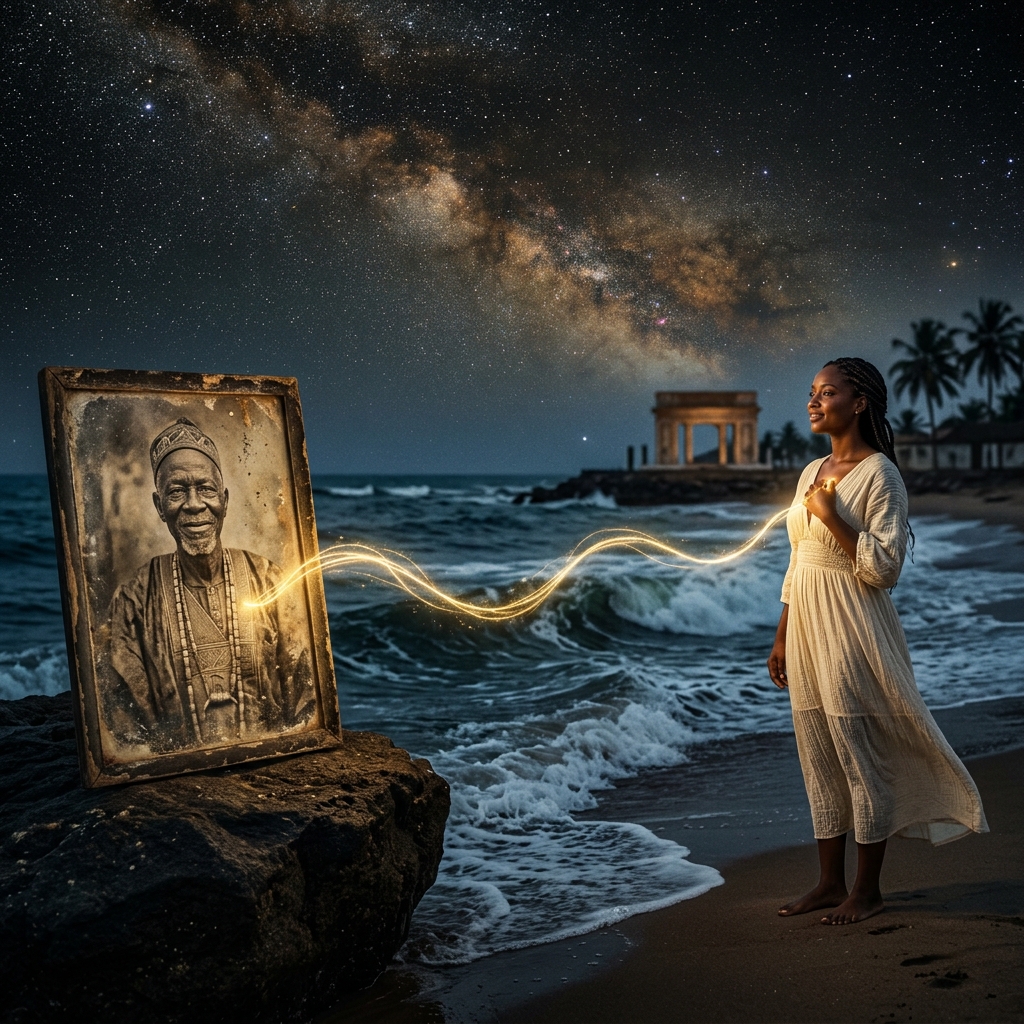
There is a form of silence that is unlike any other. It is the silence of what was lost—not through forgetting, but through force. For the millions of human beings who make up the African Diaspora across the Americas, the Caribbean, and Europe, this silence has a name. Sometimes, it carries the name of a port. Often, that port is Ouidah.
But in 2026, the silence is beginning to be broken. Ouidah is no longer just a place of rupture; it is becoming a place of suture. Genealogy, once a Western hobby of documenting family trees, has transformed here into a radical spiritual and political act.
The Archive of the Sand and the Sea
When a researcher arrives in Ouidah looking for their roots, the first shock is the absence of a centralized "archives building" in the European sense. In Ouidah, the archives are distributed. They are held in the memories of the Vigan (family elders), etched into the scarifications of the lineage, and hidden within the drum patterns of the convents.
Genealogical research in Ouidah is an exercise in patience and humility. It’s not just about searching for a name on a manifest; it's about finding a vibration that matches your own. We call this the "Call of the Blood."
Trace your family history in Ouidah
An inherited last name, a fragment of history... Discover how to begin a serious genealogical search in Ouidah.
DNA and the Bridge of Science
Technology has changed everything. Since the 2020s, the democratization of DNA testing has allowed thousands of people to narrow their search from "Africa" to "the Bight of Benin." But the DNA test is only the map, not the destination — proving African ancestry shows how to turn a result into evidence.
The real work begins when a test result of "90% Benin/Togo" meets the oral history of a family in Ouidah that remembers a son or daughter who "disappeared into the water" generations ago. This is where Ouidah Origins intervenes. We use digital tools to cross-reference these genetic markers with the known genealogies of the great families of Ouidah—the de Souza, the Adjovi, the Quenum, and many others.
Healing the Wound of the "Non-Retour"
For centuries, the Porte du Non-Retour (Door of No Return) was a psychological wall. To pass through it was to be erased. Today, the "Great Return" is a movement of re-inscription.
When a descendant of a family that was taken to Brazil or Haiti returns to Ouidah, they are not a "tourist." They are a missing member of a lineage. The genealogical ceremonies of reintegration are among the most powerful experiences one can witness in the city. They involve rituals that officially "re-attach" the person to their ancestral land and their specific Vodun protector.
Why Ouidah is Unique for Researchers
Ouidah was one of the few ports where the trade was organized under a centralized authority (the Kingdom of Dahomey) but with a high degree of interaction between different cultures (Portuguese, French, English, Brazilian). This has left a unique "cultural residue" that simplifies genealogical tracking compared to other regions.
The family compounds in Ouidah have a sense of continuity that is rare. Many of the houses that stood in the 18th century are still inhabited by the same families. The memory is anchored in the soil.
The Practicalities of Modern Research
If you are beginning this journey, understand that it is a marathon, not a sprint.
- Start with the Oral History: Document every name, every story, and every song in your current family, no matter how fragmented.
- Use Digital Platforms: Ouidah Origins and ADA are working on digitizing the records of the various traditional collectivities.
- Physical Presence: At some point, the digital must become physical. You must breathe the air of Ouidah, walk the red sand, and present yourself to the Guardians.
Conclusion: More than a Journey, a Paradigm Shift
One does not visit Ouidah as they visit Paris or Rome. You come here for a reset of your own internal software. To know where you come from is to know where you are allowed to go. Memory is not a burden; it is fuel.
Ouidah Origins aims to be the guardian of this fuel. We do not sell tours; we open doors. If you are reading these lines from the Americas, from Europe, or anywhere else in the diaspora, know this: the land of Ouidah has preserved your footprint. Your ancestors never stopped waiting for you by the beach. They are there, in the movement of the waves and the breath of the wind in the palm trees.
It is time to go home.
This article is part of Ouidah Origins' preservation mission. Genealogical data and family narratives are treated with the respect and secrecy due to the ancestral traditions of the sacred city.
- For many in the diaspora, Ouidah is where the story begins
- Genealogical research, emotional return, and ancestral ceremonies are becoming bridges to healing and identity for Afro-descendants visiting Benin