There are things in Ouidah that do not belong to the daylight.
You will not see them at the tourist sites, in the brochures, or in the carefully composed Instagram photographs taken on the Route des Esclaves. They belong to a different grammar entirely — one written not in light but in shadow, not in sound but in the hush that precedes it.
The Zangbeto are among those things.
What They Are
The Zangbeto — the name translates roughly from Fon as "masters of the night" or "guardians of the night" — are among the most ancient and revered entities in the Vodoun cosmology of the Gbe-speaking peoples of West Africa: the Fon, the Ewe, and their neighbors.
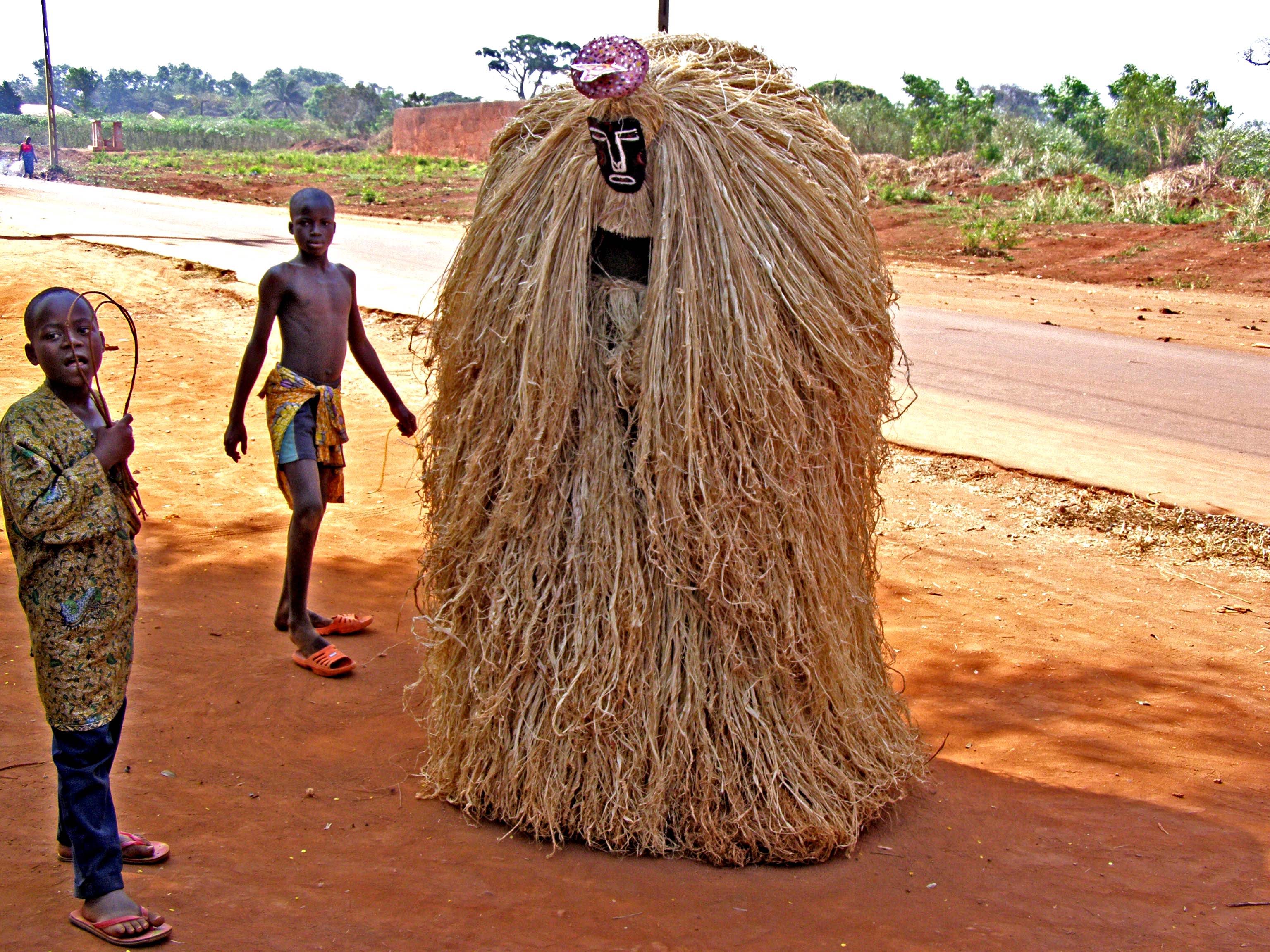
They manifest in the physical world as enormous, shaggy constructions — imagine a haymow that has learned to move, to spin, to breathe. Covered in dried grass and palm fiber, they stand between one and two meters tall. They appear without warning. They move without visible means of locomotion. They spin.
This is not metaphor. Witnesses from across centuries — European colonial observers as disdainful as they were puzzled, Haitian vodouisants who recognized cousins in the construction, anthropologists who came to explain and left more uncertain than before — all report the same thing: the Zangbeto spin at speeds that should not be possible. They stop. They start. They choose where they go.
What is inside them is not a question one asks.
The Night Patrol
Traditionally, the Zangbeto served as Ouidah's nighttime police force — a function not metaphorical but literal. In the centuries before colonial-era policing, it was the Zangbeto who patrolled the streets after dark, deterring theft, adjudicating disputes, and maintaining what the community understood as order.
Their authority derived not from weapons but from fear. And not from ordinary fear — from the specific, productive fear of the sacred: the understanding that consequences exist beyond the visible world, that certain violations attract consequences invisible to the ordinary eye.
Colonial administration attempted to suppress them. Christianity attempted to categorize them as evil. Neither succeeded. The Zangbeto retreated, adapted, and persisted — as Vodoun itself persisted.
At the Festival
Today, the Zangbeto emerge most visibly during the Vodoun Days festival in January. Their appearances draw enormous crowds — and invariably, even among visitors who came prepared for spectacle, the presence of the Zangbeto produces something that cannot be staged: genuine disorientation.
The spinning that defies physics. The sound they emit — a low, building vibration that some describe as the sound of the night itself. The crowd pressing forward in fascination and involuntarily stepping back in something older than reason.
At the 2025 edition, a Zangbeto appeared near midnight at Akron Square and spent forty-five minutes in the public space before retreating. Those who were there describe it uniformly, regardless of their background or beliefs, as the most unsettling and exhilarating thing they have ever seen.
The Question of Documentation
The Zangbeto occupy an interesting position in the digital age. Countless videos exist — taken by festival visitors on smartphones, posted to social media, viewed millions of times. And yet the videos, almost without exception, fail to capture what witnesses report experiencing in person.
This is significant. It suggests that the Zangbeto's power is not reducible to the visual alone — that whatever is happening when they appear, it operates partly in registers that cameras cannot record.
This is either a spiritual fact or a perceptual one. Perhaps the distinction does not matter as much as we assume.
The Diaspora and the Guardians
Among the most moving aspects of recent Vodoun Days festivals has been the reaction of diaspora visitors encountering the Zangbeto for the first time.
Many arrive having heard, through grandparents or community memory or Haitian vodou or Brazilian Candomblé, some echo of these entities. The Egungun they may have seen in Yoruba contexts. The concept of the sacred night patrol exists in attenuated form across the diaspora.
But the Zangbeto are specific to this coast. To this soil. And when diaspora visitors see them here, in Ouidah, the recognition that occurs is not intellectual. It is, by all accounts, something that moves in the body before it arrives in the mind.
That is, perhaps, the most important thing the Zangbeto can teach us about what Ouidah is, and why it matters.
The Zangbeto tradition is maintained by specific lineages in Ouidah and neighboring communities. Their appearances during Vodoun Days are considered sacred events. Photography and filming, while not prohibited, should be undertaken with respect.
Experience History
Beyond words, Ouidah is a physical experience. Contact us to organize a private immersion behind the scenes of our chronicles.