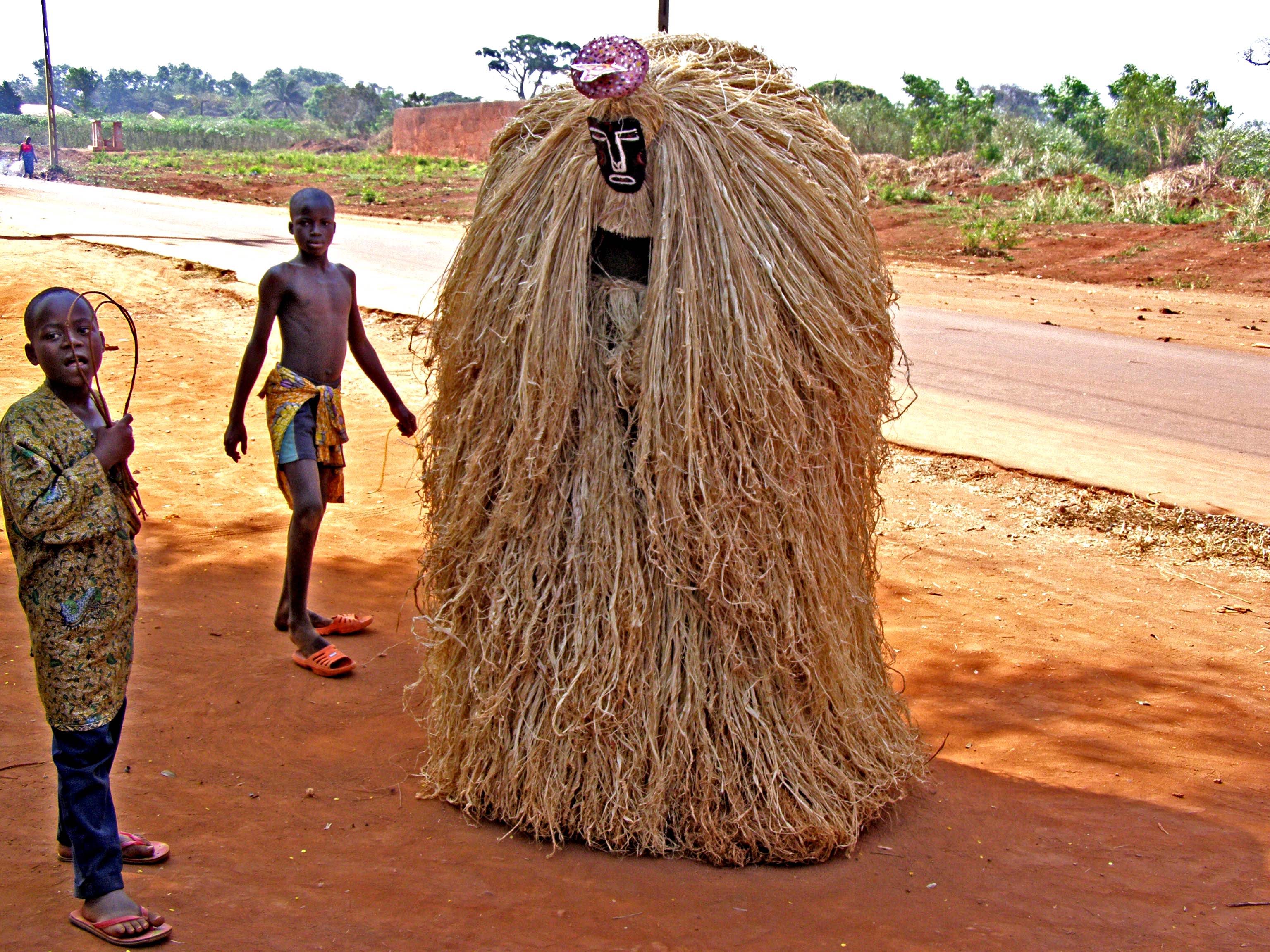
It is six o'clock in the morning in Ouidah. Atlantic mist brushes the ochre tile roofs, the skewer vendors haven't lit their coals yet, and in a narrow lane in the historic heart of the city, women in white cloth and blue beads walk in silence toward a red earth gateway. They are not going to the market. They are going to the convent.
What you see in passing — a shaded interior courtyard, earthenware jars stacked against a wall, the muted murmur of a warming drum — is the visible face of a world that has stood firm for centuries. The Vodoun convents of Ouidah are not monuments. They are living beings, places where spiritual time and human time intersect every day. And among them, two sites remain almost entirely invisible on the radar of global tourism: Zô Houé and Mami Toligbé.
Yet these are two of the rare convents that the Beninese government chose to include in its official rehabilitation program in 2024 — alongside the Python Temple, already world-renowned. This choice is not insignificant. It says something about what Ouidah is becoming: no longer merely a city of painful memory, but a living spiritual territory reclaiming confidence in itself.
What a Vodoun convent is — and why it's not what you think
Before diving into the details of these two sites, we need to establish some context. In the West, the word "voodoo" evokes dolls, needles, black magic. This image is a Hollywood invention, constructed during colonization to discredit an African religion that was troubling to colonial powers. Beninese scholars repeat this today at every Vodun Days celebration: "Vodoun has nothing to do with sorcery. Its philosophy is founded on the protection of humanity and human flourishing."
A Vodoun convent — houn in Fon — is a space of worship, formation, and spiritual initiation. You might compare it to a school of the sacred. It is here that initiates learn the chants (hounkpè), divination, medicinal plants, and the rites that regulate community life. Some remain there for several weeks, sometimes several months, cut off from the ordinary world. When they emerge, they are no longer quite the same.
Each convent is generally dedicated to a divinity — a vodoun — which may be associated with the earth, water, thunder, the forest, or more transversal energies such as prosperity and fertility. The internal hierarchy is precise: the convent chief (vodounon or mamissi), the priests and priestesses attached to the divinity, novices in initiation, and the wider community of the faithful. What strikes one about the Vodoun tradition is the central place of women: in many convents, women hold the highest spiritual authority, serving as guardians of the relationship between the living and the divinities.
In Ouidah, a city considered the spiritual capital of Benin, convents are everywhere — in the courtyards of homes, behind markets, at the end of narrow lanes. But some have a history and significance that far exceeds their neighborhood.
Zô Houé: The Convent of Fire
Zô means fire in Fon. Houé evokes home, space, hearth. Zô Houé is literally the house of fire.
This convent is linked to the divinity Hêbiosso — sometimes spelled Xèviosso or Hêviosso — the Vodoun of thunder, lightning, and celestial fire. In the Fon pantheon, Hêbiosso is one of the most powerful and most feared divinities. He represents cosmic justice: it is he who strikes liars, thieves, and disturbers of social order. Lightning is never accidental to a Vodoun practitioner — it is Hêbiosso speaking.
The ceremonies of Hêbiosso are among the most spectacular in Beninese Vodoun. They feature the Yaoïtcha dance, also called Zo Hiho — the dance of fire. Devotees in trance manipulate flames, carry earthenware pots filled with embers on their heads, and walk through fire barefoot. This is not spectacle. It is a demonstration of the protection granted by the divinity to those who have dedicated their lives to him — living proof that Hêbiosso inhabits the bodies of his initiated followers.
Historically, the cult of Hêbiosso is deeply rooted in Ouidah. It existed long before the arrival of Europeans, long before the Atlantic slave trade. When enslaved people crossed the Gate of No Return to board ships bound for Brazil, Cuba, Haiti, and Louisiana, they carried with them the memory of Hêbiosso. This is where Shango comes from in Brazilian Candomblé and Cuban Santería — the Orisha of thunder, almost identical to Hêbiosso in his attributes, his colors (red and white), his rites. The Black diaspora across the Atlantic carries within it the imprint of this Ouidah convent, even if it does not always know it.
Today, Zô Houé is undergoing rehabilitation as part of the government program for the Route of Vodoun Convents, led by the National Agency for the Promotion of Heritage and Tourism (ANPT). The official objective is to "restore these convents and sacred sites while safeguarding their originality and authenticity." No museification. No Disneyfication. A restoration that should allow visitors to approach these places without distorting them.
Mami Toligbé: The House of the Mother of Waters
A few streets away, in the same historic city, Mami Toligbé is a convent dedicated to Mami Wata — the divinity of waters, one of the most powerful and widely traveled spiritual figures in the Vodoun world.
Toligbé comes from Fon and can be understood as "the house of welcome" or "the house that receives." Associated with the cult of Mami Wata, this name takes on its full meaning: Mami Wata is above all a divinity of meeting, passage, and transformation. She welcomes those who come to her with sincerity, and she tests those who seek her out of greed.
Mami Wata is represented as a woman of troubling beauty, part woman, part fish, often entwined with a serpent. She rules over waters — the sea, rivers, rain — but her domain is not limited to the liquid element alone. She also embodies wealth, fertility, beauty, and health. "The Vodoun Dan Mami Wata is the mother of all, with absolute control over health, fertility, beauty, and wealth," confirm her devotees in Ouidah.
What makes Mami Wata fascinating from a historical perspective is her journey. She is the most dispersed Vodoun divinity in the world. When millions of enslaved people captured on the Slave Coast traversed the Atlantic from Ouidah, they took Mami Wata with them. She became Lasirèn in Haiti — the siren of the depths, companion of Erzulie Freda in Haitian Vodou. She is Yemoja in Brazil in Candomblé, Iemanjá in Umbanda, celebrated every February 2nd on the beaches of Salvador da Bahia. She is Maman de l'Eau in Guadeloupe, Lamanté in Martinique, Watramama in Suriname. She is present in the spiritual practices of Afro-American communities in Louisiana.
More than 50 million people around the world venerate this divinity in one form or another today. And one of the sources of this worldwide cult is here, in a red earth courtyard in Ouidah.
The annual ritual Agbandotô — a great ceremony of offerings to Mami Wata — is held each year at the Mami Dan convent in Ouidah. Hundreds of the faithful gather there. Devotees from the diaspora increasingly participate, seeking reconnection with practices their ancestors had carried away without being able to name them.
In April 2026, Beninese president Patrice Talon and his successor Romuald Wadagni made a joint visit to the Mami Toligbé convent to assess the progress of rehabilitation work. On site, accompanied by the delegation and convent dignitaries, they were able to observe the ongoing projects: roofing, access roads, sanitation, reception spaces. One member of the delegation put it simply: "These convents are not merely places of worship. They are the living memory of Benin."
Why these two convents matter for the diaspora
It would be easy to present Zô Houé and Mami Toligbé as simply additional tourist attractions. That would be to miss the essential point.
For a visitor from Haiti, Brazil, Cuba, the French Antilles, or the United States with a spiritual history rooted in Vodou, Candomblé, Santería, or Umbanda — entering a convent in Ouidah is an experience of quite another nature. It is tracing the thread back to the source. Recovering the original names of the divinities that one's ancestors had to rename, hide, and syncretize to survive. Understanding why Shango resembles Hêbiosso so closely. Why Iemanjá wears the colors of Mami Wata.
It is also understanding that these traditions were not invented on slave ships or in plantations. They existed here, solid, structured, transmitted from generation to generation in convents like this one. The Middle Passage did not destroy this knowledge — it transformed it, fragmented it, adapted it. But the core remained.
Benin's cultural policy recognizes this explicitly. The Talon government clearly stated its ambition to make Ouidah "the flagship spiritual destination for Africans and diasporas," drawing inspiration from the Ghanaian model of Year of Return — that program which, in 2019, officially invited the African diaspora to return to the continent. The rehabilitation of convents is part of this logic: to welcome dignely those who return.
What you can see today — and how to do it well
The two convents are in active rehabilitation. Public access is not yet formalized in the same way as for the Python Temple, which has long been accustomed to organized tourist visits. Therefore, these places must be approached with discernment.
What is accessible:
- The surroundings and exterior space of both convents can be discovered as part of a walk through the historic city of Ouidah.
- Public ceremonies — notably during Vodun Days on January 10 — allow observation of processions and rites open to the public around these sites.
- A local guide from the Vodoun community can arrange a meeting with convent dignitaries, respecting proper protocols.
What requires respect:
- The interior of the convents is reserved for initiates. Do not cross thresholds without being explicitly invited.
- Photography is subject to authorization. Always ask before taking out your camera.
- If you present yourself during a ceremony, dress simply. Avoid black clothing (a color of mourning in Vodoun context) during festive ceremonies.
- A modest offering — a few CFA francs or cola nuts — is welcome if you come into contact with the priests.
Practical information:
- Ouidah is about 40 km from Cotonou. Allow 45 minutes to 1 hour by car depending on traffic.
- The best time to visit is between October and March — outside the rainy season.
- January 10 (National Vodoun Holiday / Vodun Days) is the reference date for anything related to public ceremonies.
- For a trip focused on Vodoun heritage, it is strongly recommended to spend at least two days on site.
→ See also: Complete Guide to Vodun Days → See also: Sacred Vodoun Convents of Ouidah: Complete Map and List
Planning Your Visit
Recommended Accommodations in Ouidah: Discover our selection of hotels and lodges in Ouidah suited to all budgets and travel styles, from spiritual luxury to authentic comfort.
Guides and Concierge: For an immersion in Ouidah's Vodoun convents with respectful and informed guidance, our concierge service can connect you with certified local guides from the spiritual communities.
→ Contact Ouidah Origins Concierge
Ouidah reinventing itself — and these convents are at its heart
The rehabilitation of Zô Houé and Mami Toligbé does not happen in a vacuum. It is part of a much larger undertaking — perhaps the most important Ouidah has known in decades. The Portuguese Fort has been partially renovated. The Slave Route is being redesigned. The International Museum of Memory and Slavery (MIME) opened its doors within the Fort. A marina tourist complex is under construction facing the Gate of No Return. A 336-room Club Med is planned for Avlékété by 2027.
The city is undergoing total transformation. And in this transformation, the convents are not relics on display behind glass — they are anchoring points, proof that something living resists and transmits itself.
Zô Houé and Mami Toligbé are not yet part of standard tourist guides. They are not yet on maps of Ouidah distributed to travelers at Cotonou airport. But they will soon be at the heart of the spiritual circuit that Benin offers to the world.
Coming now means seeing something before it is entirely domesticated by mass tourism. It means meeting guardians of a thousand-year-old tradition who themselves are deciding how they want to tell their story to the world.
Article written by the Ouidah Origins team. Sources: ANPT Benin, Council of Ministers of Benin (April 2026), Les 4 Vérités (April 2026), Jeune Afrique, VOA Africa, fongbebenin.com.
Experience History
Beyond words, Ouidah is a physical experience. Contact us to organize a private immersion behind the scenes of our chronicles.