
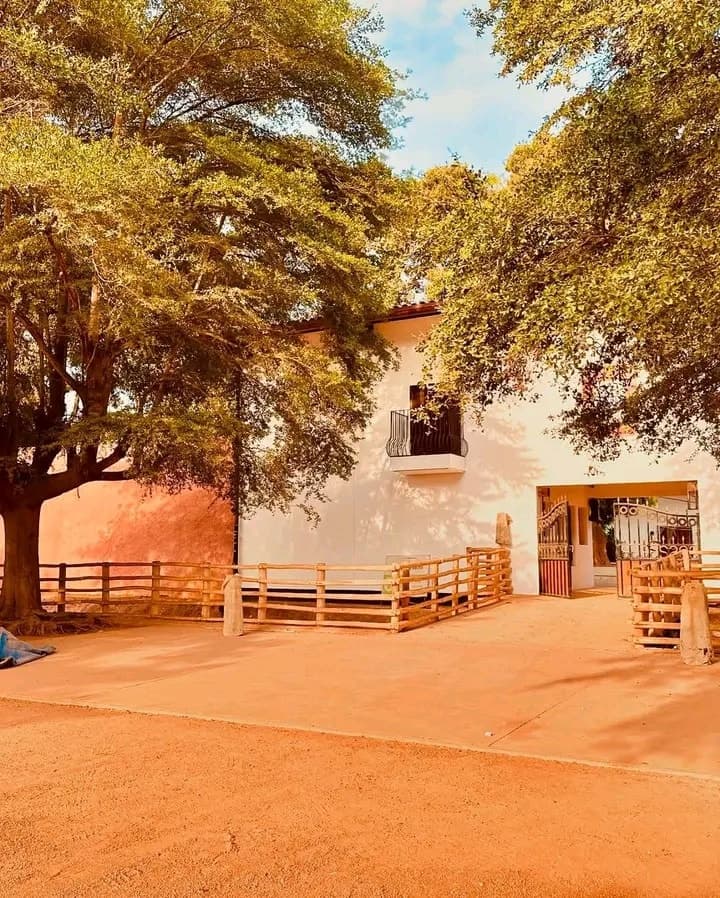
In the center of Ouidah, inside the old Portuguese fort where enslaved people were held before being loaded onto ships bound for the Americas, a museum is still under construction.
It is not a small museum. The International Museum of Memory and Slavery — the MIME, its French acronym — is one of the largest cultural infrastructure projects in West African history, part of a government program that has invested over one trillion CFA francs in Benin's cultural and heritage infrastructure since 2016. Its opening is expected in 2027, making it a major piece of the Ouidah 2027 plan.
For anyone who cares about the history of the Atlantic slave trade, about the African diaspora, about the relationship between memory and justice — this is a museum that will matter.
The building and its history
The Portuguese Fort of Ouidah — Fort São João Baptista de Ajudá — was originally built in the early eighteenth century as a trading post. Like the French and English forts that lined this coast, it became central to the organization of the Atlantic slave trade. Enslaved people were held here — in conditions designed for maximum efficiency and minimum humanity — before being marched down the Slave Route to the Door of No Return.
The fort changed hands repeatedly over the centuries, remaining under Portuguese nominal control until 1961, when Dahomey (now Benin) declared independence. It housed the Ouidah Museum of History for decades before being closed for renovation as part of the MIME project.
The decision to build the new museum inside the fort is deliberate. The building is not neutral. It is a specific site of confinement and departure. The museum built within it inhabits meaning that is already there.
What the MIME will contain
Based on architectural plans and government communications, the MIME will be organized as a chronological thematic journey through the history of slavery and the transatlantic deportation as it affected the territory of Benin — approximately 400 years of history.
The museum will cover:
- The Kingdom of Xwéda: The pre-Dahomey state that first encountered European traders.
- The Kingdom of Dahomey: Its complex role as both victim of the trade and active participant.
- The Middle Passage: The experience of transport and the diaspora communities that formed in the Americas.
- Vodun Resilience: A significant section will be devoted to the spiritual system that survived the crossing and continues to shape religious life globally.
The MIME will also include a tourist complex of 130 rooms and a reconstruction of a slave ship, making it a destination capable of hosting significant numbers of overnight visitors.
Why this museum matters differently
There is a version of slavery memorialization that is fundamentally about European guilt. It produces a kind of somber tourism.
The MIME aims to do something different. It is a museum built on African soil, for a global diaspora, narrating history from the perspective of the people most affected by it. The Beninese government's framing is explicitly about sovereignty and reclamation.
That framing does not erase the complexity of Dahomey's own role. Benin's history is not simple. The Kingdom of Dahomey was both a state that sold enslaved people and a state whose people were themselves enslaved. The wall between perpetrator and victim was never clean, and an honest museum will not draw it cleanly. But the perspective from which that complexity is examined will be different here than at any museum in Europe or the Americas.
Practical information
- Status: Under construction, expected opening in 2027.
- Location: Historic center of Ouidah, within the Portuguese Fort.
- For diaspora visitors: The MIME is designed with the African diaspora in mind. Its expected opening in 2027 makes that year a particularly significant moment for a roots trip to Ouidah.
The MIME is more than just a building; it is a statement that Benin is ready to own and narrate its own history.
- The MIME is located within the historic Portuguese Fort São João Baptista de Ajudá, a former site of confinement.
- The museum will feature a chronological journey through 400 years of history, including the Kingdom of Dahomey's role.
- The project includes a 130-room tourist complex and a reconstruction of a slave ship.
- The MIME represents a shift toward African sovereignty in narrating the history of the transatlantic trade.