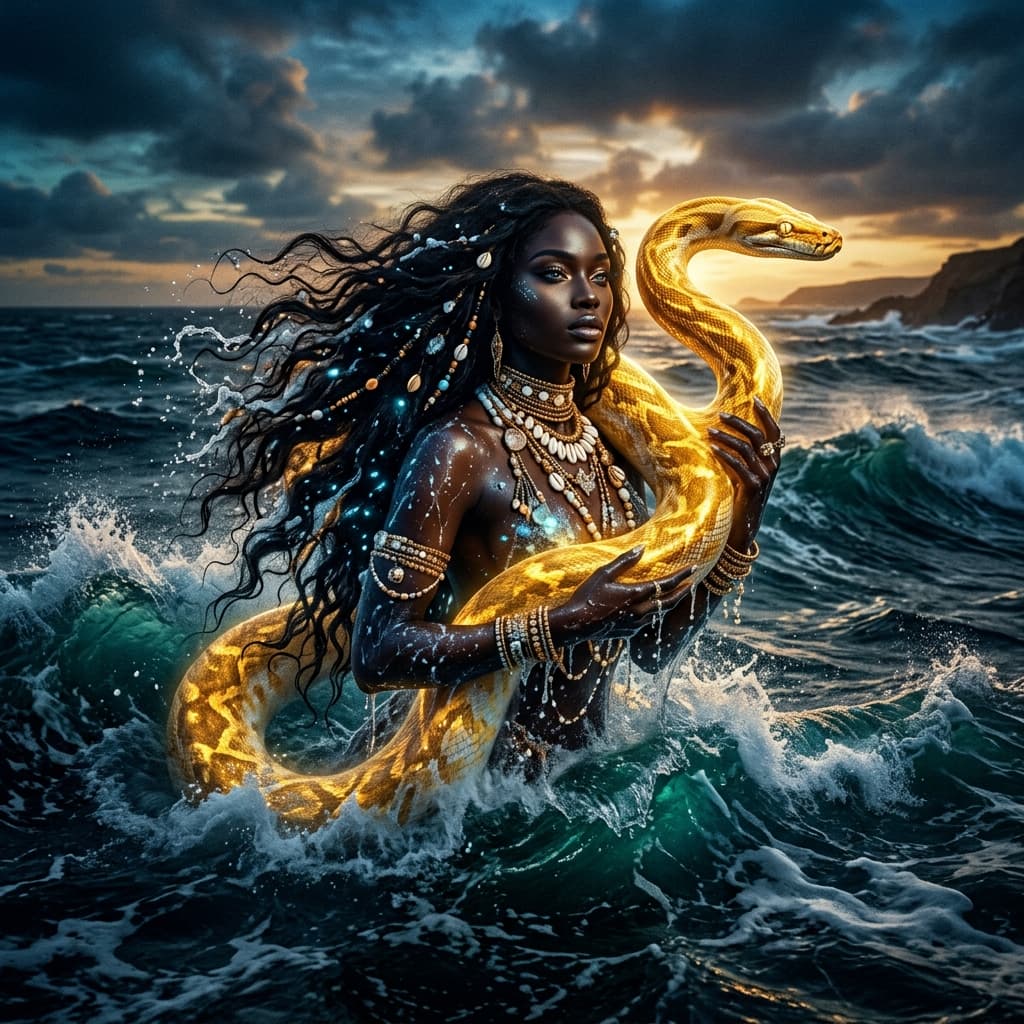
In Ouidah, if you walk toward the ocean at sunset, you are walking into the domain of Mami Wata.
She is perhaps the most famous, the most misunderstood, and the most geographically expansive of all West African spiritual forces. She is the Mother of the Waters — Mami Wata — a deity of immense power, beauty, and danger who governs the ocean, the lagoons, and the complex relationship between human prosperity and the mysteries of the deep.
Who Mami Wata is
Mami Wata is not a single entity but a family of spirits. She is often depicted as a mermaid — half human, half fish — or as a beautiful woman entwined with a large serpent. Her colors are red and white. Her domain is the water, but her influence extends to everything the water represents: wealth, beauty, fertility, and the unknown.
She is a spirit of the "other side." In Ouidah's cosmology, the ocean is the boundary between the world of the living and the world of the ancestors. Mami Wata guards that boundary. She is the one who can bring treasures from the deep (wealth, new ideas, foreign goods) but who can also take people away into her underwater realm.
The Global Goddess
What makes Mami Wata unique is her ability to absorb and transform. Unlike many other Vodun deities whose origins are rooted in specific local lineages, Mami Wata has always been a bridge.
Her imagery often incorporates elements from outside Africa — European mermaid myths, Indian spiritual prints, and symbols of modern wealth. This is not a loss of tradition; it is a manifestation of her power. She is the spirit who encounters the "other" and brings what is useful back to the community.
Across the Atlantic, Mami Wata transformed into the deities of the diaspora. In Brazil’s Candomblé, she is Yemayá, the queen of the sea. In Haitian Vodou, she is Lasirèn, the mermaid who pulls the chosen into the depths to teach them the secrets of the water. In the Caribbean and the southern United States, her presence persists in the stories of water spirits and the practice of leaving offerings at the water's edge.
Veneration in Ouidah
In Ouidah, Mami Wata’s presence is everywhere.
- The Couvent Mami: There are specific convents dedicated to her service. Her initiates are often identifiable by their white clothing and the specific beads they wear.
- Offerings by the Sea: It is common to see small offerings on the beach — perfume, mirrors, jewelry, white cloth — left for the goddess. These are not trash; they are communications.
- The Month of January: During the Vodun Days festival, the Mami Wata ceremonies are among the most visually striking, featuring elaborate costumes and dances that mimic the movement of the water.
Approaching the Water Spirit
For the visitor, Mami Wata represents the seductive and dangerous power of the Atlantic. She is a reminder that the ocean that took so many people away is also a source of life and renewal.
When you stand at the Door of No Return, you are standing in her territory. Many diaspora visitors find that their most profound spiritual moments happen not in the city, but at the water's edge, where the boundary between worlds is thinnest and the presence of the Mother of Waters is most felt.
Mami Wata is the goddess of the middle space — the one who survived the crossing and who remains the most potent link between the African coast and its children across the sea.
Experience History
Beyond words, Ouidah is a physical experience. Contact us to organize a private immersion behind the scenes of our chronicles.