There is a moment — it happens every year, but you can never predict when — when the festival stops being a festival. When the drums stop being entertainment. When the crowd stops being a crowd and becomes something else: a body, a single breathing thing, oriented toward something larger than any of its parts.
At Vodoun Days 2025, that moment arrived on the morning of January 10th.
The City That Woke Up Transformed
Ouidah had been building toward this for months. The city's preparations were visible in the freshly painted facades on the Rue du Brésil, in the temporary stages going up around Place Maro, in the pilgrims already arriving by the busload from Cotonou and beyond. By January 9th, the streets were dense with life — traders, devotees, curious tourists, diaspora visitors clutching their phones and their emotions in equal measure.
The Vodoun Days Village opened its stalls to a tide of people. Artisans from across Benin and beyond laid out their work: carved masks, beaded necklaces that encoded genealogies, kente cloth, bronzework tracing its lineage to Abomey. The smell of grilled plantain hung in the air over the low thrum of talking drums.
But no amount of color or commerce could distract from what was building spiritually.
The Zangbeto at Midnight
Nothing prepares you for the Zangbeto.
Roaming guardians of the night, enormous haystacks animated by something that defies rational explanation, the Zangbeto emerged in the small hours of January 9th and moved through the crowd at Akron Square. Their spinning — fast, inexplicable, creating their own wind — caused the crowd to part in waves of awe and genuine fear.
"My grandmother told me stories. But you cannot understand until you are standing there and the ground is shaking." — Visitor from Salvador da Bahia
This was the essential quality of Vodoun Days 2025: it refused to be mediated. You could not experience it through a screen. You had to be there, in your body, in the heat, in the dark.
The Return of the Egungun
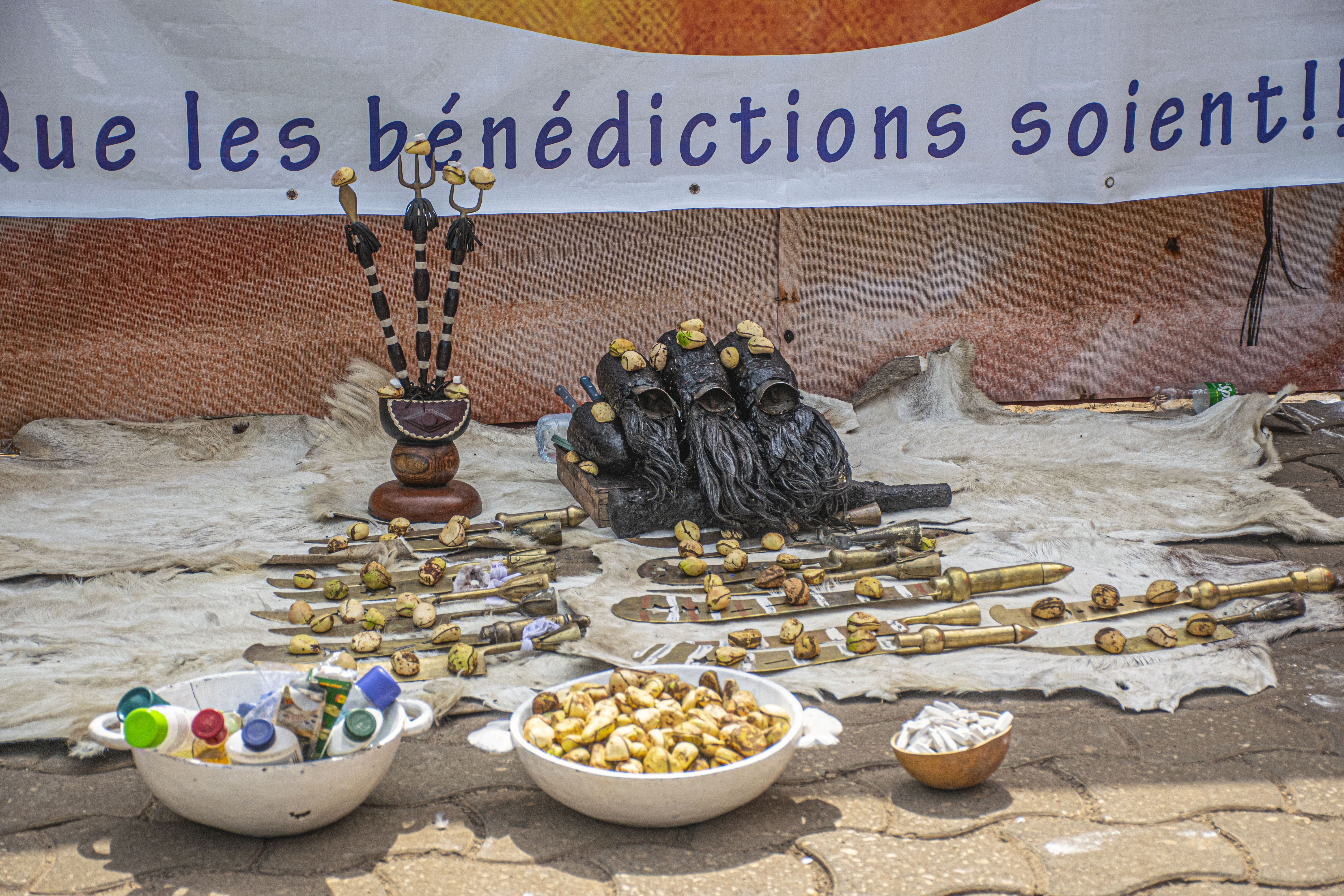
The Egungun masquerades — ancestral spirits made manifest in the world of the living, clothed in cascading layers of cloth that move and ripple like living things — processed through the historic center on the morning of January 10th.
To see Egungun in Ouidah is to understand something about the resilience of this tradition. These spirits traveled with enslaved Yoruba people across the Atlantic. They reappeared in the Candomblé of Brazil, in the Santería of Cuba, in the Vodou of Haiti. They survived. They mutated. They persisted. And here they were, back on the red earth of Ouidah, reclaiming their territory of origin.
The crowd pressed close and fell back in equal measure — respecting the sacred boundary while desperately wanting to touch something holy.
Nights on the Beach
If the days belonged to the spirits, the nights belonged to the living — and to music that moved between the sacred and the ecstatic without apology.
The beach concerts drew extraordinary crowds. The headliners of the 2025 edition — announced only close to the date, in the tradition of the festival — represented a deliberate cartography of the diaspora: West African artists whose sonic roots trace back to the same soils as the festival itself, Afrobeats producers who have made the Atlantic sound of Benin legible to a global generation, and veterans whose voices are living archives.
The Atlantic crashed through it all, indifferent and eternal.
What Changed This Year
Beyond the spectacle, Vodoun Days 2025 was notable for several meaningful shifts.
The newly launched My Afro Origins citizenship programme operated a dedicated booth at the festival, receiving enquiries and distributing information in English, French, Portuguese, and Yoruba. For many diaspora visitors, this was their first concrete encounter with the possibility of Beninese nationality.
For the first time, the festival deployed a multilingual oral history recording station, inviting visitors to document their connection to Ouidah in their own language. Hundreds of testimonies were collected over three days.
And the Sacred Forest of Kpasse, usually accessible only by those with Vodoun connections, opened select guided visits — carefully curated, respectful of the spiritual protocols — that allowed a small number of outsiders to stand beneath the ancient trees in silence.
2026 Awaits
The 2026 edition took place just days ago — you may have attended it yourself. But as the dust settles on that extraordinary weekend, it is worth pausing to look back at 2025, the year that proved the festival had grown beyond any one government's control or any tourist board's vision.
It belongs to Ouidah. It belongs to the diaspora. It belongs, perhaps most importantly, to the spirits — who have been patient, and who show no sign of leaving.
Vodoun Days takes place annually around January 10th, Benin's National Vodoun Day. The festival is free and open to all.
- The January 2025 edition of Vodun Days drew tens of thousands of pilgrims to Ouidah — from Bahia to Brooklyn, from Lagos to Lisbon
- A complete retrospective of three days that redefined the festival's place in the world