

There are things in Ouidah that do not belong to the daylight, yet refuse to extinguish at sunrise.
If you spend any time in Ouidah, or if you delve into the depths of Vodun culture in southern Benin, you will inevitably encounter them. They will not be seen in glossy brochures or on westernized advertising posters. They belong to an entirely different grammar—written not in light but in shadow, not in sound but in the rustling of raffia.
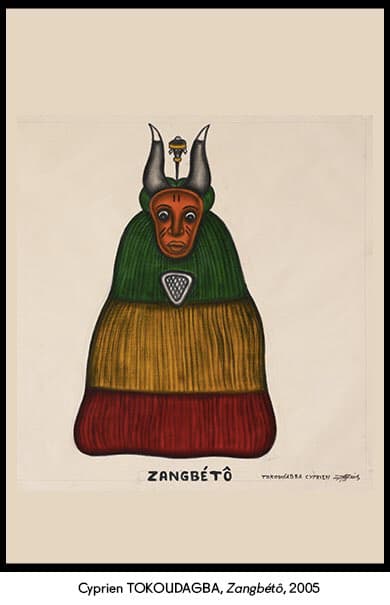
These are the Zangbeto, the "guardians of the night". The Zangbéto is one of the most enigmatic, respected, and feared figures in Vodun cosmology. Beneath their appearance as large conical structures covered in layers of colorful raffia or dried straw, they are not merely a visual spectacle. They constitute a formidable social institution, a traditional police force, a symbol of justice, and the physical manifestation of spiritual authority. Their presence in Ouidah is the guarantor of moral and spiritual order. They are inseparable from the authentic spiritual immersion.
This comprehensive piece delves into the mystical universe of the Zangbeto: their history, social role, inexplicable "miracles", and their unalterable importance in contemporary Ouidah.
1. Origins and Meaning: Who are the Zangbeto?
The Etymology of the Guardian
The word Zangbéto comes from the Goun and Fon languages, widely spoken in southern Benin (notably in Porto-Novo, the capital, and in Ouidah). It breaks down into two parts:
- Zan: the night.
- Gbéto: the hunter, or the human.
Literally, the Zangbeto is the "hunter of the night" or the "master of the night". It belongs to the great family of traditional West African secret societies, but it possesses unique spiritual attributes that distinguish it from other African masks.
The Creation Myth: An Army of Straw
The original legend of the Zangbeto is deeply rooted in the military and survival history of the coastal peoples. According to oral tradition, the Zangbéto was created by the founders of the kingdom of Porto-Novo (the Gouns) to protect against nocturnal enemy invasions and slave raids, often perpetrated by the kingdom of Danhomè (Abomey).
Faced with an overwhelming threat, the inhabitants used conical structures made of dried banana leaves and straw, hiding men inside. By moving in the dark night, imitating frightening sounds—moans, whistles, growls—and using horns to amplify these noises, they managed to convince the enemy that a real army of demonic spirits was protecting the city, thus driving the terrified assailants away.
Over time, this survival stratagem transformed into a true spiritual entity. The Zangbeto transitioned from a military ruse to the official and consecrated protector of the city, integrating into the Vodun pantheon. To fully understand its role today, one must explore the Vodun convents where it is "crafted" and honored.
2. Anatomy of a Spirit: What They Truly Are
The Visible Shell
In the physical world, the Zangbeto manifest as enormous shaggy constructions. Imagine a colorful haystack one to two meters high, tinted red, yellow, green, or left in its natural straw color.
They appear without warning. They move without visible means of locomotion. They spin on themselves with a rhythmic motion that seems to defy weight and air resistance.
The Spiritual Emptiness: The Paradox of the Zangbeto
Unlike the majority of traditional African masks (such as the Egungun or Guélédé masks) where the community knows that an initiate is under the fabric to "channel" the spirit, the premise of the Zangbeto is radically different: there is no one inside.
Although modern police and Cartesian minds reject this idea, for the initiatory community, the Zangbéto is understood exclusively as a spirit, not as a disguised human. When a Zangbéto is present, it is not an individual in costume; it is the manifestation of a collective spiritual authority, captured by complex nocturnal rituals.
This mystery is jealously guarded by the dignitaries (the Zangbétonon). Asking what is inside a Zangbeto is considered a grave insult. It is an attempt to rationalize a force that, by essence, exists to remind humans of the limits of their perception.
3. The Night Patrol: A Traditional Police Force
Historically, the Zangbeto functioned as the law enforcement of Ouidah. It was not a metaphorical police force, but a real, violent, and effective one.
Terror and Law
In the centuries before the establishment of the gendarmerie and state police, it was the Zangbeto who patrolled the dirt alleys of Ouidah after midnight. They discouraged theft, settled domestic disputes, and hunted down witches or malevolent spirits (azé).
Their authority did not stem from carrying firearms, but from spiritual terror. A specific and productive fear of the sacred: the intimate understanding that certain violations (theft, murder, betrayal) attract invisible but lightning-fast consequences. If a Zangbeto stopped in front of a compound at night and began to "horn", it meant a crime had been committed there. The next day, the family was summoned by the secret society.
Resilience in the Face of Modernity
The French colonial administration tried to suppress them, labeling them as savagery. Later, some religious missions attempted to categorize them as demonic manifestations. None succeeded.
Faced with colonial persecutions, the Zangbeto went underground, adapted their schedules, and persisted. Today, although the modern state has its courts and police stations, the authority of the Zangbéto remains intact in many neighborhoods. They are still called upon to resolve community disputes or recover stolen items. A sentence pronounced by the Zangbéto society is final; it is almost never contested by the population, for defying a human judge is one thing, but defying the "Night" is another.
4. Public Appearances and the Science of "Miracles"
While the primary function of the Zangbeto is exercised in darkness, it is their daytime appearances (the Zanhoué) that have made them famous worldwide. These public appearances during festivals, notably during the Vodun Days, draw immense crowds.
The Hypnotic Rotation
The movement of the Zangbeto is hypnotic. A rapid rotation close to the ground creates a blur of colors, accompanied by the frenetic sound of gongs, drums, and a low, rising vibration emitted by the mask itself—a sound some describe as the voice of the earth.
Witnesses through the centuries—whether skeptical anthropologists, doubtful explorers, or curious visitors—report the same anomaly: the Zangbeto spin at centrifugal speeds that should render a human being sick or unconscious within seconds. They stop abruptly. They reverse direction without losing balance.
The Proofs of Emptiness (The Miracles)
It is during these frenetic performances that the Zangbéto perform what the locals call "miracles".
Suddenly, in the midst of high-speed rotation, the assistants (the Zangan) armed with sticks stop the mask. With a theatrical gesture, they overturn the enormous straw structure, exposing the interior to the public. And there... the mask is completely empty.
Sometimes, to increase astonishment, the structure is overturned and reveals on the ground:
- A small wooden statuette (a phallus or a horned spirit).
- A basin of water from which a giant toad escapes.
- A mini-Zangbeto spinning on its own.
- A pestle crushing corn in a mortar without any human assistance.
For the community of Ouidah, these are not Las Vegas-worthy illusions. They are vital demonstrations of spiritual power. It is the proof demanded by the crowd that the entity before them is indeed a "God of the night" and not a sweating juggler in a costume.
5. The Encounter with the Diaspora
The Zangbeto occupy a unique place in the Afro-diasporic dialogue. During recent festivals in Ouidah, the reaction of Afro-descendants from the Americas (Brazil, Haiti, USA) confronted with the Zangbeto is one of the most moving phenomena to observe.
Many of these visitors arrive having heard, through family memories or through Candomblé and Haitian Vodou, the echo of these entities. The concept of the sacred night patrol exists in a diminished form throughout Latin America.
However, when these visitors see the straw whirling on the square of the Basilica of Ouidah, the recognition is not intellectual. It is visceral. As explained by a practitioner from the Louisiana diaspora: "Seeing the Zangbeto is feeling your stomach knot with a respectful fear you thought you had forgotten. It's the memory of the body."
6. Practical Guide: Attending a Zangbeto Appearance in Ouidah
If you travel to Ouidah, it is very likely that you will witness a public ceremony involving the Zangbéto. Here is the essential code of conduct:
- Respect the space and distance: Leave room for the mask. Its rotation is vigorous, violent, and unpredictable. The assistants (recognizable by their sticks) will guide the crowd to maintain a safety cordon. Never cross this circle.
- Listen to the Zangan: The men accompanying the Zangbéto are the official mediators. If a Zangan tells you to step back or crouch, do so immediately.
- Physical contact is prohibited: Never attempt to touch the straw or approach to look "under" the mask. It is a sacrilege punishable by heavy traditional fines.
- Photography: Public performances (festivals) are generally open to photography. However, the use of flash is often discouraged as it "disturbs the night". In case of doubt, or if you attend an impromptu neighborhood appearance, lower your camera.
- Offerings: During the ceremony, it is common and appreciated for spectators to humbly step forward to throw a banknote on the Zangbéto's straw or hand an offering to the assistants. It is a sign of respect for the protection the spirit brings to the city.
Conclusion: What the Night Teaches Us
In the digital age, countless YouTube and TikTok videos show the "magic tricks" of the Zangbeto. They are viewed millions of times. And yet, all these videos fail to capture what witnesses invariably describe: the physical sensation of displaced air, the oppressive sound, the instinctive panic of being judged by a faceless entity.
This suggests that the power of the Zangbeto is not reduced to a visual choreography. What unfolds in the square of Ouidah operates in sensory and emotional registers that cameras cannot encode.
The Zangbéto remind us that in Ouidah, the boundary between the material world and the spiritual world is porous, almost nonexistent. They are the masters of the night, but it is their swirling presence in the sunlight that allows the city to maintain, against all odds, its cosmic balance.
Explore Further
To deepen your understanding of the Vodun universe of Ouidah and secret societies:
- Discover the Sacred Forest of Kpassè, another pillar of spiritual heritage.
- Read our dossier on the Heritage of the Kingdom of Danhomè to understand the military context that gave birth to the Zangbéto.
- Consult the online archives of the Honmè Museum in Porto-Novo (nofollow) for the history of traditional masks.
- The Zangbeto are the traditional night guardians of Ouidah, ensuring security and justice.
- Their appearance as a whirling haystack conceals a purely spiritual reality: they are considered devoid of human presence.
- Their public 'miracles', such as high-speed rotation or the appearance of objects inside the empty structure, defy rational explanation.
- They play a crucial role as community police and peacekeepers in Benin.