Every year, on January 10th, the city of Ouidah transforms. What is ordinarily a small coastal city of 80,000 inhabitants — calm, hot, full of convents and colonial-style houses — becomes for three days the spiritual and cultural epicentre of Atlantic Africa. People arrive from all over Benin, from the sub-region, and from much further afield: Haiti, Brazil, Martinique, the United States, France, Togo, Côte d'Ivoire.
They come for Vodun Days — renamed as such since 2024, formerly the National Festival of Vodoun — the world's largest public celebration of Vodun. Three days of ritual ceremonies, concerts, processions, dances, convent openings, offerings to the sea. (Before attending anything sacred, read the ceremony etiquette guide.)
If you're considering going — whether you're part of the African diaspora seeking a link with your roots, or a cultural traveller simply curious — this guide is written for you. Not for hurried tourists. For those who want to understand what they see, respect what deserves respect, and experience something real.
What Vodun Days Are — and Where It Comes From
The National Festival of Vodoun was instituted on January 10, 1992 by former president Nicéphore Soglo, after decades of prohibition under Kérékou's Marxist regime (1975-1989). During that period, traditional religious practices had been officially condemned as "obscurantist". Convents had been destroyed. Sacred trees felled. Priests forced into hiding.
The 1992 rehabilitation was therefore as much political as spiritual. It meant: these traditions are ours, they are legitimate, they are part of who we are. The festival, initially called "Ouidah 92", was first held on January 1st in Ouidah with delegations from across the African Atlantic diaspora.
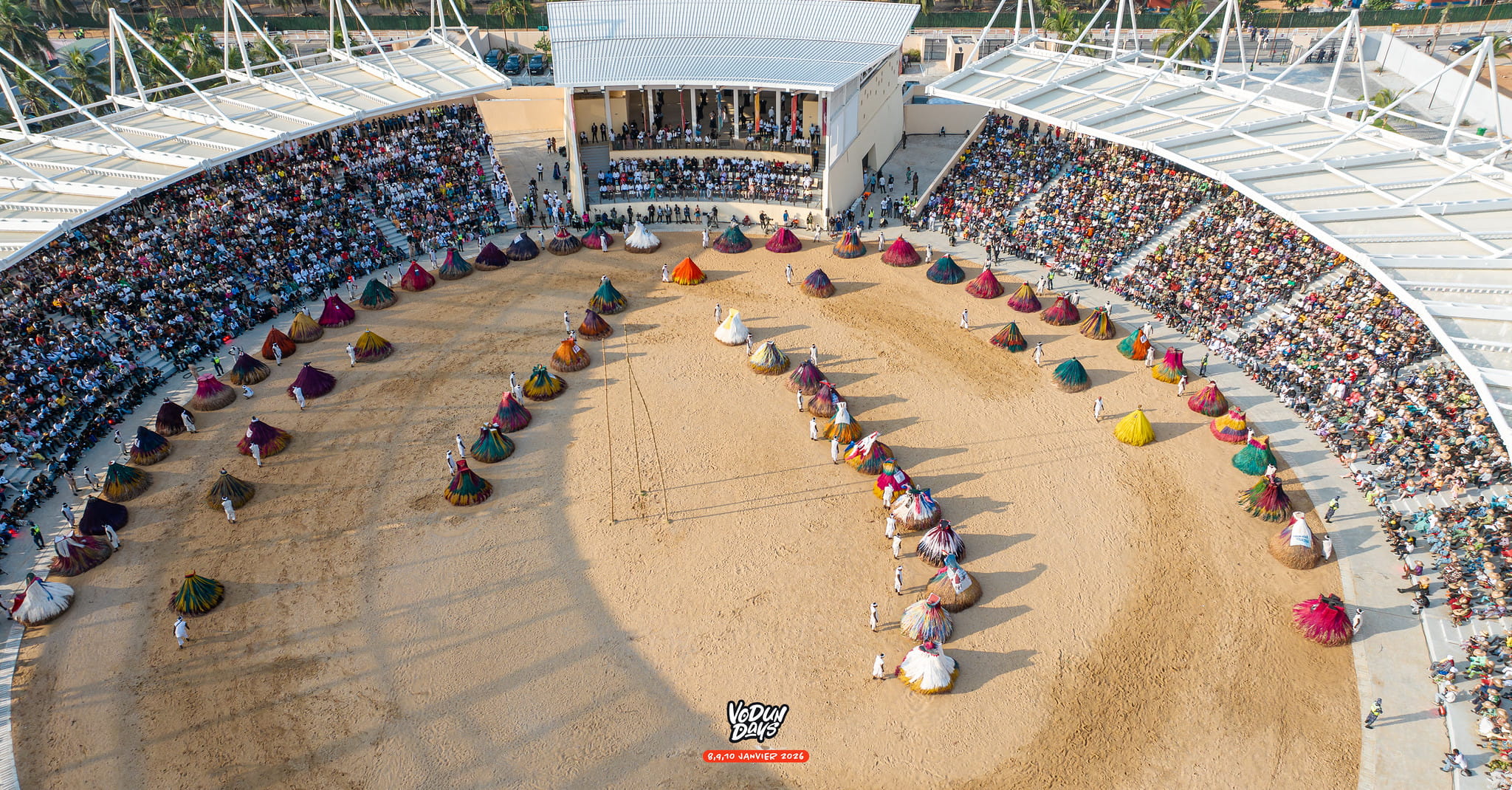
Since 2024, at the initiative of the Talon government and Benin Tourism Agency, the event has been profoundly restructured and renamed Vodun Days — an more international formula, designed to attract a global audience while maintaining spiritual grounding. The 2025 edition inaugurated the new Ouidah Arena on the beach, with 450,000 visitors expected and Brazil as guest of honour — a powerful symbolic choice that emphasised the link between Beninese Vodun and Brazilian Candomblé. The 2026 edition (8, 9 and 10 January) confirmed this growth, with artists such as Kassav', Toofan, Sagbohan Danialou, and the Balé Folclórico da Bahia — the Brazilian company that precisely embodies the return journey of Vodun culture from the Atlantic.
Vodun Days now take place every year on 8, 9 and 10 January. January 10th remains the key date — day of the great official ceremony, Benin's national holiday.
The Programme in Detail
The three days are structured around two distinct spaces: the historic heart of the city during the day, and the beach / Arena in the evening.
During the Day (8, 9 and 10 January)
Daytime activities unfold at several sites simultaneously, and this is where the experience is most authentic for those wanting to go beyond concerts:
Maro Square — one of Ouidah's great historic squares, a gathering place for the community for generations. Convent openings, ritual dances and divine processions take place here.
French Fort Esplanade — in front of the recently renovated fort, zangbétos (night guardians, represented by monumental costumes made of banana leaves) make their spectacular appearances. These figures are both protective spirits and guardians of community order.
Ninsouxwé Square — sacred space in the city's heart, site of Vodun ceremonies related to local divinities.
Kpassè Sacred Forest — the sacred forest is open to visitors during Vodun Days, with processions passing through it. This is one of the few times non-initiates can approach this normally reserved space.
Mami Convent (Mami Beach Temple) — place dedicated to the worship of Mami Wata, active throughout the festival, with ceremonies partially accessible to respectful visitors.
Vodun Days Village — festive space with craft stalls, food and entertainment. This is the most accessible and touristy part of the festival, designed to welcome everyone.
In the Evening (8, 9 and 10 January)
Evenings take place on the beach, facing the Atlantic, near the Gate of No Return:
Concerts at Ouidah Arena — opened in 2025, this new beach infrastructure hosts major concerts with Beninese and international artists. The 2026 edition programmed Kassav', whose Caribbean energy resonates directly with the links between Ouidah and the Caribbean.
Great Vodun Ceremony on January 10th — this is the most solemn moment. In the presence of high Vodun dignitaries — including Dagbo Hounon, supreme chief of the cult — and Beninese political authorities, the ceremony is held on the beach. Processions of devotees in ritual dress converge towards the sea. Offerings are laid down. Prayers are formulated for peace, for ancestors, for diasporas. It is a moment of high emotional intensity for those with a connection to these traditions.
Cultural Shows — representations of dance, traditional music, and during the 2026 edition, the Balé Folclórico da Bahia — a performance of capoeira, samba de roda and Brazilian ritual dances that physically embodies the return journey of Vodun to Africa.
Accommodation: Plan Early, Really Early
This is what catches first-time visitors by surprise: hotels in Ouidah and Cotonou are fully booked weeks before January 10th. If you plan to attend Vodun Days, reserve accommodation at least two months in advance, ideally three.
Option 1 — Stay in Ouidah (Recommended)
Staying on site avoids tiring back-and-forths with Cotonou, and gives you access to early morning ceremonies that start early. Ouidah options are limited but characterful.
The most well-known addresses: Casa del Papa, between sea and lagoon, offers water activities (canoe excursions, paddling, kayaking) and a relaxed atmosphere ideal for combining festival and rest. Book well in advance — it often fills up weeks before January 10th.
[BOOKING_LINK: hotels Ouidah Benin]
Option 2 — Vodun Days Camping
For the 2026 edition, the official Vodun Days campsite was installed in direct proximity to the Arena, the stage, Mami Temple and the beach. Two options:
- Bring your own tent : 7,000 CFA / night (approximately €10-11)
- Rent a tent on site with LED lighting : 20,000 CFA / night (approximately €30-32)
The space is 10 m² for two people. It's an immersive, authentic option, and far more economical than hotels. It is recommended for those wanting to live the festival in its entirety — awakened by the first drums in the morning, accessing ceremonies without transport.
Bookings on: boutique.vodundays.bj
Option 3 — Stay in Cotonou
Hotel options are much wider in Cotonou. Bernardin Gantin Airport is about 40 km from Ouidah (45 minutes to 1 hour drive depending on traffic). It's a realistic option if you arrive a few days before January 10th — you visit Cotonou, then head to Ouidah for the festivities.
[BOOKING_LINK: hotels Cotonou Benin]
Visa and Entry Formalities
Benin has a fully online e-visa system, fast and accessible.
Who Needs a Visa?
Citizens of ECOWAS (Benin, Burkina Faso, Côte d'Ivoire, Ghana, Mali, Niger, Nigeria, Senegal, Togo…) enter freely, without a visa. For other nationalities — French, Belgian, Swiss, Canadian, American, Haitian, Brazilian, Caribbean — an e-visa is required.
How to Get an E-Visa?
The application is made entirely on evisa.gouv.bj. The procedure takes less than 10 minutes. The official response time is 48 to 72 hours, but allow 5 days before departure for a safety margin.
Required documents: scan of passport ID page (valid for at least 6 months after your return), digital ID photo, address of accommodation on arrival in Benin.
Cost: approximately €50 to €104 depending on visa type (30 days single entry to 90 days multiple entries). The visa is valid for 90 days for most tourist types.
Mandatory Vaccine: A vaccination certificate with the yellow fever vaccine is mandatory for entry to Benin. Without it, you risk being turned away at the airport. Update it at least 10 days before departure (vaccine protection period).
Beware of Scams: The official website is evisa.gouv.bj. Be wary of third-party sites charging excessive fees for a procedure you can do yourself online.
How to Get to Ouidah from Cotonou
By car or rideshare : Ouidah is 40 km from Cotonou via the national road (via Abomey-Calavi). Expect 45 minutes to 1 hour depending on traffic. During Vodun Days, traffic is heavy on January 9 and 10 — leave early if coming during the day.
Via the Fishermen's Road : a longer but spectacular alternative — a coastal strip along the Atlantic for 30 km between Cotonou and Ouidah. More winding, but with scenery of coconut palms, lagoons and fishing villages worth the detour. Allow 1h30.
From the Airport : Cardinal Bernardin Gantin International Airport in Cotonou is about 40 km from Ouidah. Rideshare and taxis are available at the exit. It is recommended to agree on a price in advance or use a local rideshare service.
Local Transport : Zémidjans (motorcycle taxis) run through Ouidah for travel within the city. Always negotiate the price before boarding. Convenient for getting between sites during the festivities.
Codes of Conduct: What You Need to Know Before You Go
Vodun Days are a public festival, but it sits within a living spiritual context. Some basic rules allow you to experience it respectfully — and to be better received.
Clothing : dress simply and modestly. During ceremonies, avoid black (colour of mourning in many Vodun traditions during celebrations). White is welcome — many devotees wear it during processions. During the day, light clothing but covering shoulders and knees is appropriate near convents.
Photography : photography is free during street entertainment and concerts. But during ritual processions and convent openings, always ask before photographing. Some moments are sacred, some figures (like zangbétos during their trance emergence) should not be photographed from certain angles. If a guide or officiant asks you to put away your camera, comply without question.
Respectful Distance : during trance ceremonies or beach rituals, non-initiates are often kept at a distance by organisers. This is not exclusion — it is the protection of both parties. Stay at the distance you are indicated. You will see and feel much from a respectful distance.
Offerings : if invited to approach an altar or sacred space, a small offering is welcome — a few cola nuts, beads, coins, or imported perfume (Mami Wata appreciates products from elsewhere). Ask your guide what is appropriate for the Vodun involved.
Alcohol and Behaviour : during religious ceremonies, avoid consuming alcohol ostensibly. The evening celebration around the Arena is more festive and tolerant. Adapt your behaviour to the context.
Local Guides : for visitors without personal connections to Ouidah's Vodun communities, a local guide from these communities is invaluable. They will open doors, contextualise what you see, and help you avoid inadvertent mistakes. Our concierge service can recommend one.
For the Diaspora: What You Won't Find Anywhere Else
If you're Haitian, Brazilian, Martinique-based, Guadeloupe-based, Jamaican, African-American, or holder of any spiritual tradition inherited from the African Atlantic — Ouidah's Vodun Days offer you something no other event can.
You may have grown up with Haitian Vodou, Candomblé, Santería, Umbanda, Kimbwa. You know Lasirèn, Iemanjá, Yemayá, Ogoun, Shango. These names crossed the Atlantic from this coast. These divinities were transported in the holds of ships departing from the Gate of No Return, here, 3 kilometres from the Vodun Days stage.
Coming here is seeing their original form. Hearing songs in their original language — Fon, Yoruba. Seeing the colours, dances, drums as they were before the crossing. Understanding that what you carry as heritage was not invented in plantations. It came from here.
The Beninese government has made the connection with the diaspora a central axis of Vodun Days. In 2025, Brazil was guest of honour. In 2026, Balé Folclórico da Bahia — the company embodying the return journey of African culture from Bahia — was on stage. This is explicit dialogue between Ouidah and its diasporas.
Some diaspora visitors organise their stays around searching for their specific roots — trying to understand from which people, village, or tradition their ancestors came before deportation. Our concierge service can help you structure this type of roots-seeking journey.
Recommended Itinerary: 5 Days Around Vodun Days
To fully enjoy the event without living it in a sprint:
Day -2 (January 6) — Arrival in Cotonou Settlement, jet lag, discovery of Dantokpa market and lagoon edges. Dinner in a local maquis.
Day -1 (January 7) — Arrival in Ouidah Settlement in your accommodation. Stroll through the historic city: Portuguese Fort, Slave Route, Gate of No Return, Snake Temple. Visit the Brazil neighbourhood. Light dinner — the next days will be intense.
Day 1 (January 8) — First Day of Vodun Days Early wake-up. Square animations in the morning: Maro Square, French Fort Esplanade. Break at Vodun Days Village in the afternoon. Concert and shows in the evening at the Arena.
Day 2 (January 9) — Full Immersion Kpassè Sacred Forest in the morning — prime day for convent openings. Ninsouxwé Square in the afternoon. Giant concert in the evening.
Day 3 (January 10) — The Great Ceremony This is the central day. Wake up before dawn if possible. Great Vodun Ceremony on the beach with high dignitaries. Mami Wata ceremony. Last concert in the evening. Personal moment of reflection at the Gate of No Return.
Day +1 (January 11) — Decompression Visit MIME (International Museum of Memory and Slavery) if open. Lagoon walk. Return to Cotonou or flight home.
Bookings and Useful Contacts
Tickets and Vodun Days Camping : boutique.vodundays.bj Official Site : vodundays.bj Benin E-Visa : evisa.gouv.bj Cotonou Airport : Cardinal Bernardin Gantin International Airport
Recommended Accommodation: [BOOKING_LINK: hotels Ouidah] [BOOKING_LINK: hotels Cotonou]
Understand Vodun as living heritage
Vodun carries a rich history and culture. Discover our guidance on approaching sacred sites with context and respect.
Sources: vodundays.bj, gouv.bj, Mondafrique, Wa Africa Travel, Benin Tourism, Routard.
See also:
- Mami Wata in Ouidah: The Goddess of the Waters Who Crossed the Atlantic
- The Vodun Sanctuaries of Ouidah: Zô Houé and Mami Toligbé
- The Agoudas of Ouidah: When Brazil Returned to Africa
- Vodun Days 2027 in Ouidah: programme, tickets, camping, visa, accommodation, codes of conduct
- The complete guide for the diaspora and cultural travellers who want to truly experience the event