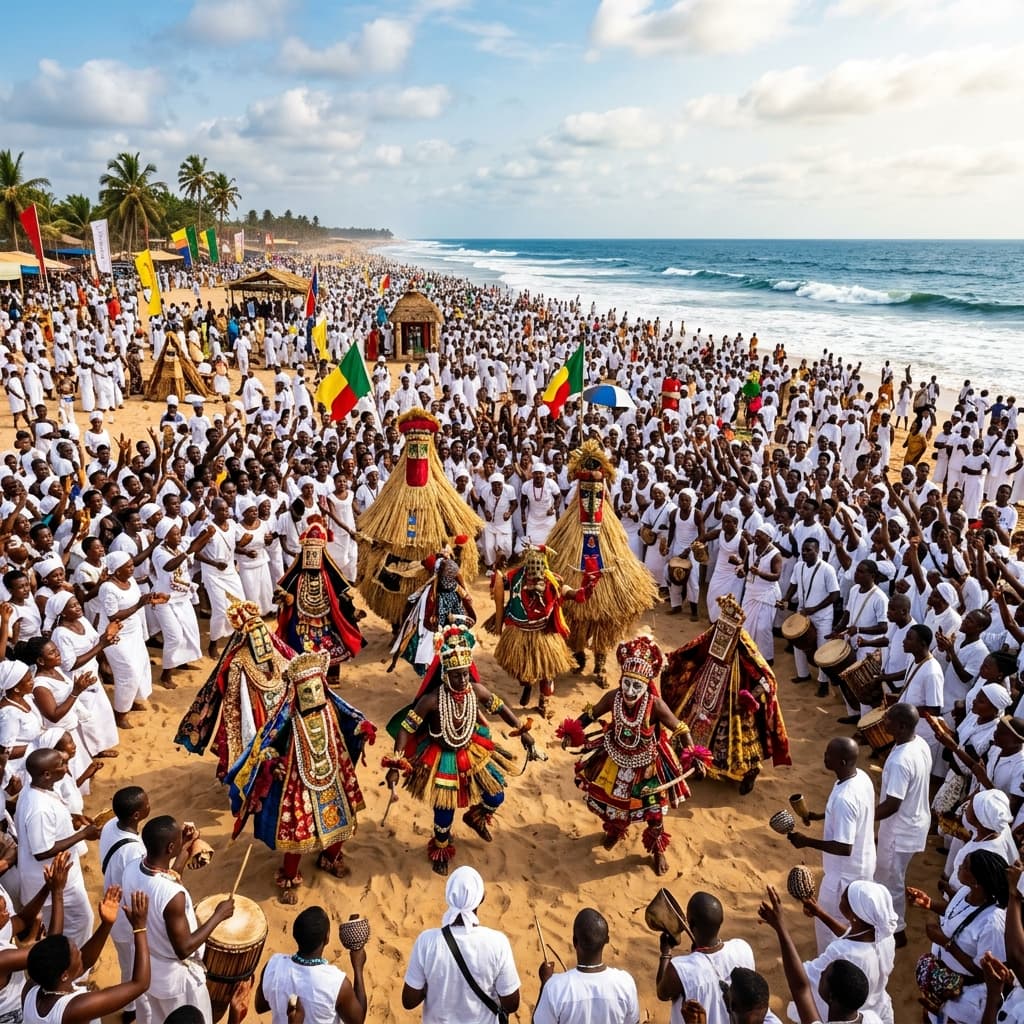
It is five o'clock in the morning on Ouidah beach. The Gate of No Return stands out in the night, a familiar silhouette facing the Atlantic. But this morning, the beach is not empty. Dozens of women in white cloth and red bead necklaces walk silently toward the waves. Some carry jars. Others hold branches of flowers. They advance to the water, then stop and sing.
They do not sing for tourists. They do not sing for cameras. They sing for Mami Wata — the queen of the waters, the greatest and most traveled of the Vodoun deities — who, according to tradition, lives in the depths of this sea that has absorbed everything: tears, the bodies of slaves thrown overboard, and the prayers of those who left never to return.
This scene is repeated every year in Ouidah. And behind it lies a story that spans five centuries, three continents, and 50 million followers.
Who is Mami Wata?
The name itself is an enigma. Some see in it English pidgin — mammy water, the mother of waters — from the colonial coasts where Europeans and Africans mingled and invented a common language to trade, sometimes to enslave. Others see purely African roots, in the Ewe and Fon languages of Benin and Togo. The origin of the name is disputed, but one thing is not: Mami Wata existed long before Europeans arrived on the Slave Coast.
In the Vodoun pantheon, Mami Wata is a deity of the waters — the sea, lagoons, rivers. But her domain does not stop at the liquid element. She governs wealth, beauty, fertility, and health. She is described by her followers as the mother of all deities, with absolute control over the balance of human life.
Her image is instantly recognizable: a woman of striking beauty, half-human, half-fish, holding a large serpent in her arms. She combs her hair before a mirror. She wears beads, perfumes, jewelry. Her sacred colors are red and white — red for power, white for purity and grace. Her devotees reproduce these colors in their clothing during ceremonies.
What makes Mami Wata unique in the African pantheon is her ability to integrate everything that comes from outside without losing her identity. She absorbed representations of European mermaids from ship prows. She incorporated images of Hindu goddesses brought by Indian merchants in the 19th century. She adopted contemporary objects as symbols of offerings — imported perfumes, sunglasses, Coca-Cola, watches. She is both deeply African and resolutely syncretic. A mirror of the history of the peoples who venerate her.
Ouidah: The Place She Set Out From
Mami Wata was not born in Ouidah. Her worship already existed along the entire West African coast — in Nigeria, Ghana, Cameroon, Congo — long before the city became a slave port. But it is from Ouidah that the deity set sail.
Between the 17th and 19th centuries, the city was the main embarkation port for the transatlantic slave trade. Hundreds of thousands of slaves captured in the inland kingdoms — Dahomey, Allada, Oyo — passed through Ouidah before crossing the Gate of No Return. They carried with them their beliefs, their songs, their deity names. Mami Wata was among this invisible baggage.
On the ships crossing the Atlantic, in the horror of the holds and the terror of the crossing, the captives invoked the spirits they knew. The sea that carried them was Mami Wata's domain. Some say that it was during these deadly crossings that she became even more powerful — transformed from a freshwater goddess into mistress of the ocean, consoler of the condemned, guardian of souls lost at sea. She guided the drowned to an invisible shore. She promised that something would survive.
When the slaves set foot in America, in Brazil, Saint-Domingue, Cuba, Louisiana, they reconstituted their practices as best they could. The names changed. The faces were disguised as Catholic saints to deceive the masters. But the deity remained.
Her Names Across the Atlantic
Today, Mami Wata lives under at least a dozen different names in the African Atlantic diaspora. Understanding these equivalences is to understand the extent of the spiritual journey that the enslaved accomplished despite themselves — and the extraordinary resilience of their traditions.
In Haiti, she is Lasirèn — the Mermaid — one of the most venerated lwa (spirits) in Haitian Vodou. Often merged with Erzulie Freda, the lwa of love and beauty, and with Simbi, the spirit of fresh waters. The ceremonies dedicated to her in Port-au-Prince, Cap-Haïtien, and rural Haiti echo directly the rites practiced on the beaches of Ouidah.
In Brazil, she is Iemanjá — also spelled Yemanjá, Yemoja — the queen of the sea in Candomblé and Umbanda. Every February 2, hundreds of thousands gather on the beaches of Salvador de Bahia, Rio de Janeiro, and São Paulo to offer her flowers, candles, perfumes. This celebration is now one of Brazil's largest popular festivals. Few who participate know that the goddess they honor began her journey on Ouidah beach.
In Cuba, in Santería, she is Yemayá — orisha of the sea, mother of the orishas, protector of fishermen and sailors. Her color is blue and white. She embodies absolute motherhood.
In Martinique and Guadeloupe, she is Manman Dlo or Maman de l'Eau — a figure halfway between Creole legend and spiritual belief.
In Suriname and Guyana, she is Watramama — the mother of water, venerated in Maroon communities descended from runaway slaves.
In Grenada, she is Mamadjo — a figure haunting the waters of the Caribbean.
All these deities share a common spiritual architecture: dangerous beauty, mastery of the waters, the ability to give and take away wealth, the link between the living and the ancestors. And all trace back, directly or indirectly, to the Slave Coast — to the villages and cities of present-day Benin from which those who carried them departed.
The January 10th Ceremony in Ouidah
January 10 is the National Vodoun Festival in Benin, instituted in 1992 after decades of prohibition under Kérékou's Marxist regime. On this day, the whole city of Ouidah is transformed. Processions cross the streets. Convents open their doors to public processions. Vodoun dignitaries parade in ceremonial dress. And on the beach, facing the Atlantic, Mami Wata's devotees hold their own ritual.
It begins before sunrise. The women — mostly, as Mami Wata worship is dominated by women, her mamissi or "wives of the deity" — first perform the purification walk through the city. They walk the streets singing hymns to the goddess, accompanied by drums whose rhythm calls the spirit. Then they converge on the sea.
On the beach, facing the waves, they lay their offerings: perfumes, flowers, fruit, alcohol, candles, but also — and this is a peculiarity of Mami Wata — imported objects, modern products symbolizing her fascination with all that comes from elsewhere. Beads are thrown into the water. Libations are poured. Prayers are spoken softly or sung collectively.
Then comes the moment of trance. The women in possession — it is said they are "ridden" by the deity — dance with a particular grace, eyes half-closed, movements undulating like water. It is Mami Wata speaking through them.
Non-initiates are kept at a respectful distance. What is said and taught in this worship is secret. But what is visible from the edges of the ceremony — the songs, the red and white colors, the processions, the obvious relationship between these women and the sea they face — says something essential about what Ouidah is: a place where the invisible is still very present.
Besides January 10, the annual Agbandotô pilgrimage — a great ceremony of offerings to Mami Wata — brings together devotees from all over Benin and the region on Ouidah beach. In March 2025, this event was led by supreme dignitary Hounnon Behumbeza, with representatives of the Beninese government present. Prayers were offered for peace, for the authorities, for the communities. A moment of vertical communion — between the living and the spirits — and horizontal — among all those who came from everywhere.
The Complex Face of Mami Wata
Mami Wata is not a simple deity. She is not the gentle mermaid of children's tales. She is powerful, demanding, and potentially dangerous for those who approach her lightly.
She is described as a deity of absolute fidelity. When she chooses a devotee — and it is often she who chooses, not the other way around — she demands total devotion. Some testimonies speak of men who met her in dreams or in the street, in the form of a woman of unreal beauty, and who made a pact: in exchange for wealth and success, they promised her fidelity. Breaking this pact is costly — illness, ruin, misfortune.
For the women devoted to her, the relationship is different. Mami Wata is protective, healing, a source of beauty and strength. She can save a family from illness, as testified by Noëllie Tohoundo, 32, who told AFP: "the queen of the waters saved them," speaking of her husband and children miraculously healed. "And it was after their recovery that the deity designated me as a devotee."
This relationship between Mami Wata and women — mostly her devotees — also carries a subversive dimension in patriarchal societies. Mami Wata is a figure of female power who submits to no male authority. Her priestesses hold spiritual authority that few men can contest. In some traditions, she is described as a free, modern woman who takes her destiny into her own hands. This is one reason why the worship has often been frowned upon by imported religions — Christianity and Islam — and by some political powers.
Why Ouidah is Her Home
Other coastal cities experienced the slave trade. Other beaches saw captives depart. But Ouidah has remained, in the Vodoun collective memory, the quintessential place of Mami Wata's presence. There are several reasons for this.
First, geography: Ouidah is a city built between the lagoon and the sea, between fresh and salt water. It is literally inhabited by Mami Wata everywhere — Lake Toho and its lagoons to the north, the Atlantic to the south. Waters are everywhere. Fishermen have always lived under the gaze of the goddess.
Then, history: the millions of souls who crossed the Gate of No Return left a spiritual imprint on this place. For devotees, Ouidah's sea is charged with these presences. It is where the dead disappeared. It is where the living come to honor them.
Finally, continuity: Mami Wata worship never ceased in Ouidah, even during the years of repression under the revolutionary regime (1975-1989). It adapted, sometimes hid, but survived. The convents dedicated to her — including Mami Toligbé, currently being rehabilitated — are living social and spiritual institutions, not museum relics.
The Diaspora Connection: Returning to the Source
For a Haitian, Brazilian, Martinican, or Guadeloupean visitor practicing a spiritual tradition inherited from African ancestors, coming to Ouidah beach on January 10 is an experience of rare intensity. It is seeing Lasirèn in her native land. It is hearing the songs their ancestors carried in the holds of ships. It is understanding that what they inherited was not invented in the plantations — that before, there was a country, a city, a beach, a community transmitting this knowledge.
The Beninese government has clearly understood this issue. The stated ambition is to make Ouidah the African counterpart of Ghana's Year of Return — a place of welcome and recognition for the African Atlantic diasporas. The rehabilitation of the Mami Toligbé convent, investments in Vodun Days ceremonies, and improved tourist infrastructure all say the same thing — you can return, and you will be welcomed.
Visiting, Understanding, Respecting
Mami Wata worship in Ouidah can be discovered at several levels depending on what you seek.
For a cultural and historical approach: Ouidah beach, the Gate of No Return, the Slave Route, and the surroundings of Vodoun convents provide context for this worship. A local guide trained in spiritual traditions can provide context without betraying the initiates' secrets.
To attend a public ceremony: January 10 is the key date. Mami Wata processions in the streets of Ouidah and on the beach are partially accessible to non-initiated visitors, provided they keep a respectful distance and do not photograph without permission. Vodun Days (January 8, 9, and 10 each year) offer a more structured setting for visitors.
For a deeper immersion: If you have a personal connection with Afro-descendant traditions — Haitian Vodou, Brazilian Candomblé, Cuban Santería — it is possible to arrange meetings with cult dignitaries in Ouidah. This requires time, respect, and often the intermediary of a trusted local contact.
Essential codes of conduct:
- Dress simply and modestly, preferably in white or light colors during ceremonies.
- Do not film dances or rites without asking.
- Bring a symbolic offering if received by priestesses — some beads, perfumes, or simply kola nuts are welcome.
- Respect the rule of secrecy: what you see inside a convent belongs to that convent.
Practical information:
- Ouidah is 40 km from Cotonou. Allow 45 minutes to 1 hour by car.
- The ideal season for a visit: October to March (outside the rainy season).
- The most accessible ceremonies: Vodun Days (January 10), Agbandotô (March).
- Recommended accommodations in Ouidah: [BOOKING_LINK: Ouidah hotels]
→ See also: [Complete Guide to Vodun Days 2026 in Ouidah] → See also: [Zô Houé and Mami Toligbé: The Two Sacred Convents of Ouidah] → See also: [The Slave Route: Complete 7-Step Guide]
Mami Wata is Still Here
It would be easy to reduce Mami Wata to a folkloric phenomenon, an exotic deity among others. That would completely miss what she represents.
She is proof that African traditions were not annihilated by the slave trade. That they crossed the Atlantic in other forms, in other languages, with other faces, but intact at their core. That the 50 million people who venerate her today — from Port-au-Prince to Salvador de Bahia, from Lagos to Paris — share a common heritage of which Ouidah is one of the sources.
Every January 10, when women in red and white walk toward the sea on Ouidah beach, they do more than pray. They keep alive a spiritual thread that connects continents and centuries. They remind us that something survived — that what was taken on the ships did not disappear, it just changed shores.
Coming to Ouidah to see this is to touch something real.
Preparing Your Spiritual Visit to Ouidah
Our concierge team can assist you for a respectful and profound experience around Vodoun worship in Ouidah: connecting you with local guides from spiritual communities, organizing visits during Vodun Days, personalized itineraries for the diaspora.
→ [Contact Ouidah Origins Concierge]
Accommodations in Ouidah: [BOOKING_LINK: Ouidah hotels]
Article written by the Ouidah Origins team. Sources: AFP / France Info, Le Matinal Bénin (March 2025), Liberté Algérie, VOA Afrique, Nofi Media, Mythologica, Beeso, Wikipedia.
Experience History
Beyond words, Ouidah is a physical experience. Contact us to organize a private immersion behind the scenes of our chronicles.