In Ouidah, everything eventually returns to the sea.
You can begin in the red-soil lanes of the historic center, walk the renewed Slave Route, pause at the new Gate of No Return, and think the story ends when you reach the Atlantic. But the coast does not close anything. It opens. It calls. It remembers.
On this shoreline, the sea is not just a dividing line between Africa and the Americas. It is a witness. It saw captives leave, descendants return, fishermen settle, bulldozers advance, and ceremonies rise again. Within that shifting memory, Mami Wata holds a central place.
The sea as archive
Visitors instinctively look toward the horizon. Locals also watch the sand, the tides, the color of the water, and the way the wind moves dust inland. Ouidah's coastline is a living archive.
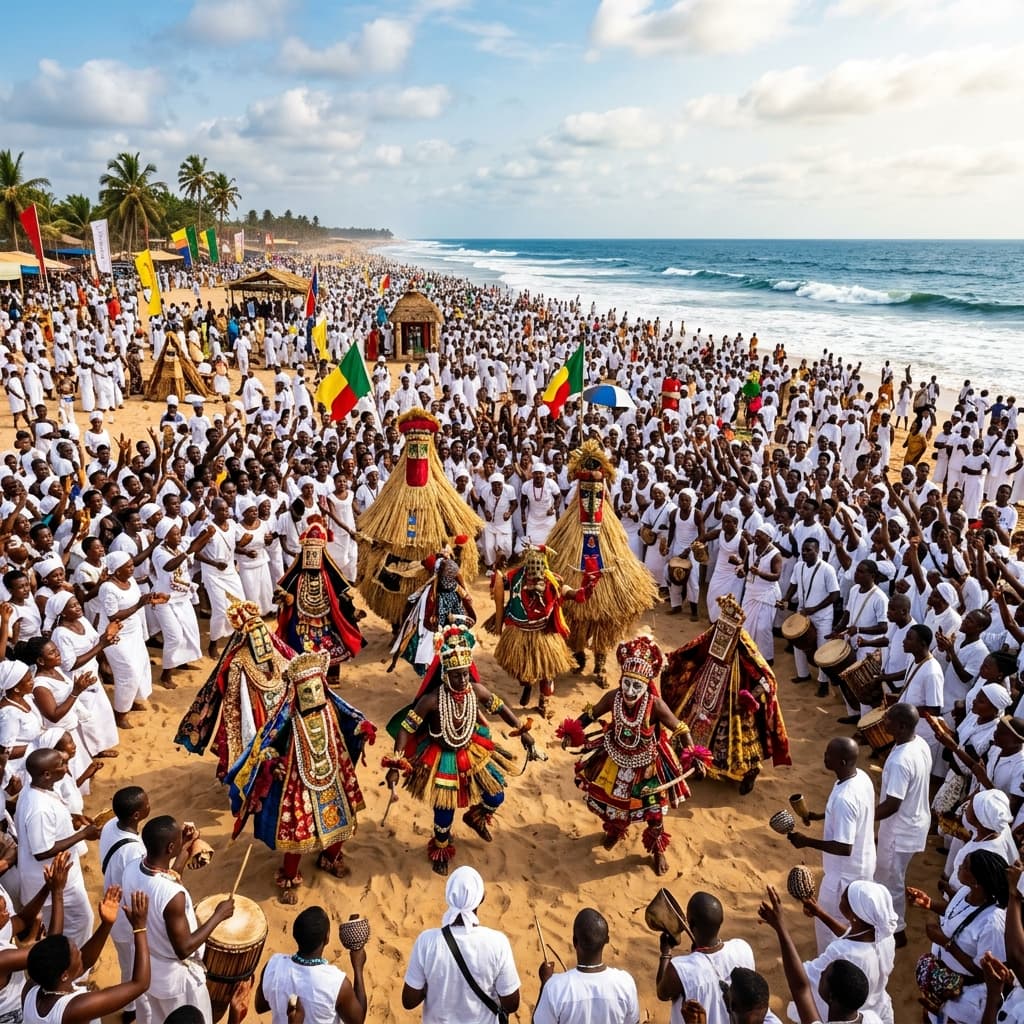
Every storm reshapes the shore. Every development project redraws daily use. Every ritual procession reaffirms that the sacred never left the beach. That is why Avlekete, often described as a simple seaside area, is in fact a spiritual territory. The crowds that gather there during the Vodun Days 2026 are not only there for a show. They are listening to what the sea has kept.
Mami Wata, a figure of depth
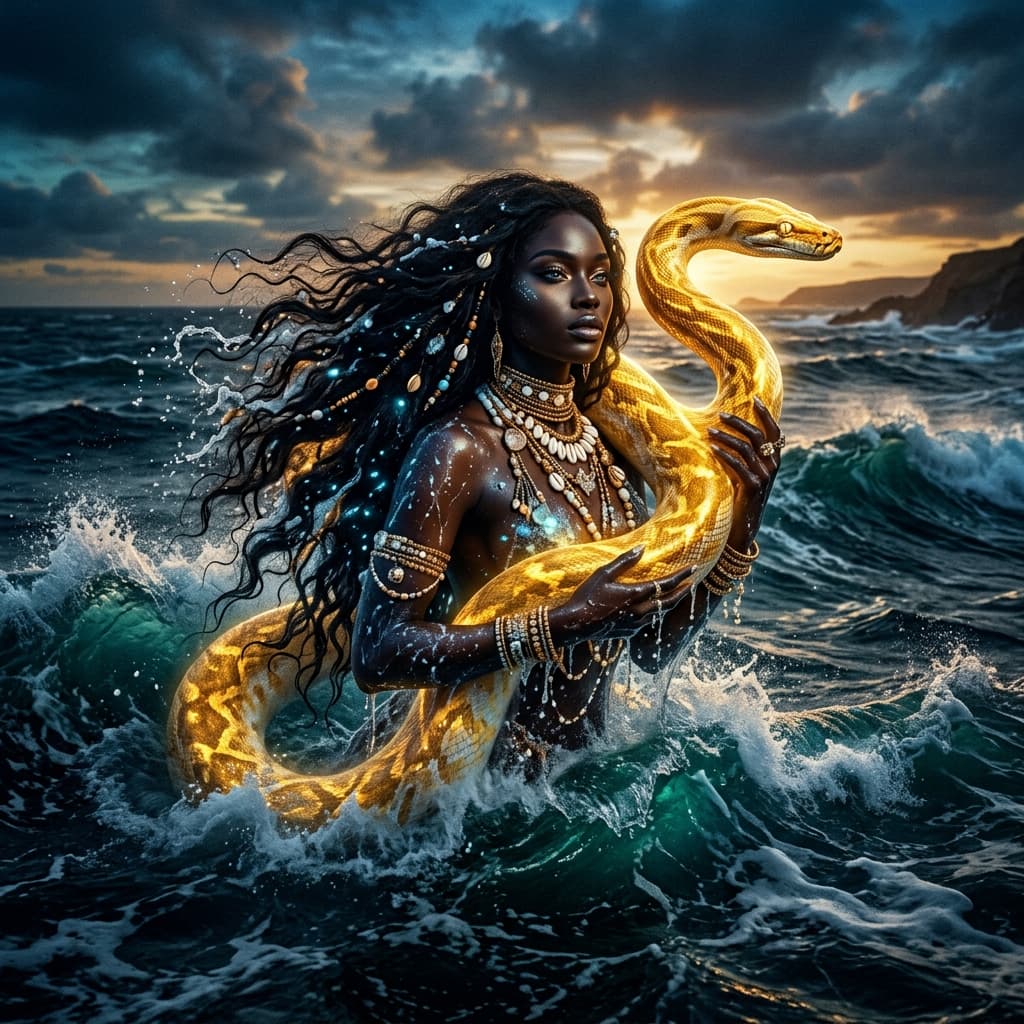
Mami Wata is too often reduced to a seductive image of aquatic femininity. In Ouidah, that reading is too small. She is guardian, mediator, a force of abundance, but also of demands. She reminds people that water nourishes and takes.
In local narratives, Mami Wata belongs to a world where wealth is never separated from respect. People do not only ask her for favors; they owe her gestures, restrictions, and ethics. That matters in Ouidah, where Atlantic memory requires special attention to departure, return, and crossing.
"The sea never forgives amnesia. It always returns what was entrusted to it." — Shoreline keeper, Avlekete
Avlekete between ritual and change
Recent changes along the coast have unsettled local imagination. What some read as investment, others read as a fragile balancing act. That is the case around Avlekete, which has become a meeting point of tourism, liturgy, and economy.
The tension is not new. Ouidah has long lived in-between: how do you welcome without desecrating, modernize without flattening, bring the world in without erasing the voices that were already here? The community's answer is not rejection. It is a demand for depth.
Avlekete's sand is not empty land to be exploited. It is inhabited ground. Every ceremony, offering, and song reminds us that the coast does not belong only to cadastral maps; it belongs to stories.
Return is not only memory
For the diaspora, Ouidah's sea is often the first physical encounter with a history long read in books. But return is not just a memorial gesture. It is a process of re-tuning.
Many visitors arrive looking for ancestors. They leave understanding that return can also be spatial, spiritual, and linguistic. A city like Ouidah does not offer simple answers. It offers thresholds. It teaches you to stand for a long time before the same line of water until you hear what the archives do not say.
What the coast forces us to see
The projects underway along the shoreline should not be read only as tourism upgrades. They are cultural decisions. Material choices, the distance left to the waterline, the protection of ritual sites, the signage: all of it forms a language.
When that language is right, the coastline becomes a space where memory, economy, and spirituality coexist. When it is not, it turns into a facade.
The real question is therefore not whether Ouidah should evolve. It is how the city can keep speaking to the world without losing the grammar of its waters.
To continue the thread, read our piece on Avlekete's sacred beach and our analysis of the Vodun Days 2026.
Restitution 2.0
Ouidah Origins is more than a travel resource; it is an infrastructure for memory. Read our manifesto on why we believe the Slave Route is not a tourist attraction.
Read the ManifestoExperience History
Beyond words, Ouidah is a physical experience. Contact us to organize a private immersion behind the scenes of our chronicles.