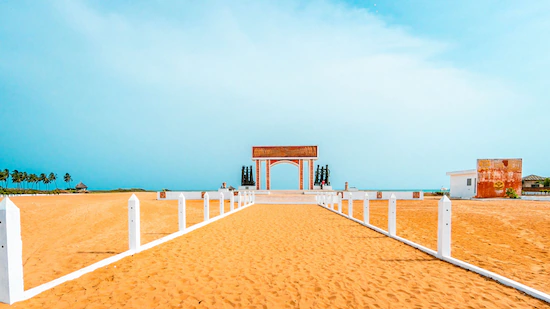
For thirty years, the arch inaugurated in 1995 marked the entrance to Ouidah's beach — the last point of solid ground for millions of captives torn from Africa. A sober monument, heavy with history, but built to human scale. Today, it has been replaced by something of an entirely different dimension.
In December 2025, a new Door of No Return was officially unveiled to the public. Seven stories tall. A vertical, monolithic structure overlooking the Slave Route and the Atlantic Ocean — visible from afar, impossible to ignore.
A Will to Inscribe Memory in Space
The choice of height is deliberate. It carries a clear intention: that this monument should not be discreet. That the violence of deportation, the irreversibility of departure, the pain of a continent — all of this should be written into the very verticality of the structure.
Positioned along the original axis of the Slave Route, between the city centre's auction square and the coastline, the new Door stands as the focal point of the entire memorial journey. It is now one of the most imposing memorial monuments on the West African coast.
Design: Power and Restraint
The vertical structure is not merely a technical achievement. It houses exhibition spaces and observation platforms offering unobstructed views over the ocean — a physical reminder of the immensity of the crossing that millions of captives were forced to make. This monument is the centrepiece of the Ouidah 2027 plan, the strategic vision reshaping the entire historic city.
The End of an Arch, the Beginning of a Symbol
The old Door, dismantled in December 2025, was born from a UNESCO project. It was a symbol of an era when the restoration of the memory of the transatlantic slave trade was still finding its form. Thirty years later, Benin has decided to assert this memory differently — higher, louder, more visible.
This shift in scale also reflects a deep transformation in the country's relationship to its own past. Benin is no longer content to merely commemorate: it is turning memory into architectural ambition, into a territorial marker, into a magnet for visitors.
Ouidah, Laboratory of World Memory
The new Door is part of a series of projects transforming the historic city of Ouidah: redesigned roads, landscaped pavements, rehabilitation of heritage buildings. A city reinventing itself while remaining true to the history that shaped it.
For visitors from the African and Afro-descendant diaspora, this monument carries a particular resonance. It literally transforms Ouidah's beach — already the end of the Slave Route and a sacred site of Mami Wata — into a space charged with unparalleled symbolic power. The site is now digitally connected to the future International Museum of Memory and Slavery (MIME).
The Challenge of Erosion
Building a monument of this scale on an erosion-threatened coastline required unprecedented coastal protection works. The episode of the original arch — periodically menaced by rising waters — had already served as a lesson. The long-term survival of this heritage is at the heart of ongoing work on digital preservation that ensures Ouidah's memory endures beyond what stone and steel alone can guarantee.
The Door of No Return has become, for many, a Door of Return.
Explore the Slave Route and the Door of No Return in our Pillars section.
Practical Travel Advice for Ouidah
When planning your visit to the historical and Vodun sites of Ouidah, it is essential to keep a few practical considerations in mind. The city is best explored with a local certified guide who can provide accurate historical context and help you navigate the delicate customs surrounding active shrines and sacred spaces. Always ask for permission before taking photographs of individuals, shrines, or during public rituals. Respecting the local communities and their living traditions ensures a mutually beneficial experience. Additionally, wearing light clothing and carrying sufficient bottled water will keep you comfortable during your walking tours along the Route of the Slaves and around the historic quarters. For currency, while the West African CFA franc (XOF) is the local currency, carrying small denominations is highly recommended for purchases at local artisanal markets and when tipping local guides.
- Unveiled in December 2025, the new Door of No Return rises seven stories above the Atlantic
- It replaces the 1995 arch and sets a new scale for the duty of memory