To understand Ouidah, you have to understand the Kingdom of Dahomey.
You will walk the Slave Route in Ouidah. You will pass the Portuguese Fort. You will stop at the Gate of No Return, facing the Atlantic. And if you continue inland, you will see the palaces of Abomey, listed as a UNESCO World Heritage Site.
Everything you see has a history. A long, complex, often painful, sometimes grand history. And it does not begin with Europeans. It begins on the Abomey plateau in the seventeenth century, when the Fon founded one of the most powerful and sophisticated states in West Africa.
That state was the Kingdom of Dahomey. It ruled for nearly three centuries over what is now southern Benin. It played a central role in the Atlantic slave trade. It resisted French colonization fiercely. And it left behind a culture, a political organization, and spiritual traditions that still live in the streets of Ouidah today.
Understanding Dahomey is how you understand why Ouidah is what it is.
Origins: legend and history
It all starts in Tado, a town now in Togo on the banks of the Mono River and the mythical birthplace of the Fon, Ewe, and Aja peoples. Oral tradition says the daughter of Tado's king was impregnated by a leopard while drawing water. The son born from that legendary union became the founder of the Dahomean dynasty.
Myth or not, the story matters: Dahomey's kings claimed a supernatural origin, half human and half animal. That sacred dimension of royal power was central to the state's organization. The king was not only a military or political leader — he was a singular being, linked to ancestors and vodun forces.
In the sixteenth century, groups from Tado migrated east and settled around Allada. From there, three brothers disputed power and founded three distinct kingdoms: Allada, Hogbonou, and Abomey.
Abomey became the nucleus of future Dahomey.
Houegbadja: the founder
Do-Aklin's grandson, Houegbadja (r. c. 1645-1685), is universally recognized as the true founder of the Kingdom of Dahomey. He turned a cluster of villages into a coherent state with institutions, laws, and royal ideology.
Under his reign, capital punishment became the king's exclusive prerogative. He built the first palaces of Abomey and enclosed the capital, giving the city its name: Agbome, meaning "in the enclosure" in Fon. He established the tax system, created the Great Customs ceremonies, and appointed ministers, giving shape to royal government.
It was also under Houegbadja that the first gbeto appeared — female elephant hunters who brought meat and ivory to the king. They were direct ancestors of the celebrated Agojie, the Dahomey Amazons.
Houegbadja remains so central in Fon memory that he is still invoked at the end of prayers and ceremonies.
Agaja the conqueror: Ouidah enters Dahomean history
Houegbadja's grandson Agaja (r. c. 1708-1740) transformed the regional balance — and brought Ouidah into the kingdom's story.
In 1724, he conquered Allada. Then in 1727, he subdued Savi, the Xwéda kingdom whose coastal capital was Ouidah. From that moment, Ouidah, previously an independent city with its own spiritual traditions, came under Dahomean authority.
That conquest was decisive. By taking Ouidah, Dahomey gained direct access to the Atlantic and to European trade. The Portuguese, English, and French forts on the coast became commercial partners of the new ruler of the land. And that commerce took a particularly brutal form: the slave trade.
Agaja was also constantly at war with the Oyo Empire to the east, which kept pressure on Dahomey. His royal emblem was a European sailing ship — a symbol of his conquest of the coast and his opening to maritime trade.
The slave trade economy: how Ouidah became West Africa's largest slave port
Between the eighteenth and nineteenth centuries, Dahomey built its prosperity on a system of systematic violence: the capture, sale, and export of human beings.
The mechanism was precise. The king sent armies on raids against neighboring kingdoms and villages. Captives were brought to Abomey, sorted, and some were integrated into the army or royal plantations. Others were taken to Ouidah, gathered in enclosures, inspected, sold to European slavers, and loaded onto ships bound for the Americas, Brazil, and the Caribbean.
Under Tegbessou (r. 1732-1774), Dahomey sold more than 9,000 enslaved people each year. At that time, the king's revenues were estimated to be four to five times those of the richest landowners in England. The kingdom was one of the chief suppliers of the Atlantic slave trade.
From that era come Ouidah's Slave Route, the Zomaï House, and the Gate of No Return.
Ghézo: the kingdom at its height
Ghézo (1818-1858) marks the peak of the Kingdom of Dahomey.
He came to power through a coup, overthrowing his brother Adandozan with decisive help from the Brazilian slave trader Francisco Félix de Souza, known as Chacha. Their pact transformed Ouidah: De Souza became the kingdom's commercial representative and organized the trade on an industrial scale.
Militarily, Ghézo freed Dahomey from Oyo vassalage. In 1823 he defeated Oyo in open battle, an unprecedented achievement. Dahomey stopped paying the humiliating tribute it had owed for decades and became fully sovereign.
It was also under Ghézo that the Agojie reached their full power. He made them a permanent elite corps, armed them with modern rifles, and trained them in advanced military tactics. They became his personal guard, his first-line shock troops, and a symbol of Dahomean power.
By the 1850s, international pressure against the Atlantic slave trade was growing. The British imposed a naval blockade on the Dahomean coast in 1851 and 1852. Ghézo was forced to adapt the economy and expand palm oil production. The transition was painful; slavery had been far more profitable.
Decline and resistance: Béhanzin against France
After Ghézo, Glélé and then Béhanzin inherited a kingdom under mounting pressure.
France expanded its influence along the coast, and Dahomey was gradually encircled.
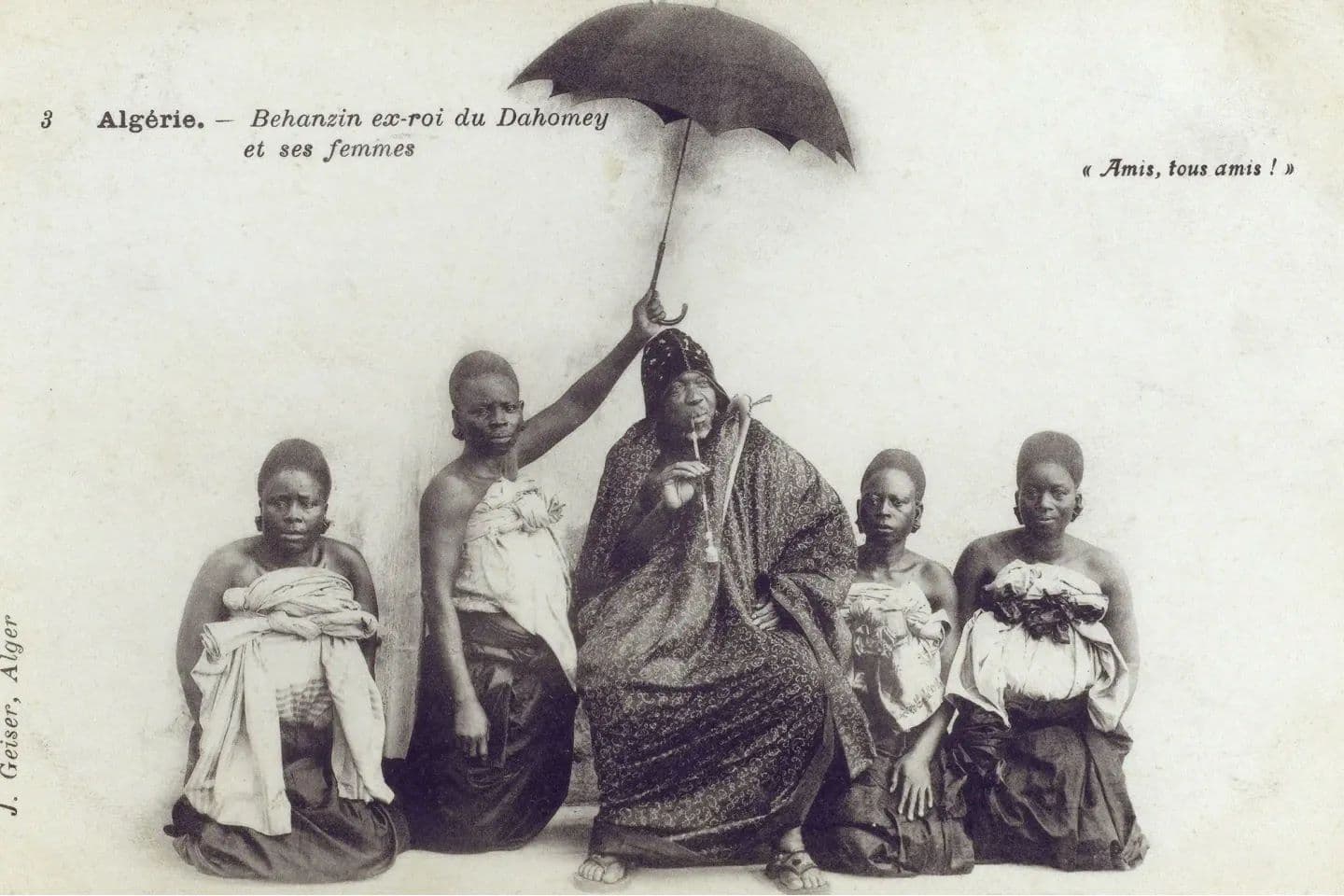
Béhanzin took the throne in 1889. From the start, he refused to recognize the territorial concessions made to the French. He insisted that Cotonou and Porto-Novo belonged to Dahomey. His stance was clear: Dahomey was sovereign.
War broke out in 1890. The first battles were fierce, and Dahomean forces inflicted serious losses on French columns. Béhanzin obtained modern weapons through German traders. He resisted.
The second Dahomean war began in the summer of 1892. France sent an expedition under General Alfred-Amédée Dodds. The battles were intense. The Agojie fought at the front with a discipline and courage that stunned French soldiers.
Despite the resistance, French technological superiority prevailed. In November 1892, the French marched on Abomey. Béhanzin ordered his own palace burned rather than let it fall intact to the invaders. After two years on the run, he surrendered on January 15, 1894.
What followed was a betrayal. Béhanzin thought he was surrendering to negotiate in Paris. He was put on a ship instead. Destination: the Caribbean island of Martinique, not France. He lived there for eleven years, then was transferred to Algeria. He died in Blida on December 10, 1906, far from his kingdom and never allowed to see Abomey again.
His remains were repatriated in 1928. He was officially rehabilitated as a national hero in 1976.
A plundered legacy — and a partial return
The French conquest of Dahomey included the systematic looting of the royal treasures of Abomey. General Dodds seized Béhanzin's throne and dozens of royal objects, which were sent to France and kept there for more than a century.
On October 27, 2021, France officially returned 26 royal works to the Republic of Benin. It was one of the first major restitutions of African art objects looted by a former colonial power.
Those works are now displayed at the Béhanzin Museum in Cotonou and the Royal Palaces Museum of Abomey. Seeing them with their history in mind is to see more than museum pieces: it is to see the remains of a sovereign state that resisted to the end.
What this means for your visit to Ouidah
Ouidah cannot be separated from Dahomey. Every site in the city carries a layer of that history.
The Slave Route is not only a memory of the trade — it is the path Ghézo's armies forced captives to walk on their way to sale.
The Auction Square / Place Chacha is where Francisco Félix de Souza organized sales under Dahomean royal authority.
The Portuguese Fort is one of the European installations Agaja encountered after conquering Ouidah in 1727.
The Gate of No Return marks the point where hundreds of thousands of people embarked to never return.
The Sacred Forest of Kpassè and the Temple of Pythons are legacies of Xwéda culture — the people Dahomey conquered in 1727.
Understanding all of this does not make the visit sadder. It makes it more honest.
Visiting sites linked to the Kingdom of Dahomey
In Ouidah: the Slave Route, the Gate of No Return, the Portuguese Fort, the MIME, and the Auction Square.
In Abomey: the Royal Palaces Museum is essential for understanding Dahomean civilization in depth.
In Cotonou: the Béhanzin Museum displays the 26 works returned by France in 2021.
For more context, read our pieces on the Agojie and Dahomean power, our practical Vodun Days guide, and our portrait of the Dagbo Hounon.
The history of the Kingdom of Dahomey is not a comfortable story, but it is a necessary one. It is the story of a state that tried to navigate a changing and dangerous world on its own terms, leaving a legacy that still defines the country today.
Restitution 2.0
Ouidah Origins is more than a travel resource; it is an infrastructure for memory. Read our manifesto on why we believe the Slave Route is not a tourist attraction.
Read the Manifesto- Dahomey emerged from a Fon political tradition rooted in Tado and consolidated at Abomey.
- The conquest of Ouidah in 1727 gave the kingdom direct access to the Atlantic and the slave trade.
- The Agojie embodied Dahomey's military and symbolic power for generations.
- Béhanzin's resistance to France remains one of the high points of Beninese political history.