The history of Ouidah is told, most often, through its kings, its slave traders, and its monuments.
The women are there, in every part of the story. They are just not always named.
This is their chapter.
The merchants of the historic market
The Ouidah market — one of the oldest continuously operating markets on the West African coast — has been run by women for centuries.
This is not a contemporary development or a post-independence policy. It is the organic result of the specific economic organization of the Fon people, in which women held primary responsibility for trade and commerce while men held primary responsibility for agriculture and military activity. The distinction was not a hierarchy — it was a division of labor that gave women substantial economic power and social authority.
The women of the market were not simply sellers. They were economic brokers — controlling the flow of goods between producers and consumers, setting prices, managing credit, maintaining the commercial relationships that held the market economy together. In the colonial period, French administrators consistently underestimated the economic power of market women, treating them as informal traders rather than recognizing the sophisticated commercial system they operated.
Their descendants are still there. The Ouidah market today is still primarily run by women. The stalls selling spices, ritual objects, textiles, and food are staffed by women who learned the trade from their mothers, who learned from theirs. The specific combination of goods — the Vodun ritual items alongside the everyday foodstuffs — reflects the same integrated understanding of the sacred and the commercial that has characterized this market for centuries.
The Vodun priestesses
The Vodun religious system grants women significant spiritual authority.
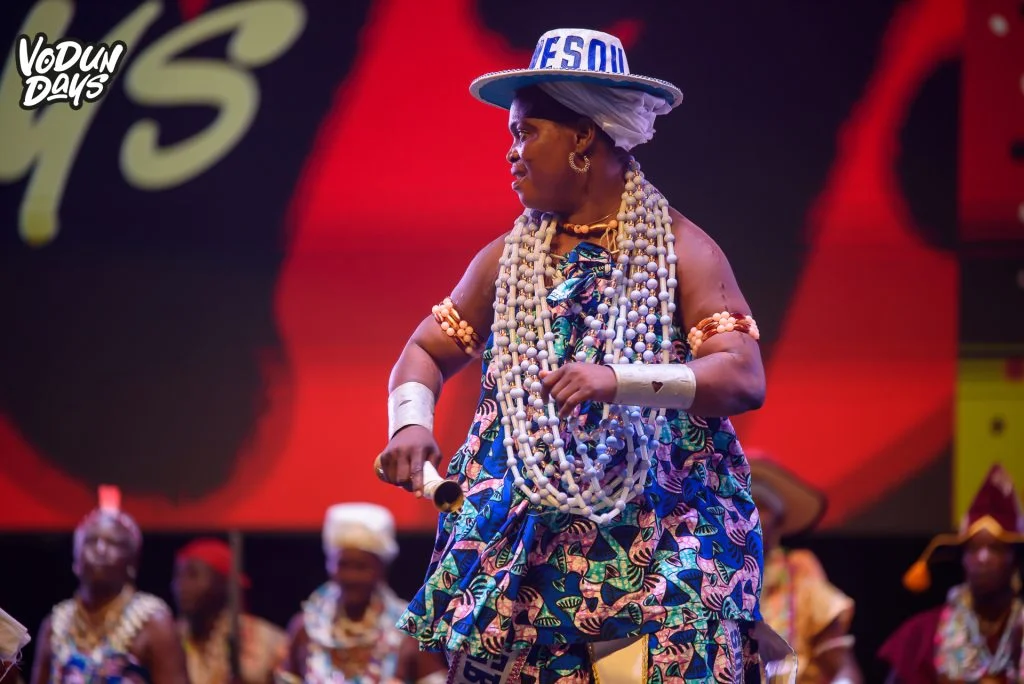
Female Vodun priests — Vodunssi or Mambo in the Haitian tradition, which maintains the same fundamental structure — are initiated through the convent system and may reach the highest levels of religious authority within their tradition. The female head of a Vodun convent holds a position of considerable community power: she mediates between the living and the divine, manages the initiation of new devotees, and maintains the ritual knowledge of her lineage.
In Ouidah's convents today, women serve as priestesses across multiple Vodun traditions. The Mami Wata tradition — the water deity associated with healing, prosperity, and the ocean — is particularly associated with female spiritual authority. Mami Wata's devotees are predominantly women, and her priestesses hold significant status in the communities where she is worshipped.
The connection between the women merchants of the market and the women priestesses of the convents is not coincidental. Both represent domains in which Fon women have exercised authority continuously for generations, regardless of the political regimes — the Kingdom of Dahomey, French colonialism, post-independence governments — that have come and gone around them.
The Agojie: the woman warriors
The Agojie are the element of Ouidah's women's history that has received the most recent international attention — partly through the 2022 film The Woman King, which brought their story to a global audience.
The Agojie were the female military corps of the Kingdom of Dahomey. They were not a symbolic unit or a ceremonial guard. They were a fully trained, fully deployed combat force that participated in the Dahomey military campaigns of the eighteenth and nineteenth centuries. At their peak, they numbered in the thousands and constituted a significant portion of the Dahomey military's total strength.
Their training was rigorous. Their discipline was renowned, including among the European observers who encountered them during the French colonial campaigns of the 1890s. Colonel Alfred Dodds, who led the French expeditionary force that ultimately defeated Dahomey in 1894, recorded his respect for their military capability.
The Agojie are today commemorated in the Museum of the Epic of the Amazons and Kings of Dahomey in Abomey — the museum being developed to house the returned royal treasures. Their history is also embedded in the streetscape of Cotonou, where a thirty-meter statue of an Agojie warrior stands at the central roundabout as one of the defining landmarks of the city.
The continuity
What connects the market women, the Vodun priestesses, and the Agojie is not simply that they are all women in a city with a complex history.
It is that all three represent forms of authority and agency that have persisted across discontinuity — across the slave trade, across colonialism, across independence, across development pressure.
The market women of Ouidah did not lose their economic position during the French colonial period. The Vodun priestesses maintained their spiritual authority through two centuries of Christian missionary activity. The memory of the Agojie survived the military defeat of 1894 and the long colonial suppression of Dahomey's history.
In a city where so much was lost, taken, or suppressed, this continuity matters. It suggests something about the specific forms of power that are most resilient — not the monumental, not the official, not the state-sanctioned, but the practiced, the inherited, the communal.
For the diaspora visitor to Ouidah — particularly for women of the diaspora — this history is not background. It is part of what this place has to offer: evidence that the women who were part of the culture that was disrupted by the slave trade were not only victims of that disruption but bearers of the traditions that survived it.
Restitution 2.0
Ouidah Origins is more than a travel resource; it is an infrastructure for memory. Read our manifesto on why we believe the Slave Route is not a tourist attraction.
Read the Manifesto- The women of Ouidah have always been at the center of power — as merchants in the historic market, as Vodun priestesses, as the Agojie warriors of the Dahomey kingdom
- Here's their story