

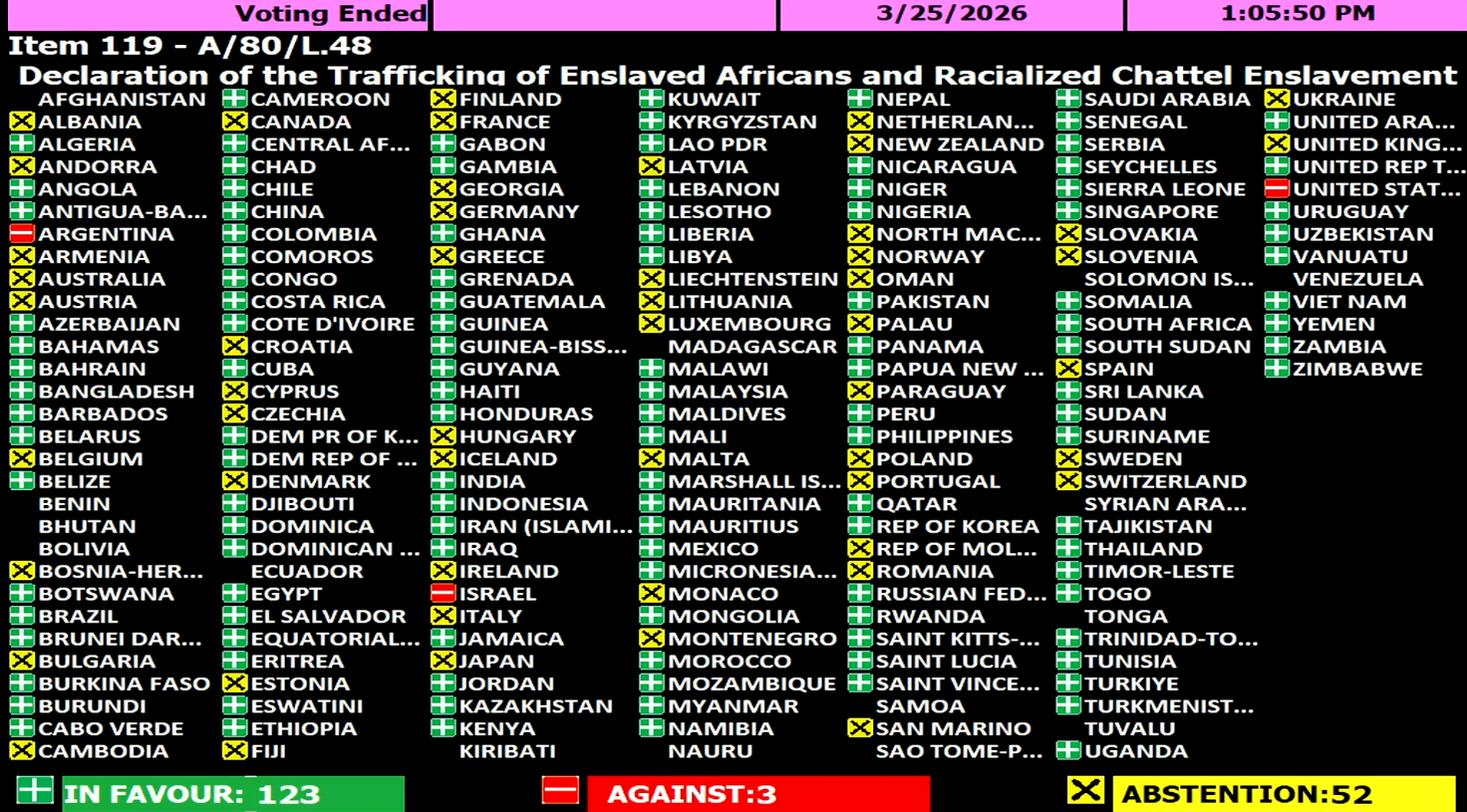
On the morning of 25 March 2026, in the General Assembly Hall of the United Nations in New York, 123 countries raised their hands.
They were voting on Resolution A/80/L.48 — a text declaring the transatlantic trafficking of enslaved Africans and the system of racialized chattel slavery that followed to be "the gravest crime against humanity." A resolution that had been in preparation for months, co-sponsored by 54 African states, championed by Ghana's President John Dramani Mahama, and supported by the African Union and the Caribbean Community. A resolution that represented the culmination of twenty-five years of diplomatic struggle, failed conferences, walkouts, vetoes, and language compromises so carefully worded they had drained the meaning from the very thing they were trying to say.
Three countries voted against: the United States, Israel, and Argentina.
Fifty-two abstained: the entire European Union bloc, the United Kingdom, Canada, Australia, Japan.
And one country that had put its name on the resolution since 17 March — one of the 54 co-sponsors, one of the countries whose history is most directly inscribed in what the resolution was naming — was simply not there.
Benin's seat was empty.
The door that opens onto the Atlantic from the beach at Djègbadji, four kilometres from the historic centre of this city, is called the Door of No Return. It is called that because the people who passed through it never came back. They were loaded onto ships, crossed the ocean, and were sold. Their descendants are the people for whom this resolution was written — the tens of millions of Afro-Americans, Afro-Brazilians, Afro-Caribbeans, Afro-Europeans who carry, in their bodies and their spiritual practices and their surnames, the consequence of what happened on this shore.
The door was here. The resolution named what happened at this door. And Benin — the country that has built its entire diplomatic and cultural identity around the memory of this door — was absent from the moment of naming.
This article is about what happened. About the twenty-five years that led to that vote. About why Benin's absence matters beyond the administrative explanation that was offered. And about what it tells us about the gap between memorial ambition and memorial accountability.
I. Durban, 2001: The Conference That Almost Said It
The story does not begin in 2026. It begins in Durban, South Africa, in September 2001.
The World Conference Against Racism was the United Nations' most ambitious attempt to address the legacies of slavery, colonialism, and racial discrimination in a single binding international framework. One hundred and sixty-three countries sent representatives. Sixteen heads of state attended. Mary Robinson, then UN High Commissioner for Human Rights, presided.
The African bloc arrived with a clear position: the transatlantic slave trade should be formally declared a crime against humanity, and the states responsible should be required to pay reparations.
What happened instead was a masterclass in diplomatic language as a form of evasion.
The final Durban Declaration acknowledged that slavery and the transatlantic slave trade "were a crime against humanity and should always have been so." The insertion of "should always have been so" — added at the insistence of Egypt, in response to concerns from common law countries about retroactive legal liability — transformed an affirmation into a wish. Slavery was not declared a crime against humanity. It was declared something that should have been declared a crime against humanity. The distinction is legally and politically enormous.
The United States and Israel withdrew from the conference mid-way through, ostensibly over language relating to Israel and Palestine. Their departure allowed other Western states to step back from the reparations debate while blaming the walkout on unrelated controversies. The African states, recognizing that their demand for financial compensation threatened to derail the entire conference, dropped the explicit claim for inter-state reparations and settled for language about "partnership" and "solidarity."
The conference ended with a declaration that acknowledged the horror, expressed "profound regret," and called for action — without specifying what action, by whom, for whom, by when, or funded by what.
It was, as one scholar described it, a document that contained rhetoric that satisfied the African bloc without applying any legal principle retroactively. The language was crafted to be simultaneously true and toothless.
The African states went home with an acknowledgement. The Western states went home with no obligations. The diaspora went home with nothing.
II. Twenty-Five Years of Diplomatic Increments
What followed Durban was twenty-five years of careful, incremental, largely invisible work.
In 2006, the UN General Assembly adopted Resolution 61/19, recognizing that "the slave trade and slavery are among the worst violations of human rights in the history of humanity." Not the worst. Among the worst. The language continued to hedge.
In 2007, the General Assembly designated 25 March — the anniversary of the abolition of the transatlantic slave trade by the United Kingdom in 1807 — as the International Day of Remembrance of the Victims of Slavery and the Transatlantic Slave Trade. The day was important. It gave the question an annual moment of focus. It did not create obligations.
In 2009, the Durban Review Conference met in Geneva. The United States, Israel, Canada, Australia, Germany, and others boycotted. Those who attended reaffirmed the 2001 declaration. No new ground was broken.
In 2023, the African Union adopted the Accra Proclamation on Reparations, calling on African states to develop a unified position on what reparations should look like. The AU designated 2025 as its Theme Year for "Justice for Africans and People of African Descent Through Reparations," and declared 2026–2036 the AU Decade for Reparations.
The slow accumulation of these positions — each one a small move forward, none of them individually decisive — created the conditions for what happened on 25 March 2026.
Ghana's President John Mahama, arriving at the 80th session of the General Assembly as chair of the 54-member African Group, brought with him a text that had learned from every previous failure. It did not demand inter-state financial compensation in legally binding terms. It called for dialogue on reparations. It requested formal apologies, the return of looted cultural property, and the consideration of compensation. It was, in legal terms, non-binding.
But it contained something that no previous UN document had contained.
It declared the transatlantic slave trade not a tragedy, not an atrocity, not something that "should always have been" a crime — but the gravest crime against humanity. Not past tense conditional. Present tense declarative.
"History does not disappear when ignored," Ghana's Foreign Minister Samuel Ablakwa told the assembly. "Truth does not weaken when delayed. Crime does not rot. And justice does not expire with time."
The shift from "should have been" to "is" — from Durban 2001 to New York 2026 — took twenty-five years.
III. Who Voted and Who Didn't — and What That Tells You
The vote: 123 in favour. 3 against. 52 abstentions.
Three countries voted against. Their positions require individual attention because they are not equivalent.
The United States described the resolution as "highly problematic in countless respects." Its representative argued that the UN "was not founded to advance narrow interests, establish niche international days or create costly meeting and reporting mandates." The specific objection to reparations rested on the legal argument that acts performed when they were not prohibited under international law cannot create legal liability. This argument — that because slavery was legal at the time of its practice, it cannot create retroactive obligation — was precisely the argument that the jus cogens doctrine was designed to defeat. Certain acts are so fundamentally contrary to human dignity that they are unlawful regardless of whether they were legal at the time. The slave trade meets every definition of such an act.
What the American "no" vote actually communicated was something simpler than legal theory: the United States is not prepared to accept the legal or financial implications of acknowledging the slave trade as a crime. The word "crime" creates liability. Liability creates obligation. Obligation creates cost. This is the calculus.
Argentina voted no for reasons that remain opaque. Argentina has a small but historically significant Afro-Argentine population, descendants of enslaved people brought to the Río de la Plata region. The country's representative offered no detailed public explanation. Argentina's vote stands as one of the more inexplicable of the session.
Israel's no vote reflected ongoing tensions in the relationship between Israel and the African bloc — tensions that have their roots partly in the Durban 2001 conference, where the conflation of the Palestinian question with the anti-racism agenda created lasting damage to cooperation between the two sides.
The 52 abstentions tell a different story. The European Union, speaking through Cyprus on behalf of all EU member states, offered a carefully worded explanation that acknowledged the "unparalleled tragedy" of the slave trade while objecting to the resolution's use of the word "gravest." The EU's legal objection was that designating one crime as the gravest implies a hierarchy among crimes against humanity — a hierarchy that does not exist in international law.
This argument is technically defensible. It is also, in context, a form of evasion. The question of whether the transatlantic slave trade is legally the single most severe crime against humanity compared to every other crime that qualifies under the Rome Statute is, in some sense, a distraction from the more fundamental question: are the countries whose wealth was built on that crime prepared to acknowledge it as a crime and engage with the consequences?
The answer, in the form of 52 abstentions and 3 no votes, was: not yet.
France's abstention generated particular controversy. French MPs from Guadeloupe, Martinique, and French Guiana — the overseas territories whose populations are direct descendants of enslaved Africans transported by French ships — publicly denounced their own government's position. Martinique MP Béatrice Bellay called it "a deeply incomprehensible signal" contradicting France's own legislative history. France passed a law in 2001 — the Taubira law — recognizing the slave trade as a crime against humanity under French domestic law. It then abstained from a UN resolution that would recognize it as a crime against humanity under international law. The contradiction is not subtle.
The Netherlands was the only European country to have issued a formal apology for its role in the slave trade, which it did in 2022. It still abstained.
IV. Benin: Co-Sponsor, Co-Author, Absent
And then there is Benin.
Benin was not simply a country that voted for the resolution. Benin was one of the 54 African states that co-sponsored it — meaning Benin's name was on the document as an author, not merely as a supporter. Since 17 March, eight days before the vote, Benin was formally committed to the text.
On 25 March, when the vote was called, Benin's seat in the General Assembly Hall was empty.
The explanation that emerged — delivered by Foreign Minister Olushegun Adjadi Bakari on 30 March, five days after the vote — was administrative. A "dysfunction" in internal procedures, occurring in a period of heightened domestic political activity as Benin's presidential election on 12 April approached, had prevented the transmission of formal voting instructions to the country's permanent representative in New York. Without instructions, the ambassador did not vote.
"I was not reachable for a few days," the minister said, "because I was occupied with a certain number of matters. Our Permanent Representative was not able to participate in the vote."
The government moved quickly to correct the record. On 27 March, a formal notification of intention to vote in favour was transmitted to the General Assembly Secretariat and recorded in the official minutes of the session. Benin's position was clear. Benin's presence was not.
The reaction — particularly among Beninese civil society, diaspora communities, and cultural actors — was sharp. Ériyomi Adéossi, the promoter of the Festival International Couleurs d'Afrique and a longtime advocate for dialogue between Benin, the Caribbean, and the diaspora, called it "an incongruity between the displayed commitment and the concrete actions." He was not accusing the government of indifference. He was naming something more uncomfortable: the gap between a country that has made memorial diplomacy its primary soft power instrument and a country whose diplomatic infrastructure failed to show up at the defining vote of that diplomacy.
The Foreign Minister's characterization of the incident as a "dysfonctionnement administratif" is, on the available evidence, accurate. There is no suggestion that Benin's position on the resolution was in doubt. The co-sponsorship was genuine. The subsequent correction was genuine.
But accuracy and adequacy are different things. And the question that the incident raises is not primarily one of intent. It is one of priority.
V. The Paradox at the Center
Here is what makes Benin's absence so difficult to explain away with administrative language.
No country in the world has invested more, over the past decade, in making the memory of the transatlantic slave trade central to its national identity, its diplomatic posture, and its tourist economy.
The Slave Route, designated a UNESCO Site of Memory, runs four kilometres from the historic centre of Ouidah to the Door of No Return on the Atlantic coast. The International Museum of Memory and Slavery — the MIME, being built inside the Portuguese Fort where captives were held before their deportation — is scheduled to open in 2027. The Bateau du Départ, a life-size replica of L'Aurore, the last French slave ship to leave Ouidah, now stands anchored near the Door of No Return as a museum of the crossing. The government has invested over one trillion CFA francs in cultural and memorial infrastructure since 2016.
In 2024, Benin passed Law No. 2024-31 — the most radical citizenship provision of its kind — offering full Beninese nationality to any person of African descent whose ancestors were deported from the African continent during the slave trade. In July 2025, the American singer Ciara became one of the most high-profile beneficiaries of this law, generating global coverage and spotlighting Benin's diaspora strategy. In 2021, France returned 26 royal treasures looted from the Dahomey kingdom — an act of restitution that Benin's government had pursued for years and received with enormous ceremony.
This is a country that has made the slave trade — its memory, its consequences, its reparative dimensions — the centerpiece of its international positioning. The Ouidah Slave Route is not a heritage site that Benin happens to have. It is the axis around which an entire decade of cultural and diplomatic investment has been organized.
And on the day that the United Nations formally named what happened on this shore as the gravest crime against humanity, Benin was not in the room.
The gap between the ambition and the execution is not simply embarrassing. It is diagnostic.
VI. What Ghana Understood That Benin Didn't (That Day)
Ghana's leadership of the resolution was not accidental. It was the product of sustained diplomatic work — years of preparatory consultations, careful language negotiation, alliance-building across regional blocs, and the personal commitment of President Mahama who made this resolution a flagship of his presidency.
What Ghana demonstrated on 25 March 2026 was that memorial diplomacy, taken seriously, is a full-time institutional commitment. It requires not just the political will to name things correctly, but the administrative infrastructure to be present at the moment of naming.
Benin has the political will. It has demonstrated that, consistently, over ten years of investment in physical and legal infrastructure for diaspora engagement. What the incident of 25 March reveals is that the administrative infrastructure has not kept pace with the ambition.
This is not a small distinction. The resolution that was adopted on 25 March is non-binding — it does not create immediate legal obligations. But it creates something else: a framework of language, a political precedent, a documented majority position that can be invoked in future negotiations. The work of reparative justice is not completed in a single vote. It is advanced, incrementally, through the accumulation of such moments.
To be named as a co-author of the most significant such moment in twenty-five years, and then to be absent from it, is to squander precisely the kind of soft power that Benin has been building.
Ghana was present. Ghana made the speech. Ghana's president stood at the podium and said, on behalf of the African group, that this was "a route to healing and reparative justice." Ghana's name is on the history of this vote.
Benin's name is on the document. It is not on the history of the day.
VII. The Abstentions, the No Votes, and the Argument About Hierarchy
The Western objection — that calling the slave trade "the gravest" crime against humanity creates an impermissible legal hierarchy — deserves more than dismissal.
The concern is not fabricated. Under international law, there is no formal hierarchy among crimes against humanity. The Rome Statute of the International Criminal Court does not rank crimes. Each violation of human dignity is treated as equivalent in its legal weight. Creating a legal category of "the gravest" crime, the argument goes, risks minimizing the suffering of victims of other crimes — genocides, mass rapes, ethnic cleansings — by implying a ranking.
The counter-argument, made forcefully by the International Service for Human Rights and others, is that this objection proves too much. Declaring the transatlantic slave trade the "gravest" crime against humanity does not create an Olympics of suffering. It recognizes a specific and quantifiable scale: four centuries of a global economic system built on the commodification of a specific race, displacing between 12.5 and 15 million people, reshaping the demographics and economics of four continents simultaneously. No other crime against humanity has operated at this scale, for this duration, with this degree of systematic legal and commercial organization.
The argument that acknowledging this scale diminishes the suffering of other victims is, in practice, an argument for continued silence. It is the diplomatic equivalent of "all lives matter" as a response to "Black lives matter": technically inclusive, functionally evasive.
What the EU's abstention ultimately communicates is not a principled legal disagreement. It is a strategic choice to avoid the implications of the word "crime." The Netherlands apologized. The apology was a political act with political consequences. An international declaration that slavery was a crime is a legal act with potential legal consequences. The EU is not prepared to take that step.
The UN Secretary-General António Guterres called for "far bolder action" from more states. He was addressing, without naming them, the 52 countries that chose the safe middle ground of abstention over either the honesty of the no vote or the commitment of the yes.
VIII. What Ouidah Is, and What It Owes
There is a specific geography to this question that makes it different for Ouidah than for any other place.
The Door of No Return is not a symbolic monument to a general historical wrong. It is a specific physical place where specific people were loaded onto specific ships. The Slave Route is not a metaphor — it is a path that still exists, four kilometres of earth and sand between the city's historic centre and the Atlantic. The Bateau du Départ, now open as a museum near the shore, is a reconstruction of the actual ship.
The resolution adopted on 25 March 2026 named what happened in this specific place. It said: the thing that this door represents, the thing that this route memorialises, the thing that these ships carried out of here — that is the gravest crime against humanity.
For Ouidah, this is not an abstract international legal development. It is a formal recognition of the event that defines this city's place in world history.
The question of what Benin does with this recognition — how it uses it, how it builds on it, how it ensures that the gap between memorial ambition and memorial execution does not repeat itself — is a question with a specific answer required here, in this city, on this coast.
The answer begins with the MIME. The museum being built inside the Fort where captives were held should open in 2027 not as a heritage site but as a living argument — for recognition, for dialogue, for the reparative framework that the UN resolution calls for but does not create. If the MIME opens as a cultural tourism destination without engaging with the legal and political landscape that the March 2026 vote has created, it will be a missed opportunity of the same kind as Benin's empty seat.
The answer continues with the citizenship program. Law 2024-31 is the most ambitious practical expression of reparative justice by any African state. Its full implementation — the administrative infrastructure to process applications, the support for diaspora returnees, the genuine legal and practical access for those who qualify — requires the same level of institutional attention that the law itself received.
And the answer includes the voice that Benin does or does not take in the global conversation about reparations going forward. The AU Decade for Reparations has been declared: 2026–2036. This is ten years of sustained advocacy, negotiation, and pressure. Benin — which has the strongest memorial infrastructure on the continent, the clearest legal framework for diaspora engagement, and the most symbolically significant geography — should be at the center of that decade, not its margin.
IX. The Administrative Error as Symptom
The Foreign Minister was honest about what happened. A scheduling conflict. A period of political distraction. A failure of internal communication. An ambassador without instructions who sat out the vote.
These things happen in diplomatic systems. They will happen again. The question is not whether the error was understandable — it was. The question is what the error reveals about the systems in place to prevent it.
A country that has made the memory of the slave trade the center of its international identity needs, at minimum, a diplomatic tripwire that fires when any vote even adjacent to this topic approaches. When Ghana tabled Resolution A/80/L.48 — when Benin put its name on the co-sponsor list — someone in the Foreign Ministry should have flagged the vote date, ensured the Permanent Representative in New York had the instruction well in advance, and confirmed attendance.
None of that happened. Not because no one cared, but because the administrative infrastructure that translates political will into diplomatic presence had a gap.
Eriyomi Adéossi, speaking publicly after the incident, called for the transformation of this episode into a "catalyseur d'action" — a catalyst for action, for strengthening dialogue with Afro-descendants, for affirming Benin's role as "an indispensable voice in the battles for historical recognition and justice." He was right. The error, acknowledged and corrected, can become a mandate for reinforcing exactly the systems that failed.
X. What the Vote Means — and What It Doesn't
Resolution A/80/L.48 is not legally binding. Its adoption does not create an enforceable right to reparations. No country is immediately required to pay anything, apologize for anything, or return anything.
What it does is shift the language of the possible.
In 2001, the best the world could agree on was that slavery "should always have been" a crime. In 2026, 123 countries declared that it is the gravest crime against humanity. The shift from conditional to declarative, from past tense to present, from acknowledgement to naming — this is not nothing. It is the linguistic foundation on which future arguments will be built.
The resolution calls for dialogue on reparations including formal apologies, the return of looted cultural property, financial compensation, and guarantees of non-repetition. None of these are immediately required. All of them are now inside the frame of official UN language.
The AU Decade for Reparations — 2026 to 2036 — will determine whether that language becomes policy. Ten years of sustained advocacy, building on the 123 yes votes, working to move the abstainers, and developing the legal and financial frameworks that turn political declarations into concrete remedy.
For the diaspora visitor to Ouidah — for the person who walks the Slave Route, stands at the Door of No Return, descends into the cales of the Bateau du Départ — what the March 2026 vote means is this: the world, or a majority of it, has now formally agreed on what happened here. Not as a tragedy, not as a historical wrong, but as a crime. The gravest crime against humanity.
The naming is not justice. But justice cannot begin without naming.
Conclusion: The Empty Chair and What Fills It
The bureaucratic story of Benin's absent delegation will fade quickly. A minister was unavailable. Instructions weren't transmitted. A formal correction was filed in the minutes. The record shows Benin in favour.
But the image of the empty chair — of the country that houses the Door of No Return being absent from the vote that named it — will take longer to fade for those who noticed it.
Not because Benin's commitment to the cause is in doubt. It isn't. The investment in infrastructure, in law, in diplomacy over the past decade is real and significant.
But because the gap between ambition and presence is also real. Because the work of reparative justice requires not just buildings and laws and museums, but consistent, disciplined, institutionally anchored diplomatic presence at every moment when the conversation advances.
Ghana showed up. Ghana led. Ghana made the speech and cast the vote and put its name in the history of the day.
Ouidah has the door. It has the route. It has the fort and the ship and the forest and the ceremonies and the law and the museum coming in 2027.
What it needs next is a diplomatic infrastructure equal to what it carries.
The decade of reparations has begun. The chair cannot be empty again.
The UN Resolution A/80/L.48 — "Declaration of the Trafficking of Enslaved Africans and Racialized Chattel Enslavement of Africans as the Gravest Crime against Humanity" — was adopted by the United Nations General Assembly on 25 March 2026 with 123 votes in favour, 3 against, and 52 abstentions. Benin, a co-sponsor of the resolution since 17 March 2026, was not present for the vote. A formal notification of intent to vote in favour was transmitted to the UN Secretariat on 27 March 2026 and recorded in the official minutes.
→ See also: Benin's Cultural Tourism Model: What Other African Nations Haven't Figured Out Yet → See also: Return of Cultural Treasures: Ouidah, Benin, and the Colonized Heritage → See also: How to Get Beninese Citizenship as an Afro-Descendant: The Complete 2026 Guide → See also: The MIME: Ouidah's New International Museum of Slavery Memory
- On 25 March 2026, the UN declared the transatlantic slave trade the gravest crime against humanity
- Benin — the country with the Slave Route, the Door of No Return, and the Bateau du Départ — was absent from the vote