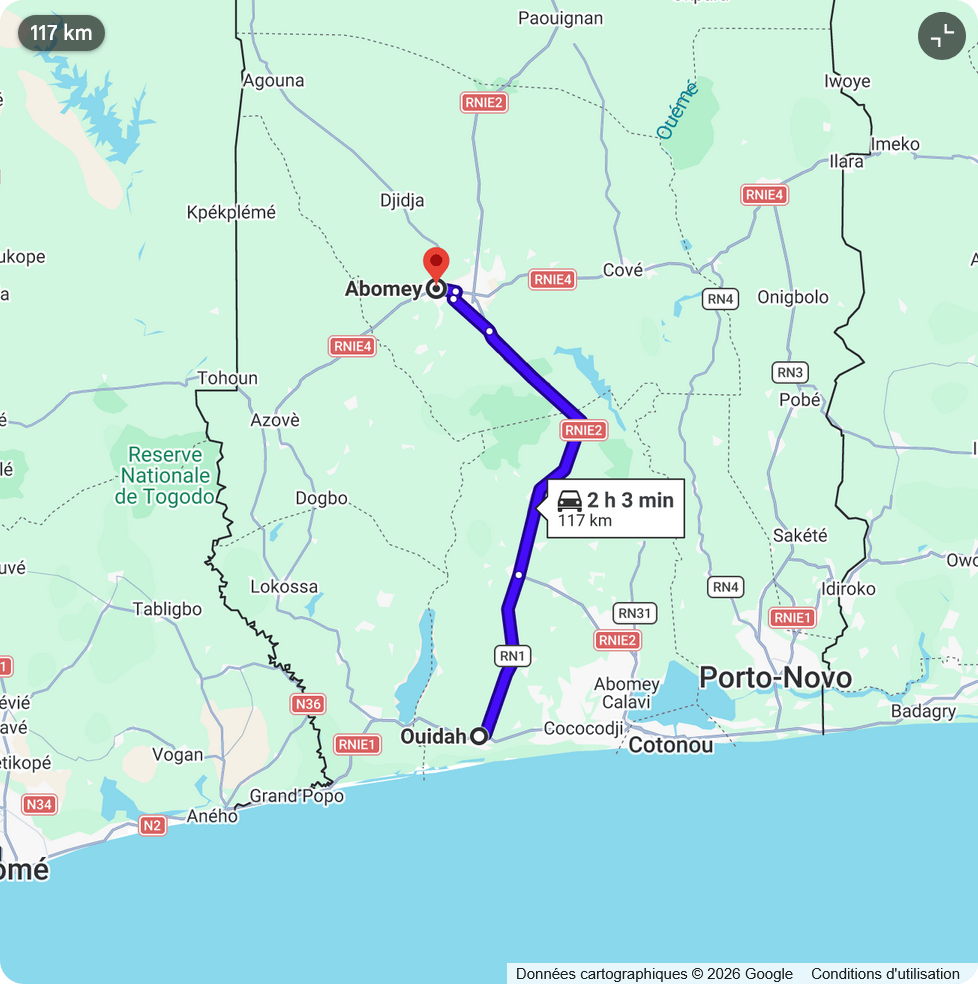
Two cities. Two distinct but deeply intertwined legacies. And now, a pact between their mayors to build together what Benin has never truly had: a structured cultural tourism circuit capable of keeping visitors in the country longer.
On 3 March 2026, Christian Houetchenou, mayor of Ouidah, welcomed his counterpart Franck Métolé Kpassassi, mayor of Abomey. A working meeting, concrete in its ambitions, going far beyond mere protocol. Two months later, what began as a shared vision is becoming an institutional reality — one that could change the way the world experiences Beninese history.
Two Cities Made to Go Together
History already linked them centuries ago. Abomey was the capital of the powerful Kingdom of Dahomey, whose kings controlled the slave trade that passed through Ouidah before captives were loaded onto ships bound for the Americas. The coast and the interior plateau — two faces of the same tragedy, two facets of the same civilisation.
Today, both cities hold UNESCO World Heritage status: Ouidah for its Slave Route and Vodun memorial sites, Abomey for its royal palaces. Yet few visitors make the journey between the two. A typical international traveller arrives at the Door of No Return, walks the Slave Route, visits the Python Temple — and flies home without ever seeing Abomey. The circuit that would tell the complete story — from the palaces of power to the shore of departure — has never been properly structured.
That is precisely what this alliance sets out to change.
Two Cities, One Single Narrative
If Ouidah was the Atlantic gateway — the threshold where Africa met the sea and everything changed — Abomey was the brain that orchestrated the kingdom's political, military, and commercial life for nearly three centuries.
- Abomey: The Seat of Kings. The Royal Palaces bear witness to the extraordinary sophistication of Dahomean civilisation. Discover the history of the Kingdom.
- Ouidah: The World Interface. The place where Africa encountered Europe and the Americas. The future MIME will bridge these two realities in ways no institution has managed before.
Walking from Abomey's palaces to Ouidah's shore is not sightseeing. It is following the actual path of history — the decisions made in throne rooms, the captives marched to the coast, the ships that carried them across an ocean they would never cross back.
The Royal Palaces of Abomey: A UNESCO Site Under Restoration
At Abomey, visiting the palaces of kings Ghézo and Glèlè is not optional — it is the point. These are not polished museums. They are living sites where royal spirituality is still practised, where the walls carry bas-reliefs that narrate victories, proverbs, and the logic of a civilisation that preceded European contact by centuries.
- The Throne Room: The sculpted thrones — resting, according to tradition, on the skulls of defeated enemies — communicate a specific idea of power. Sacred, total, undeniable.
- The Bas-Reliefs: Each panel tells a story. Each king had his own visual language. Reading them requires a guide, and Abomey has some of the finest heritage guides in West Africa.
- The Ancestors' Temple: Active, not archival. This is a place where the dead are still addressed.
For more information on conservation at this site, consult the UNESCO World Heritage listing.
What the New Pact Entails
During their March meeting, the two mayors agreed on the creation of a joint operational monitoring committee. Its mission: to turn exchanges into concrete actions. On the agenda:
- Integrated tourist circuits linking the key sites of both cities into a single coherent journey
- Coordinated approaches to historic site preservation, including shared expertise and resources
- Joint thinking on visitor flow management — how to welcome more visitors without degrading the heritage experience
- Co-promotion on international tourism markets, presenting the two cities as a single, unmissable destination
The Abomey delegation rounded off its March visit with an immersion in the streets of Ouidah — witnessing first-hand the urban transformation underway in the coastal city, and understanding what structured heritage tourism can do for a community over a decade.
Ouidah as a Model
What Abomey wants is the Ouidah method. In fewer than ten years, the historic coastal city has become a laboratory for heritage tourism: the rehabilitation of historic buildings, the redesign of public spaces, the transformation of the Vodun Days into an internationally recognised annual event drawing visitors from across the diaspora.
"We are no longer content to contemplate our past — we are shaping it for the future," summarised Mayor Houetchenou during the March exchanges.
The method is replicable. It requires institutional will, consistent investment, and — crucially — inter-communal cooperation. The Ouidah-Abomey axis is an attempt to extend that model beyond a single city.
8 May 2026: Both Mayors on the Ground
On Friday 8 May 2026, following a working session at Abomey's city hall, mayors Franck Kpassassi and Christian Houétchénou conducted a joint visit to several tourism and hotel construction sites. The goal: to assess first-hand the progress of sites that now sit at the heart of the cooperation between the two historic cities, and to calibrate expectations for what the convention will commit both municipalities to support.
The sites visited:
-
Hôtel le Trône — a five-star hotel nearing completion in Abomey. Its opening will fundamentally change the city's tourism profile: visitors will be able to sleep inside the heritage zone, making multi-day stays both comfortable and meaningful. For years, Abomey suffered from a structural problem common to heritage cities in West Africa — extraordinary daytime visits, but no reason to stay overnight. Le Trône is the answer to that problem.
-
The Museum of the Kings and Amazons of Dahomey (MURAD) — the future national museum dedicated to the full history of the Kingdom of Dahomey, with specific attention to the Amazons — the Agojie — the world-renowned female warrior corps that served the Dahomean kings. Where Hollywood's The Woman King sparked global curiosity, the MURAD will provide the actual history. It is set to become one of the most significant cultural destinations in West Africa.
-
The rehabilitation sites of the royal palaces of kings Guézo, Glèlè, Gbèhanzin and Agoli-Agbo — restoration works on the UNESCO-listed palace complex. These are not cosmetic renovations. They are structural interventions designed to preserve irreplaceable heritage for the next century, while making the sites more accessible and legible for international visitors.
-
The Institut Français d'Afrique Noire (IFAN) — a historic research and cultural institution whose renovation will reinforce Abomey's position as a centre of academic and scientific heritage, not only a monument city.
This field visit marks a turning point in the cooperation's history: it is no longer diplomatic language. It is expressed in concrete, scaffolding, construction timelines, and opening dates. Both mayors saw, with their own eyes, what the partnership is being asked to support — and both left with a clearer understanding of what needs to happen before and after the 14 May signature.
14 May 2026: The Convention Signing
The decisive milestone is set. The Cooperation Convention between the historic cities of Abomey and Ouidah is scheduled to be officially signed on Thursday 14 May 2026. This document will formalise the legal and operational framework for collaboration between the two municipalities: integrated circuits, shared heritage management, joint international promotion, and a calendar of concrete joint actions.
Beyond the two cities, the Abomey-Ouidah axis is setting a precedent for the whole country. Benin has 77 communes. Many of them carry historical and cultural wealth that remains largely invisible to the outside world. If two of the country's most internationally recognised heritage cities can build a formal cooperation framework, the model can be replicated — adapted to other pairings, other histories, other circuits.
The ambition stated publicly is clear: cooperation and mutual valorisation of heritage across all 77 communes, for the international visibility of Benin and the direct benefit of local communities. The Ouidah-Abomey axis is the proof of concept.
A Circuit Benin Was Missing
For lovers of culture and memory, a combined stay in Ouidah and Abomey represents an experience with no equivalent anywhere in the world: the shore from which the enslaved departed, and the capital of the kingdom that organised the trade — united in a single journey of perhaps 48 to 72 hours.
Day 1 in Ouidah: walk the Slave Route, stand at the Door of No Return, visit the Python Temple, explore the Brazilian Quarter. Day 2 in Abomey: the royal palaces, the MURAD (opening soon), the Throne Room, a conversation with a heritage guide who can explain what it means that these two cities are finally talking to each other.
On the Abomey side, visitabomey.com is working to showcase this royal heritage in digital form — the palaces of the Fon kings, restituted treasures, the memory of the Amazons. A natural complement to what Ouidah Origins documents along the coast.
This duo could well become the beating heart of Beninese cultural tourism — and one of the most historically loaded circuits in all of Africa.
The Reconciliation Through Culture
For a long time, a quiet tension existed between the descendants of those captured and sold through Ouidah, and the descendants of the Dahomean power that participated in the trade. History is not simple here. Abomey was not only a victim of the colonial system — it was also an actor within it.
Today, these two poles are working together to offer a complete and honest historical truth. Tourism becomes a tool for national and international dialogue. "You cannot heal what you refuse to look at directly," say the conservators at the École du Patrimoine Africain (EPA), based in Benin — one of the continent's leading heritage training institutions.
The Ouidah-Abomey circuit is now a reality for every traveller seeking depth over spectacle. To plan your visit, consult the Visit Benin portal or explore the Ouidah Origins journal for detailed guides to each site.
This cooperation is also inseparable from the broader transformation described in the Ouidah 2027 plan — a vision in which the entire region becomes a world reference for memory, culture, and diaspora heritage tourism.
The chair at the table has been set. On 14 May, both mayors will sit down and sign. What follows will depend on what both cities choose to build together.
Discover how Ouidah's Afro-Brazilian legacy also speaks to the transatlantic connections that link Ouidah to the world.
- On 8 May 2026, the mayors of Ouidah and Abomey conducted a joint field visit to four key heritage and tourism sites in Abomey.
- The Cooperation Convention between the two historic cities is scheduled for official signature on 14 May 2026.
- The Hôtel le Trône (5★) and the MURAD museum are among the flagship projects at the heart of this new partnership.
- This alliance sets a precedent for inter-communal cooperation across all 77 Beninese communes.
- The Ouidah-Abomey circuit offers one of the most historically significant combined journeys in West Africa.