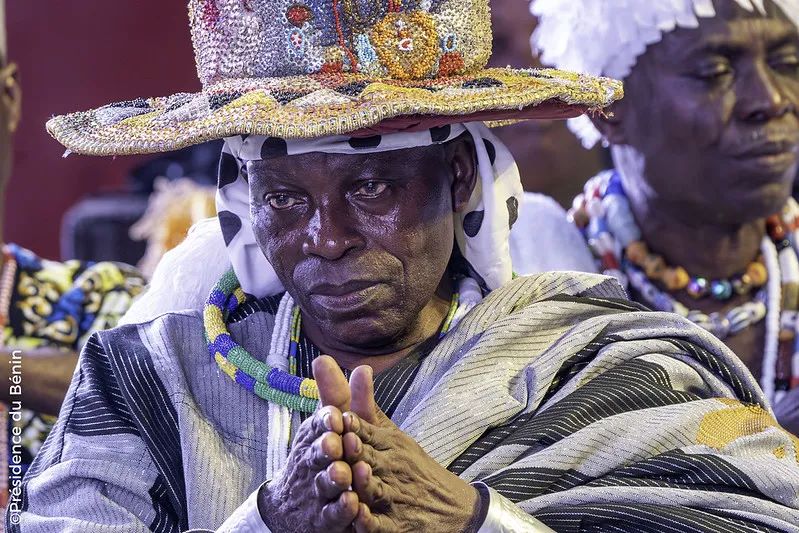
Every year on January 10, as the sun starts sinking over Ouidah's beach, a figure steps out of the crowd and walks toward the sea. Multicolored headdress, shimmering blue cloth, rows of beads around the neck. The crowd parts. The drums change rhythm. Women in white bow down. Dignitaries lower their heads.
This is Dagbo Hounon.
For the 50 million Vodun followers across the world in Benin, Haiti, Brazil, Cuba, Louisiana, and the Caribbean, he is the highest living spiritual authority of their religion. His official title: Supreme Leader of Vodun Worship Worldwide. His seat: a red-earth palace in a discreet street of Ouidah.
And yet, outside Benin and diaspora circles, few people know who he is, what he does, or how to approach him. This article fills that gap.
The Title: What "Dagbo Hounon" Really Means
Dagbo Hounon is not a birth name. It is a title, one of the oldest and most meaningful in the Vodun world.
In Fon, the language of the Fon people who dominate the Ouidah and Abomey region, Hounon means the head of a convent, guardian of a sacred space, the priest who links humans and Vodun deities. Dagbo, sometimes written Daagbo, is the prefix that signals supremacy and absolute greatness. Dagbo Hounon therefore literally means the greatest guardian of the sacred, the pontiff above all pontiffs.
The title belongs to the Houxwe Dynasty, a spiritual lineage rooted in Ouidah for centuries. Its palace, the Houxwe Palace, is the official residence and the center of Vodun governance. This palace is not a museum. It is a living place where Dagbo Hounon holds audiences, issues decisions, receives dignitaries, followers, and visitors from around the world.
Each Dagbo Hounon chooses a pontifical name at enthronement. The current one, Dagbo Hounon Tomadjlèhoukpon Hounwamènou Mètogbokandji II, born on December 31, 1951 in Ouidah, chose a name translated by a striking poetic formula: "A river cannot be measured against the sea." A name that reflects the nature of his authority, vast, deep, impossible to contain.
The Lineage: Twenty-Two Pontiffs Before Him
The title of Dagbo Hounon does not date from the colonial period, nor from Benin's independence in 1960. It goes much further back, to when Ouidah was still called Gléhué, before the kings of Abomey conquered it in 1727, even before Europeans built forts and trading posts there.
The Houxwe Dynasty is the guardian of Huendo Vodun, the deity of seas and oceans, the aquatic force that governs Ouidah's relationship with the Atlantic. Through this lineage, a spiritual authority was built over generations and survived everything: Dahomean conquest, the Atlantic slave trade, French colonization, and the decades of repression under Kérékou's Marxist regime.
The first Dagbo Hounon clearly remembered in historical records is often considered the founder of the reigning line as it exists today. Since then, succession has remained within the Houxwe Dynasty, according to complex customary rules that do not necessarily follow direct primogeniture. The High Council of the Dynasty and Vodun sages designate the successor after deliberations that may last months.
When the previous Dagbo Hounon, Hounan, the twenty-second of the line, died of a heart attack in the night of March 11-12, 2004, in Ouidah at age 90, his death triggered worldwide mourning. Followers came from Haiti, Brazil, Trinidad and Tobago, Cuba, the United States, and Europe to pay tribute. He was buried after a ten-hour ritual.
The current Dagbo Hounon, second of the name, was enthroned on June 25, 2006, under President Boni Yayi. Son of the ninth Dagbo Hounon of the Houxwe Dynasty, he had worked as a court clerk in Benin's justice system before enthronement, a detail that says much about this title: an ordinary man with an ordinary profession who suddenly becomes the spiritual leader of 50 million people.
What Dagbo Hounon Actually Does
The question seems simple. The answer is multiple.
At the local level, Dagbo Hounon is Ouidah's moral, judicial, and religious authority. The Houxwe Palace plays a leading role among Benin's traditional and religious elites, and customary executive, religious, and judicial powers are held by Dagbo Hounon. He exercises them at his discretion after consulting the High Council of the Houxwe Dynasty, the sages, and senior dignitaries of the court. His rulings are published as pontifical bulls and carry authority in matters related to Vodun.
Nothing in Ouidah is decided without consulting him. Before major electoral events, political leaders would seek his blessing. This reality has not fundamentally changed with the enthronement of Dagbo Hounon II. Beninese presidents maintain regular ties with him. President Talon has publicly praised his collaboration in organizing Vodun Days since 2024.
At the national level, Dagbo Hounon is the Beninese government's main interlocutor on all issues related to Vodun: rehabilitation of convents, organization of January 10 celebrations, and relations with diasporas. He is recognized by law and state authorities as one of the country's most important spiritual leaders.
At the international level, his authority extends, in theory, to all Vodun followers worldwide. According to one close associate, "no decision concerning Vodun worship can be made without his approval." In practice, this authority is moral rather than administrative. Vodou communities in Haiti or Candomble communities in Brazil have their own structures and autonomy. But the symbolic recognition of Ouidah as the original source, and of Dagbo Hounon as guardian of that source, is widely shared in the Atlantic African diaspora.
Supernatural Powers: What His Followers Believe
One cannot write about Dagbo Hounon without addressing what, for his followers, sets him apart from any other spiritual leader: his supernatural powers.
According to Dah Midédji Mintonoudoté, one of the dignitaries of Vodun worship, he holds supernatural powers that allow him to walk on ocean waters. He goes there periodically to communicate with ancestors and renew his powers.
Dagbo Hounon is the leader of Huendo Vodun, deity of seas and oceans, closely linked to Mami Wata in Ouidah's tradition. This water affiliation is central to his spiritual identity. He says it clearly: "I am of water. My mythical ancestor is in the sea, just like the tohio of the Houeda people, Houeda Dangbe, commonly known as the python."
The former Dagbo Hounon Hounan had a giant tortoise in his family compound in Sogbadji. According to legend, the patriarch crossed the ocean on this creature's back to meet the divinities.
These stories are not folklore for foreign visitors. They are religious truths for millions of people. Understanding them, even without subscribing to them, is essential to grasp what Dagbo Hounon truly represents.
A Man Between Two Worlds
What makes the current Dagbo Hounon's profile especially striking is the tension between the ordinary and the sacred.
Before his enthronement in 2006, he was a court clerk. A justice official, with an office, files, schedules. Then he was designated by the Dynasty Council, enthroned in a solemn ceremony, and overnight became the spiritual leader of 50 million people.
He spends most of his time in his palace, where he holds audiences and receives dignitaries, followers, tourists, and authorities. He is father of twelve children.
He speaks frankly about the challenge of his role. "We need to prove to the world that Vodun has nothing satanic or evil," he told AFP. "Vodun is tolerance, sharing, love, generosity, peace."
This mission, stripping Vodun of the image imposed by centuries of colonization, missionary narratives, and Hollywood, is likely the most important mission of his pontificate. In this spirit, he actively supported the transformation of the January 10 festival into Vodun Days, with an explicitly international opening. "Today, I am very happy to hear people speak of Vodun Days. The days of Vodun have truly improved...", he said in January 2025.
He also articulates a cosmic and universal vision of his religion. "Once you breathe air, you are a child of Vodun; once you drink water, you are a child of Vodun; once you walk on Sakpata's earth, you are already a child of Vodun." A statement that clearly says: Vodun does not belong only to Beninese, nor only to Africans. It belongs to all who breathe.
Houxwe Palace: Where He Lives and Receives Visitors
Houxwe Palace is located in Sogbadji district in Ouidah, a sandy street, low houses, a guarded inner courtyard. Built with traditional red-earth techniques (pisé), it is the home of the Houxwe Dynasty and the official residence of the Dagbo Hounon. It includes the pontiff's audience hall, where he meets with his court.
The reception room is arranged around a raised throne surrounded by fetishes, old photos of predecessors, and flags of other countries such as Brazil and Haiti. These flags are not decoration. They are a declaration: Vodun is universal, it crossed oceans, and its diaspora children are welcome here.
The court around him is structured with state-like precision: members hold specific spiritual or temporal functions. Kpatenon is the first attendant during ceremonies. Dagbe Non oversees the Python Temple. Kpasse Non oversees Kpasse Sacred Forest. Zon Non supervises convents of the Hebiosso divinity across the city. Every function is inherited, transmitted, and codified across generations.
How to Meet Him
Dagbo Hounon is not inaccessible. He receives visitors, but according to protocol that requires preparation.
During Vodun Days (January 8, 9, and 10): this is the best moment for visitors to see Dagbo Hounon in public function. He presides over the Great Ceremony of January 10 on the beach, in the presence of dignitaries and authorities. His entrance is announced by drums. He gives final blessings and addresses the crowd. This is a public appearance, accessible to all present visitors.
Outside the festival period: it is possible to request an audience at Houxwe Palace. Dagbo Hounon receives visitors: tourists, diaspora members, foreign delegations, researchers, journalists. The process requires a trusted local intermediary or specialist guide, advance contact with the court, and strict protocol respect.
Basic protocol for a palace visit:
- Remove your shoes when entering the courtyard.
- Do not take photographs without explicit permission.
- Bring an offering, kola nuts, local gin, or what your guide recommends.
- Dress modestly; avoid black.
- Wait to be invited to speak. Do not interrupt.
- If you have ties to Vodun or Afro-descendant practice, it is welcome to mention it; Dagbo Hounon pays special attention to the diaspora.
Our concierge service can organize a protocol visit to Houxwe Palace as part of a cultural stay in Ouidah.
Dagbo Hounon and the Diaspora: An Explicit Link
One of the most important dimensions of the current pontificate is the explicitly cultivated relationship with Atlantic African diasporas.
He states it very clearly: "Our brothers who were deported left Vodun in Ouidah. That is why Ouidah is the world seat of Vodun." This world seat is not a metaphor or political ambition. It is a theological statement: Vodun has a source, that source is Ouidah, and Dagbo Hounon is its guardian.
His predecessor Hounan had already laid foundations for this international relation. Open to the world and other religions, he met Pope John Paul II during the pope's 1993 visit to Benin. He also traveled to Haiti to visit the local Vodou pantheon. These two acts, meeting the pope and going to Haiti, summarize a dual ambition: to be recognized on the global religious stage and to keep living ties with the diaspora.
The current Dagbo Hounon continues in this direction. His palace, with flags of Brazil and Haiti in the audience room, sends a clear message to every diaspora visitor: you have a place here. What you practice there comes from here. And you are welcome to return.
Why Understanding Dagbo Hounon Changes Your Visit to Ouidah
For many visitors, Ouidah means the Slave Route, the Door of No Return, and the Python Temple. These are important sites. But they mostly tell the past, deportation, slave trade, memory.
Dagbo Hounon is the living present. He is proof that something was not broken by four centuries of violence and uprooting. That tradition survived, was transmitted, and even strengthened through confrontation with history. And that it still exercises real authority, recognized by a state and respected by millions.
Knowing who he is before arriving in Ouidah means arriving with a reading framework that few tourists have. It means understanding why crowds part when he walks to the sea on January 10. It means grasping what the Great Vodun Ceremony truly is, not folklore, but the annual act by which the guardian of tradition renews his link with divinities and reminds the world that Ouidah is still here.
Visiting Houxwe Palace
Address: Sogbadji district, Ouidah. Ask your guide; the palace is not always clearly marked on online maps.
Access: By appointment or through a guided tour. Contact our concierge service to organize a protocol-respectful visit.
Best time: During Vodun Days (January 8-10) to see Dagbo Hounon in public ceremonies. Outside the festival, private audiences are possible by appointment.
Accommodation in Ouidah: [BOOKING_LINK: hotels Ouidah Benin]
Understand Vodun as living heritage
Vodun carries a rich history and culture. Discover our guidance on approaching sacred sites with context and respect.
See also:
- Practical Guide to Vodun Days in Ouidah
- Mami Wata in Ouidah: The Goddess of the Waters Who Crossed the Atlantic
- The Vodun Sanctuaries of Ouidah: Zo Houe and Mami Toligbe
Sources: Wikipedia FR, AFP / La Gazette France, La Libre Belgique, Jeune Afrique, Les Nouvelles d'Afrique, La Nation Benin, vaudou.org (Houxwe Palace), Globe Reporters.
- Dagbo Hounon is the Supreme Leader of Vodun worship — a living authority for 50 million followers across Benin, Haiti, Brazil, Cuba, and the Caribbean
- Profile, role, Houxwe Palace Ouidah, and how to approach him during your visit