Most people who come to Ouidah come for the Slave Route. They come for the Door of No Return. They come to stand at the edge of the Atlantic and feel the weight of what happened here.
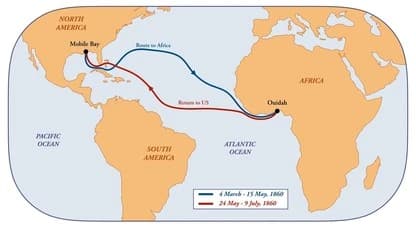
What fewer people know — what most travel guides fail to say — is that the story did not end at the water's edge. It continued. It crossed the ocean. It took root in Haiti, in Brazil, in Cuba, in New Orleans, in the Caribbean islands whose names most Beninese schoolchildren have never learned. And in many of those places, it is still alive.
Ouidah did not just lose people to the Atlantic. It exported a cosmology.
What left on those ships
Between the 1670s and the 1860s, Ouidah was one of the largest slave embarkation points in the world. The figures are not comfortable: over the course of roughly two centuries, more than a million enslaved people passed through this coast. They came from across the Kingdom of Dahomey and its surrounding territories. They belonged to the Fon people, the Ewe, the Aja, the Yoruba.
They brought with them, encoded in memory because they were permitted to carry nothing else, the entire spiritual system of Vodun. The deities. The rituals. The cosmological understanding that the world is inhabited by spirits — vodun — and that the relationship between the living and these forces is the central business of human life.
Colonial authorities tried to suppress it. Slaveholders banned African ceremonies, forced conversion to Christianity, outlawed the speaking of African languages. What happened instead was not erasure. It was transformation.
The enslaved people did something extraordinary. They looked at the Catholic saints imposed on them and saw, in many cases, the vodun they already knew. Legba, the trickster deity who opens all paths, became Saint Peter — the keeper of gates. Sakpata, the deity of earth and disease, became Saint Lazarus. Mami Wata, the water spirit, found her reflection in the Virgin Mary. The outer form changed. The inner structure did not.
This process — called syncretism — is one of the most remarkable acts of cultural survival in human history. And it began here. In this city. On this coast.
Haiti: where Vodun became the national religion
The clearest line runs to Haiti.
Haitian Vodou — the spelling changes, but the lineage is direct — is descended from the religious traditions of the Fon and Ewe peoples of what is now Benin and Togo. The Fon language left its fingerprints all over Haitian Vodou: the spirits worshipped in Haiti, called lwa, take their names and characteristics from the Beninese vodun. Damballa, the great serpent deity of Haitian Vodou, is descended from Dan — the rainbow serpent worshipped at the Python Temple in Ouidah, a living deity whose descendants still reside there today. Legba, who opens ceremonies in Haiti as the guardian of crossroads, is the same Legba venerated in Ouidah — younger here, more virile, before the Atlantic crossing aged him into the old man of the Caribbean.
Over sixty percent of Haitians today identify as Vodou practitioners. The religion was officially recognized by the Haitian government in 2003 after centuries of state suppression. The Haitian Revolution of 1791 — the only successful slave revolt in history — was preceded by a Vodou ceremony at Bois Caïman. The men and women who dismantled French colonialism in Haiti carried their spiritual system from the coast of West Africa, through the Middle Passage, and into the mountains where they made their stand.
Brazil: Candomblé and the Jeje nation
In Brazil, the largest African diaspora population outside Africa, the traditions of Ouidah's coast arrived in a different form.
Brazilian Candomblé — the dominant Afro-Brazilian religion — is organized into what it calls nacoes, or nations, representing the African ethnic and linguistic groups from which enslaved people were brought. The Jeje nation, one of the oldest and most prestigious, takes its name from the Fon people, using terms borrowed directly from the Fon and Ewe languages. Its spirits are called vodun — the same word, unchanged, still resonant in the terreiros of Bahia and São Paulo. What that kinship preserved, and what it transformed, is the subject of Candomblé and Vodun: what connects and what divides them.
The connection between Bahia's African Brazilian community and Ouidah is not metaphorical. It is documented. In the nineteenth century, freed Afro-Brazilians began returning to the West African coast, and many settled in and around Ouidah. Their descendants are known today as the Agudas — a community whose Afro-Brazilian architecture still marks the streets of Ouidah, whose surnames are Portuguese, and whose cultural identity bridges two continents. Walking through Ouidah's historic center, you can identify their houses: the ornate facades, the pastel colors, the wrought iron — all brought back from Brazil, written into the walls of the city that first sent their ancestors away.
The Balé Folklórico da Bahia, Brazil's most celebrated African-Brazilian dance company, has performed at Vodun Days in Ouidah. The spiritual system that traveled from this coast to Brazil has come home, at least temporarily, in the bodies of its descendants.
Cuba: Santería and the Orisha tradition
Cuba's story runs slightly differently. The enslaved people brought to Cuba came largely from Yoruba territories to the east, but the Fon and Ewe spiritual traditions arrived alongside them, and the resulting Cuban religious landscape reflects both. Santería — more formally known as Lukumí or Regla de Ocha — is primarily Yoruba in origin, but shares the same fundamental architecture as Vodun: a pantheon of deities who govern specific domains of life, ritual communication through possession, the centrality of the ancestor relationship, and the survival strategy of Catholic saint correspondence.
The more direct connection lies in Cuba's Arará tradition, which is Dahomean in origin — meaning it traces to the Kingdom of Dahomey, the predecessor state of modern Benin, which used Ouidah as its primary slave port.
Louisiana and the United States: the most misrepresented branch
Louisiana Voodoo — sometimes called New Orleans Voodoo — is the most distorted version of a living tradition in popular Western culture. Hollywood turned it into a prop. Horror films turned it into a threat. Neither bears any relationship to the spiritual system that arrived here from the West African coast.
What actually exists in Louisiana, beneath the tourist spectacle of voodoo dolls and ghost tours, is a genuine religious tradition rooted in the same Fon and Ewe cosmology that defines Haitian Vodou and Beninese Vodun. It arrived through New Orleans, which received large numbers of enslaved people from the Kingdom of Dahomey and, later, waves of Haitian refugees after the 1791 revolution.
Marie Laveau, the nineteenth-century figure known as the Voodoo Queen of New Orleans, was a practitioner of this tradition. Her spiritual lineage runs, through several centuries and an ocean, back to this coast.
The "Return of the Children"
In recent decades, something has begun to move in the other direction.
Each year, an increasing number of descendants of the enslaved travel to Ouidah — from Brazil, from Haiti, from the Caribbean, from the United States — not as tourists but as pilgrims. They walk the Slave Route in reverse, from the Door of No Return back into the city. The ceremony is called the Return of the Children.
It is not a comfortable ritual. It is not supposed to be. It is a collective act of spiritual reclamation — the recognition that the people who left through the Door of No Return were not gone, that their descendants survived, that the cosmology they carried across the ocean is still alive, and that it is possible to return.
The Vodun Days festival in January is partly designed for this. The 2026 edition attracted hundreds of thousands of visitors, including large contingents from the diaspora, drawn not just by the spectacle of the ceremonies but by the need to make a connection that has been severed for centuries.
If you are reading this from the Americas or the Caribbean, the spiritual system you may have grown up adjacent to — whether as Vodou, as Candomblé, as Santería, as Voodoo — did not begin in those places. It began here. In Ouidah. On this coast.
That is not a metaphor. It is a fact with a specific address.
- Ouidah was a primary embarkation point for over 1 million enslaved people between 1670 and 1860.
- The spiritual system of Vodun survived the Middle Passage through syncretism with Catholic saints.
- Haitian Vodou and Brazilian Candomblé (Jeje nation) maintain direct linguistic and ritual links to Ouidah.
- The 'Return of the Children' ceremony in Ouidah marks a growing movement of spiritual reclamation by the diaspora.