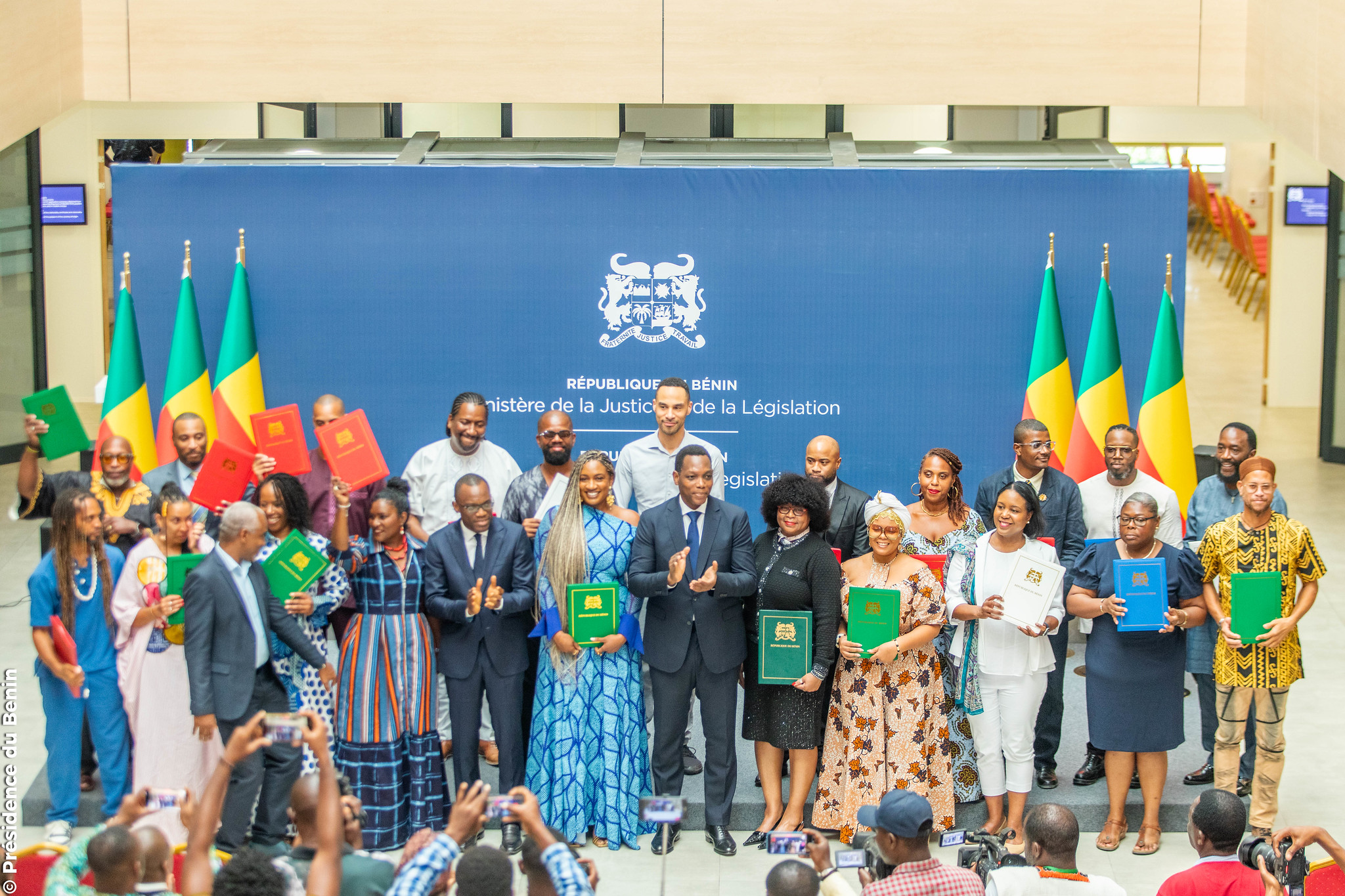
They came from far away — the United States, Brazil, the Caribbean. Some spent years researching to find the thread connecting them to this West African coast. Others followed an instinct, a dream, a phrase heard in childhood. And in 2026, Benin told them, in four successive waves: you are home.
Four Ceremonies, A Fast-Accelerating Pace
The pace of naturalizations sharply accelerated over the year. Nine Afro-descendants received Beninese nationality in March 2026. Twenty-two followed in May. Then, on July 30, 2026, at the Cotonou judicial complex, twenty-eight new citizens swore allegiance in the largest ceremony to date.
This progression — from 9 to 22 to 28 people over four months — brings the total number of Afro-descendants naturalized in 2026 alone to nearly sixty. This gesture is not only symbolic; it is the result of a rigorous policy framed by the Benin citizenship law, amended in 2025 to remove the DNA proof requirement and make the process more accessible to applicants relying on family history and archival records.
To understand how these people prepared their dossiers, you can consult our guide on how to find ancestors in Ouidah or our complete guide on proving African ancestry. Applications can also be started through the official portal myafroorigins.bj (nofollow).
The Inspiration of Patrice Talon
This policy is a pillar of Patrice Talon's legacy, aiming to make Benin the homeland of all Afro-descendants. Among the public figures who have pursued the process, singer Ciara and NFL quarterback Russell Wilson, her husband, have completed or advanced their naturalization — visibility that has helped bring international attention to the program.
Ouidah at the Heart of the Journey to the Roots
For many Afro-descendants making this journey to Benin, Ouidah is an unavoidable stop — often the most emotionally charged one. The Slave Route, the Door of No Return, the beach of Avlekete: all places where the memory of deportation becomes tangible.
Some visitors describe their arrival on Ouidah's beach as a moment of catharsis — the sea that swallowed their ancestors, now the place of their own return.
A Policy Built for the Long Term
Beyond the symbol, the naturalisation of Afro-descendants is accompanied by a broader reflection on what "return" can mean for the African diaspora. Benin is not the only African country exploring this path — Ghana with its "Year of Return" initiative in 2019, Senegal, Tanzania — but it is one of the few to have institutionalised the gesture through a nationality law.
For Ouidah, a city of memory par excellence, this dynamic is a unique opportunity. It transforms the historic city into something more than the sum of its monuments: a living convergence point for a global diaspora in search of roots.
The Community's Welcome in Ouidah
In Ouidah, the arrival of these new citizens is perceived with a mix of respect and fraternity. Family collective heads open their doors. "They are not strangers, they are family members who have been lost for a long time," explains a dignitary from Place Chacha.
- Social Reintegration: The new citizens often participate in "Hand Washing" rituals to mark their purification and return to the family circle.
- Economic Contribution: Many naturalised citizens invest in local real estate or tourism, actively participating in the Ouidah 2027 urban transformation.
What This Changes
These successive naturalisations are also a sign that "roots tourism" — the journeys Afro-descendants make to reclaim their history — is becoming a structured market and a daily reality for Ouidah.
The new Door of No Return, the Vodun Days, the alliance with Abomey, the urban renovation projects: everything converges toward a city preparing to welcome this return. Not as a tourist curiosity. As a historical inevitability.
Find the story of departure in our article on the Slave Route and the story of return in our Journal section.
- Through 2026, Benin held four naturalization ceremonies for descendants of the slave trade: 9 people in March, 22 in May, and 28 on July 30
- A powerful symbolic gesture, gradually transforming Ouidah into a place of return as much as memory