
The boat was called L'Aurore.
It left Ouidah around 1860, bound for Cuba, carrying its last cargo of captive human beings across the Atlantic. The slave trade had been legally banned for decades. L'Aurore was one of the clandestine operations of the trade's final phase — a ship that knew it was doing something the international community had already decided to prohibit, making its crossing anyway.
The people it carried had names. Families. Languages. Spiritual systems. They arrived in Cuba with all of these intact, in memory if not in practice, and they did what enslaved Africans did everywhere they were brought: they preserved what they could, transformed what they had to, and built something new from what remained.
The Cuba branch of the Ouidah diaspora is the least documented, the least discussed, and the least visited. Most diaspora visitors to Ouidah come from Haiti, from Brazil, from the United States — not from Cuba. The cultural connections between Benin and Cuba are known to specialists and virtually unknown to everyone else.
This is their story.
The Arará nation
Cuban religious culture is organized, in part, around what it calls naciones — nations, representing the African ethnic groups from which enslaved people were brought. The most famous is the Yoruba-derived Lucumí tradition, the basis of Santería. But there is another: the Arará nation, directly descended from the Fon and Ewe peoples of the Dahomey coast — the same peoples who constitute the spiritual and cultural foundation of Ouidah.
The name Arará is a corruption of "Allada" — the Fon kingdom of Allada, which preceded the Kingdom of Dahomey and occupied the same coastal territory. The enslaved people who arrived in Cuba from this region brought with them the Vodun system: the pantheon of deities, the ritual structures, the music, the understanding of the relationship between the living and the spiritual world.
In Cuban Arará practice, the deities are called vodú — the same word. Sakpata, the Vodun deity of earth and healing, is present in the Cuban Arará tradition as Babalú-Ayé. Héviosso, the deity of thunder, appears as Chango in the broader Afro-Cuban religious landscape, having migrated between the Arará and Yoruba traditions through the mixing of African communities in Cuba.
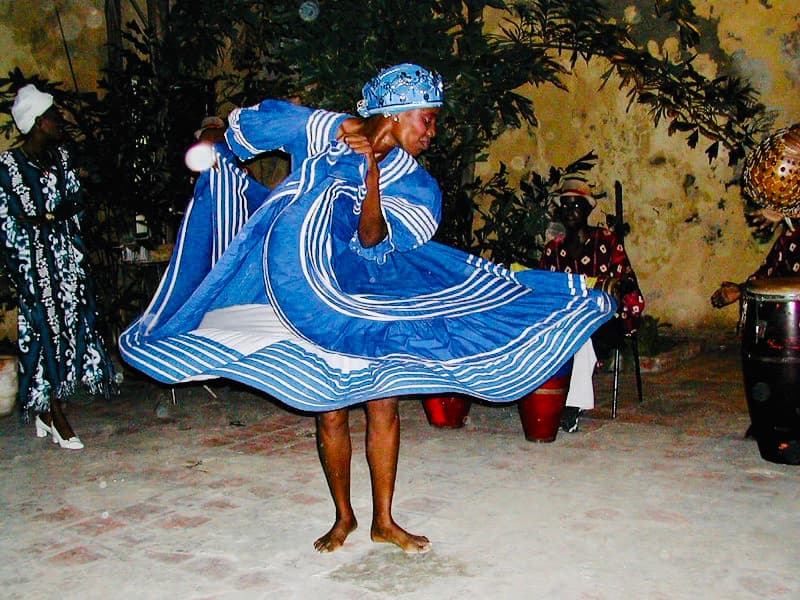
The music of the Arará is distinct from Yoruba-derived music — different rhythmic patterns, different drum tuning, different vocal structures. Cuban ethnomusicologists have documented the specific lineage carefully. What they have documented is a direct musical descent from the ceremonial music of the Vodun convents of coastal Benin.
The late trade and its specific geography
The Cuba connection is partly explained by timing.
The large-scale slave trade from the Dahomey coast to Brazil was concentrated in the seventeenth and eighteenth centuries. The Cuba trade, particularly in its final clandestine phase, ran later — into the 1840s and 1860s. This means the Cuba branch carries within it cultural material from a later period: a time when the Kingdom of Dahomey was at its height, when the Vodun ceremonial system was highly developed and institutionalized, when the specific cultural identity of the Fon and Ewe peoples was particularly distinct and self-conscious.
The people who were loaded onto ships like L'Aurore in the 1850s and 1860s were not from the ancient world of the early trade. They were from a sophisticated West African state with a developed bureaucracy, a standing army, a complex religious system, and a clear cultural identity. They brought all of this to Cuba.
What survives in Cuba today
In the eastern provinces of Cuba — Santiago, Guantánamo, Matanzas — Arará communities have maintained their religious traditions with varying degrees of continuity. The practice went underground during the Cuban Revolution, when Afro-Cuban religious practices were officially discouraged. It reemerged after 1990, when the Cuban government's relationship to Afro-Cuban religion shifted significantly.
Today, Arará ceremonies are practiced by a relatively small number of initiated communities, but they have been documented by Cuban ethnographers and are recognized as part of Cuba's intangible cultural heritage. The rhythmic patterns, the songs in the Fon language (transformed over generations but still recognizable to Fon speakers), the deity names, the ceremonial objects — all of these connect back, through two centuries and an ocean, to the convents of Ouidah.
For diaspora visitors to Ouidah who come from Cuban backgrounds — or from Florida, New York, or Madrid, where the Cuban diaspora is concentrated — the city's significance is direct and specific. The spiritual system you may have grown up adjacent to, the music of your grandparents' generation, the ceremonial practices that were kept alive through revolution and suppression — they began here. In these convents. On this coast.
The Bateau du Départ as a Cuba monument
L'Aurore was a Cuba-bound ship. The Bateau du Départ — the life-size replica of L'Aurore now anchored near the Door of No Return — is, in a very specific sense, a monument to the Cuba branch of the diaspora.
Most visitors to Ouidah understand the connection to Haiti and Brazil. Few know that they are also standing at the departure point for the ancestors of the Cuban Arará communities. The plaque and the monument make this legible now, in a way it was not before.
For the Cuban diaspora visitor, the Bateau du Départ is not a general memorial. It is the specific ship.
Restitution 2.0
Ouidah Origins is more than a travel resource; it is an infrastructure for memory. Read our manifesto on why we believe the Slave Route is not a tourist attraction.
Read the ManifestoEditorial transparency
This content was developed with the assistance of our AI agents.