The question is almost always the same.
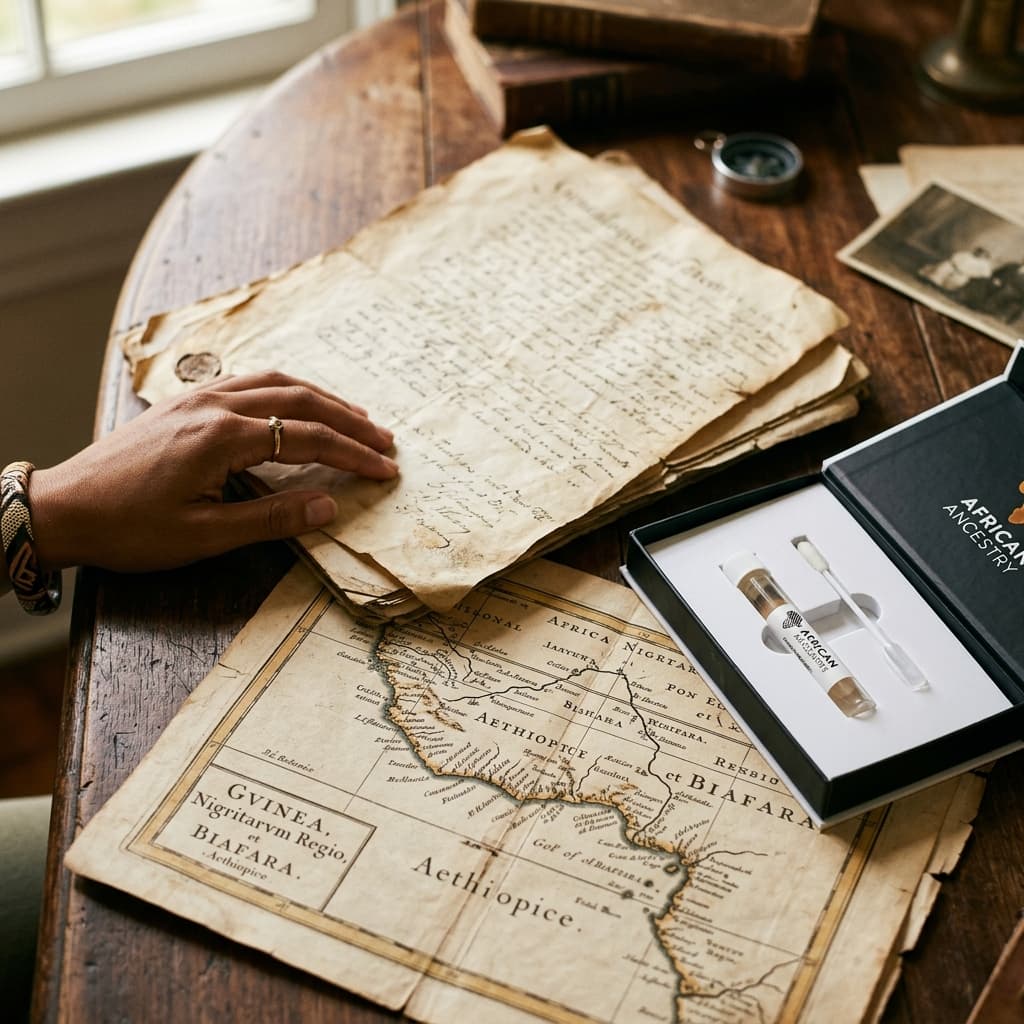
You get the DNA results back. Or you find an old document, a family story half-remembered, a surname that doesn't quite fit the country you grew up in. And somewhere in the results, there is West Africa. Sometimes specifically the Bight of Benin. Sometimes, if the data is detailed enough, something that points toward the Fon or Ewe peoples — the ethnic groups whose homeland is the coast of what is now Benin and Togo.
What do you do next?
This is a guide for that question. Not a promise of easy answers, because there aren't any. But a realistic map of what's possible, what's difficult, and how to approach a search that matters.
Start with what you already have
Before anything else, gather what exists in your own family.
This sounds obvious. It rarely is. Most diaspora families have layers of undocumented knowledge — the relative who knew things but never wrote them down, the grandmother who remembered names but thought no one was interested, the old photographs with no labels on the back.
Before you fly to Ouidah, spend time with your oldest living relatives. Record the conversations. Ask not just about names but about practices: food, ceremonies, expressions, music, spiritual traditions. The survival of Vodun across the Atlantic suggests that cultural memory persists far beyond what people consciously realize they're carrying. A grandmother who still puts water out for the ancestors, or who has an unusual relationship with a particular animal or element, may be practicing something older than she knows.
Collect every surname in your family tree, as far back as you can go. Note the ones that seem anomalous — that come from a different language, that don't quite fit the naming patterns of the country you grew up in. In Brazil, many Aguda surnames are Portuguese but were adopted upon return to Africa; in Haiti and Louisiana, French and Spanish surnames were imposed at the point of enslavement. These are clues, not endpoints.
DNA testing: what it can and cannot tell you
DNA tests marketed to the diaspora have exploded in popularity over the past decade. The results are useful but limited, and understanding the limitations matters.
What they're good at: Identifying broad regional origins. If your results show significant West African ancestry, and specifically origins among the Fon-Ewe or related ethnic groups, that is a meaningful signal. Tests from companies like AncestryDNA, 23andMe, and African Ancestry can narrow this further, sometimes to specific countries or coastal regions.
What they cannot do: Identify specific ancestors. Trace your lineage to a specific family or village. Distinguish between different enslaved groups who were mixed together at embarkation points. Tell you whether your ancestors specifically passed through Ouidah, or through one of the other West African slave ports (there were dozens).
The Slave Voyages database — a collaborative scholarly project available free online — has digitized records of over 36,000 slave voyages and documents the embarkation point, destination, and other details for many of them. If your family history suggests a specific destination in the Americas and a specific time period, searching this database can help you identify whether the most likely embarkation point was Ouidah, Badagry, Elmina, or elsewhere.
The archives question: what exists and what doesn't
Here is the honest truth about African genealogical archives, which you should know before you book a flight.
For much of the pre-colonial and early colonial period in West Africa, oral tradition was the primary means of transmitting history. Written records existed — the Kingdom of Dahomey maintained administrative records, and European trading posts kept ledgers — but these records documented transactions, not people. The enslaved were recorded as cargo, not as individuals with names, families, and histories.
This means that tracing a direct lineage from a specific diaspora individual back to a specific West African ancestor is, in most cases, not currently possible. Not because the people weren't real, but because the system that enslaved them deliberately removed the documentary trace.
What does exist in Benin:
- The National Archives of Benin in Porto-Novo hold colonial-era administrative records from the French period, which begins in the 1890s. For diaspora families with ancestors who returned to Benin after emancipation — the Aguda community in particular — these records can be enormously useful. Birth, marriage, and death registers from the early colonial period can help trace family lines.
- Family oral historians in specific communities — particularly among royal families and lineages connected to the old Dahomey kingdom — maintain detailed oral genealogies going back many generations. These are not always accessible to outsiders, but a trusted local guide or researcher can help make introductions.
- The Slave Route project, administered by UNESCO, has done significant work to document the history of the trade and the communities most affected by it. The Ouidah Museum of History (currently being transformed into the MIME) holds records and collections relevant to this research.
The Aguda community: a specific and documented connection
If your family history suggests ancestors who were freed from slavery in Brazil and returned to West Africa in the nineteenth century, the Aguda community of Ouidah offers a specific and well-documented pathway.
The Agudas are the descendants of freed Afro-Brazilian enslaved people who returned to the West African coast, primarily between the 1830s and the early twentieth century. Many settled in Ouidah, where their distinctive architecture — pastel colors, ornate facades, Portuguese colonial style — still marks the historic center of the city. Their surnames are predominantly Portuguese: da Silva, de Souza, Ferreira, dos Santos.
The de Souza family deserves particular mention. Francisco Félix de Souza, also known as Chacha, was one of the most powerful slave traders on the West African coast in the early nineteenth century. His descendants are still prominent in Ouidah. Their family history is complex — de Souza was himself of mixed African and Brazilian origin, deeply embedded in the slave trade — but for any diaspora researcher with connections to Brazilian slavery and the Bight of Benin, this lineage is a documented thread.
Practical steps for a roots research visit
If you are coming to Ouidah specifically to research your ancestry, these are the concrete steps that will give your visit the most traction.
Before you arrive:
- Order a West African DNA test if you haven't already. African Ancestry in particular specializes in African lineage identification and can sometimes identify specific ethnic groups.
- Search the Slave Voyages database (slavevoyages.org) for voyages that match your family's known history.
- Join diaspora genealogy communities online — there are active groups specifically focused on Bight of Benin research, and experienced researchers who can point you toward resources you won't find through general searching.
In Ouidah:
- The Ouidah Museum of History is the natural starting point. Even in its current transitional state (the full MIME reopening is expected in 2027), the staff can direct you to relevant resources and local specialists.
- The Fondation Zinsou, with locations in both Cotonou and Ouidah, supports cultural and heritage research and can connect you with archivists and oral historians.
- Ask specifically about the doyen de famille tradition — community elders who maintain oral genealogies. In some lineages, these oral records go back ten or more generations.
Managing expectations: You may not find a name. You may not find a specific village. What you may find instead is something harder to articulate but no less real: a sense of cultural recognition, a feeling of kinship with the spiritual practices you encounter, a confirmation that the traditions you carry — consciously or not — have a specific and ancient point of origin.
Several diaspora visitors have described returning to Ouidah as the experience of recognizing something rather than discovering it. That the ceremonies feel familiar. That the spiritual vocabulary resonates. That standing at the Door of No Return and walking back into the city feels, despite everything, like coming home.
That is not nothing. For many people, it is everything.
Sanctuaries & Refuges
Curated stays in Ouidah
Le Jardin Secret
A colonial guesthouse with a lush garden and a timeless, melancholic atmosphere. Perfect for historians and quiet seekers.
Casa Del Papa Resort
The premier seaside resort in Benin, nestled between the lagoon and the Atlantic. Eco-chic bungalows and a world-class spa.
Djegba Hôtel
Located 100m from the Door of No Return. A peaceful sanctuary with a pool, ideal for reflecting after visiting historic sites.
Partnering with Booking.com to support heritage preservation. (Affiliate)
Restitution 2.0
Ouidah Origins is more than a travel resource; it is an infrastructure for memory. Read our manifesto on why we believe the Slave Route is not a tourist attraction.
Read the Manifesto- DNA tests provide regional signals (Fon, Ewe) but rarely identify specific villages or ancestors.
- Oral tradition remains the primary historical record; written administrative archives are mostly colonial (post-1890s).
- The 'Aguda' community offers the most documented lineage pathway for those with Brazilian connections.
- Roots research in Ouidah is often more about cultural recognition than finding a specific name.