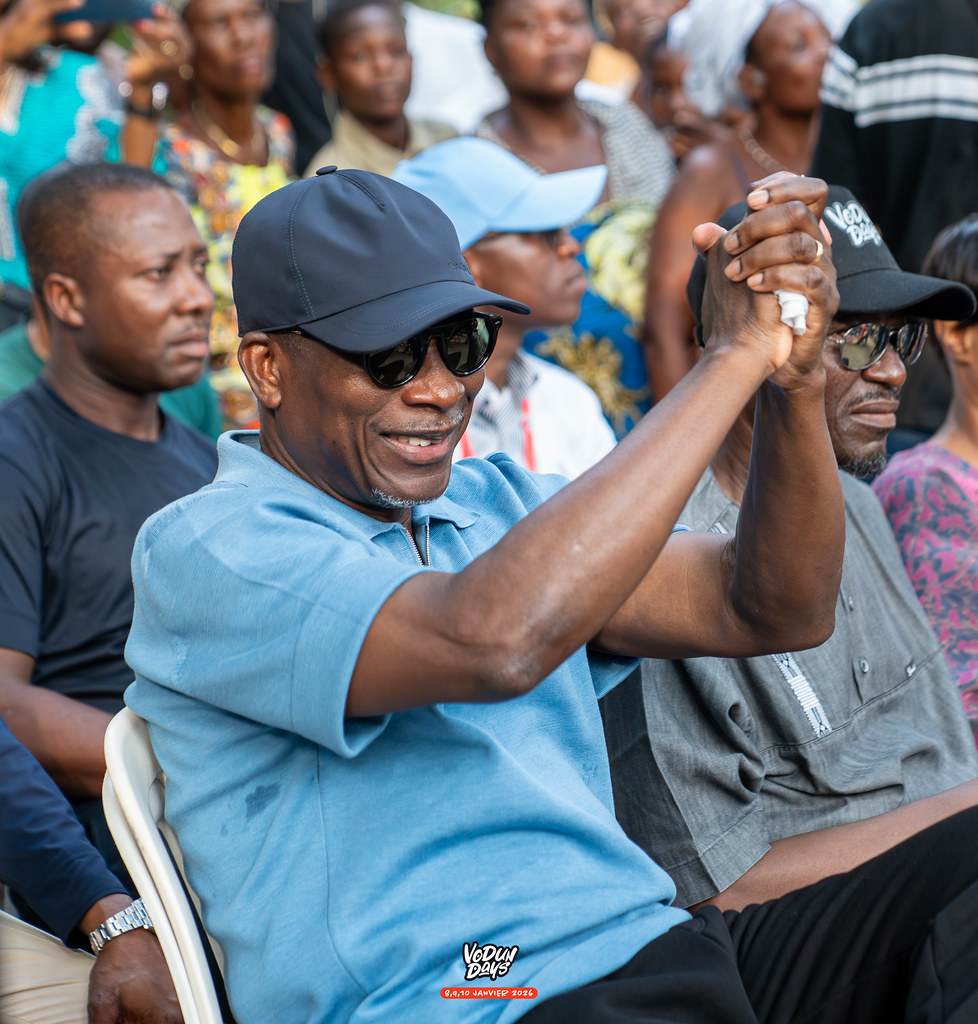
This Easter Monday 2026, festival-goers at the Ouidah Blue Festival enjoying the Djègbadji coastline were treated to an unexpected surprise: the presence of Benin's President, Patrice Talon, on the beach — no motorcade, no protocol, simply walking among the crowd.
But it was a single sentence spoken in that moment that traveled far beyond the festival grounds:
"At the end of my mandate, I intend to come and settle in Ouidah."
A simple declaration, made in the relaxed atmosphere of an Easter Monday beside the Atlantic. And yet, for those who know Ouidah — its layers of history, its symbolic weight, its singular relationship with power and memory — these words carry considerable significance.
Djègbadji: Scene of an Unexpected Meeting
The Head of State had been staying in the historic city for several days when he decided, spontaneously, to walk down to the beach at Djègbadji. Warmly welcomed by those present, he shook hands, exchanged words, and offered his Easter greetings.
No official speech. No podium. Just a head of state who chose, for a few hours, to blend into the living fabric of the city.
This image — the President at Djègbadji, a few steps from the sea that swallowed millions of enslaved men and women — is not a neutral one. In a city where history is everywhere, every gesture carries meaning.
Ouidah: More Than a Retirement
Should Patrice Talon follow through on this intention, his settling in Ouidah would be far more than a residential choice. It would be a signal.
For centuries, the city has been a crossroads of civilizations — the Slave Route, the Door of No Return, the vodun temples, the Afro-Brazilian architecture of the Agoudas, the Basilica of the Immaculate Conception. It is a city where layers of time overlap at every street corner, where world history was made and continues to unfold.
To choose Ouidah as a home after power is to choose a form of continuity — with Benin's heritage, with Africa's memory, with the diaspora that keeps returning to these shores.
A City in Transformation
This declaration comes at a particular moment. Ouidah is reinventing itself. Investment in cultural tourism is accelerating; international festivals (Vodoun Days, Ouidah Blue Festival) draw a global audience each year; and the reconstruction of the Door of No Return signals a clear political will to place the city at the heart of the African diaspora's narrative.
That the head of state himself would express the desire to end his days here only reinforces this momentum.
Institutionalising Change
Talon's lasting contribution lies not only in unlocking budgets, but in building durable institutions — most notably the ANPT (National Agency for Heritage Promotion and Tourism Development), which provides the administrative backbone for what might otherwise remain a series of one-off projects.
- The Ouidah 2027 Plan: A strategic document setting long-term objectives for the transformation of the historic city — from road infrastructure to heritage digitisation.
- The Concessions Model: To ensure the sustainable maintenance of flagship sites such as the Golf Club or the Club Med at Avlékété, the State favours long-term partnerships with private operators — a model that has drawn international investors to a coastline that, a decade ago, was largely underdeveloped.
For economic analyses of project viability in Benin, see reports from the IMF (nofollow) or the World Bank (nofollow).
One Sentence, One Symbol
Patrice Talon is still in office. His final choice will remain his own. But in a city like Ouidah, words spoken aloud have a tendency to take root.
That Easter Monday on the beach of Djègbadji, between the sound of waves and the rhythms of the festival, something was said. And Ouidah — a city that forgets nothing — will remember it.
- An unexpected declaration on the beach of Djègbadji
- During the Ouidah Blue Festival, the Beninese President confided that he wants to make his home in the sacred city when his term ends
- A choice that, if confirmed, carries deep symbolic weight