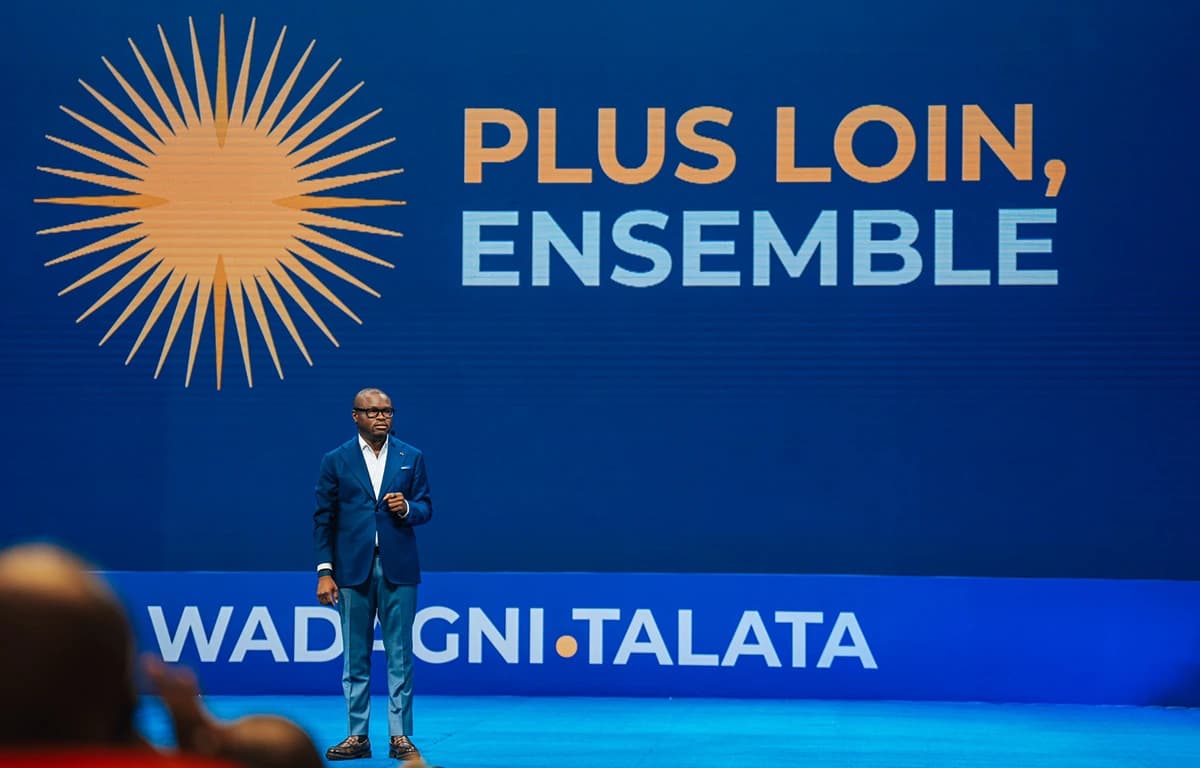
Patrice Talon announced, on Djègbadji beach during the Ouidah Blue festival, that he wished to settle in Ouidah after the end of his term.
It was a strong symbolic gesture. Significant. And a bit ironic: the man who committed more than a billion dollars to the cultural and tourist transformation of Benin chooses, for his retirement, the city that has been the center of gravity for all this investment.
But Talon's declaration does not change what is now the central political equation for Ouidah: since the presidential election of April 2026, Benin has a new president. And the question that deserves to be asked—honestly, without surface optimism or pessimism—is this: what continues, and what is at risk of stopping?
What Talon Built
To understand the stakes, one must first measure the scale of what was committed under his presidency.
Since 2016, the Talon government has invested approximately 1,250 billion CFA francs in culture, tourism, and the arts. This figure is not abstract. It translates into concrete projects: the MIME being finalized in the Portuguese Fort of Ouidah, four museums under construction or open across the country, the 26 works returned by France, the Avlékété Golf Club, the Club Med partnership, the Bateau du Départ, the Vodun Days which grew from 97,000 visitors in 2024 to over 700,000 in 2026, and the citizenship program for Afro-descendants.
All of this is linked to a precise political vision: making culture and memorial tourism the second pillar of the Beninese economy, after agriculture. And making Ouidah—not Lagos, not Abidjan, not Accra—the center of gravity for this positioning.
It is an ambitious vision, coherent over ten years, and largely fulfilled.
The Real Risk
The risk is not that Talon's successor will destroy what has been built. The infrastructures are there—physically, legally, institutionally. The MIME will be inaugurated. The Golf Club will open. The Bateau du Départ is already in service.
The risk is more subtle: that the strategic vision that gives meaning to these investments disappears with the one who carried it.
A hotel complex, a museum, a memorial path—all of this can function technically without a political vision behind it that says why it's there and for whom it's made. The difference between a tourist attraction and a cultural act is the intention that inhabits it. And intentions change when governments change.
Concretely: will Vodun Days continue to receive the same budgetary support? Will the naturalization program for Afro-descendants be maintained and expanded? Will discussions on the restitution of remaining works in European museums continue at the same level? Will the ANPT retain the same mandate and resources?
What Continuity Means Structurally
There is good news in this question: a large part of Beninese cultural investment is now co-financed by international institutions that have their own schedules and commitments.
The French Development Agency (AFD) has committed 35 million euros to the Abomey museum. The World Bank is financing 240 million dollars for coastal protection. UNESCO maintains its partnership on the Slave Route. These commitments do not stop with a change of presidency.
Likewise, the partnership with Banyan Group for Dhawa Ouidah, the management contract for LAGO Avlékété S.A. for the Golf Club, and the Club Med concession—these agreements have durations and contractual obligations independent of the Beninese political calendar.
What can change: the political priority given to this sector in the national budget. The level of personal commitment of the head of state in the international promotion of Benin as a cultural destination. The speed of implementation for projects still in the development phase.
Talon in Ouidah: A Signal
There is something important in Talon's retirement declaration on Djègbadji beach.
A president who chooses to spend his retirement in the city he transformed is not disengaging. It is, in a way, a form of embodied continuity. An informal but real presence in Ouidah's cultural space, regardless of the color of the government that succeeds him.
Ouidah has seen many ambitions pass. Some have stayed. The Slave Route has existed since 1992. The Door of No Return since 1995. Vodun Days since 2024. The Bateau du Départ since 2026.
What is built remains. What remains attracts. What attracts generates resources. And resources create, in turn, their own logic of continuity—independent of the political decisions of the moment.
For the visitor planning a trip to Ouidah in 2027 or beyond: the transformation of the city is advanced enough to be sustainable. The flagship projects will be open. The experience will be there.
The question of whether Benin will maintain the same level of cultural ambition under a new presidency is real. But it does not change what is now visible, standing, and open on Djègbadji beach.
Restitution 2.0
Ouidah Origins is more than a travel resource; it is an infrastructure for memory. Read our manifesto on why we believe the Slave Route is not a tourist attraction.
Read the ManifestoEditorial transparency
This content was developed with the assistance of our AI agents.