
There are two ways to get from Cotonou to Ouidah.
The first is the inland highway — the RN1, fast and functional. The second is the Route des Pêches. It takes longer. It requires more patience. It is worth it entirely.
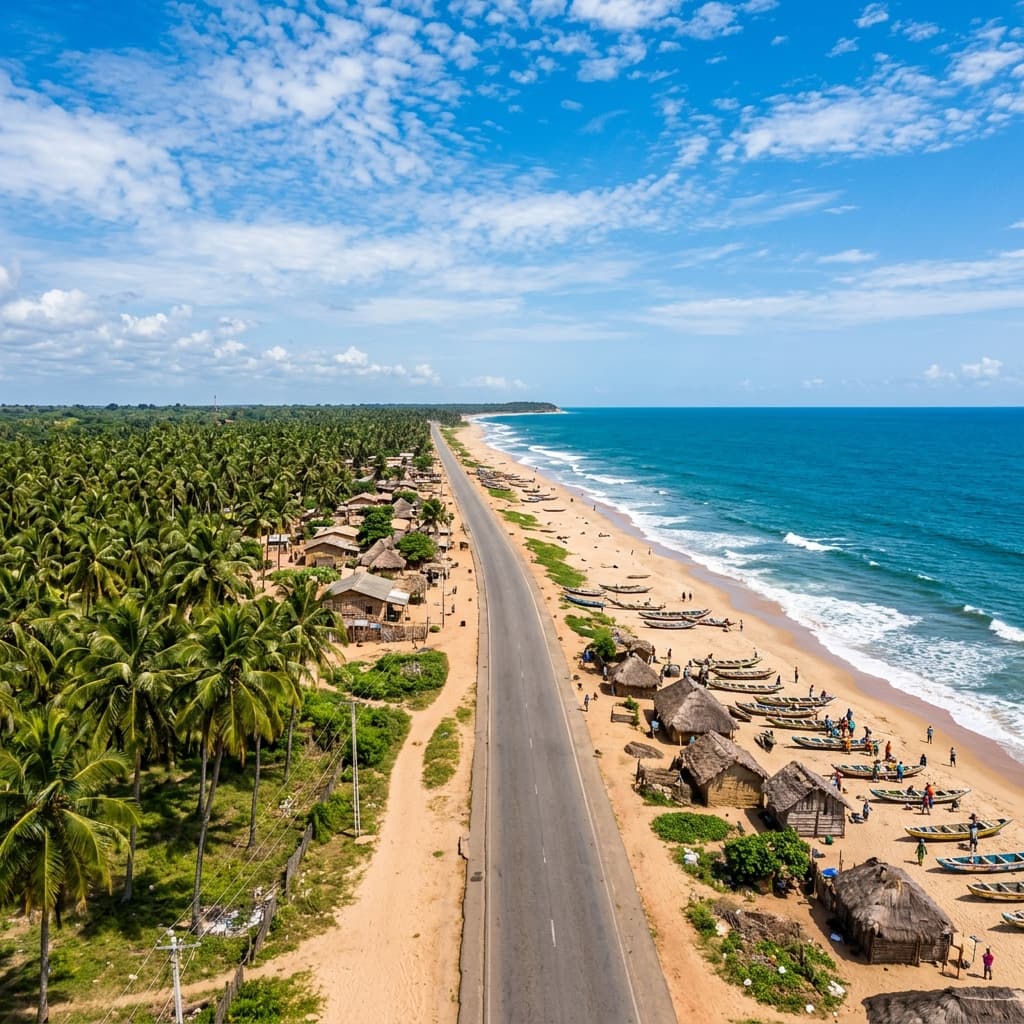
The Route des Pêches — the Fishing Road — runs approximately 40 kilometers along Benin's Atlantic coast, following the narrow strip of land that separates the ocean from the network of lagoons. It connects Cotonou's western edge to Ouidah, passing through a landscape that compresses most of what makes this part of West Africa unique.
What the road looks like
On one side: the Atlantic. Not a calm ocean, but the full force of the West African coast with large, constant waves. The beach is wide and largely empty, filled with fishing boats hauled out between the water and the treeline.
On the other side: coconut palms, dense vegetation, and the Agouin lagoon. Through gaps in the greenery, you catch flashes of still water and reflected sky.
Between the two is the road itself. Historically a sandy track, it is currently being transformed as part of a major infrastructure investment. Paved sections now occasionally give way back to sand, making for a journey that feels like a transition between two eras.
The villages are small and frequent. You'll see the boats going out before dawn, the nets coming in, and the women selling the catch at improvised roadside markets.
What you encounter along the way
The Route des Pêches is a cultural transect through coastal civilization — the Ouidah beaches guide covers its shoreline stop by stop.
- Adjahouta: Home to the Grand Vodun Temple of the Light (Temple de la Lumière). Led by Dah Bokpè, it is a colorful, mural-covered center of worship and community.
- Local Markets: Compressed views of the coastal economy where the integration of fishing, commerce, and spiritual practice is visible every few kilometers.
- Avlékété: The striking juxtaposition of a traditional fishing village on one side of the road and the emerging infrastructure of international luxury tourism (Ouidah Golf Club) on the other.
How to travel it
- Motorcycle (Zemidjan): Still the best way for a sandy-road experience. Takes 2-3 hours with stops.
- Bicycle: For the adventurous. Physically demanding due to sandy sections but offers complete freedom.
- Car: Recommended only for the paved sections or with a 4WD for the remaining sand.
- On Foot: The Route des Pêches à la Marche is an annual event in late August covering 32km with thousands of participants.
What the road is becoming
The Route des Pêches is transforming. The government's tourism plan designated Avlékété as the center of a major resort zone. Paving and new infrastructure are changing the road's character.
The version of the road that exists right now — still partly sand, still full of fishing villages going about their business — is worth experiencing before the transformation is complete. It is a road that rewards the traveler who isn't in a hurry.
Practical Travel Advice for Ouidah
When planning your visit to the historical and Vodun sites of Ouidah, it is essential to keep a few practical considerations in mind. The city is best explored with a local certified guide who can provide accurate historical context and help you navigate the delicate customs surrounding active shrines and sacred spaces. Always ask for permission before taking photographs of individuals, shrines, or during public rituals. Respecting the local communities and their living traditions ensures a mutually beneficial experience. Additionally, wearing light clothing and carrying sufficient bottled water will keep you comfortable during your walking tours along the Route of the Slaves and around the historic quarters. For currency, while the West African CFA franc (XOF) is the local currency, carrying small denominations is highly recommended for purchases at local artisanal markets and when tipping local guides.
- The Route des Pêches is a 40km scenic coastal route connecting Cotonou and Ouidah.
- The landscape features the Atlantic Ocean on one side and lagoons/coconut palms on the other.
- Ongoing infrastructure projects are transforming the sandy track into a paved coastal highway.
- Traveling by motorcycle (zemidjan) remains the most immersive way to experience the route's fishing villages.