

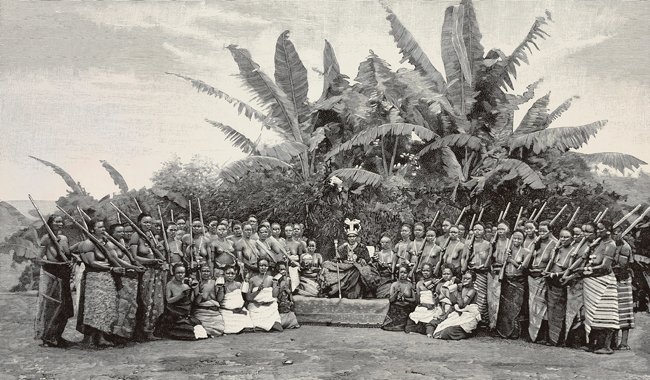
In 1892, a French military column marched toward Abomey. About fifty kilometers from the Dahomean capital, it was blocked by an army armed with Winchester rifles and blades. The soldiers prepared for battle. Then they looked closer and realized the opposing army was made up of women.
French military archives document that moment of shock. The soldiers later wrote about the "incredible courage and audacity" of these warriors. They called them the "Amazons of Dahomey" because they had no other term for what they were seeing.
But these women did not need the Greeks' name. They had their own: Agojie. Or Mino — "our mothers" in Fon.
Before the film, there was the history
In 2022, The Woman King brought the Agojie to global audiences. Millions discovered that in precolonial Africa there had been a real, trained, organized, feared all-female army.
What the film cannot fully show is the depth and duration of that history. The Agojie did not exist for just a few heroic years. They existed for more than two centuries, from the late seventeenth century until Dahomey's defeat by France in 1894. Their legacy still shapes Beninese identity today.
Before you visit Benin, before you walk the Slave Route in Ouidah or enter the royal palaces of Abomey, understanding the Agojie is essential.
Origins: from elephant hunters to elite soldiers
The Agojie story begins with the gbeto — a corps of female elephant hunters created under King Houegbadja. They brought meat and ivory to the king and already had reputations for physical strength and independence.
But it was a woman who transformed these hunters into soldiers. That woman was largely erased from official history.
Tasi Hangbe — also called Nan Hangbe — was the twin sister of King Akaba. When her brother died suddenly in 1708, she took the throne and ruled Dahomey from 1708 to 1711. She was the only woman ever to rule Dahomey — and according to the strongest sources, the true creator of the Agojie military corps.
During her short reign, she trained women for combat and integrated them into the kingdom's standing army. When her successor Agaja overthrew her, official memory suppressed her. But the corps she created survived and grew.
Under Ghézo: the apex
Under King Ghézo, the Agojie reached their full power and definitive organization.
Ghézo made the army the backbone of the state. He expanded its budget and structure, and the Agojie benefited from that investment. They received official uniforms and were equipped with Danish rifles obtained through the slave trade.
At its height, the corps counted between 4,000 and 6,000 women, roughly a third of Dahomey's entire army. They were organized into specialized brigades: close combat, rifle fire, offensive operations, and enemy pursuit. They were led by generals appointed directly by the king.
Every minister and major court dignitary also had a female double — an Agojie attached to that office as a kind of counterweight in state affairs. The Agojie were not only soldiers. They were a political counterbalance at the heart of the kingdom.
Recruitment and training
How did one become an Agojie?
Sources describe several paths. The main one: every three years, the king's subjects had to present their daughters before a royal review council. Selected candidates, usually around sixteen, left their families and entered the king's household. Some came from enslaved backgrounds and were freed into the royal harem. Others were noble daughters seeking social advancement.
Some volunteered. Others were recruited by force.
Once inside the corps, training was intense and unforgiving. Daily physical training included endurance, hand-to-hand combat, and weapons handling. The Agojie trained in guerrilla tactics, surprise attacks, and ambushes. In close combat, their area of excellence, "no man could withstand them," according to French testimony.
Their discipline was strict. Celibacy was mandatory during service. The Agojie were considered symbolic wives of the king. They never went out without their gris-gris and amulets. The Mino corps had a semi-sacred status, deeply tied to Fon Vodun belief.
They had their own military insignia, their own band, their own war songs, and their own place in royal parades. They were soldiers, politicians, and spiritual figures at once.
On the battlefield
The Agojie fought on every Dahomean military front for two centuries. Their victories were many — against neighboring kingdoms, during slave-raiding campaigns, and in territorial wars.
But they also suffered heavy defeats. In 1851 and 1864, battles against Abeokuta inflicted massive losses.
The battles against France made them legendary.
In January 1890, the Agojie launched a surprise attack on the French garrison at Cotonou. The French were not prepared and suffered serious losses.
In 1892, during the second Dahomean war, the Agojie fought in the major battles of Dogba, Kana, and Kpokissa. They charged French lines with bayonets, held positions under machine-gun fire, and only retreated when encirclement became total. On October 26, 1892, about fifty kilometers from Abomey, they stopped the French advance armed with Winchester rifles and blades.
French technological superiority ultimately won. But the Agojie resistance left a lasting mark on French military memory.
Dissolution and survivors
On November 17, 1894, Dahomey was placed under French protectorate. The new ruler imposed by the French dissolved the Mino corps. The surviving Agojie returned to their families and faded into anonymity.
The last known survivor was Nawi. In 1978, a Beninese historian met her in the village of Kinta. She said she had fought the French in 1892. In November 1979, Nawi died, carrying the last living memories of what it meant to be an Agojie.
The Woman King, Black Panther, and global cultural legacy
The Agojie entered global pop culture through several routes. Black Panther paid explicit homage through the Dora Milaje. The Woman King brought their story to cinema worldwide. Part of the film was shot in the Royal Palaces of Abomey.
Jules Verne had already referenced them in Robur the Conqueror. UNESCO published a comic book about them. Their story moved across centuries, borders, and media.
The forgotten queen: Tasi Hangbe
One angle rarely covered: Tasi Hangbe is at the center of a historical rehabilitation effort in Benin.
Erased from official memory by Agaja, she has been rediscovered by Beninese historians. Today, her name is tied to the revaluation of women's place in Dahomean history.
Where to find the Agojie trace in Benin
In Abomey: the Royal Palaces Museum of Abomey is the central site for understanding the Agojie. Royal tapestries show battle scenes in which they fight alongside kings.
In Cotonou: the Esplanade of the Amazons and its monumental statue have become one of the country's most photographed sites.
In Ouidah: the Agojie appear in Dahomey's military history and in the narratives linking the coast to the royal court inland. For context, read our Kingdom of Dahomey article and our practical Vodun Days guide.
What the Agojie tell us about precolonial Africa
It is tempting to tell the Agojie story as an exception. That would miss the point.
The Agojie are not an exception. They are proof that precolonial African societies had political, military, and social forms that European colonizers could not imagine — and therefore refused to recognize.
They were women who chose, or were chosen. Women who fought. Women who took part in royal politics. Women whose status was semi-sacred and protected by law and religion.
Coming to Benin in the Agojie footsteps is coming to look for that truth.
Restitution 2.0
Ouidah Origins is more than a travel resource; it is an infrastructure for memory. Read our manifesto on why we believe the Slave Route is not a tourist attraction.
Read the Manifesto- The Agojie existed for more than two centuries as Dahomey's elite military corps
- They were soldiers, political counterweight, and spiritual figures within the kingdom