In the center of Ouidah, surrounded by the growing city, is a wall. Behind that wall is another world.
The Sacred Forest of Kpassè is not a park. It is not a botanical garden. It is a four-hectare remnant of the original tropical forest that once covered this coast, preserved for centuries because it is the dwelling place of the spirits.
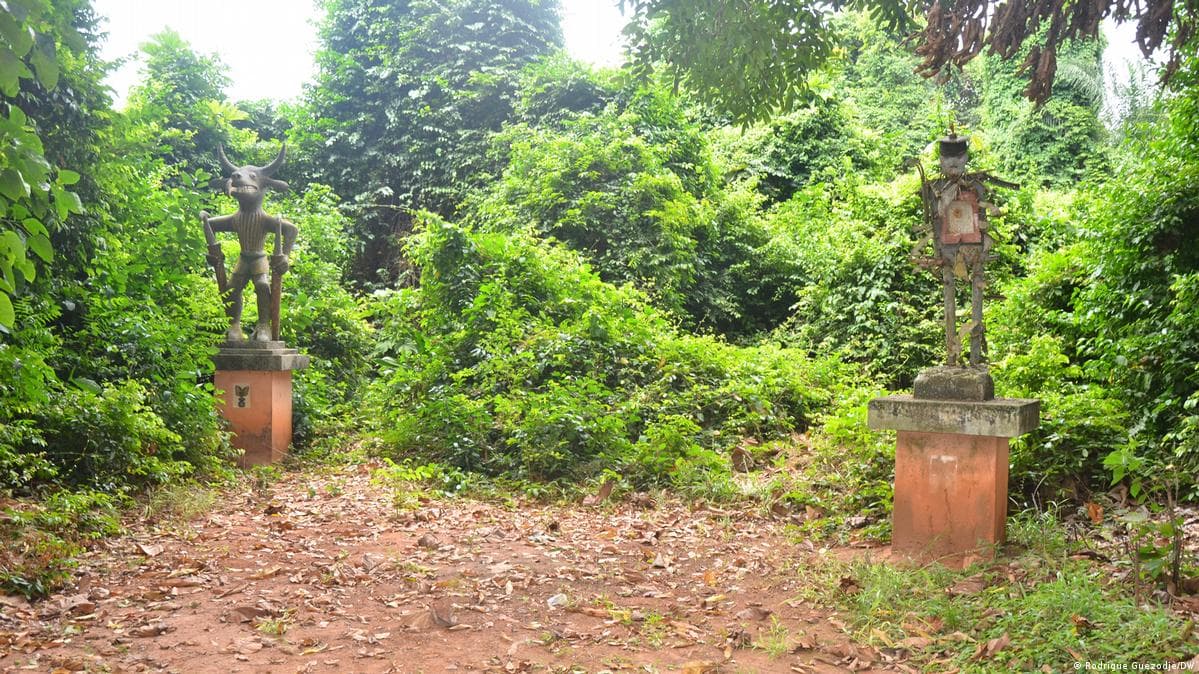
For the visitor, the forest is perhaps the best place to understand the physical and visual landscape of Vodun.
The Myth of Origin
The forest is named after King Kpassè, the second ruler of the Kingdom of Xwéda and the founder of Ouidah in the fourteenth century. According to local history, when the king neared the end of his life, he did not die in the ordinary sense. Instead, he entered this forest and transformed into an Iroko tree to continue protecting his people.
That tree — ancient, massive, and still standing — is the heart of the forest. It is an object of profound veneration. For the people of Ouidah, the king is not a historical figure; he is a living presence within the forest.
A Gallery of the Deities
In the 1990s, the forest was transformed into an open-air gallery of Vodun cosmology through the addition of contemporary sculptures representing the major deities. As you walk the shaded paths, you encounter them:
- Legba: The guardian of the crossroads and the messenger between humans and the spirits. He is often depicted as a powerful, sometimes provocative figure, always at the entrance to sacred spaces.
- Sakpata: The deity of the earth and of infectious diseases (specifically smallpox). He is a spirit of both destruction and purification.
- Héviosso: The deity of thunder and lightning, associated with divine justice.
- Mami Wata: The water spirit, often depicted as a mermaid, governing wealth and the mysteries of the ocean.
- Egungun: The spirits of the ancestors, represented through the elaborate masquerades that appear during festivals.
These sculptures are not just art; they are educational tools and ritual focal points. They provide a face to the forces that govern Ouidah’s spiritual life.
The Forest as Active Sacred Space
While visitors are welcome, it is important to remember that the forest is an active site of religious practice. You will see small altars at the base of trees, spots where offerings have been made, and areas that are clearly cordoned off.
Certain parts of the forest are restricted to the priesthood and initiated devotees. These are the spaces where the most serious ceremonies and initiations take place. The silence of the forest is not the silence of abandonment; it is the silence of concentrated presence.
Visiting the Forest
- Guides: Do not try to walk the forest alone. Local guides are essential to provide the stories behind the sculptures and to ensure you do not inadvertently enter restricted areas.
- Respect: Speak quietly. Do not touch the sculptures or the offerings.
- Offerings: It is appropriate to leave a small offering at the base of the Iroko tree or at one of the altars if your guide suggests it.
- Photography: Photography is generally permitted for the sculptures, but always check with your guide first.
The Sacred Forest of Kpassè is a place of deep shadow and old light. It is where Ouidah’s past and its spiritual present are most visibly entwined. To walk its paths is to walk through a map of the soul of the city.
Practical Travel Advice for Ouidah
When planning your visit to the historical and Vodun sites of Ouidah, it is essential to keep a few practical considerations in mind. The city is best explored with a local certified guide who can provide accurate historical context and help you navigate the delicate customs surrounding active shrines and sacred spaces. Always ask for permission before taking photographs of individuals, shrines, or during public rituals. Respecting the local communities and their living traditions ensures a mutually beneficial experience. Additionally, wearing light clothing and carrying sufficient bottled water will keep you comfortable during your walking tours along the Route of the Slaves and around the historic quarters. For currency, while the West African CFA franc (XOF) is the local currency, carrying small denominations is highly recommended for purchases at local artisanal markets and when tipping local guides.
- The forest is dedicated to King Kpassè, the founder of Ouidah, who is said to have transformed into a tree.
- It serves as a physical gallery of Vodun deities (Legba, Sakpata, Héviosso) through contemporary sculptures.
- The forest is an active sacred space used for ceremonies, offerings, and initiations.
- Visitors are welcome during the day but must be accompanied by a guide to respect restricted areas.