

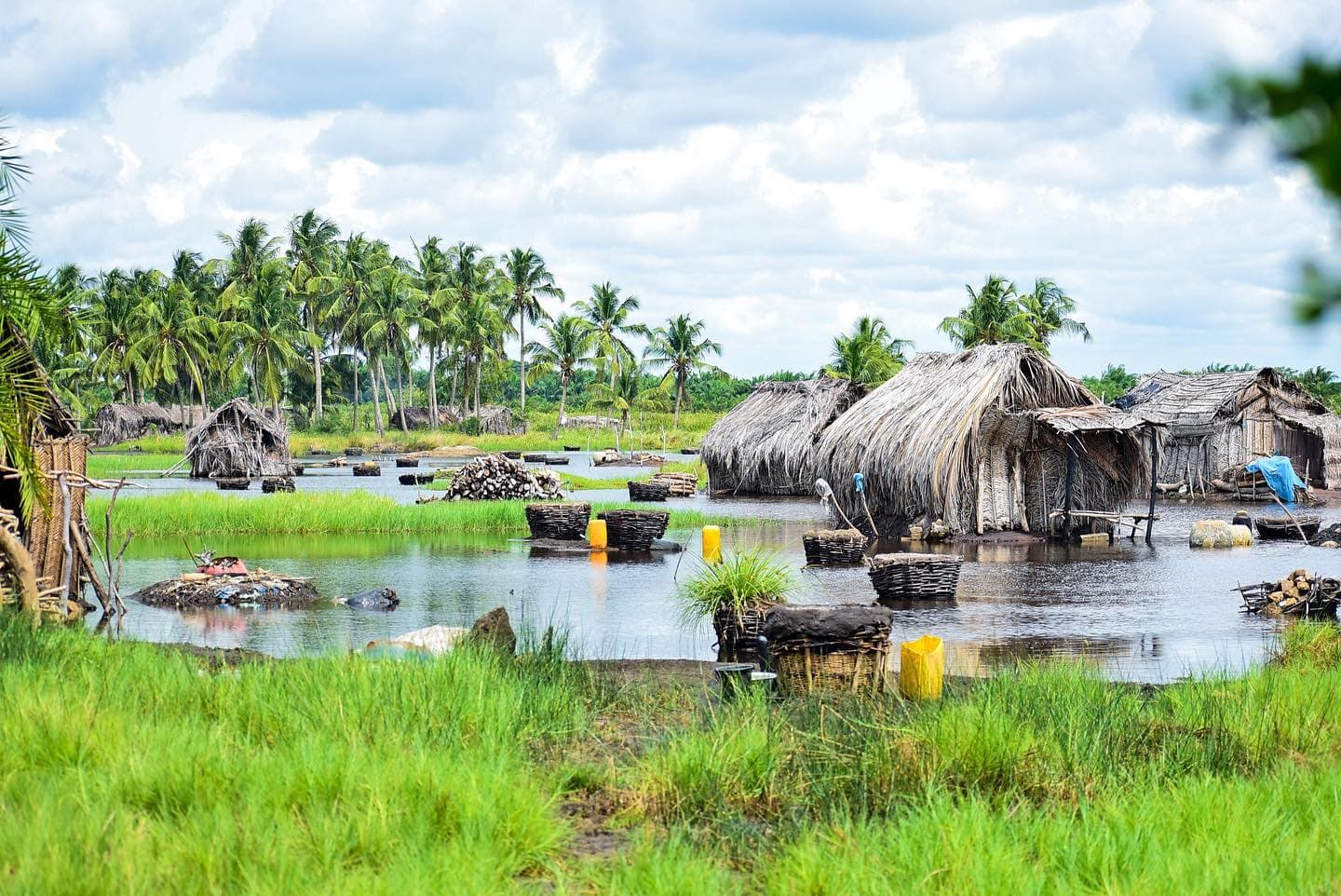
Most people drive straight past it.
The road from Cotonou to Ouidah along the coast passes close to Djègbadji — a small settlement on the edge of Lake Toho, a few kilometers from the Door of No Return. The taxis don't stop there. The standard tour itineraries don't include it. And yet, the guides who know this coast well consistently describe it as the most unexpectedly moving experience in the Ouidah region.
The name itself tells you what the place is. Djègbadji, in the local Fon language, means roughly "salt flats" — or more precisely, "the lowlands of salt." The village has been producing salt by hand, using techniques passed down through generations, for as long as anyone can remember. No factory. No industrialization. The same method, the same tools, the same knowledge — extracted from the lagoon-adjacent soil by women who begin the process before dawn.
It is, in an area dense with monumental history, a place that is simply alive.
How salt is made here
The process begins with the soil itself.
The land around Djègbadji is hydromorphic — waterlogged, saturated with the salt that migrates upward from the lake through capillary action. The women who work here — and it is predominantly women, across all age groups — identify and collect this salt-laden sand from the edges of the lagoon.
The sand is placed in large baskets. Water is poured through it, leaching out the salt and creating a concentrated brine. This brine is then boiled in large clay pots over wood fires, until the water evaporates and the salt crystallizes. The process takes time. The fires need tending. The crystallization needs monitoring — a handful of palm kernels dropped into the boiling brine tell an experienced producer whether the concentration is right.
What comes out at the end is coarse, slightly mineral, completely artisanal salt. The same salt that has been traded from this coast for centuries. The same salt that seasoned the food in the Kingdom of Dahomey's courts.
A 2025 scientific study published in the American Journal of Modern Physics analyzed the capillary mechanics of the Djègbadji salt marshes in detail — the first academic work to examine the underlying physics of this traditional process. The methods that the women of Djègbadji have practiced for generations turn out to be a precise, if intuitive, application of the thermodynamic properties of hydromorphic soil under evapotranspiration pressure. The science caught up with the practice centuries later.
The women of Djègbadji
The village's economy rests on two activities: fishing, done primarily by men in wooden pirogues on Lake Toho, and salt production, done primarily by women.
The division is not incidental. Salt production in Djègbadji is matrilineal knowledge — passed from mother to daughter, grandmother to granddaughter. The clay pots, the baskets, the wood fires, the specific technique of reading the brine — all of this is taught by watching and doing, not by formal instruction.
Several NGOs have worked with the village to try to replace the wood-fired ovens with cleaner-burning alternatives. The environmental impact of the current method — in a mangrove-adjacent ecosystem that the women themselves have worked to preserve — is real. The women of Djègbadji are not unaware of this tension. They manage it, as they manage everything else here, through knowledge accumulated over time.
What strikes visitors most, consistently, is the combination of physical work and knowledge precision. This is not unskilled labor. It is a technical practice that requires reading a landscape, understanding a material process, and managing time and fire simultaneously — while also fishing, while also raising children, while also maintaining the houses built on the water.
Getting there
Djègbadji sits on the edge of the lagoon, accessible by small boat from the main road. There is no bridge. You take a pirogue across a short stretch of water and arrive in a village that the development wave building up around Ouidah has not yet fully reached.
The houses are built on the water — thatched roofs, walls of dried palm leaves, structures that have adapted to the rise and fall of the lake over generations. The village is divided into eight neighborhoods, each with its own social organization.
A guided visit of two to three hours covers the salt production process from start to finish: identifying the soil, the leaching, the boiling, the crystallization. You can talk with the producers. You can buy salt directly from the women who made it.
The best time to visit is early morning — the production is most active before the midday heat. The boats start at dawn.
Why it belongs on your Ouidah itinerary
Most Ouidah itineraries are structured around monuments. The Slave Route. The Door of No Return. The Python Temple. The Sacred Forest. These are irreplaceable, and you should visit them.
But Djègbadji offers something different: a living economy that has nothing to do with tourism, in a place where you are a guest rather than a visitor. The women working here are not performing their tradition for an audience. They are doing their work. Your presence, if you arrive respectfully and with a guide who is known to the community, is absorbed into that.
The stop is often described as unexpected precisely because it does not fit the register of the rest of the Ouidah experience. The memorial sites require you to hold something heavy. Djègbadji simply shows you a community that has been doing the same thing, carefully, for a very long time — and invites you to watch.
That is not nothing. In a region where the history can feel overwhelming, Djègbadji is a breath.
Practical information Location: Edge of Lake Toho, Djègbadji, commune of Ouidah — accessible by pirogue Best time: Early morning (before 9am) Duration: 2–3 hours Access: Via the Route des Pêches, then by boat Guide: strongly recommended — ask the Ouidah Origins concierge for a trusted local contact
Restitution 2.0
Ouidah Origins is more than a travel resource; it is an infrastructure for memory. Read our manifesto on why we believe the Slave Route is not a tourist attraction.
Read the ManifestoEditorial transparency
This content was developed with the assistance of our AI agents.