Key Takeaways
- The Fondation Zinsou was created in June 2005 in Cotonou by Marie-Cécile Zinsou, with her family's support.
- Its Ouidah museum, opened on November 11, 2013, in the Villa Ajavon, is described as the first contemporary art museum in sub-Saharan Africa outside South Africa.
- The Villa Ajavon was built in 1922 by a wealthy merchant from Togo, in an Afro-Brazilian style.
- Admission is free: in 2015, the foundation reported that 80 percent of its visitors were under 20.
- The collection brings together Beninese artists (Cyprien Tokoudagba, Romuald Hazoumè, Gérard Quenum, Dominique Zinkpè) and artists from across the continent.
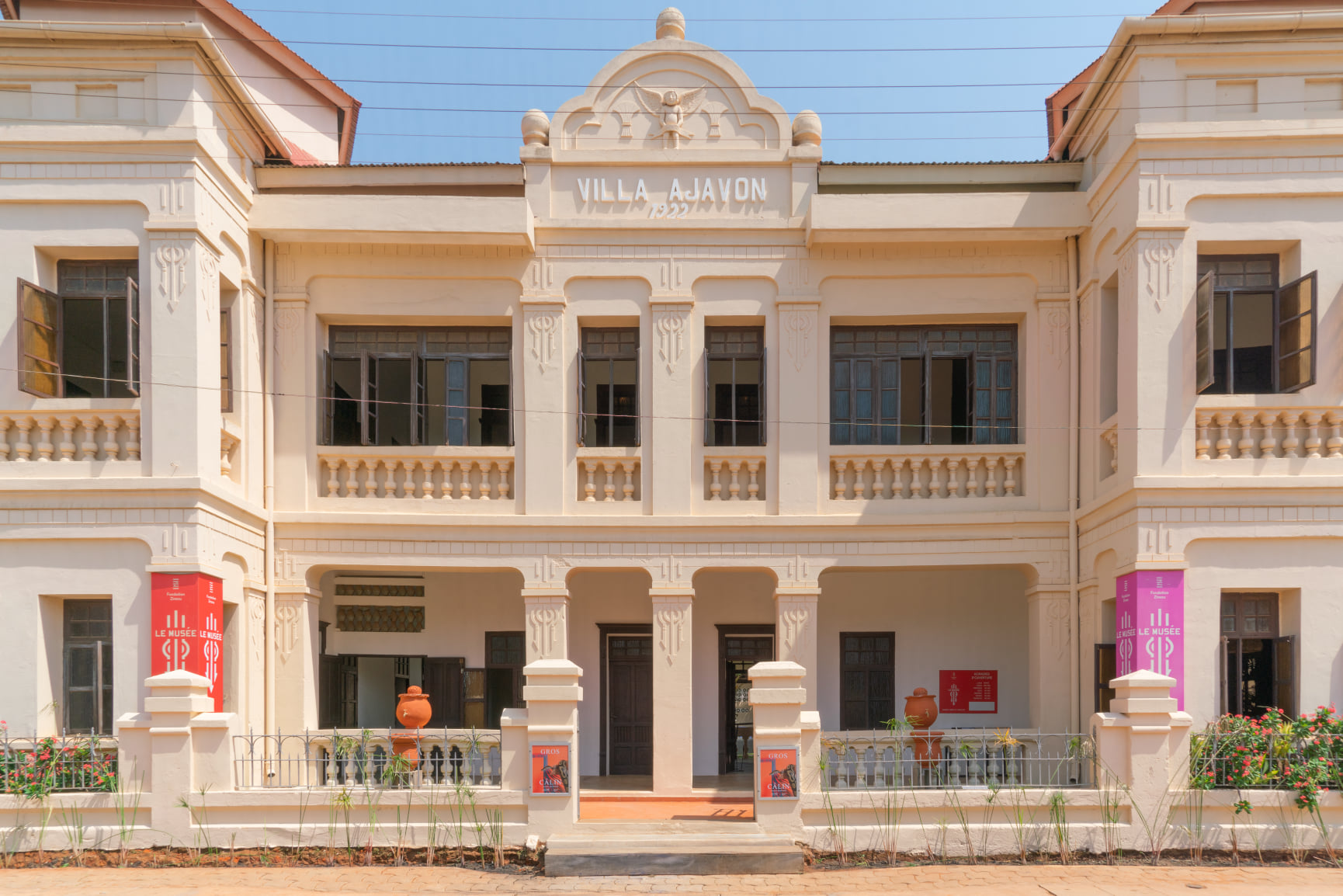
Behind Ouidah's basilica stands a low house with a pale facade, many windows and a scalloped pediment. You enter through a wooden door where two initials, V and A, intertwine. Inside: no ticket desk, no turnstile. Photographs, sculptures, installations, paintings. And often, groups of schoolchildren.
This is the Fondation Zinsou museum, housed since 2013 in the Villa Ajavon. In a town known worldwide for the memory of the slave trade and for vodun, it is a place that looks at today's Africa through its artists.
This pillar tells the story of the foundation and of the villa, what you can see at the museum, and why free admission is at the heart of the project.
A contemporary art museum in Ouidah
The Fondation Zinsou museum opened on November 11, 2013. Wikipedia describes it as the first contemporary art museum in sub-Saharan Africa outside South Africa. It is, in any case, the first of its kind in Benin.
It shows photography, sculpture, installation, video, painting, drawing and lithography. The works often deal with memory, tradition and the way today's artists rewrite them.
Admission is free. That is a founding choice, not a detail.
The foundation, from Cotonou to Ouidah
The Fondation Zinsou was created in June 2005 in Cotonou by Marie-Cécile Zinsou, with her family's support, including her father, the economist Lionel Zinsou, later prime minister of Benin, and her great-uncle Émile Derlin Zinsou, a former president of Dahomey.
Its ambition was clear: to share the continent's artistic creation as widely as possible. The foundation does not sell the works it shows, as a gallery would; it builds a collection, organizes exhibitions and exchanges with other institutions.
The first exhibitions, in June 2005, featured Beninese artist Romuald Hazoumè and photographer Jean-Dominique Burton. Over the years, the foundation built a whole educational program:
- 2005: launch of the "Les Petits Pinceaux" (Little Brushes) children's workshops;
- 2009: opening of the Gbegamey mini-library in Cotonou, and launch of a cultural bus;
- 2011 and 2012: new mini-libraries in Akpakpa, Fidjrossè and Agla;
- 2015: launch of "Wakpon, le musée fait le mur," a mobile app;
- 2021: opening of the Cotonou LAB.
According to Wikipedia, within eight years the foundation had gathered about 1,000 works, organized 24 exhibitions and published 17 art books. In 2015, it employed 63 people, with an annual budget of 800,000 to one million euros, funded by private patronage.
The Zinsous, a Beninese family
The Zinsou name is well known in Benin, and its history sheds light on the foundation.
Émile Derlin Zinsou, the founder's great-uncle, was president of the Republic of Dahomey from 1968 to 1969, a period of political instability marked by coups. He remained a figure in Beninese public life for decades, until his death in 2016 at the age of 98.
Lionel Zinsou, the founder's father, was born in Paris in 1954. An economist and investment banker in France, he was appointed prime minister of Benin in June 2015. In 2016, he ran for president; Patrice Talon won in the runoff.
The foundation was thus born in a family that is both Beninese and French, at the crossroads of politics, economics and culture. That also helped it raise significant private patronage. Its project, however, has stayed focused on art and audiences.
Marie-Cécile Zinsou
Marie-Cécile Zinsou was born in Paris in 1982. She studied art history at the American University of Paris. According to Wikipedia, the Ouidah museum grew out of a promise she made in 2003 to Beninese art students: to show them contemporary works from their own continent, which they had only seen in reproduction.
Her work has been recognized several times. In 2014, she was made a Chevalier of the Order of Arts and Letters, and the Fondation Zinsou received a grant from the Praemium Imperiale of the Japan Art Association, which supports young artists and institutions. In 2020, she sat on the jury that chose Kapwani Kiwanga for the Marcel Duchamp Prize. In October 2021, she was appointed president of the board of the Villa Medici, the French Academy in Rome.
Why Ouidah?
After eight years in Cotonou, the foundation chose Ouidah for its museum. The choice was not random.
Ouidah is the town of the memory of the slave trade, the Slave Route and the Door of No Return. It is also a town of vodun, with the Temple of Pythons and the Kpassè sacred forest. Putting a contemporary art museum here says that the town's story is not only about the past, and that its people, especially the young, are entitled to the art of their own time.
The choice was also practical. Ouidah is only about 45 kilometers (28 miles) from Cotonou, the economic capital, by paved road. Schools from Cotonou, Ouidah and neighboring towns can visit in a day, and foreign travelers, almost all of whom come to Ouidah for the Slave Route, find the museum on their way. It speaks to two audiences at once: young Beninese and visitors from around the world.
The opening exhibition in 2013 brought together African and international artists, including Romuald Hazoumè, Malian photographer Malick Sidibé and Cameroonian photographer Samuel Fosso.
The Villa Ajavon
The museum occupies the Villa Ajavon, built in 1922 for a wealthy merchant named Ajavon, originally from Togo, who had settled in Ouidah. It is a single-story house set on the street, in an Afro-Brazilian style blended with colonial influences.
According to the foundation, its main facade is symmetrical, with many openings, topped by a polylobed pediment. The wooden door frames bear the intertwined initials V and A, and the pilasters are decorated with circular motifs. The whole, the foundation says, recalls the houses of Salvador, Bahia.
The villa tells another chapter of Ouidah's history in its own way. After the end of the slave trade, in the 19th century, the town became a major exporter of palm oil. Prosperous merchants, many from other towns along the coast, and the Afro-Brazilian Aguda community built houses borrowing from Brazil's architectural vocabulary. Our pillar on the Brazilian legacy covers this in detail.
The villa was renovated to house the museum, while preserving its original features.
The collection
The foundation's collection brings together Beninese artists of every generation and artists from across the continent.
Among the Beninese artists in the collection:
- Cyprien Tokoudagba (1939-2012), painter and sculptor from Abomey, who made most of the artworks along the Slave Route;
- Romuald Hazoumè, known for his masks made from plastic gasoline cans;
- Gérard Quenum, Dominique Zinkpè, Kifouli Dossou, Emo de Medeiros.
Among artists from other countries: photographers Malick Sidibé (Mali) and Samuel Fosso (Cameroon), Ivorian artist Frédéric Bruly Bouabré, Congolese painter Chéri Samba, South African artist Zanele Muholi, Congolese photographer Sammy Baloji, Tunisian artist Aïcha Snoussi, and the visual artist Bruce Clarke.
Exhibitions change regularly. According to Wikipedia, the museum has shown, among others, Malagasy artist Joël Andrianomearisoa in 2017 and Beninese photographer Ishola Akpo in 2020.
Seven artists to know before you visit
Exhibitions change, but some names come up often in the collection. Knowing a little about them makes the visit richer.
Romuald Hazoumè, the jerrycan masks
Born in 1962 in Porto-Novo, Romuald Hazoumè began in the mid-1980s a series of masks made from plastic gasoline cans, the jerrycans used all over Benin to carry fuel smuggled in from Nigeria. Cut, pierced and adorned, they take on the look of traditional masks. They are funny, beautiful and political at once.
His installation La Bouche du Roi, named after a place on the Beninese coast, recreates the plan of a slave ship with hundreds of cans arranged like captives. The British Museum acquired it in 2007, for the bicentenary of the abolition of the British slave trade. The same year, Hazoumè received the Arnold Bode Prize at documenta 12 in Kassel. It was his work that opened the Fondation Zinsou's first exhibitions in 2005.
Cyprien Tokoudagba, the painter of the palaces
Cyprien Tokoudagba (1939-2012), from Abomey, spent years restoring the bas-reliefs of the royal palaces of Dahomey. His work, with its stylized figures and bold colors, draws on royal and vodun imagery. International audiences discovered him at the Magiciens de la Terre exhibition in Paris in 1989. His style runs all along the Slave Route, where he made most of the artworks.
Malick Sidibé, the eye of Bamako
Born in 1935 in Mali, Malick Sidibé photographed Bamako's youth from the 1950s to the 1970s: dances, parties, studio poses, bell-bottoms and vinyl records. In 2007, he became the first photographer and the first African to receive the Golden Lion for Lifetime Achievement at the Venice Biennale. He died in 2016.
Samuel Fosso, self-portrait as history
Born in 1962 in Kumba, Cameroon, Samuel Fosso opened his own photo studio in Bangui, in the Central African Republic, while still a teenager. Using the last frames on his rolls of film, he made self-portraits in which he staged himself. He turned that into a lifetime's work: taking on characters and figures from African history, he questions identity, power and memory.
Frédéric Bruly Bouabré, a visionary's alphabet
On March 11, 1948, the Ivorian Frédéric Bruly Bouabré (1923-2014) had a vision that shaped the rest of his life. He invented an alphabet for the Bété language, made of hundreds of small pictograms drawn on cards, and devoted thousands of drawings to "knowing the world." His small cards in pen and colored pencil now hang in major museums.
Chéri Samba, painting that speaks
Born in 1956 in the Democratic Republic of the Congo, Chéri Samba is one of the great figures of Kinshasa's "popular painting." His brightly colored canvases, often with text, comment with humor on urban life, politics, money, AIDS and the place of African artists in the global market. You read his paintings as much as you look at them.
Zanele Muholi, visual activist
South African photographer Zanele Muholi describes themself as a visual activist. Their work documents and celebrates the lives of Black LGBTQIA+ people in South Africa. The self-portrait series Somnyama Ngonyama ("Hail the Dark Lioness") made Muholi known worldwide.
Seeing these artists in Ouidah, in a house from 1922, carries a particular meaning. Many of them speak, each in their own way, about memory, identity and power. Those are the very questions the town raises.
If you have already met some of these artists in American museums, the Ouidah museum offers the reverse view. Samuel Fosso's work, for instance, was the subject of a major exhibition, "Affirmative Acts," at the Princeton University Art Museum, and Romuald Hazoumè's "Fâ" series was shown at the Neuberger Museum of Art at SUNY Purchase. Here, you see them at home, in front of a Beninese public.
Cosmogonies: the collection on tour
The Zinsou collection does not stay in Ouidah. It travels.
In summer 2021, the MO.CO. Hôtel des collections in Montpellier, France, presented "Cosmogonies. Zinsou, an African collection," through October 10, 2021. It brought together nearly 110 works by 37 artists from several generations, including Frédéric Bruly Bouabré, Cyprien Tokoudagba, Malick Sidibé, Chéri Samba, Zanele Muholi, Ishola Akpo, Sammy Baloji and Aïcha Snoussi.
The exhibition showed that a collection built in Africa, by an African institution, could travel to European museums, rather than the other way around. In the context of the restitution debate, that reversal carried real weight.
Free admission as a philosophy
Why is admission free? Because the foundation wants to reach local people first, especially the young, for whom even a modest ticket would be a barrier.
The bet paid off. In 2015, according to Wikipedia, 80 percent of the foundation's visitors were under 20. School groups, children's workshops and mini-libraries are part of the same project: making art something familiar, not a luxury for an elite or for tourists.
For foreign visitors, that changes the experience. There is a good chance you will share the rooms with Ouidah schoolchildren, looking at the same works as you, with their own questions.
The museum and the restitution debate
The Ouidah museum opened at a time when Africa was calling ever more loudly for the return of its heritage.
In 1892, during the conquest of Dahomey, General Alfred Dodds's troops looted the royal palaces of Abomey. Among the objects taken to France, 26 royal treasures were kept at the Musée du quai Branly in Paris. Their restitution was signed at the Élysée Palace on November 9, 2021, by Presidents Emmanuel Macron and Patrice Talon.
In Benin, the 26 works were shown at the Palais de la Marina, the presidential palace in Cotonou, in the exhibition "Art of Benin, Yesterday and Today: From Restitution to Revelation," from February 2022, across more than 2,000 square meters, alongside works by contemporary Beninese artists.
That dialogue between royal objects and contemporary art is one the Fondation Zinsou had been practicing for years. Marie-Cécile Zinsou was also one of the voices in the public debate about keeping African art in Africa and about African audiences' access to their own heritage.
Ouidah, a town of artists
The Fondation Zinsou museum is not Ouidah's only art venue. The town is also an open-air gallery of the last thirty years of Beninese art:
- more than 27 artworks, mainly by Cyprien Tokoudagba, line the Slave Route;
- the Kpassè sacred forest holds sculptures of vodun deities;
- the Door of No Return, rebuilt in 2025, carries more than 200 sculptures by Fortuné Bandeira.
Visiting the museum after those places shows how contemporary artists engage with the same history in other forms: photography, installation, video.
Visiting the museum
- Address: Villa Ajavon, behind the Basilica of the Immaculate Conception, in central Ouidah.
- Admission: free.
- On site: guides, Wi-Fi, a shop where some works are for sale, restrooms. Photography is allowed.
- Good to know: there is no dedicated parking. Check opening hours and the current exhibition on the foundation's website before you go.
- Time: allow about an hour.
The museum pairs easily with the other sites downtown: the Temple of Pythons and the basilica are a few minutes' walk away, as are the Slave Route and the Portuguese Fort. After a morning devoted to the memory of the slave trade, the villa offers another view, turned toward today's Africa.
Getting there and fitting it into your day
Most visitors come to Ouidah from Cotonou, where the international airport is. The drive along the coastal highway takes around an hour, depending on traffic, by taxi, rental car with driver, or shared taxi. Once in Ouidah, the town center is compact: the Villa Ajavon, the basilica, the Temple of Pythons and the old auction square where the Slave Route begins are all within walking distance of each other, and motorcycle taxis (zem) can take you anywhere else for a small fare.
A good rhythm for a first visit is to start early with the Slave Route, while it is still cool, and to come back to the museum in the hottest part of the day. The villa's rooms are shaded, and the change of mood, from memorial to contemporary art, gives you time to take in what you saw in the morning.
Plan a visit to Ouidah with a local guide →
Sources
- Fondation Zinsou, Wikipedia (French): founding, collection, budget, audiences, Praemium Imperiale.
- Ouidah Museum of Contemporary Art, Wikipedia (French): opening, villa, services, exhibitions.
- Fondation Zinsou, history and Fondation Zinsou, the Villa Ajavon.
- Zinsou Collection, at the Ouidah museum.
- Romuald Hazoumè, Wikipedia, La Bouche du Roi, Wikipedia and Neuberger Museum of Art, "Romuald Hazoumè: The Fâ Series".
- Malick Sidibé, Wikipedia, Samuel Fosso, Wikipedia, Princeton University Art Museum, "Samuel Fosso: Affirmative Acts" and Frédéric Bruly Bouabré, Wikipedia.
- Chéri Samba, Wikipedia and Zanele Muholi, Wikipedia.
- Lionel Zinsou, Wikipedia and Émile Derlin Zinsou, Wikipedia.
- Marie-Cécile Zinsou, Wikipedia.
- MO.CO., "Cosmogonies. Zinsou, an African collection".
- Musée du quai Branly, restitution of 26 works to the Republic of Benin and Artnet, the Palais de la Marina exhibition.