Key Takeaways
- The Zangbeto are a masking society of the Gun (or Ogu) people, found in Benin, Togo and Nigeria. The name means "hunters of the night" or "people of the night."
- Tradition links their origin to the founding of the kingdom of Hogbonou, today's Porto-Novo, by Te-Agbanlin.
- They patrol at night, watch over neighborhoods, chase thieves and, in local belief, witches. They also act as mediators.
- Tradition holds that no human is under the raffia costume. Touching the costume is a serious taboo.
- At Vodun Days in Ouidah, the Zangbeto perform on the esplanade of the French Fort: 18 masks danced there on January 8, 2026.
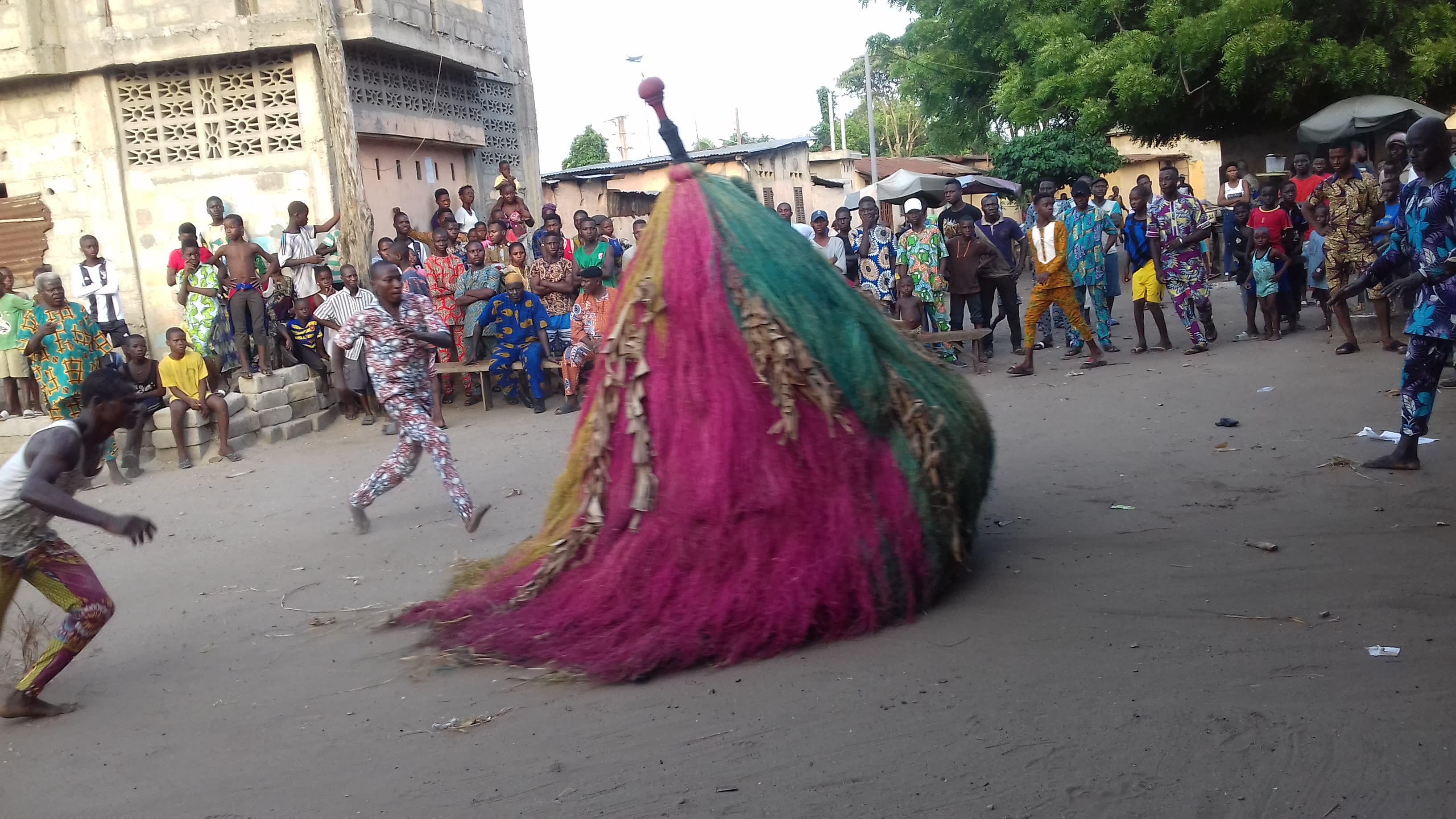
On the esplanade of the French Fort in Ouidah, one January morning, the crowd forms a circle. The drums start. A man in ceremonial dress raises his arms and calls out like an announcer. Then the thing enters the ring: a tall stack of raffia, dyed red, yellow and green, with no face, no arms, no visible feet. It moves forward, stops, then begins to spin, faster and faster, until its fringes fly out flat.
This is a Zangbeto. In the villages and neighborhoods of southern Benin, you do not usually see one in daylight. Its realm is the night. It guards the streets, sends people home, watches, and punishes.
This pillar explains who the Zangbeto are, where tradition says they come from, how they are organized, what they do, and how to see them respectfully in Ouidah.
Who are the Zangbeto?
The Zangbeto are a masking society of the Gun people, also called Ogu or Egun. The Gun live in southeastern Benin around Porto-Novo, and also in Togo and Nigeria, especially in Badagry, near Lagos.
The name comes from the Gun language. Zan means "night." The most common translation, used by Benin's government, is "hunter of the night." Other sources, such as English Wikipedia, give "people of the night" or "night watchmen." Both readings say the same thing: the Zangbeto belongs to the night.
It is a secret society. Only initiates, all men, know how it works. According to Wikipedia, its gatherings are open only to the Zangbeto themselves and to vodun devotees, the vodúnsɛntó.
The origin legends
There is no single history of the Zangbeto, but several stories passed down orally. All of them tie the Zangbeto to the birth of the kingdom of Hogbonou, today's Porto-Novo, Benin's capital.
Three brothers from Allada
Tradition says an Aja dynasty from Tado, in present-day Togo, settled around 1600 in Allada. When the king died, three brothers fought over the succession. One stayed in Allada. Another went north, and his line founded the kingdom of Abomey. The third, Te-Agbanlin, went east and founded Hogbonou.
Two versions of the trick
The version told on French Wikipedia says Te-Agbanlin and his companions, surrounded by enemy troops, used a ruse thought up by a hunter prince, Padonou Hennoukoun. They built cone-shaped huts of bamboo covered with dry banana leaves, with eyeholes and handles. The blast of a horn did the rest: frightened by the shapes and the noise, the enemy scattered.
Another version, told by Florence Bourreau in Le Petit Journal Cotonou, is about crossing the forests. Te-Agbanlin protected himself from wild animals with a frame of raffia and banana leaves, and an antelope horn, his hunting tool. When he reached Porto-Novo, he used the zangbeto mask, of Aja origin, to drive off the Yoruba already living there. The antelope still appears on the doors of the Zangbeto temple.
English Wikipedia mentions a third tradition: the Zangbeto were sea spirits who once came out of the ocean dressed in raffia.
These stories are not historical records. Still, they get one thing right: the Zangbeto began as a force of protection, tied to royal power and to a community's safety. Once the kingdom was established, tradition says, Te-Agbanlin set up nightly Zangbeto patrols to guard the town.
Porto-Novo, home of the Zangbeto
To understand the Zangbeto, you need to know the city where they were born.
The Gun call it Hogbonou, the Yoruba Ajashe. According to Wikipedia, Te-Agbanlin and his group settled there in the late sixteenth century. The Portuguese name Porto-Novo, "new port," came later: in 1730 the Portuguese Eucaristo de Campos is said to have named it for its resemblance to the city of Porto.
The kingdom of Porto-Novo lived between two powers. To the west, Dahomey, founded by a branch of the same Allada royal family, wanted to expand. To the east, the Yoruba empire of Oyo, to which Porto-Novo paid tribute, offered protection against that Fon expansion. Life on a frontier goes some way toward explaining why a security institution like the Zangbeto mattered so much.
In the nineteenth century, after a British bombardment in 1861, the kingdom accepted French protection in 1863. Porto-Novo became the capital of French Dahomey in 1900 and remains Benin's official capital today. The local monarchy survived colonial rule, with kings such as Toffa I.
So the Zangbeto belongs to a royal city that had to defend itself against powerful neighbors. No wonder tradition makes it the founder's weapon.
One people, two countries
The Gun speak Gungbe, a language of the Gbe family, close to the Fon spoken in Ouidah and Abomey. It is spoken in and around Porto-Novo and also across the Nigerian border, in Badagry and parts of Lagos State, where the Gun are called Egun or Ogu.
That border, drawn in colonial times between French and British territories, split one people in two. The Zangbeto ignore it. You find them on both sides, with the same costumes, rules and stories. That is why the most cited study of their modern role is about Badagry, in Nigeria, rather than Benin.
A tight organization
Behind the mystery, the Zangbeto are highly organized.
Every neighborhood in Porto-Novo has its own Zangbeto, each with its own character. The oldest and tallest is called Kpakriyao. It can stand up to four meters high and, according to Benin's government, is considered the chief of all the Zangbeto.
The zangan is the go-between for the Zangbeto and the community. He speaks, announces and translates the mask's messages, because the Zangbeto does not speak like a human. He is easy to spot during an outing: he is the man addressing the crowd.
The zanvi are young initiates who play percussion during outings. They set the rhythm and escort the mask as it moves.
In Porto-Novo, the Zangbeto temple is where the society's decisions are made and its rules set.
Initiation
According to French Wikipedia, membership is for men only and involves several steps:
- a payment in livestock, drinks and money;
- a ritual flogging to test the candidate's courage;
- an oath of secrecy;
- learning a recognition code known only to initiates.
Secrecy is the heart of the institution. An initiate does not reveal what he has learned or what happens during outings. That secrecy is what gives the Zangbeto its authority.
The costume and the spirit
Straw and raffia
The costume is a dense mass of thin strands of raffia, straw or other fibers, often dyed in bright colors. It forms a kind of haystack or cone, sometimes topped with horns, a mask or objects. Its shape recalls the cone-shaped huts of the legend.
No one under the raffia
Gun tradition, as reported by Wikipedia, holds that there is no human under the costume, only spirits of the night. During outings, those who carry the Zangbeto are said to be in a trance, inhabited by spirits with special knowledge.
So it is very serious to touch the raffia or suggest that a man is inside. According to Wikipedia, the offense was once punishable by death. Today it remains a serious taboo, and visitors should keep their distance.
The spinning dance
The high point of an outing is the spin. The Zangbeto whirls, speeds up, stops dead, starts again. Sometimes it sinks to the ground as if emptied, then rises again. Modern festivals showcase these displays, which organizers and Wikipedia describe as moments of "magic." For believers, it is not a show: it is the spirit in the raffia making itself known.
Guardians of the night
Neighborhood police
The Zangbeto's first job is security. Wikipedia describes them as traditional guards or police, charged with keeping order. At night they patrol the streets, watch over property, track down thieves and, in local belief, witches and evil spirits.
When a Zangbeto goes out at night, residents know to stay indoors. Nobody wanders the street as it passes. That informal curfew is part of what makes it work: a neighborhood where the Zangbeto walks is not an easy place to steal.
Judging and reconciling
The Zangbeto does more than keep watch. It steps in to settle disputes between neighbors or families and takes part in the community's moral life.
Nigerian scholar Folashade Hunsu studied the Zangbeto of Badagry, Nigeria, in a 2011 paper for the Nordic Africa Institute. She shows that the society has reinvented tradition to meet the challenges of a modern town. In her account, the Zangbeto do not act arbitrarily or violently: they combine traditional symbolic acts with the art of speech. And they coexist peacefully with formal political and police institutions, in a town that is ethnically and religiously diverse.
Today
According to French Wikipedia, the Zangbeto now act as mediators in community disputes and work with the police against crime. The institution has lasted for centuries by adapting, without giving up the source of its strength: mystery and the respect it commands.
That adaptation has limits. A traditional police force that is secret and men-only raises questions in a state governed by law: who reviews its decisions, and how are the people it names as guilty treated? Researchers who have studied it stress mediation over punishment. But the subject is sensitive, so bring it up tactfully if you discuss it with residents.
Zangbeto and Egungun: not the same
In Benin, people often confuse the Zangbeto with the Egungun, the Yoruba ancestral masquerades. They are two different institutions.
- The Egungun embody ancestors returning among the living. Their costumes are layers of often rich cloth, and they speak in a guttural voice. They come from the Yoruba world.
- The Zangbeto are spirits of the night, guardians of order. Their costume is raffia, with no human shape. They come from the Gun and Aja world.
They do share one thing: the absolute rule against touching the costume, and the idea that no ordinary human is underneath.
Other guardians of the night
The Zangbeto is not the region's only night institution. Among the Yoruba, the cult of Oro plays a similar role. Oro is a deity of communal justice whose voice is the bullroarer, an instrument swung on a cord that makes a deep, whirring roar.
When Oro is out, a curfew falls. According to Wikipedia, women and outsiders must stay indoors, because Oro must not be seen by them. Tradition says the cult exists to keep the peace and cleanse the community.
These practices are debated today. In Nigeria, The Guardian ran an opinion piece calling the Oro festival "anti-women," and communities still announce curfews. The Zangbeto are also a men-only society. The place of women in these traditional security institutions is an open question, in Benin as in Nigeria.
The Zangbeto in Ouidah
Ouidah is not the Zangbeto's birthplace; that remains Porto-Novo. But the town hosts them at its big festivals, and that is where most travelers first meet them.
At Vodun Days
During Vodun Days, the Zangbeto perform on the esplanade of the French Fort. Benin's government published an article about their show at the 2025 edition. In 2026, according to the published program, the opening show took place on January 8, from 9 to 11 a.m., with 18 masks from several towns.
It is the best chance to see them up close, in daylight, in a setting built for an audience. You will see the zangan speak, the zanvi drum, and the masks spin until you feel dizzy.
A few practical tips: get there early, because the best spots around the circle fill up fast. Bring water and a hat, since there is little shade on the esplanade in the late-morning sun. Stay behind the line the organizers mark out, even when a mask rushes toward the crowd; that sudden charge is part of the show, and stepping back is part of the etiquette. Children love it, but keep small ones close.
The rest of the year
Outside the festival, Zangbeto outings depend on local communities. They often happen at night, in the neighborhoods, and are not meant for visitors. If you hear their drums, watch from afar, or go inside like the residents do.
The Zangbeto also appear at other festivals, including in Porto-Novo, Abomey-Calavi and Cotonou, and represent Beninese culture at national and international events.
A day in Porto-Novo
To go further, spend a day in Porto-Novo, a little over two hours' drive from Ouidah via Cotonou. The city is quiet, green and full of old houses. You can visit the Musée Honmè, set in the former royal palace, the Musée da Silva, devoted largely to Afro-Brazilian heritage, and the Great Mosque, whose colorful facade recalls the baroque churches of Brazil, built by Agudas who came back from Bahia.
Ask your guide to show you a Zangbeto temple from the outside. You will not go in, but you will see how these places sit within the neighborhoods, among houses, markets and churches.
Why it is worth it
The Zangbeto is often sold to tourists as a show. It is also, and first of all, a social institution. Watching it spin on the fort's esplanade, then realizing that it guards whole neighborhoods at night, gets at something essential about Vodun: a religion that does not stand apart from daily life, security, justice and neighborliness.
And the diaspora?
Unlike the Egungun, whose worship survives in Brazil, or Fa, which lives on in Cuba and the United States, the Zangbeto did not give rise to a known tradition across the Atlantic. It is a neighborhood institution, bound to a territory and its kings.
There is still a link to the history of the slave trade. Badagry, one of the Zangbeto's strongholds in Nigeria, was itself a slave port, like Ouidah. The Zangbeto now watch over towns whose beaches saw captives leave. For a diaspora visitor, seeing these night guardians in places marked by the Slave Route carries weight: an African institution of protection, still standing.
Badagry, Ouidah's mirror across the border
If you are traveling the coast between Lagos and Ouidah, Badagry deserves a stop. The town lies about 69 kilometers (43 miles) southwest of Lagos, right by the border with Benin, and its original inhabitants are the Ogu, the same people as the Gun of Porto-Novo. Their language belongs to the Gbe family, like Fon.
Badagry grew into a trading town in the eighteenth century and became a major slave port. Its own Point of No Return stands on Gberefu Island, where captives were taken to the ships. Tradition speaks of a well there whose water was meant to make them forget their fate, a story that echoes Ouidah's Tree of Forgetfulness. The town also has heritage museums and what some consider the first multistory building in Nigeria, completed in 1845 by the missionary Henry Townsend.
For an American visitor retracing the slave trade, Badagry and Ouidah make a natural pair: two ports, two memorials, two peoples of the Gbe world. And in both, the Zangbeto still walk at night.
Seeing the Zangbeto respectfully
- Never touch the costume. This is the most important rule. Keep your distance, even if the mask comes close.
- Listen to the zangan. He tells you where to stand and when to step back.
- Photos. At the public shows during Vodun Days, photos are usually fine. At a night outing or a ritual, always ask the zangan or your guide. A no means no.
- Do not try to find out who is underneath. Asking, even as a joke, is an insult.
- At night, follow the locals. If a Zangbeto comes out and people go inside, do the same.
For how to behave at sacred sites, see our guide to experiencing Vodun respectfully.
Plan a visit with a local guide →
Sources
- Zangbéto, Wikipédia: etymology, legend of Te-Agbanlin and Padonou Hennoukoun, zangan, zanvi, Kpakriyao, initiation, current role.
- Zangbeto, Wikipedia: Ogu people, secret society, costume, belief that no human is inside, touching taboo, sea spirits.
- Florence Bourreau, "La fondation de Porto-Novo, Tè-Agbanlin et le Zangbeto," Le Petit Journal Cotonou, 2016.
- Government of Benin, "Vodun Days 2025 : les Zangbéto en démonstration sur l'esplanade du Fort français".
- Banouto, "Vodun Days 2026 : le programme détaillé des trois jours à Ouidah" and La Nation, "Les Zangbéto illuminent le Fort français de Ouidah".
- Porto-Novo, Wikipedia: Hogbonou and Ajashe, Eucaristo de Campos (1730), Oyo, French protectorate (1863), capital (1900).
- Oro Festival, Wikipedia and The Guardian Nigeria, "Oro: A Yoruba Festival That Is Anti-Women".
- Badagry, Wikipedia.
- Folashade Hunsu, Zangbeto: Navigating Between the Spaces of Oral Art, Communal Security and Conflict Mediation in Badagry, Nigeria, Nordic Africa Institute, Discussion Paper 53, 2011.