Key Takeaways
- The Sacred Forest of Kpassè originally covered 30 hectares; only about 4 remain today, absorbed by the town's growth.
- According to legend, Kpassè, second ruler of Savi and founder of the Hueda kingdom, turned into an iroko tree in the mid-seventeenth century, well before the Fon conquest of 1727.
- The forest holds 36 plant species across 20 families, along with statues of deities such as Legba, Sakpata, Hêbiosso and Mami Wata.
- The site has been on UNESCO's World Heritage tentative list since 1996, with no final inscription to date.
- Many of the forest's statues bear the mark of Beninese sculptor Cyprien Tokoudagba (1939-2012), whose work has been shown as far as the Centre Pompidou.
You enter through a low gate cut into a concrete wall. Behind you, Ouidah at midday: motorbikes, vendors, a flat light that erases shadows. Ahead, a drop in temperature, the smell of damp earth, a dimness created by a canopy so dense it reduces the sky to almost nothing.
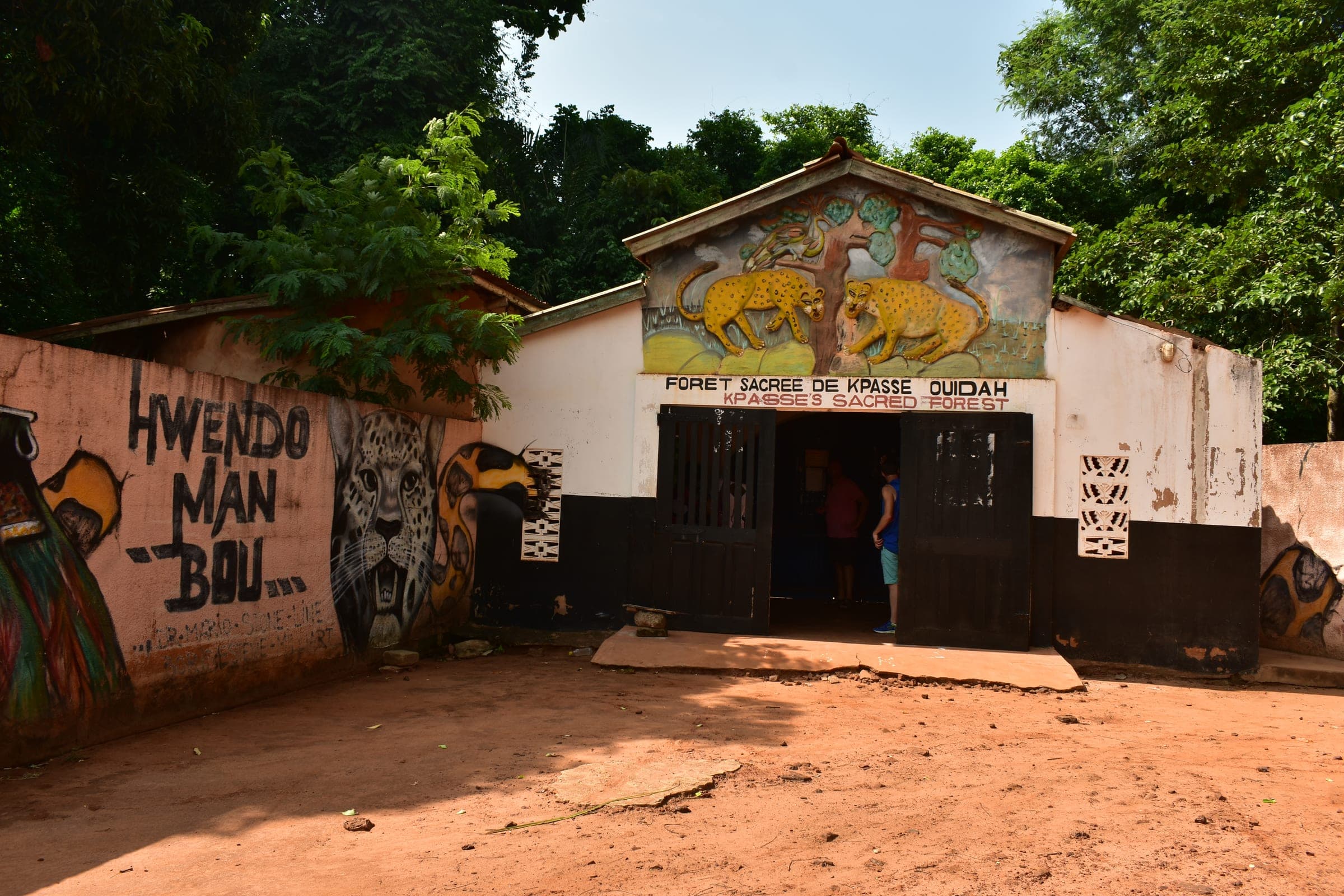
This is the Sacred Forest of Kpassè. Four hectares at the heart of the town, considered a remnant of the coastal forest that once covered the region before urban growth closed in.
This pillar tells the legend of King Kpassè, what the forest holds today, and how to visit it respectfully.
A much larger forest, once
The Sacred Forest, Kpassèzoun in Fon ("zoun" meaning sacred grove), originally covered roughly 30 hectares. Today it covers only about 4, a little over a tenth of its original size. Ouidah grew by nibbling away at its edges, first with farmland, then with compounds and roads.
What remains is still alive: tall iroko trees, shrines, an orally transmitted pharmacopeia, and a legend that continues to shape the town's religious life.
The legend of King Kpassè
Who Kpassè was
According to tradition, Kpassè was the second ruler of Savi and founder of the Hueda (or Xwéda) kingdom, the people who built Ouidah before the Fon conquest. The Hueda were a coastal people whose civilization was built around the Atlantic and the spiritual forces tied to water and earth.
The transformation into an iroko
According to Wikipedia, the legend places Kpassè's transformation in the mid-seventeenth century: the king is said to have vanished, then reappeared miraculously as an iroko (Milicia excelsa) at the heart of the forest, which became sacred from that moment on.
The timeline deserves precision, since two separate events are sometimes conflated. The Kpassè legend belongs to the seventeenth century. The Fon conquest of Ouidah and Savi came much later, on March 9, 1727: King Agadja of Abomey killed by trickery Houffon, then the last king of Savi, with help from his own daughter, one of Houffon's wives, who is said to have wet the gunpowder meant to defend the town. Houffon is not Kpassè, and although both stories belong to the same Hueda kingdom, they should not be merged.
The tree associated with the Kpassè legend still stands at the forest's most sacred point, wrapped in white cloth.
Why the forest survived
After their conquest, the Fon did not destroy the forest. A commonly given local explanation is theological: in a world where trees, spirits and natural forces hold a recognized place, erasing a site regarded as a living king would have been incoherent, whoever held political power. That explanation, though, belongs to local interpretation more than to an independent written source, and should be presented as such.
What is better documented is the survival itself: despite centuries of urban expansion, despite pressure from the French colonial administration in the late nineteenth century, the community held the forest's boundary, shrinking over time, but never erased.
What the forest holds today
The trees and plants
According to Wikipedia, the forest holds 36 species across 20 families, dominated by legumes, mulberry-family plants, dogbanes and coffee-family plants. It is also home to squirrels, pythons, vipers and several bat species.
Some of these plants have medicinal uses, passed down orally by the priests who tend the forest. That oral transmission leaves the knowledge fragile: as far as we know, there is no complete, public written record of this pharmacopeia. Beninese and international researchers have begun documenting some of these plants, as the work on Newbouldia laevis below in this pillar shows, but most of the knowledge remains held by a small number of priests, whose loss without a trained successor would mean an irreversible gap.
The canopy above is dominated by tall iroko trees, whose age local tradition puts at several centuries, though no published scientific dating exists. Under the largest of them, the air feels noticeably cooler than outside the walls, a contrast almost every visitor notices within the first few steps.
The statues and deities
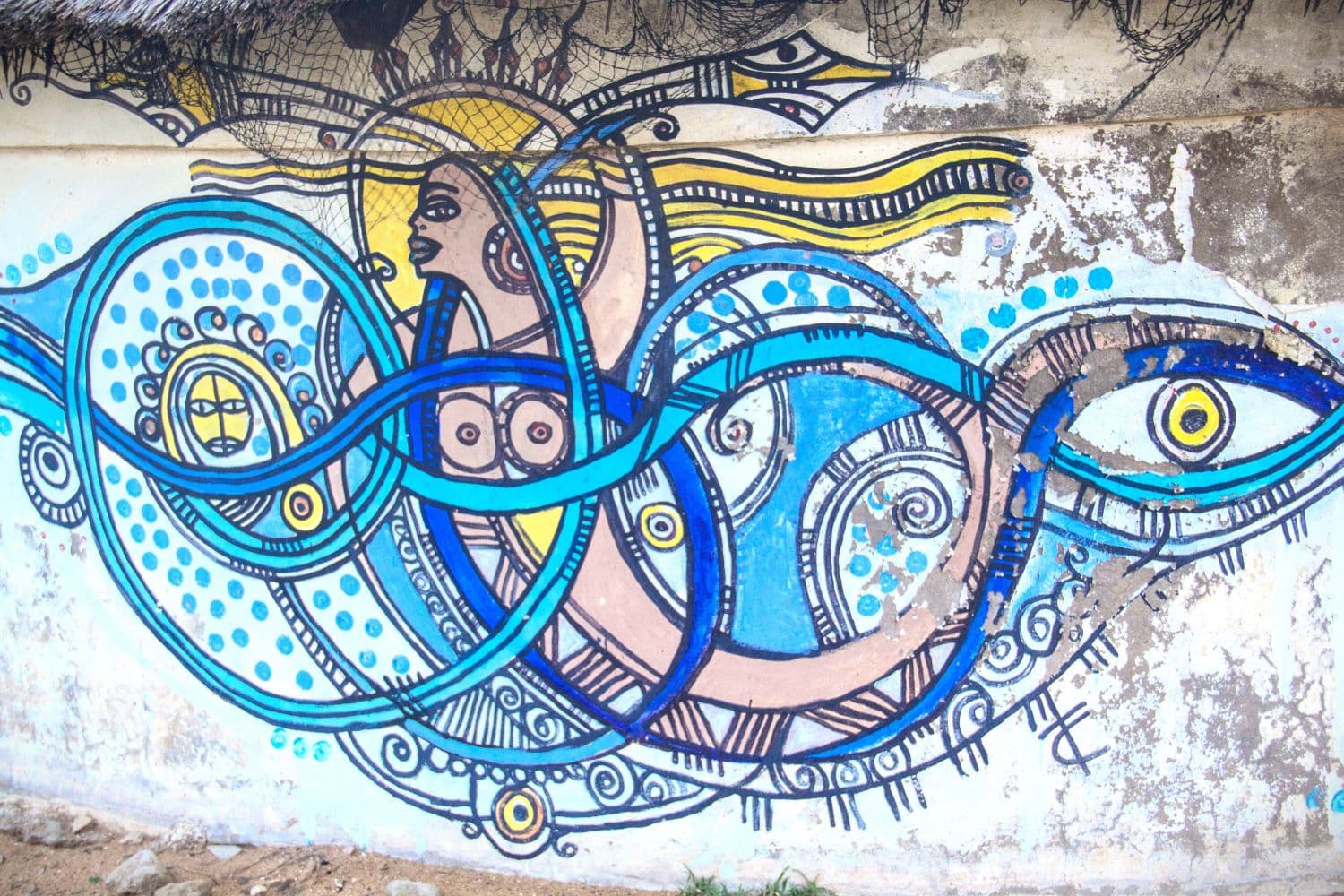
The forest holds statues of several deities from the Vodun pantheon: Mami Wata, a water deity; Gu, tied to war and blacksmithing; Ogoun Zobla; Sakpata, tied to the earth and disease; Hêbiosso (or Hevioso), the thunder deity; and Legba, the messenger who guards thresholds.
Many of these statues bear the mark of Cyprien Tokoudagba (1939-2012), the Beninese sculptor and painter whose work has been shown at the Smithsonian's National Museum of African Art in Washington and at the Centre Georges Pompidou in Paris. In the forest, these pieces are not museum objects: they live outdoors, wear down, and are restored.
Legba, Sakpata and Hêbiosso in the diaspora
Several of these deities have related figures in African diaspora religious traditions. Legba is recognized in kindred forms as Papa Legba in Haitian Vodou, Elegua in Cuban Santería, or Exu in Brazilian Candomblé: in each of these traditions, a figure holds the role of guardian of crossroads and ritual openings, greeted first at ceremonies. Sakpata and Hêbiosso also have correspondences noted in several of these traditions, under names and forms that vary by region.
Still, it is worth resisting the temptation to treat these figures as strictly identical: five centuries of separation and each society's own path have produced distinct traditions that share a common origin without mapping onto each other one for one.
For a diaspora visitor who already practices one of these traditions, or inherited it through family, visiting the forest often carries particular weight: seeing, in the very place where these figures have been honored for centuries, a statue of Legba or Sakpata close to ones known elsewhere can be a striking experience. It is a chance to measure both the continuity and the distance between these traditions, rather than looking for a perfect match that does not exist.
The posts of the kings
In front of the entrance to the area reserved for initiates, inside the forest, stand carved wooden posts representing the successive kings of Ouidah's throne. Less striking than the large deity statues, this gallery is a reminder that the forest is not only a natural shrine: it is also a site of dynastic memory, where the town's political authority still symbolically ties back to its legendary founder.
That is the spirit behind a practice reported by several local sources: a new ruler of Ouidah is said to enter the forest before taking office, to establish a link with Kpassè's spirit. This orally transmitted tradition shows the place the forest still holds in local legitimacy, alongside other religious authorities in the town, such as the Daagbo Hounon, the supreme head of Vodun in Ouidah, whose residence, the Houxwé palace, stands nearby.
A plant between pharmacy and ritual
Among the forest's species, Newbouldia laevis, sometimes called the "boundary tree" or "African hyssop," illustrates well the continuity between medicine and worship in Vodun tradition. Studies conducted in Benin show the plant serves both documented medicinal uses, against coughs, headaches, constipation or convulsions in children, and ritual ones: marking out shrine boundaries, enthronement ceremonies for traditional chiefs, purifying spaces believed tainted by negative influences.
This double function is not an isolated curiosity. Inside the Sacred Forest, several plants serve as both remedy and ceremonial ingredient, which is why the priests who handle them are both religious officiants and keepers of local plant knowledge.
A forest that resists urban growth
The story of the forest's shrinkage, from 30 to 4 hectares, is worth pausing on. It did not vanish all at once, but through continuous encroachment, matching Ouidah's growth: fields first, then houses, then roads. This process, documented by historians of the town, played out over centuries, from the Hueda era through Benin's independence in 1960, by which point the forest had already reached roughly its current size.
What let these last four hectares survive was less a particular legal status, long absent, than an ongoing religious practice: as long as a community keeps coming to pray, initiate and heal in a place, that place resists urban pressure in a way the law alone does not always guarantee. UNESCO's tentative-list inscription in 1996 came as a late recognition of what local practice had already preserved.
A UNESCO listing still pending
Since October 31, 1996, the Sacred Forest has been on UNESCO's World Heritage tentative list, a preliminary step toward a possible full inscription. Thirty years later, that full inscription has still not happened.
Part of the holdup lies in the nature of the site itself. A World Heritage inscription generally requires a precise management plan, long-term preservation guarantees, and controlled visitor access. But the forest is not a frozen heritage site: it is an active place of worship, where initiations and ceremonies take place that the community may not want opened further to outside scrutiny. Reconciling those two logics, the World Heritage framework and a living shrine, requires negotiations that have not yet concluded.
The Python Temple, the forest, and the town
The Sacred Forest is not an isolated site: it is part of a cluster of Vodun places that shape central Ouidah. The Python Temple stands a few minutes' walk away, and together with the nearby Afro-Brazilian cathedral, the three form a triangle where Catholicism and Vodun physically coexist within a small area.
This closeness is not a matter of recent urban planning: it reflects the town's older layout, where places of worship settled near the center of power rather than at its edges.
Visiting the forest
Getting there
The forest sits in central Ouidah, a few minutes' walk from the Python Temple and the Afro-Brazilian cathedral.
Admission and guided visits
Admission carries a modest fee. A guided visit, at extra cost, is strongly recommended: the shrines, customs and off-limits areas are not marked with signs.
When to visit
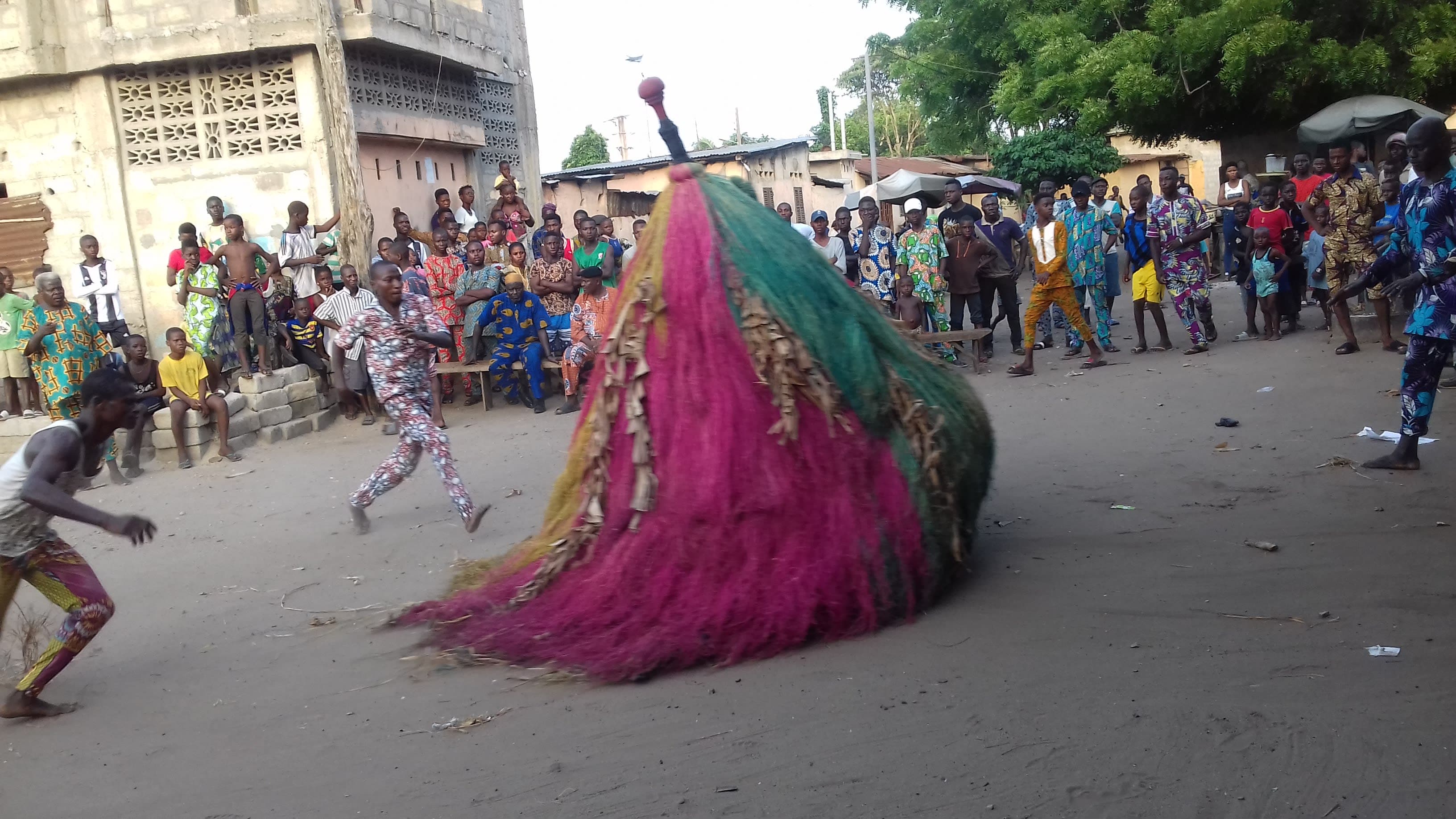
Late afternoon is a good time: light filtered through the canopy turns golden, and the heat eases off. During Vodun Days in January, ceremonies take place around the forest, with drums and libations, offering a rare chance to see the living relationship between the community and this place.
Why a guide makes all the difference
Without a guide, a visitor sees trees, a few statues, a path. With someone who knows the shrines, the same walk becomes legible: you understand why a statue faces a certain direction, why some paths stop short, why you are asked to remove your shoes at one spot and not another.
A guide also serves as an interface with the priests who tend the forest. A question put directly to an unfamiliar visitor rarely gets a full answer; the same question, relayed by a trusted guide, often opens the conversation.
Etiquette
- Do not raise your voice inside the forest.
- Point with a closed fist or a nod, never an outstretched finger.
- Remove your shoes when asked.
- Respect areas where photography is forbidden.
- Do not enter any restricted area without an invitation from a priest or your guide.
- Move slowly.
Pairing the visit
The forest works well as part of a morning or late afternoon that also takes in the Python Temple and the cathedral, both within walking distance. Allow an hour to ninety minutes for the forest alone with a guide, more if a ceremony is under way.
What this story is worth remembering
The Sacred Forest of Kpassè is a good illustration of a principle worth keeping in mind while visiting Ouidah: the difference between legend, which carries a spiritual truth for those who hold it, and historical fact, dated and documented elsewhere. The Kpassè legend and the 1727 conquest both unfold within the same Hueda kingdom, but they are not the same event, and conflating them weakens both stories rather than strengthening them.
What can be said with confidence: a forest that once covered 30 hectares now covers 4, it has survived centuries of pressure, and it continues to host a living cult, not a frozen site for visitors.
Arrange a guided visit to the Sacred Forest →
Sources
- Forêt sacrée de Kpassè, Wikipédia: size (30 then 4 hectares), Kpassè legend (mid-seventeenth century), 36 species in 20 families, deities, wildlife.
- Royaume houéda, Wikipédia and research on Agadja's conquest: death of King Houffon on March 9, 1727.
- Cyprien Tokoudagba, Wikipédia: biography, international exhibitions.
- UNESCO, World Heritage Tentative List, Benin: listed since 1996.
- Iroko (Milicia excelsa), Wikipédia.