Key Takeaways
- Benin's national Vodun holiday was created in 1996 by President Nicéphore Soglo, born in Ouidah, following the Ouidah 92 festival, actually held from February 8 to 18, 1993.
- Since a law passed on July 30, 2024, the holiday is no longer fixed on January 10 but falls on the second Friday of January, with the preceding Thursday also a holiday.
- According to Benin's statistics institute (INStaD), 740,668 people attended the 2026 edition in Ouidah, up from 435,250 in 2025.
- The program spans the Python Temple, the Slave Route, the Kpassè Sacred Forest and the beach, with Zangbeto, Egungun and Mami Wata ceremonies.
- Vodun had been suppressed under the Marxist-Leninist regime of Mathieu Kérékou (1972-1990); the national holiday is a direct response to that period.
One January morning in Ouidah, before the crowds gather, the town is still in its ordinary state. Motorbikes weave through the streets, vendors set up their stalls, the basilica bell strikes the hour. Then, little by little, something shifts: the beat of drums, the growing patches of white clothing, the crowd visibly thickening.
This is Vodun Days. For four days, every year around the second Friday of January, Ouidah becomes the center of Benin's national Vodun holiday. The town's population, around 90,000, is joined by hundreds of thousands of visitors from across Benin and the diaspora.
This pillar explains where the holiday comes from, how it unfolds, and how to attend it respectfully.
What the Vodun holiday is
Benin's national Vodun holiday is not a cultural festival staged for visitors. It is first a religious celebration, carried by Vodun communities themselves, to which the state has given a national framework and an official calendar.
In Vodun practice, deities make contact with humans through possession: a devotee enters a trance, and the community understands the deity to be speaking through their body, with a voice and gestures different from their own. During Vodun Days, these moments of possession multiply, both in public and in private, in temples, in family courtyards, and on the beach.
Priests and initiates
Understanding what happens during Vodun Days means knowing two words.
The hounon is the priest of a vodun, usually a man, in charge of the cult and acting as intermediary between the deity and humans. The word comes from the Fon hun-, the prefix tied to vodun, and -gan, "chief." The diviner of Fa is called a bokonon.
The hounsi, or vodounsi, literally "spouses of the vodun" in Fon, are a shrine's initiates, men or women depending on the cult. The word comes from hun, which refers both to the blood certain deities are fed and to the secret kept within the shrine: a hounsi is someone "married" to that secret through initiation.
Becoming a hounsi is not an ordinary choice. People enter a shrine because they have "heard the call" of the vodun, often signaled by an unexplained illness. A consultation of Fa then directs the person to the shrine of the relevant deity. Training that follows traditionally takes years, sometimes up to seven, during which the initiate learns the songs, dances, taboos and gestures specific to their vodun.
It is these hounon and hounsi, trained over years, who carry out most of the ritual work of Vodun Days. Visitors only see the public part of it.
Where the holiday comes from
Suppression under Kérékou
To understand Benin's national Vodun holiday, you first need to understand what it reversed.
In 1972, General Mathieu Kérékou seized power in a coup. In 1975, he declared the country Marxist-Leninist and renamed it the People's Republic of Benin. Under that ideology, Vodun was treated as backward superstition, incompatible with the socialist project. A 1976 ordinance against witchcraft, documented by researcher Emmanuelle Kadya Tall, targeted Vodun cults and dignitaries in particular. Practice was restricted in ways that were partial and often contradictory for close to two decades.
Ouidah 92 and the return of democracy
The Marxist-Leninist regime collapsed in 1989-1990. In 1991, democratic elections brought Nicéphore Soglo, born in Ouidah, to the presidency.
From February 8 to 18, 1993, Ouidah hosted the "Ouidah 92" festival, officially the first world festival of Vodun arts and cultures, "Reunion of the Americas and Africa." It carries the name of the year it was planned for, though it was ultimately held in 1993. At President Soglo's initiative and with UNESCO's support, it brought together priests and delegations from Haiti, Cuba, Brazil, the United States and Trinidad and Tobago.
The following year, UNESCO launched its "Slave Route" project in Ouidah in September 1994, documenting the history of the slave trade and its cultural legacies, Vodun included.
A national holiday, then a change of date
Benin's national Vodun holiday was established in 1996, formalizing what Ouidah 92 had begun. Ouidah's choice as the epicenter was not arbitrary: it is the town of the Slave Route, of the Python Temple, and Soglo's own hometown.
For a long time the holiday had a fixed date, January 10. A law passed on July 30, 2024, adopted unanimously by the National Assembly, changed that calendar: the holiday now falls on the second Friday of January, with the preceding Thursday also a holiday, making for a four-day celebration from Thursday through Sunday. It was in that same stretch, in January 2026, that the third edition under the name "Vodun Days" drew a record number of attendees.
How the celebration unfolds
The approach
The days before the main weekend are not simple preparation: for Vodun communities, they are part of the ritual. Shrines open, altars are fed, ancestral spirits are invoked.
On the evening before the main gathering, the Zangbeto, the Gun people's guardians of the night, come out into the streets. For many residents, their appearance marks the real start of the sacred period.
The main day
At the Python Temple, a high priest performs the holiday's first public libations, formally opening the ritual season.
The main procession sets out from the town center and moves down the Slave Route to the sea, along three to four kilometers of red dirt road, in the opposite direction from the one enslaved captives were forced to walk for centuries.
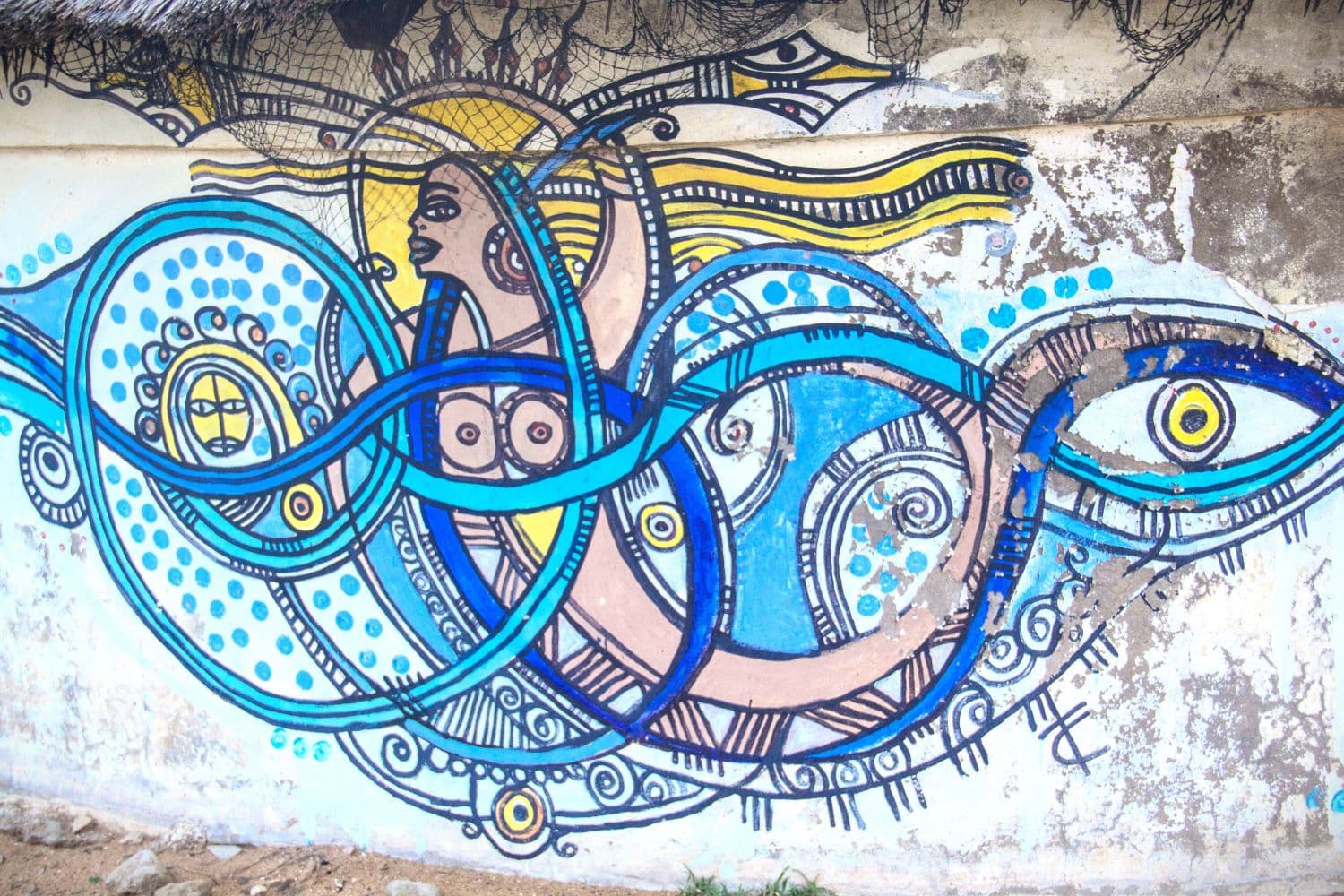
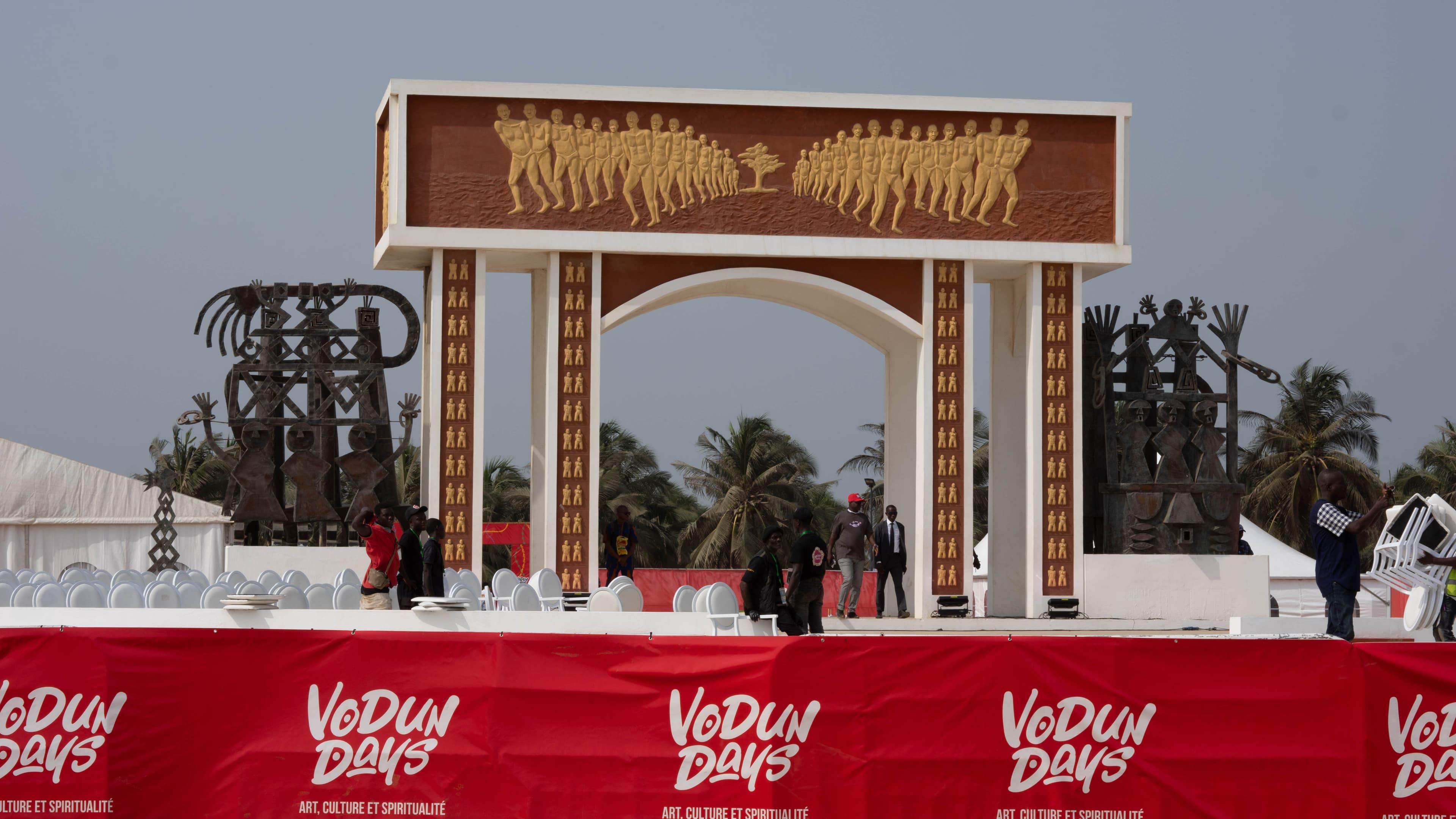
On Ouidah's beach, near the Mami-Plage temple, circles of drummers form. Devotees of Mami Wata, dressed in white, sometimes enter the water in a trance. It is one of the festival's most photographed moments, and one where the presence of diaspora visitors is most visible and emotionally charged, given how close the beach sits to the Door of No Return.
On the esplanade of the French Fort, Egungun ancestral masks and more Zangbeto perform in daylight. In 2026, eighteen Zangbeto masks danced there on the festival's first morning. At the Kpassè Sacred Forest, ceremonies reaffirm the bond between the town and its founding king.
Throughout the day, trance possession spreads through the crowd. For the community, this is not a performance: it is a collective consultation of the deities.
Winding down
In the days that follow, the intensity fades. The final rituals thank the deities and close, for another year, the sacred period.
How many people attend
Official figures give a sense of how much the celebration has grown since it moved to the "Vodun Days" format. For the first edition, Benin's national statistics institute (INStaD) estimated 44,000 people on the beach on January 9, 2024, and 53,000 for the evening of January 10. In 2025 it counted more than 435,000 participants over three days. For the 2026 edition, January 8 to 10, INStaD counted 740,668 participants over three days, 70.2 percent more than in 2025, and 1,942,949 visits across all sites. Beninese made up 80.5 percent of participants; the others came from 56 countries, including Togo, Nigeria, France and the United States.
The 2026 program
The recent format of Vodun Days follows a three-day main structure, with variations from one edition to the next.
The first day combines daytime activities in public squares and on the beach with a large evening concert featuring Beninese and international artists. The second day is generally devoted to the grand Vodun ceremony, with large-scale cultural performances, less entertainment-focused than the first day. The third day combines celebrations in Ouidah's arena in the afternoon, then festive activities on the beach in the evening.
Throughout these three days, Hounvè dances specific to certain Vodun cults, Zangbeto and Egungun appearances, processions honoring the deities, and open-air concerts follow one another. Exhibitions and workshops also offer a more educational way into Vodun, aimed at visitors discovering the tradition for the first time.
Tourism and lived religion, side by side
Vodun Days occupy an unusual position: both a religious holiday carried by Vodun communities and a pillar of Benin's tourism strategy. The state has invested in visitor infrastructure, international communication and concert programming, without turning the ceremonies themselves into a fully staged show.
That double nature explains contrasts visitors often notice: a concert stage with modern sound equipment a few hundred meters from a circle of traditional drums where a very real possession consultation is taking place. The two coexist without either erasing the other. Understanding that coexistence, rather than trying to sort "authentic" from "touristic," makes for a better experience.
What diaspora visitors recognize
For a visitor from Brazil, Cuba, Haiti or the United States, some elements of Vodun Days echo traditions already familiar at home. A drum pattern, a song, a dance posture can recall a Candomblé, Santería or Haitian Vodou ceremony seen elsewhere. That is no coincidence: these traditions share a common origin on this same coast, each later reshaped by the crossing and by the country where it landed.
Still, it is worth resisting the urge to treat these traditions as identical. Five centuries of separation, different colonial contexts and each society's own path have produced practices that share roots but differ in their current form. Recognizing a family resemblance is one thing; treating it as a single unbroken practice is another.
The festival's geography
Understanding Vodun Days means understanding that it unfolds in several places at once, each with its own role.
The Python Temple opens the celebration. The Slave Route serves as the processional axis to the sea. The beach and the Mami-Plage temple host the water-related ceremonies. The Kpassè Sacred Forest holds the ceremonies tied to royal ancestors. The esplanade of the French Fort hosts the mask displays. And the Afro-Brazilian cathedral, facing the Python Temple, stays open throughout, its Catholic worshippers crossing paths, in the same street, with Vodun practitioners.
Beyond Ouidah
Benin's national Vodun holiday is not confined to Ouidah, even though the town has become its epicenter. Other towns in southern Benin, notably Abomey, Porto-Novo and Grand-Popo, hold their own ceremonies during the same period, often less crowded and more intimate. For a visitor staying more than a week in the region, pairing Ouidah with one of these towns shows different faces of the same holiday, away from the main site's crowds.
The diaspora dimension
Since its creation, the holiday has drawn visitors from the African diaspora, especially from Brazil, Haiti, Cuba and the United States. For many, this is not an ordinary tourist trip: it is a chance to meet, in their place of origin, traditions their ancestors carried away and transformed elsewhere.
One common mix-up is worth correcting, though. There is no program called "Return Journey" that grants citizenship based on DNA. The real mechanism is the 2024 law on citizenship for people of African descent, implemented through the My Afro Origins platform, based on specific criteria our dedicated article covers. Vodun Days are not the official launch ceremony of that administrative process, but for many participants they are its most meaningful moment.
What this means for African American visitors
For African American travelers, Vodun Days often arrive at the end of a longer emotional itinerary: the Door of No Return, the Slave Route, maybe a DNA test result that pointed toward Benin or a neighboring country. Standing on the beach during the festival, watching Mami Wata devotees enter the same ocean that carried captives away, can feel like the point where an abstract family history becomes a physical, present-tense fact.
It helps to arrive with realistic expectations. Vodun Days is a Beninese national holiday, run for and by Beninese communities, not a program built around diaspora visitors. That does not make it less meaningful for someone tracing African ancestry here; it means the meaning has to be found within a real, ongoing religious life, not a reenactment staged for outsiders. Many travelers say the experience is more powerful for that reason, not less.
Attending Vodun Days respectfully
Photography: wide shots of the procession and public gatherings are generally accepted. Photographing someone in deep trance is not always welcome; ask your guide before pointing a camera at a ceremony.
Dress: white is the color associated with respect and peace in many Vodun ceremonies. Wearing it is well regarded, though not required of visitors.
Animal sacrifice: it is part of some ceremonies. This is not a show staged for visitors, but an offering usually followed by a communal sharing of the meat. If this makes you uncomfortable, choose with your guide which ceremonies to attend.
Trance: do not touch, photograph up close, or address someone in trance without going through those around them or a supervising priest. This is not a staged moment.
Getting ready
- Book accommodation months in advance. Ouidah fills up during the holiday; Cotonou, about thirty kilometers away, is a fallback option.
- Check the official program, published each year at vodundays.bj, for exact timings, which vary from one edition to the next.
- A local guide changes everything. Announced schedules are approximate; ceremonies follow their own rhythm.
- Arrive the evening before the main day, so as not to miss the Zangbeto coming out.
- Set aside time for the sacred forest, less crowded than the beach but just as central to the holiday's theology.
- Stay flexible on timing. Ceremonies follow a spiritual rhythm, not a tourist schedule; something announced for the morning can start much later.
- Bring water and sun protection. Outdoor ceremonies, especially on the beach, often run for hours under the dry-season sun.
- Bring cash. Card payments are rare outside Cotonou, and small vendors along the route only take cash.
Before you go
Vodun Days demand more preparation than an ordinary cultural festival, precisely because that is not what it is. A guide who knows the priestly families, the real ceremony schedule and the rules to follow transforms the experience: instead of watching a crowd from a distance, you understand what each gesture means.
January fills up fast, in Ouidah and in the surrounding lodging alike. Booking early remains the best advice, whatever level of guidance you choose.
Arrange a guided Vodun Days visit →
Sources
- Fête du Vodoun, Wikipédia: established in 1996, current format.
- National Assembly of Benin, adoption of law no. 2024-32 setting the annual festival of traditional religions, July 30, 2024: second Friday of January, preceding Thursday a holiday.
- Festival Ouidah 92, Wikipédia: actual dates (February 8-18, 1993), UNESCO support.
- Emmanuelle Kadya Tall, "De la démocratie et des cultes voduns au Bénin," Cahiers d'études africaines, 1995: 1976 anti-witchcraft ordinance.
- Government of Benin, "Près de 100 mille personnes… à Ouidah" (January 15, 2024: INStaD estimates), "Record absolu : les Vodun Days 2025 accueillent plus de 435 000 participants" (January 16, 2025) and "Succès éclatant des Vodun Days 2026" (January 12, 2026).
- Government of Benin, "Vodun Days 2025 : les Zangbéto en démonstration sur l'esplanade du Fort français".
- Oungan, Wikipedia and fongbebenin.com, "Les vodouns": hounon, hounsi, initiation.
- SRTB (Benin public broadcaster), "Vodun days 2026 : près de 2 millions de visiteurs avec un fort impact économique" (French) (January 26, 2026, INStaD figures).
- Vodun Days, official programme of the 2026 edition (vodundays.bj).
- Our article My Afro Origins and the 2024 law on citizenship for people of African descent.