Every year, as the harmattan begins to fade and the February heat settles over the coast of Benin, a unique melody rises from the historic quarters of Ouidah. It is not the deep rhythm of Vodun, nor the liturgical chants of the Basilica, but a hybrid sound—brassy and percussive. It is the call of the Burrinha, the beating heart of the Ouidah Carnival.
One Crossing, Two Destinies
The Ouidah Carnival is not merely a party; it is a bridge built across the Atlantic. It finds its roots in the 19th century, during the return of the Agudas—freed Africans and their descendants who returned from Brazil. In their luggage, they carried more than just architectural techniques or recipes; they brought the festive soul of Salvador de Bahia.
The Burrinha (literally "the little donkey" in Portuguese) is the purest expression of this fusion. While in Rio the carnival has become a global industry, in Ouidah, it has remained a family affair—a community ritual where every mask tells a lineage's story.
The Dance of the Burrinha: Masks and Mysteries
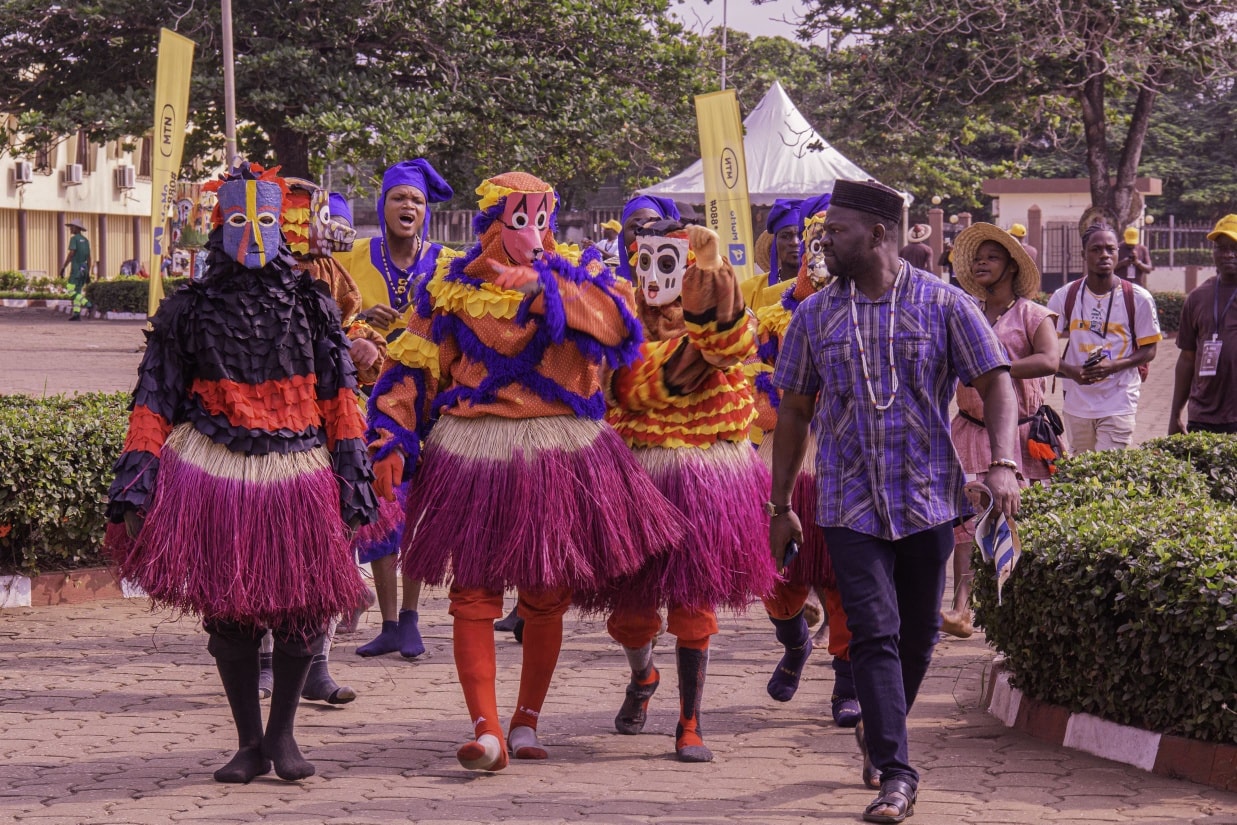
At the center of the parade, the Burrinha character leaps forward. Carried by a dancer whose body is hidden within a light frame representing a donkey, it twirls to the sound of tambourines (pandeiro) and square drums (patingué).
But it is not alone. Around it gravitates a fantastic and social bestiary:
- The Animals: The bull, the horse, and even the serpent, recalling fables of the bush and the city.
- The Colonial Figures: Characters wearing wax or wooden masks, mimicking with ironic precision the governors, merchants, and high-society ladies of the last century.
- Mami Wata: The water deity, often represented with her python belt, reminding us that even in a Brazilian-style festival, local divinities are never far away.
Laughter as an Act of Resistance
Why dress up as a "master" or a "donkey"? For the Agudas, the carnival was historically an outlet. In a society marked by the scars of slavery and colonial pressure, dressing up allowed for a reversal of roles. Mocking the powerful through satire was a way to reclaim one's identity.
As the elders of the Zomachi quarter often say: "To laugh at the monster is to prove it did not succeed in devouring you." Every step of the Burrinha dance is a celebration of resilience.
From Tradition to International Reach
Long confined to the alleys of Zomachi and Maré, the carnival reached a new milestone with the launch of the Ouidah International Carnival (CIO).
The first edition in December 2023 transformed the city into a global stage. Under the direction of Wilfrid Houndjè, over 4,000 artists and delegations from Guadeloupe, Brazil, and Togo marched along the Slave Route, transforming this path of pain into an avenue of joy and reconciliation.
Highlights of the CIO:
- The Mask Parade: A unique blend of Burrinha and traditional Beninese masks.
- The Scientific Forum: Conferences on the economic impact of cultural tourism.
Horizon 2027: A Bridge to the Caribbean
The momentum of the carnival is reaching a new level. On April 8, 2026, Ouidah welcomed a major delegation from Guadeloupe. The carnival group "Point d’interrogation", supported by the Minalèkô association presided over by Ramsès Aguessy, visited the historic city to immerse themselves in its heritage in preparation for the 2027 edition.
This visit, centered around the CIAMO Center, facilitated intense artistic exchanges but, more importantly, took on a historic institutional dimension. In the presence of Coline Toumson-Venite (President of ARAD and Cultural Advisor to the Head of State), the artists were briefed on the mechanisms for obtaining Beninese nationality for Afro-descendants.
For Wilfrid Houndjè, general delegate of the CIO, the goal is clear: to make 2027 a rallying point for carnival groups from Guadeloupe, Martinique, and Haiti. The symbolic walk taken by the delegation, from the Auction Square (Place aux Enchères) to the Door of No Return, marks the beginning of a new era where the carnival is no longer just a celebration, but an act of diplomatic and cultural homecoming.
How to Experience the Carnival?
If you plan to visit Ouidah for the Carnival, here are some tips:
- The Date: While the large international festival has variable dates, the family tradition of the Burrinha is very active around the month of February.
- The Place: Head to Place Maro or the vicinity of Casa do Brasil. This is where the energy is most authentic.
- Respect: The carnival is festive but deeply linked to family histories. Always ask for permission before photographing troupe members behind the scenes.
The Ouidah Carnival is proof that culture is a living matter, capable of crossing oceans, surviving oblivion, and being reborn stronger, carried by the eternal rhythm of the Burrinha.
Discover other facets of Aguda heritage in our article on The Brazilian Legacy.
- The Burrinha is the heart of the carnival, symbolizing the unbreakable link between Ouidah and Bahia.
- The carnival was historically an act of satire and cultural resistance for the Agudas.
- The 2023 edition marked the launch of the Ouidah International Carnival (CIO) with over 4,000 participants.