Key Takeaways
- Fa is the Fon name for Yoruba Ifá. It rests on 16 basic signs that combine in pairs to make 256 signs, each tied to stories and prescriptions.
- The diviner is called the bokonon. He works with a chain of eight half-seeds (akplekan) or with sacred palm nuts.
- Historians say the kingdom of Dahomey borrowed Fa from the Yoruba. Queen mother Hwanjile encouraged its use in the eighteenth century.
- In 2008 UNESCO inscribed the Ifá divination system nominated by Nigeria. Benin's Fa is a close branch without its own listing.
- Ifá survived the slave trade: in Cuba, babalawos such as Remigio Herrera Adeshina passed it on in the 1800s, and Cuban lineages later reached the United States.
In a courtyard in Ouidah, a man sits on a mat. In front of him lies a chain of thin seeds split in half. He holds it by the middle, flicks it out, and watches it land. Some half-seeds show their hollow side, others their rounded back. He makes a note, casts again, notes again. Then he starts to speak, slowly, about an animal, a deity, a journey told long ago.
This is a consultation of Fa, Benin's great divination system. The diviner is called the bokonon. He does not read the future in a crystal ball: he draws one sign out of 256 and recites the stories attached to it to shed light on your question.
This pillar explains what Fa is, where it comes from, what happens during a consultation, what history says about it, and how it crossed the Atlantic.
Fa in a nutshell
The word Fa (also written Fâ) means two things. It is first a deity, the spirit of divination and of knowledge of destiny. It is also the system used to consult that deity.
Fa is the Fon form of Yoruba Ifá, practiced in Nigeria and eastern Benin. Both share the same architecture: 16 basic signs that combine in pairs to make 256 signs. In Benin the signs are called du; in Yoruba, odù.
Each sign is more than a symbol. It carries a body of stories, proverbs, prescriptions and sometimes plant knowledge. According to UNESCO, in the Ifá tradition each odù holds around 800 verses, and no one knows the exact number, because it keeps growing.
The person who consults is the bokonon in Fongbe, the babalawo in Yoruba. The knowledge is oral first and foremost. There is no holy book to open: it all lives in memory.
Where does Fa come from?
Borrowed from the Yoruba
The Fon kingdom of Dahomey, founded in the seventeenth century around Abomey, and the much older Yoruba kingdom of Oyo were rivals. For a long time Oyo dominated Dahomey, which paid it tribute. Yet exchanges between the two worlds never stopped: trade, war, marriage, priests moving back and forth.
That is how Dahomey absorbed parts of Yoruba culture, including Ifá divination. According to an introduction published by the Smithsonian, Dahomey folded Ifá into its existing beliefs. The French administrator and ethnologist Bernard Maupoil, author of the standard work on the subject, noted that scholars agreed Fa was not the result of conquest: it was adopted, not imposed.
Queen mother Hwanjile
In the eighteenth century Fa took root at the court of Abomey. Under King Tegbesu (1740-1774), a woman played a decisive role: Hwanjile, named kpojito, "queen mother," for helping Tegbesu win the throne.
According to historians of Dahomey, whose work Wikipedia summarizes, Hwanjile reorganized the kingdom's religion. She brought in the creator deities Mawu and Lisa from Aja country and placed them at the head of the pantheon, and she encouraged the use of Fa divination. From then on Fa became a tool of government: kings consulted it before major decisions.
Gèdègbé, diviner of kings
The most famous bokonon in Benin's history was Gèdègbé (or Guédégbé). Born around 1850, he died in Abomey on March 7, 1936. He was attached to the court of the kings of Abomey and served as diviner to King Béhanzin, the ruler who fought the French conquest from 1890.
Late in life, Gèdègbé became the main teacher of Bernard Maupoil, then posted in Dahomey (1933-1936). He passed on much of his knowledge and left Maupoil many divination objects, now held at the Musée du quai Branly in Paris. The result was La Géomancie à l'ancienne Côte des Esclaves, published in 1943 by the Institut d'ethnologie: nearly 700 pages that remain the foundation of any serious study of Fa.
The journal Gradhiva sums up what Maupoil learned from Gèdègbé: the bokonon is a true scholar of oral knowledge, at once diagnostician, prescriber, memory specialist, botanist, psychologist and spiritual director.
Fa in Fon mythology
In Fon cosmology, Fa is tied to several deities.
Mawu, the creator, set the destiny of every being. Fa is often described as her "writing" or "alphabet": the way humans can read what she has planned.
Legba, the messenger, guardian of crossroads and doorways, is essential to every consultation. Nothing passes between humans and deities without him. You will see him outside almost every house and temple in Ouidah, as a small mound of earth.
Gbadu, daughter of Mawu, is described as the female counterpart of Fa and the goddess of fate. In the stories collected by anthropologist Melville Herskovits among others, she sits at the top of a palm tree and has sixteen eyes around her head, which she can only open with Legba's help. Her sons are said to have taught humans "the alphabet of Mawu," meaning divination.
Gbadu's sixteen eyes match the sixteen basic signs of Fa. Myth and technique tell the same story.
The bokonon's tools
The divination chain
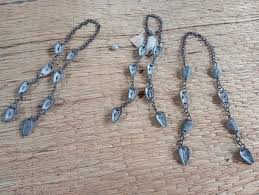
The most visible tool is the divination chain, called akplekan in Fongbe and opele in Yoruba. It is made of eight half-seeds strung on a cord, four on each side.
The bokonon holds it by the middle and casts it. Each half-seed lands either hollow side up or rounded side up: two possibilities. The four on the left give one basic sign, the four on the right give another. Together they point to one of the 256 signs, in a single throw.
The chain is fast. It is used for everyday consultations and for follow-up questions during a session.
The sacred palm nuts
The most solemn method uses sacred palm nuts, called fadekwin. The Smithsonian describes them as the dwelling of Fa himself. The bokonon passes them from one hand to the other and checks how many remain: one or two. He then draws a single or double mark in powder spread on a divination tray, often wood powder. After eight rounds, the sign is complete.
This method takes longer. It is kept for serious questions and major ceremonies.
The sixteen basic signs
The sixteen basic signs have Fongbe names, among them Gbe, Yeku, Woli, Di, Loso, Wele, Abla, Akla, Guda, Sa, Ka, Trukpin, Tula, Lete, Ce and Fu. A "doubled" sign, where both halves match, is called meji: Gbe-Meji, Yeku-Meji and so on. These are the most important, the "mother signs."
All the others come from combinations. Sixteen times sixteen: 256.
A body of knowledge learned by heart
Getting the sign is only the start. The real work comes next.
Each sign points to a set of stories. They feature deities, animals, kings, hunters, clever women, travelers. Each one tells how a character consulted Fa, what was prescribed, and what happened depending on whether they obeyed.
The bokonon does not hand down a flat answer. He picks, from the sign's stories, the ones that speak to the situation and lets the person make the connection. It is thinking by analogy, much like a parable.
Training is long. It often starts young, in a family of diviners, under a master. The apprentice memorizes signs, stories, songs, taboos, plant remedies and offerings. It takes years before he can consult alone.
UNESCO stresses how fragile this knowledge is: Ifá priests are often elderly, have few resources to train successors, and young people are turning away from the practice. The same worry exists in Benin.
Kpoli, each person's sign
Fa does not only answer one-off questions. It also reveals each person's personal sign, called the kpoli.
The kpoli is revealed during an initiation in the forest of Fa (fazun). There you learn the sign you were born under. It points to forces you have to reckon with, food or behavior taboos, deities to honor.
It is not a horoscope. It is a compass for life. Many people in Benin know their sign and refer to it when big decisions come up. Fa is also consulted at a child's birth, before a marriage, before a journey, during an illness or a family dispute.
A consultation, step by step
Every bokonon has his own habits, but a consultation usually follows the same steps.
- The question. You explain your situation. Some bokonons ask you to say the question out loud; others prefer that you keep it to yourself.
- The invocation. The bokonon greets Fa, Legba and the ancestors.
- The draw. He casts the chain or works the palm nuts and obtains a sign.
- The stories. He recites the sign's stories and relates them to your question. He may cast again to narrow things down: is the situation favorable? Which offering fits?
- The prescription. The session ends with guidance: an offering, sometimes an animal sacrifice, plants, a way to behave, a taboo to keep.
According to the Smithsonian, offerings can include palm oil, gin, flour or kola nuts, and the blood of a sacrificed animal is offered to vodun altars. Sacrifice is part of the practice. If you would rather not witness it, say so beforehand.
Fa and the other vodun
Fa holds a special place in the vodun world. Other deities have their temples, followers and festivals. Fa is how people communicate with them. It shows which deity is asking for an offering, which protects a family, which lies behind a misfortune.
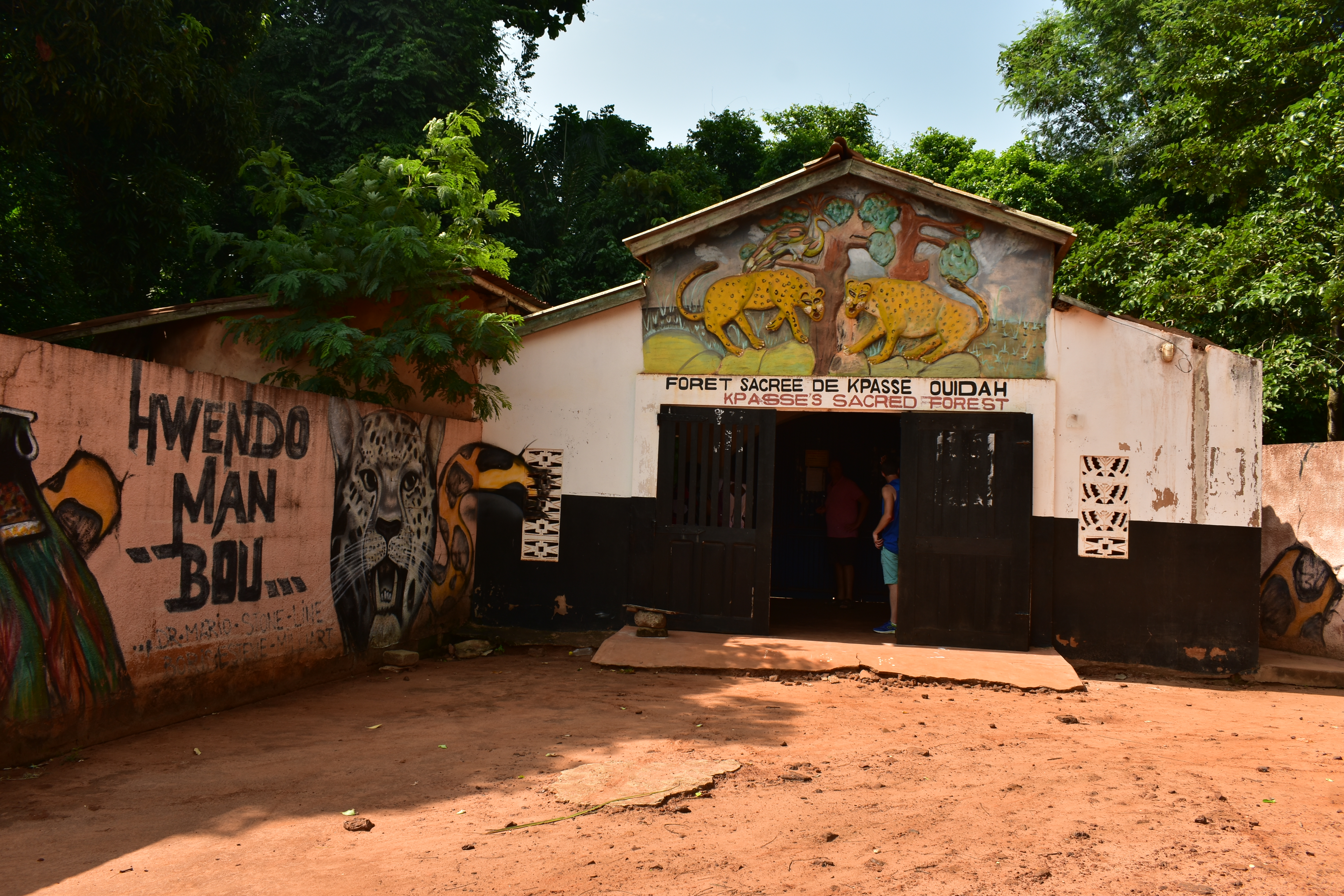
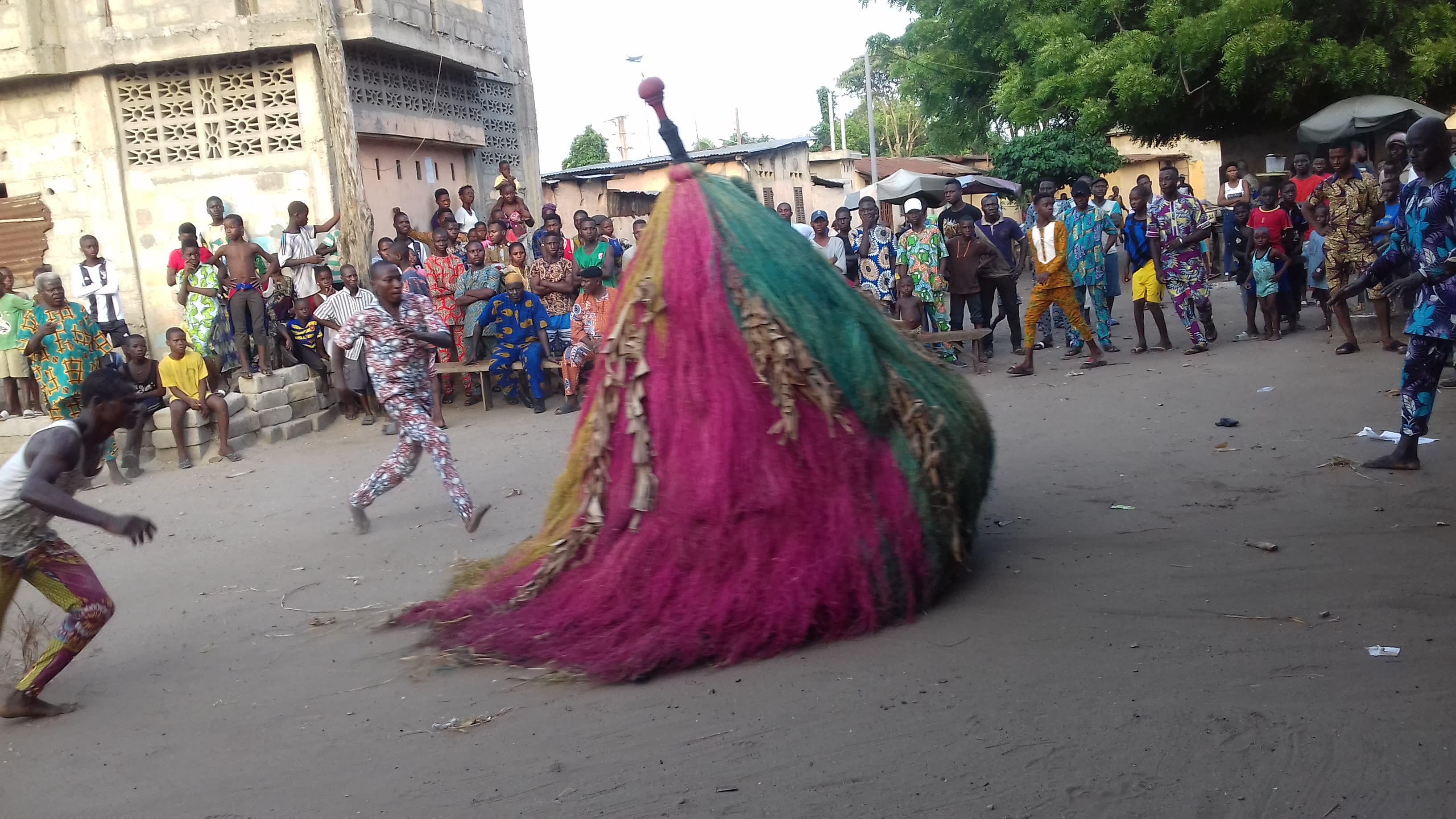
In Ouidah, that means the bokonon is often consulted before going to the Python Temple, before a ceremony in the Kpassè Sacred Forest, or before the masks come out. Many religious decisions go through him first.
It is also why Fa crosses religious lines. Some Christian or Muslim Beninese consult it now and then, quietly, about a family matter or an illness that will not go away. Fa does not ask for exclusive belief: it answers a question.
What Fa is not
Fa is not fortune-telling. The bokonon does not claim to watch the future like a movie. He links a situation to a set of stories and draws advice from them.
Nor is it a magic formula that guarantees an outcome. Following a prescription does not ensure everything will go well; within the system's logic, it restores a balance.
And like any sought-after practice, Fa attracts impostors. A diviner who promises quick wealth, demands large sums or uses fear to sell protection should raise a red flag. A serious bokonon takes his time, explains, and pushes nothing.
256 signs: a binary logic
The 256 signs of Fa have struck many observers. Each half-seed has two possible positions; eight positions give two to the eighth power, or 256 combinations. That is the number of possible values in a byte.
American mathematician Ron Eglash studied these African divination systems in his book African Fractals (1999). He sees them as a formal use of binary logic and puts forward a bold hypothesis: geomancy, which he traces to African divination practices, passed through the Islamic world and reached Europe in the twelfth century through translators such as Hugo of Santalla, eventually influencing Leibniz, one of the fathers of binary arithmetic.
That lineage is debated, and it should be presented as a thesis, not a settled fact. But it makes a point colonial eyes long refused to see: Fa is a rigorous system of knowledge, built by people who thought with precision.
Fa and the powers that be
In the days of the kings, Fa sat at the heart of power. The kings of Abomey had their own diviners and consulted them before war, successions and major ceremonies.
The colonial period changed things. Christian missions fought vodun worship, and the administration distrusted it. Yet it was a colonial administrator, Maupoil, who left the fullest description of Fa, thanks to Gèdègbé.
After independence, the Marxist-Leninist regime of Mathieu Kérékou (1972-1990) waged a so-called "anti-feudal" struggle. According to research by Emmanuelle Kadya Tall, a 1976 ordinance against witchcraft targeted vodun cults and dignitaries in particular. Vodun practice was restricted in ways that were partial and often contradictory.
The return of democracy in 1990 opened a new chapter. Indigenous religions gained recognition, the Ouidah 92 festival celebrated vodun cultures, and a yearly day was later dedicated to them. Today, Vodun Days, held around the second Friday of January, put Fa among the traditions the state showcases.
UNESCO and Fa
You will often read that "Fa is a UNESCO World Heritage practice." That is not accurate.
UNESCO proclaimed in 2005, then inscribed in 2008 on the Representative List of the Intangible Cultural Heritage of Humanity, the Ifá divination system, nominated by Nigeria. Benin's Fa belongs to the same family and shares its architecture and many of its stories, but it has no separate listing.
The UNESCO entry is still a useful guide to Fa: it describes knowledge passed on orally, threatened by aging priests and by growing intolerance toward traditional divination.
Fa in the diaspora
The slave trade carried hundreds of thousands of people from this region to the Americas, Yoruba and Fon among them. Some of them were diviners. The system survived unevenly from one country to the next.
Cuba, land of the babalawos
Ifá survived best in Cuba. The babalawo Remigio Herrera, known as Adeshina, born in Yorubaland and initiated before his capture, landed as a slave in Matanzas around 1833. Once free, he founded a cabildo in Regla, across the bay from Havana, around 1860, and it became a major center of Ifá and orisha worship. He initiated the first generations of Cuban-born babalawos and died in 1905.
Today Ifá is central to the Afro-Cuban religion known as Regla de Ocha or Santería.
From Havana to Miami and South Carolina
For American readers, this story is close to home. After the Cuban Revolution of 1959, many Cubans settled in the United States, and Cuban babalawo lineages took root in Miami, New York and beyond. Ifá and Santería are now part of American religious life.
There is also a homegrown chapter. In 1970, Oba Efuntola Oseijeman Adelabu Adefunmi I founded Oyotunji African Village near Sheldon, in Beaufort County, South Carolina, a community built around Yoruba religion and culture. For many African Americans it became a first point of contact with orisha worship and Ifá.
Bahia's last babalaô
In Brazil the story went differently. Candomblé mostly uses the jogo de búzios, cowrie-shell divination, rather than the chain or the palm nuts of Ifá. Bahia's great babalaô was Martiniano Eliseu do Bonfim (1859-1943). Born in Salvador to freed African parents, he went to Africa as a teenager with his father, studied Yoruba and English at a mission school, and returned eleven years later as a babalaô. He is considered the last babalaô of Bahia of his era.
And Ouidah?
Consulting Fa in Ouidah, a few miles from the Door of No Return, means meeting the Beninese form of a knowledge that also made the crossing. For a visitor who has met Ifá in Miami or at Oyotunji, it is a way to see one of its roots.
Consulting Fa in Ouidah
Finding a bokonon
There are many bokonons in Ouidah, but few advertise. The safest route is a referral: a guide, a family, a vodun priest. Be wary of offers made on the street or at tourist sites.
Come prepared
- A real question. "How should I approach this situation?" works better than "Will this happen?"
- Time. A consultation can last an hour or more. Do not squeeze it between two visits.
- An interpreter. Many bokonons consult in Fongbe. A guide who translates faithfully makes all the difference.
- The fee, agreed in advance. It varies with the diviner and the consultation. Ask first, and bring cash.
- An open mind. The prescription may surprise you. No one will force you to follow it, but hear it out.
What to expect as a first-timer
If you have never sat with a diviner, a few things may feel unfamiliar. The session is not a performance staged for you. The bokonon may speak for long stretches in Fongbe before your guide translates, and the stories can seem, at first, to have nothing to do with your question. That is normal. The link usually becomes clear toward the end, or later, once you have had time to think it over.
You may also be asked personal questions: about your family, your parents, your work. Answer as honestly as you are comfortable with. And if the prescription involves an offering you cannot or do not want to make, say so plainly. A good bokonon will suggest an alternative or explain what is at stake. Nobody expects a visitor to know the rules in advance.
Respect the space
Always ask before photographing the tools or the consultation. Some objects must not be touched. And if someone offers you an initiation, take the time to understand what it involves before saying yes.
To explore more of the town's vodun sites, read our pillars on the Kpassè Sacred Forest, the Egungun and the Zangbeto.
Get introduced to a trusted bokonon →
Sources
- UNESCO, "Ifa divination system": Nigeria, proclaimed 2005, inscribed 2008, about 800 verses per odù, threats.
- Smithsonian Folklife Festival, "An Introduction to Fa Divination of Benin" (2019): bokonon, akplekan, fadekwin, Dahomey and Oyo, offerings.
- Bernard Maupoil, La Géomancie à l'ancienne Côte des Esclaves, Institut d'ethnologie, Paris, 1943 (MNHN page).
- Gradhiva, "L'expérience de Bernard Maupoil au Dahomey : entre science et engagement" and Gèdègbé, Wikipédia.
- Hwanjile, Wikipedia and Tegbesu, Wikipedia.
- Gbadu, Wikipedia: sixteen eyes, Legba, "the alphabet of Mawu."
- Ron Eglash, African Fractals, Rutgers University Press, 1999.
- Emmanuelle Kadya Tall, "De la démocratie et des cultes voduns au Bénin," Cahiers d'études africaines, 1995.
- Remigio Herrera, Wikipedia.
- Oyotunji, Wikipedia.
- Martiniano Eliseu do Bonfim, Wikipédia.
- Ifá, Wikipedia.