He crossed the threshold in the opposite direction.
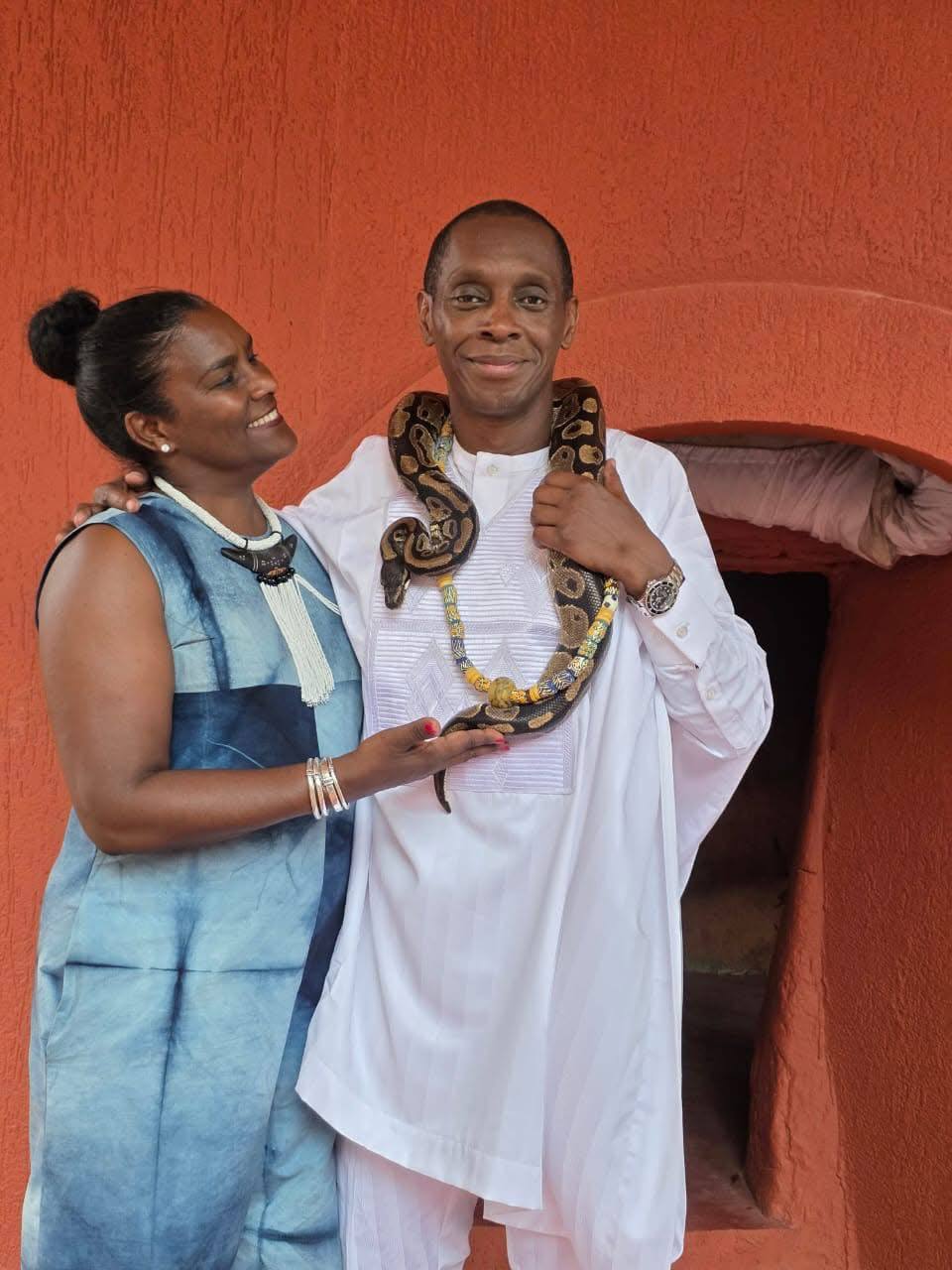
On the morning of 22 May 2026, in Ouidah, Claudy Siar walked where millions of men and women had walked for the last time. The Door of No Return, the monument inaugurated in 1995 at the end of the Slave Route, has symbolised for thirty years the point of embarkation for over a million Africans deported to the Americas. For the Guadeloupean RFI host, it became, on that day, something else entirely.
"The Door of No Return was, for me, the Door of Return."
He could not hold back his tears. And he did not try.
Who is Claudy Siar?
Born on 2 November 1964 in the 11th arrondissement of Paris, raised in Vigneux-sur-Seine, Claudy Siar is one of the most important figures in Afro-Caribbean culture in France. Since 13 March 1995, he has hosted "Couleurs Tropicales" on RFI every week — a programme that has become an institution for millions of listeners of African and Caribbean music worldwide. He founded Tropiques FM, the radio station of the French overseas communities. He has sung, produced, and campaigned. His entire career has been built around the idea of the "conscious generation" and Pan-Africanism.
But he also carried, without knowing it precisely, something else: an ancestral thread connecting him to Ouidah. A DNA test revealed it. And 22 May 2026 transformed that revelation into an official certainty, an assumed identity, an accomplished return.
The Zossoungbo Lineage — Founding Families of Ouidah
The DNA test spoke clearly: Claudy Siar belongs to the Zossoungbo lineage, one of Ouidah's founding families. This revelation goes beyond simple genealogy. It inscribes the broadcaster into the very depth of this city's history — not as a visitor, not as a memorial tourist, but as an heir.
The Zossoungbo were there before Ouidah became the largest slave-trading port in West Africa, before the Slave Route was traced, before the Door of No Return came to symbolise the brutal tearing-away. They watched the departures. And now, their blood returns.
"I am no longer an Afro-descendant but an African from Ouidah, from the lineage, the family of the Zossoungbo, the founders of Ouidah."
Kodjovi: The Name of Monday
According to Fon tradition, every child receives a name determined by the day of their birth. Claudy Siar was born on a Monday. He therefore receives the name Kodjovi — the name given, in this tradition, to those who come into the world on that day.
This name is not a nickname. It is a recognition. It is the sign that the ancestors had already named him, long before he found them.
He is now Kodjovi Claudy Siar, of the Zossoungbo family.
Two Ceremonies, Two Registers
The day of 22 May unfolded in two distinct moments, two registers that together make up the fullness of this return.
The first ceremony — the Fâ — remained secret. The Fâ is the divinatory oracle at the heart of Vodun spirituality, that intimate dialogue between a person and their ancestors, where destiny is read in the signs and gestures of the diviner. That moment belonged only to Claudy Siar and those who accompanied him in that interior sanctuary.
The second ceremony was more open: a collective and personal reconciliation. Claudy Siar deposited his sorrows, his defeats, the weight of months he describes as unjust. The customary dignitaries of Ouidah interceded. Something lifted. What cannot always be named in words — the relief of a recovered identity, the weight of a history restored — manifested in the body of this man who wept.
The ceremony was organised by the Mairie de Ouidah and the agency Retour Gagnant Bénin, within the framework of the Afro-descendant return movement encouraged by Benin's new legislation.
22 May: A Date That Owes Nothing to Chance
The timing of this return is dizzying.
22 May 1848 is the day the decree abolishing slavery was applied in Martinique — the Caribbean island whose heritage Claudy Siar partly carries. It is precisely on 22 May 2026, at 6pm (Cotonou time), that he receives his Beninese nationality certificate and passport.
One hundred and seventy-eight years after abolition, a man whose ancestors were torn from this coast returns and receives a document that says: you are from here. It takes a moment to grasp the amplitude of this coincidence. Or perhaps it is not a coincidence at all. Perhaps it is precisely what the ancestors had arranged.
Law 2024-31 and My Afro Origins
Claudy Siar's return is part of a broader national dynamic. In September 2024, Benin enacted law 2024-31, allowing diaspora Afro-descendants to obtain Beninese nationality. The process runs through the digital platform My Afro Origins and requires proof of sub-Saharan African ancestry — genealogical or attested by an accredited DNA test. Application fees are $100.
Since the programme's launch, Beninese authorities receive approximately a hundred new applications every day, with thousands of files currently under review. American singer Ciara was among the first beneficiaries of this historic law, in July 2025.
Claudy Siar himself had publicly announced the news as early as August 2025: "Since August 2025, I am of Beninese nationality and proud of it." 22 May 2026 is the public and symbolic culmination of that process, with the ceremony in Ouidah.
What This Return Says About Ouidah
Ouidah is not merely a place of memory. It is a place of resolution.
Millions departed from this beach. And since the Slave Route has existed as a recognised memorial itinerary, something has been slowly repairing itself — not in the sense that history is erased, but in the sense that it is being completed. Claudy Siar's return is one such completion. A thread retied. A circle closed.
The broadcaster who has devoted thirty years of his life to carrying Afro-Atlantic music to the world — from zouk to Afrobeats, from reggae to conscious rap — belongs, biologically and spiritually, to the city that was the departure point for those cultures. Kodjovi Claudy Siar, of the Zossoungbo family, is at home in Ouidah.
And Ouidah receives him.
Also explore our guide to tracing your ancestors in Ouidah and how the My Afro Origins programme is opening the door to return for thousands of Afro-descendants.
- On 22 May 2026 — anniversary of the abolition of slavery in Martinique — Claudy Siar officially received Beninese nationality in Ouidah.
- A DNA test revealed he belongs to the Zossoungbo lineage, one of Ouidah's founding families.
- Born on a Monday, he received the name Kodjovi according to the Fon tradition of birth-day naming.
- Two ceremonies marked the day: the Fâ (private Vodun oracle) and a public collective reconciliation.
- Benin's law 2024-31 allows Afro-descendants to obtain Beninese nationality via DNA test or genealogical proof, for $100.