Since 2022, it was known as the Ouidah Biennial. It already carried within it a singular ambition: to make this Beninese coastal city a crossroads of Vodun artistic creation, a space for dialogue between African aesthetics and their extensions across the diaspora. But in 2026, something shifts. Something deepens.
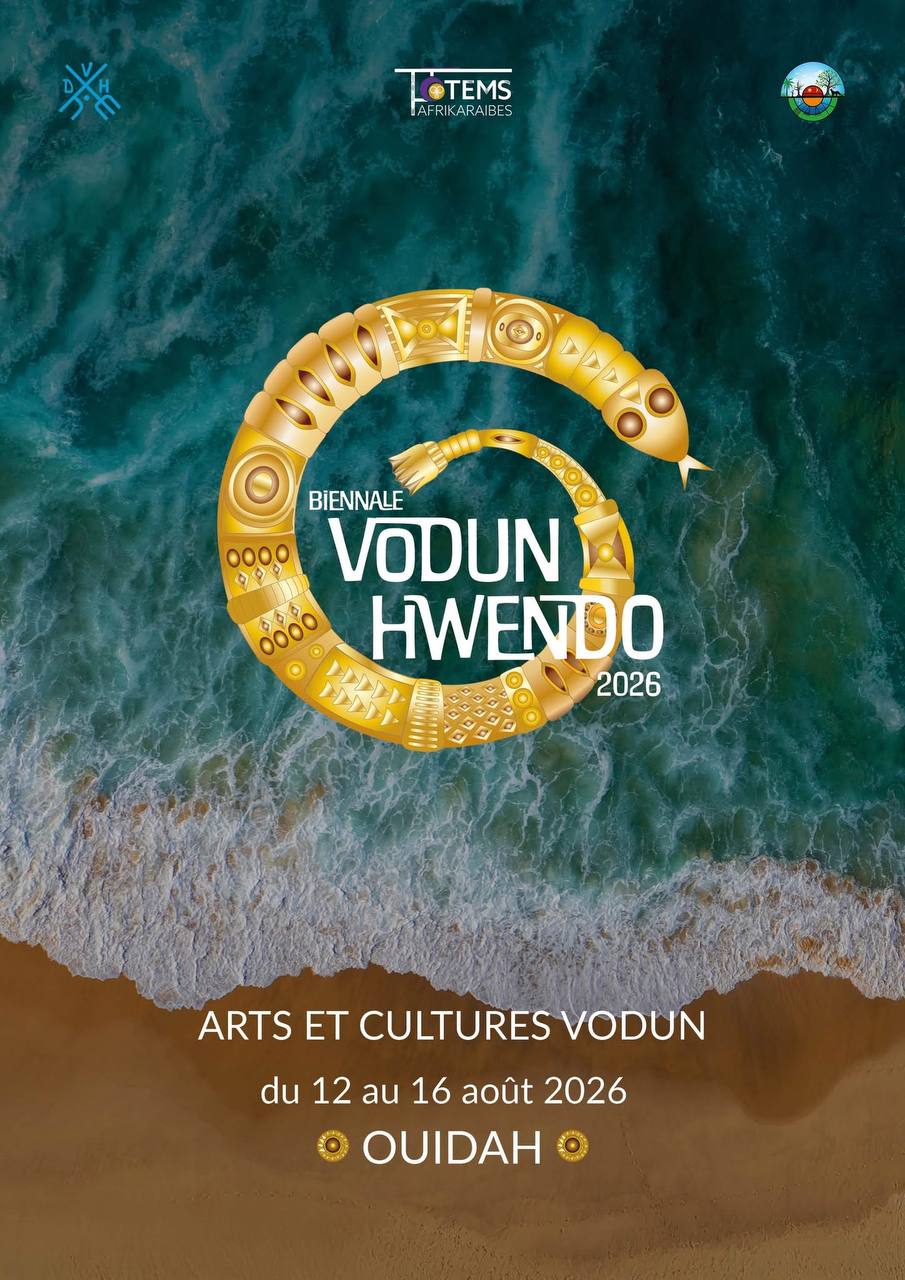
It is now called Vodun Hwendo.
And this name change is not cosmetic. It is programmatic.
What Vodun Hwendo Means
In the Fon language, hwendo means the path, the movement, the journey. Vodun Hwendo is literally the path of Vodun — the spiritual, artistic and memorial trajectory that Vodun communities have been tracing across the Atlantic for centuries. The name already announces the intention: this biennial is not another festival. It is a platform for collective journeying.
This name change accompanies a fundamental transformation. The Vodun Hwendo Biennial will no longer be situated solely within the frame of cultural entertainment. It becomes a transatlantic curatorial platform dedicated to the study of Vodun aesthetics and narratives from a decolonial perspective.
That word — decolonial — deserves to be taken seriously. It is not a slogan. It is a method: looking at Vodun artistic creation not through the lens of 19th-century Western ethnology, but through the lens of the communities themselves. Understanding Vodun forms, gestures, sacred figures, ritual objects, sounds and textiles as autonomous aesthetic systems — with their own logic, their own history, their own future.
Anchored in Ouidah Since 2022
The choice of Ouidah as anchor is not accidental. Ouidah is the place par excellence where Vodun has shown itself, been heard, and negotiated with the world. It is from this shore that millions of human beings were taken — and it is precisely here that Vodun survived, transformed, and travelled.
Haitian Vodou, Brazilian Candomblé, Cuban Santería, Trinidadian Shango — all of these religious and aesthetic traditions carry the imprint of what took shape in Ouidah and its surroundings, three centuries ago. Vodun Hwendo is the institutional space that acknowledges this fact and draws its curatorial consequences.
The biennial unfolds between artistic creation, ritual knowledge and research, in a permanent dialogue between artists, researchers and Vodun communities on an Afro-Atlantic scale. This triptych is foundational: neither purely academic, nor purely spectacular, nor purely ritual — but all three at once, in dialogue and creative tension.
Since its first edition in 2022, the biennial has laid the foundations for this dialogue. The third edition takes a decisive step further.
2026: Totems AfriKaraïbes — Metamorphosis
The theme of the third edition is Totems AfriKaraïbes. It fits within a broader reflection on metamorphosis — that of forms, bodies, identities, and memories that cross the Atlantic and transform without disappearing.
Totems are figures of mediation: between the visible and invisible worlds, between ancestors and the living, between the local and the transatlantic. A Vodun totem is not an idol. It is an interface. And it is precisely this notion of interface — of passage, threshold, transformation — that organises the programming of this third edition.
The Caribbean enters explicitly into the dialogue. The Afro-Atlantic space is no longer only Benin–Brazil. It expands to include Haiti, Cuba, Martinique, Guadeloupe, Trinidad — all those islands that carry, in their spirituality and their arts, the echo of the Beninese coast.
The Totems AfriKaraïbes platform is led under the executive direction of Noudeou Noëlie Houngnihin, who coordinates this dialogue between the African and Caribbean shores of the Vodun world.
12 to 16 August 2026 in Ouidah
The programme of this third edition weaves together:
- Exhibitions — works by contemporary artists working at the intersection of Vodun aesthetics and current creation, in dialogue with ritual objects and ancestral forms
- Performances — site-specific creations that mobilise the body, voice, trance and gestures of Vodun as artistic materials
- Workshops — spaces of transmission and exchange between ritual practitioners, artists and researchers, open to local and international audiences
- Conversations — dialogue formats that bring together voices from Africa, the Caribbean and the diaspora to think collectively about Vodun aesthetics and memories
This programme unfolds across Ouidah over five days, in heritage and contemporary sites that are themselves part of the subject: a city where every square, every tree, every path is potentially a space of Vodun memory.
Michel Meyer: From Agolo to Sa Majesté des Mers et Océans
Michel Meyer is no stranger to the Afro-Atlantic world. In 1994, he directed the music video for "Agolo" by Angélique Kidjo — a song that became a global anthem of African identity, opening the doors of the world's greatest stages to Kidjo. That video, shot with visceral energy and deeply rooted imagery, already bore the signature of a filmmaker who understands that Vodun culture is not a backdrop. It is a language.
Thirty years later, Meyer returns to that same source with a project of an altogether different scope: the feature documentary Sa Majesté des Mers et Océans (90 minutes, 4K), co-produced by Laboratorio Arts Contemporains (Benin) and Fame Production (France).
At the heart of the film: Dada Daagbo Hounon Houna II, supreme spiritual chief of Vodun Hwendo, son and successor of the late Dada Daagbo Agbessi Houna I — who in 1988 opened, at the Casa do Benin in Salvador de Bahia, a new chapter of Afro-Atlantic spiritual diplomacy, alongside Pierre Verger and Gilberto Gil. This sacred lineage is the thread that runs through the entire film.
From 2019 to 2022, a Franco-Beninese team followed Dada Daagbo Hounon Houna II alongside women, cult masters, babalawo and artists — bearers of a living aesthetic of care, the sacred and transmission. The result is an immersion into the inner workings of a cosmic heritage, where spirituality becomes artistic language and rituals become living archives.
This documentary participates in a reconfiguration of narratives: restoring the voice to the heirs, connecting the peoples of the Black Atlantic, and legitimising Vodun as a foundational source of contemporary creation.
Brazilian Premiere — Salvador de Bahia & Cachoeira
In August 2025, the film held its Brazilian premiere as part of the OCUPA – Casa do Benin 2025 programme, in partnership with UFBA (Federal University of Bahia):
- 📍 Salvador de Bahia — 12 August 2025
- 📍 Cachoeira — 20 August 2025
This is no coincidence. Brazil, and Salvador de Bahia in particular, remains a land of resonance for Vodun cosmogony — a spirituality of four elements (earth, water, fire, air) that structures the relationships between the living, the ancestors and the orishas. It was here, at the Casa do Benin, that the historic 1988 chapter of Afro-Atlantic spiritual diplomacy first opened. The film's screening in these very places, thirty-seven years later, completes a circle.
Erol Josué: Haiti and the Path Back
Erol Josué is one of the most important figures in the transmission of Afro-Atlantic cultures. Singer, dancer, choreographer, actor and Haitian Vodou priest (houngan), he is also Director General of Haiti's Bureau of Ethnology. His artistic work — two acclaimed albums, numerous international stage performances — is inseparable from his spiritual practice. For Josué, Vodou is not an object of study: it is a way of being in the world.
He has already come to Ouidah, to the Door of No Return, to honour the ancestors and call for symbolic reparation. His presence at Vodun Hwendo embodies precisely what the biennial wants to be: a space where ritual and creation are not two separate things, but a single practice of presence in the world.
Josué also represents the Haitian dimension of this Afro-Atlantic dialogue — a central dimension in the theme Totems AfriKaraïbes, Haiti being one of the countries where Vodou has best preserved itself and most freely affirmed itself as a national religion and living heritage. In Haiti, the lwa — the Vodou spirits — are not distant divinities. They are present, demanding, relational. They require that you show up. Josué's work is about showing up.
Why This Matters for Ouidah
The Vodun Hwendo Biennial fits into the broader transformation of Ouidah as a cultural capital. The Ouidah 2027 plan envisions a rise in memorial and cultural tourism, and the biennial is one of its key artistic pivots.
It completes the calendar of major events: the Vodun Days in January, the Biennial in August — two moments of international reach, two different temporalities, two audiences that overlap and expand. Where the Vodun Days are primarily a spiritual and popular celebration, Vodun Hwendo is more curatorial and research-oriented. Together, they offer the full spectrum of what Ouidah has to say to the world.
Vodun Hwendo, by becoming a curatorial platform with a decolonial mission, positions Ouidah not only as a site of memory, but as a site of knowledge production about Afro-Atlantic aesthetics. A city that does not merely invite visitors, but thinks, creates, and projects ideas outward.
For artists, researchers and diaspora travellers, this biennial is an invitation. Not only to come and see. But to come and participate in something being built.
The path is open. The name says it: Vodun Hwendo. The path of Vodun.
Also explore how the Vodun Days have transformed Ouidah into an international spiritual capital each January — and what the MIME is preparing for 2027.
- The Ouidah Biennial changes its name and becomes Vodun Hwendo — a transatlantic curatorial platform with a decolonial mission.
- The 3rd edition runs from 12 to 16 August 2026 in Ouidah, around the theme Totems AfriKaraïbes.
- Artists, researchers and Vodun communities dialogue across Africa, the Caribbean and the diaspora.
- Michel Meyer (director of Sa Majesté des Mers et Océans) and Erol Josué (Haitian Vodou priest and singer) are among the invited figures.
- The biennial combines exhibitions, performances, workshops and conversations around the theme of metamorphosis.