

There is a place on the coast of Benin where the land ends and the Atlantic begins, and where, for over two centuries, that meeting point meant one thing only. The Door of No Return in Ouidah stands at the edge of the beach as both monument and wound. Millions passed through it, carried onto ships, taken west. Most never came back.
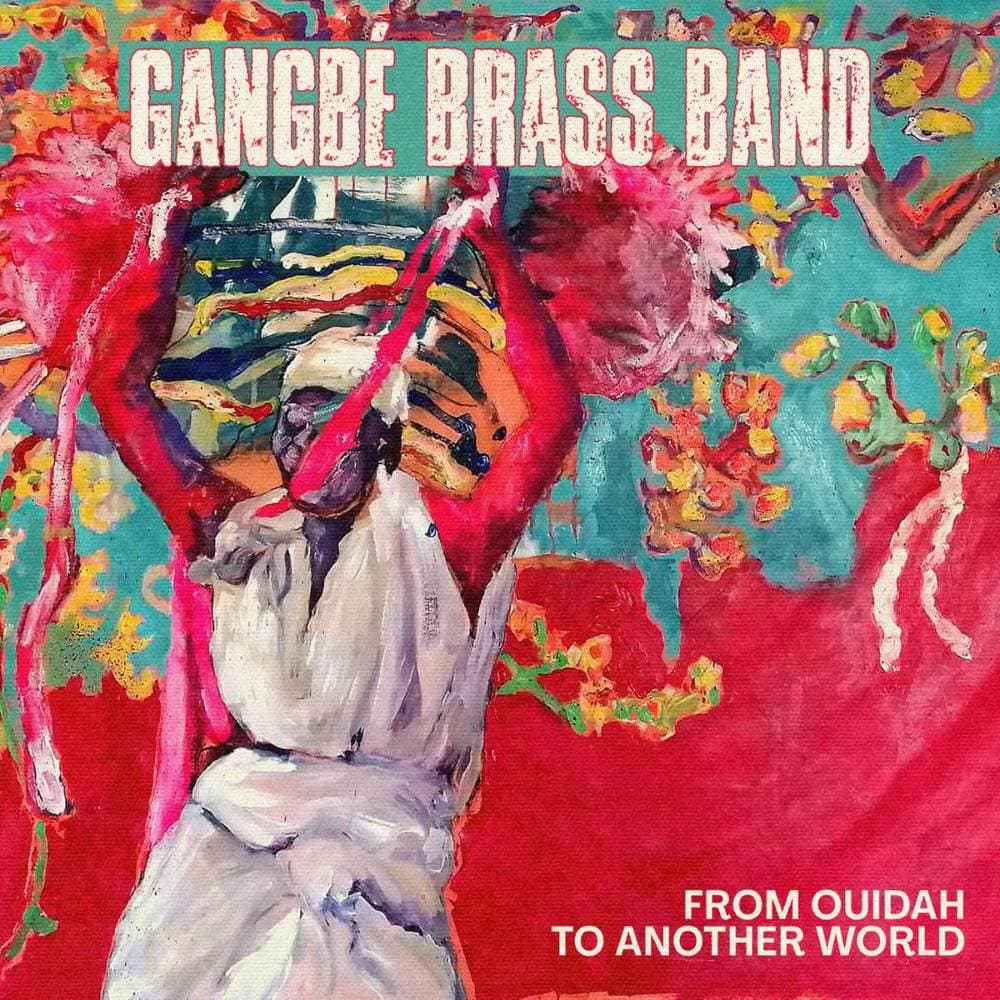
The Gangbé Brass Band named their sixth album after this city. Not after Benin in general. Not after West Africa. After Ouidah specifically, and the world that flows outward from it. From Ouidah to Another World is not a tribute record or a commemorative gesture. It is an argument. And after thirty years of playing, the band has earned the right to make it.
The port where everything begins
Ouidah is a small city, about an hour west of Cotonou along the coast road. It does not announce itself with size or noise. What it carries is weight.
The city was the primary slave-trading port of the Kingdom of Dahomey during the seventeenth and eighteenth centuries. Estimates suggest that more than one million enslaved people were embarked from its shores, making it one of the most significant departure points in the entire history of the transatlantic slave trade. The route from the city center to the beach, roughly four kilometers of red laterite earth lined with sacred trees and Vodun shrines, became known as the Route des Esclaves. The Door of No Return was built in 1992, a symbolic arch facing the ocean, marking the point where those who left did not return.
But Ouidah is not defined only by what it lost. The city is also a living center of Vodun practice, home to some of the oldest initiatory societies in the region, to the python temple of Dangbe, to the Aguda community whose Brazilian roots trace back to freed slaves who returned across the same Atlantic. Every January, the Fête du Vodun draws practitioners and visitors from across the diaspora. The city breathes in both directions.
This is the Ouidah the Gangbé Brass Band chose as the title of their album. Not the postcard version, not the museum version. The full one, with the grief and the return and the sacred trees still standing.
When you stand at the Door of No Return and face the ocean, you are facing the same water that carried everything away. The Gangbé's album asks what came back.
A band born from metal and memory
Gangbé means "sound of metal" in Fon, one of the principal languages of southern Benin. The name is specific in the way that matters: it refers not to brass instruments in the Western sense, but to the ritual iron bell struck in Vodun ceremonies, the cloche whose ring opens communication between the visible and invisible worlds.
The band was founded in Cotonou in 1994, when eight musicians who had been playing separately came together around a shared idea: to bring the fusion of brass music and Beninese traditional rhythms into public space. Their early work found support from André Jolly, then director of the Centre Culturel Français de Cotonou, which gave them rehearsal space and early performance opportunities. From there, the group built its own path.
The current lineup credited on From Ouidah to Another World reflects three decades of collective evolution:
- Dehoumon Athanase Obed — the band's central creative force, bandleader and primary architect of their musical vision
- Akloe Ebenezer Abdias Zasahou
- Ahouandjinou Wendo Martial
- Avihoue Benoit
- Odjo Prosper
- Kpitiki Crespin
Their instrumentation is worth examining closely. The Gangbé builds its sound on trumpets, trombones, and sousaphone — the brass tradition imported to West Africa through French colonial military bands, which trained local musicians in European wind instruments for parade and ceremony purposes. This is not an irony the band ignores. It is part of what they work with: the idea that these instruments arrived through domination and were repurposed into something else entirely.
Set against the djembe, agogo bells, and polyphonic vocals rooted in Fon and Yoruba ceremonial music, the brass becomes something no colonial officer intended. The metal rings differently here.
The sound they built: Vodun, jazz, and the brass tradition
The Gangbé's musical vocabulary is not a fusion in the polite, world-music-festival sense. It is a negotiation between languages that have always been in contact, whether or not the official history acknowledged it.
At the foundation sits Vodun rhythm. The ceremonial cycles of Sato, Zinti, and Ogbon are not decoration in the Gangbé's music; they are structure. These polyrhythmic patterns, passed through generations of practitioners in southern Benin and Togo, carry specific spiritual and social functions. When the Gangbé uses them, they do not lift them out of context for effect. The band emerged from that context.
Layered above this foundation is afrobeat, and here the debt to Fela Anikulapo Kuti is openly declared. The Gangbé has played at the Shrine in Lagos with Femi Kuti. They have recorded tributes to the "Black President." Their command of afrobeat's extended groove structures, the way a phrase can lock into a cycle and breathe within it for minutes without losing tension, comes from genuine study. This is not influence at a distance. It is proximity.
The jazz dimension adds harmonic complexity and the capacity for individual voices to speak within the collective. Western big-band structures inform how the Gangbé organizes its sections, how the brass trades phrases, how the soloists emerge from and return to the ensemble. Jazz arrived in West Africa through the same Atlantic routes the album traces. Its presence in the Gangbé's sound is not an adoption of something foreign; it is a recognition of something that was always partly theirs.
The group sings in Fon, Yoruba, and French, languages that map the layers of southern Benin's history: the precolonial, the diaspora, and the colonial. When all three appear in a single track, the political argument is embedded in the music itself, without requiring explanation.
Thirty years on the road: a discography as a journey
Six albums across thirty years is not a prolific pace. Each Gangbé record is a marker, not a product.
Gangbé (1998) — The debut, recorded with the support of French group Lo'Jo after a meeting at the Festival du Théâtre des Réalités in Bamako. Thirty-five tour dates in Europe and Canada followed. The album introduced a sound that European audiences had not encountered: not traditional African music for the world music circuit, and not jazz with African seasoning, but something that refused both categories.
Togbé (2001) — "The voice of the ancestors." A deeper turn toward Beninese tradition, released on the Contrejour label in Brussels. The title set the direction: before looking outward, look back.
Whendo (2004) — "Roots." The third album continued the excavation, with "Remember Fela" as its explicit tribute to the figure who had shaped their approach to political music.
Assiko (2008) — A rhythmic shift, expanding the palette while holding the center. The band's touring had taken them to dozens of countries by this point. What they absorbed on the road began appearing in the grooves.
Go Slow to Lagos (2015) — A direct address to the West African megacity and the Fela legacy embedded in it. The Gangbé traveled to Lagos, played with Femi Kuti, filmed a documentary. The album was both a pilgrimage and a statement of continuity.
Then came ten years of touring, evolving, and living with the music. The major stages followed: Montreux Jazz Festival, WOMAD, Jazz à Vienne, Jazz Festival Brasil in Rio de Janeiro, Music World in Shanghai. Collaborations with Angélique Kidjo, Michel Portal, Femi Kuti. A documentary. Festival headline slots across Europe and North America.
Thirty years of that. And then, in December 2025, album six.
From Ouidah to Another World is what a band sounds like when it no longer needs to prove anything. That is not complacency. It is clarity.
What "From Ouidah to Another World" actually argues
The central claim of this album is historical, musical, and political at once, and the Gangbé makes it without ever becoming a lecture.
The argument runs like this: the brass band tradition did not originate in Europe and arrive in Africa. It passed through Europe, yes, and through the American South, and through New Orleans specifically, but its deepest roots trace to West African musical forms that crossed the Atlantic in the bodies of enslaved people. The street brass bands of New Orleans, the second-line tradition, the parade music that became jazz, all of it carries the memory of rhythmic systems, collective musical organization, and the relationship between brass and ceremony that existed in places like Ouidah long before any French colonial officer arrived with a trombone.
The brass band went out from Africa. It transformed in the Americas. It came back changed.
Ouidah is the hinge. The port from which music departed and to which, in altered form, it returned.
Athanase Obed Dehoumon, the band's pillar and the primary force behind this album's conception, has spoken about the intention to trace these invisible circulations rather than simply celebrate a heritage. The album does not frame the transatlantic slave trade as a story of victimhood, nor does it perform easy reconciliation. It does something more difficult: it holds the grief and the creativity together, simultaneously, in the same groove.
The progression through the album's tracks reflects this. Percussion enters in layers, discreet at first, building until the polyrhythm locks in and drives. The brass breathes through it. The fanfare becomes a narrator, not an ornament. The album moves without linearity, looping back, bifurcating, suspending expectation before resolving. It mirrors the history it traces: not a straight line from past to present, but a circuit that is still running.
What Dehoumon and his bandmates have built is a sonic proof of concept for something historians and cultural theorists argue in books that most people will never read: that the Black Atlantic is not a story of loss and dispossession alone, but of radical creativity under pressure, of cultural memory that survived the Middle Passage and returned.
The Gangbé plays that proof. You can hear it.
Inside the album: tracks, textures, and what each piece carries
From Ouidah to Another World was released on December 5, 2025, on the Salt'n Ginger Music label. The track listing, partially reconstructed from available information, includes pieces that carry their weight in their titles alone.
"La porte du grand retour" inverts the monument's name deliberately. The Door of No Return becomes the Door of the Great Return. The piece does not explain this reversal; it enacts it, building from a grounded bass figure into something that opens.
"Complainte pour un déporté" holds the grief without softening it. A lament, but not a dirge. The brass carries it with the kind of weight that comes from intimacy with the subject, not distance from it.
"Vignon" — a name, a place, a person; the specificity is the point. The Gangbé does not speak in abstractions about Beninese culture. It speaks in proper nouns.
"Ouidah Spiritual" places the city in direct conversation with the American spiritual tradition, another form that grew from African roots transplanted by force. The title is a thesis.
"Ayé" — featuring Angélique Kidjo. The word means "the world" in Yoruba and Fon. Kidjo was born in Ouidah. She grew up in Cotonou. She left Benin in 1983, built a career across four decades, won five Grammy Awards, and remained, in everything she does, tethered to the same coast the Gangbé calls home. Her presence on this album is not a guest appearance in the industry sense. It is a homecoming embedded in a song about the world.
Lionel Loueke, the other featured collaborator, was born in Cotonou in 1973. He studied at Berklee, trained at the Thelonious Monk Institute, became one of the most singular guitarists in contemporary jazz, was mentored by Herbie Hancock, and has spent his career weaving West African musical memory into jazz improvisation. His appearance on From Ouidah to Another World closes a specific circuit: Cotonou-born, world-forged, returned in sound.
The decision to feature two Beninese artists of global stature who both maintain their roots is not coincidental. It reflects the album's core logic. You leave. You carry what you know. It transforms. You bring it back. The loop does not close with loss; it closes with multiplication.
The production by Salt'n Ginger Music gives the album space to breathe. Nothing is over-polished. The sousaphone rumbles in the low end with physical presence. The percussions retain their textural complexity. The voices, when they come, feel like they are in the room with you.
Ouidah as a living source, not a monument
There is a version of Ouidah that exists for outside consumption: the slave trade port, the Door of No Return, the dark tourism circuit. This version is not false, but it is incomplete in ways that matter.
The Ouidah that practitioners know, that residents know, that the Gangbé knows, is a city where the sacred is not historical. The python temple is not a museum. The ceremonies are not performances. The Route des Esclaves is walked by people who live alongside it, who know the trees that line it by name, who understand that the grief and the devotion and the daily life are not separate registers but a single, layered reality.
What the Gangbé does on this album is refuse the monument version. Ouidah is not a wound to be commemorated. It is a source. A place from which things continue to flow.
For those who travel to Ouidah looking for something beyond the surface of the historical sites, the album offers a way in. The music maps a sensibility that the city itself embodies: that what was taken can return transformed, that cultural memory is not fragile but durable, that creativity is one of the forms survival takes.
The Fête du Vodun in January. The Aguda houses with their hybrid Brazilian-Yoruba architectures in the streets near the center. The smell of the lagoon at dusk, and the drums that start up before you can see where they are coming from. Ouidah is all of this at once, and the Gangbé album does not explain it. It sounds like it.
Why this album matters now
The question of what belongs where, and to whom, has moved to the center of global cultural conversation in ways that seemed impossible a decade ago. The restitution of African heritage objects from European museums. The renegotiation of who tells African stories and in what form. The renewed visibility of diaspora artists claiming connections to specific homelands rather than continental identities.
From Ouidah to Another World enters this conversation from an unusual position. It does not make demands. It does not argue through press releases or institutional statements. It makes its case in brass and percussion and polyphonic voice, in thirty years of accumulated authority, in the specific choices of who stands on a track and what their name means in the context of where this music comes from.
The album is also a counter-argument to a certain nostalgia. Some conversations about African cultural heritage treat the continent's traditions as things to be preserved, protected, kept intact against outside influence. The Gangbé has never operated this way. Their music is deeply rooted and genuinely open, because they understand that the roots are strong enough to hold transformation. You do not protect a living culture by freezing it. You protect it by letting it move.
After thirty years of playing on stages across six continents, this band knows the difference between adaptation and dilution. From Ouidah to Another World is the record of that knowledge.
FAQ
Who is the Gangbé Brass Band? The Gangbé Brass Band is a Beninese musical ensemble founded in Cotonou in 1994. The name means "sound of metal" in Fon, referring to the ritual iron bell used in Vodun ceremonies. The band blends West African Vodun rhythms, afrobeat, jùjú music, and jazz through an instrumentation of brass instruments, traditional percussion, and polyphonic vocals in Fon, Yoruba, and French. They are widely regarded as one of the most important brass bands to emerge from Africa.
What is "From Ouidah to Another World" about? Released on December 5, 2025, on the Salt'n Ginger Music label, From Ouidah to Another World is the band's sixth album and marks their thirtieth anniversary. It traces the circular journey of African musical memory across the Atlantic: from Ouidah through the slave trade to the Americas, where it transformed into brass band and jazz traditions, and back to the continent in new forms. The album features guest appearances by Angélique Kidjo and Lionel Loueke, both Beninese artists of global standing.
Where can I listen to the album? From Ouidah to Another World is available on Bandcamp at gangbbrassband.bandcamp.com, and on major streaming platforms. It was released in vinyl gold, CD digipack, and digital formats.
What is the connection between Ouidah and New Orleans? Ouidah was one of the principal ports of departure during the transatlantic slave trade, from which over one million enslaved people were transported to the Americas. A significant number landed in Louisiana, where African rhythmic and ceremonial traditions merged with European brass band music to produce the street brass band tradition of New Orleans. The Gangbé's album traces this circulation, arguing that brass band music is not European in origin but African in memory, returned to the continent in transformed form.
Who are the members of the Gangbé Brass Band on this album? The credited members on From Ouidah to Another World are Dehoumon Athanase Obed, Akloe Ebenezer Abdias Zasahou, Ahouandjinou Wendo Martial, Avihoue Benoit, Odjo Prosper, and Kpitiki Crespin. The band was originally founded with eight musicians in 1994 in Cotonou.
Why is Ouidah important to Beninese culture? Ouidah is the historical and spiritual center of Vodun practice in West Africa, home to major initiatory societies, the python temple of Dangbe, and the Aguda community whose origins trace to freed slaves who returned from Brazil. The city hosts the annual Fête du Vodun each January, drawing practitioners and diaspora visitors from across the world. It is also the birthplace of Angélique Kidjo. Its significance extends far beyond its role in the history of the slave trade.
Conclusion: from Ouidah, to everywhere
Thirty years is long enough to know what you are. The Gangbé Brass Band has spent three decades answering a question that most groups never ask: not "where are we going?" but "where did this come from, and what does that mean for where it goes next?"
From Ouidah to Another World is their most complete answer. It holds the history of a port city and a people's dispersal, the return of musical forms that survived the crossing, and the clarity of a group that has played enough stages to know the difference between what audiences want to hear and what needs to be said.
The loop from Ouidah is still running. The album is one turn of it, documented in brass, percussion, and the voices of a city that has never stopped sending its music into the world.
If you come to Ouidah looking for that music, you will find it. Not in a museum. In the streets, in the ceremonies, in the sound of the ocean at the edge of the Route des Esclaves where the land runs out and everything continues.
- Gangbé Brass Band celebrates its 30th anniversary with its sixth album, 'From Ouidah to Another World'.
- The album traces the journey of African musical memory across the Atlantic and its return.
- Features collaborations with global Beninese artists Angélique Kidjo and Lionel Loueke.