Key Takeaways
- The word "Aguda" comes from Ajudá, the Portuguese name for Ouidah. It refers to freed slaves and free people who returned from Brazil and Cuba starting in 1835.
- The Aguda settled in the Brésil, Zomaï and Docomè neighborhoods, not a "Singbomey quarter," which is actually the name of the de Souza family residence.
- The Maison du Brésil, in the Zomaï neighborhood, dates from 1930 and belongs to the de Souza family. It now houses a museum.
- The Basilica of the Immaculate Conception (1903-1909) was built at the initiative of the Catholic mission under Bishop Dartois, with help from Christians and Vodun believers, not by the Aguda.
- Portuguese surnames such as de Souza, da Silva, d'Almeida, Paraíso and Martinez are still carried today in Ouidah, Porto-Novo and Lagos.
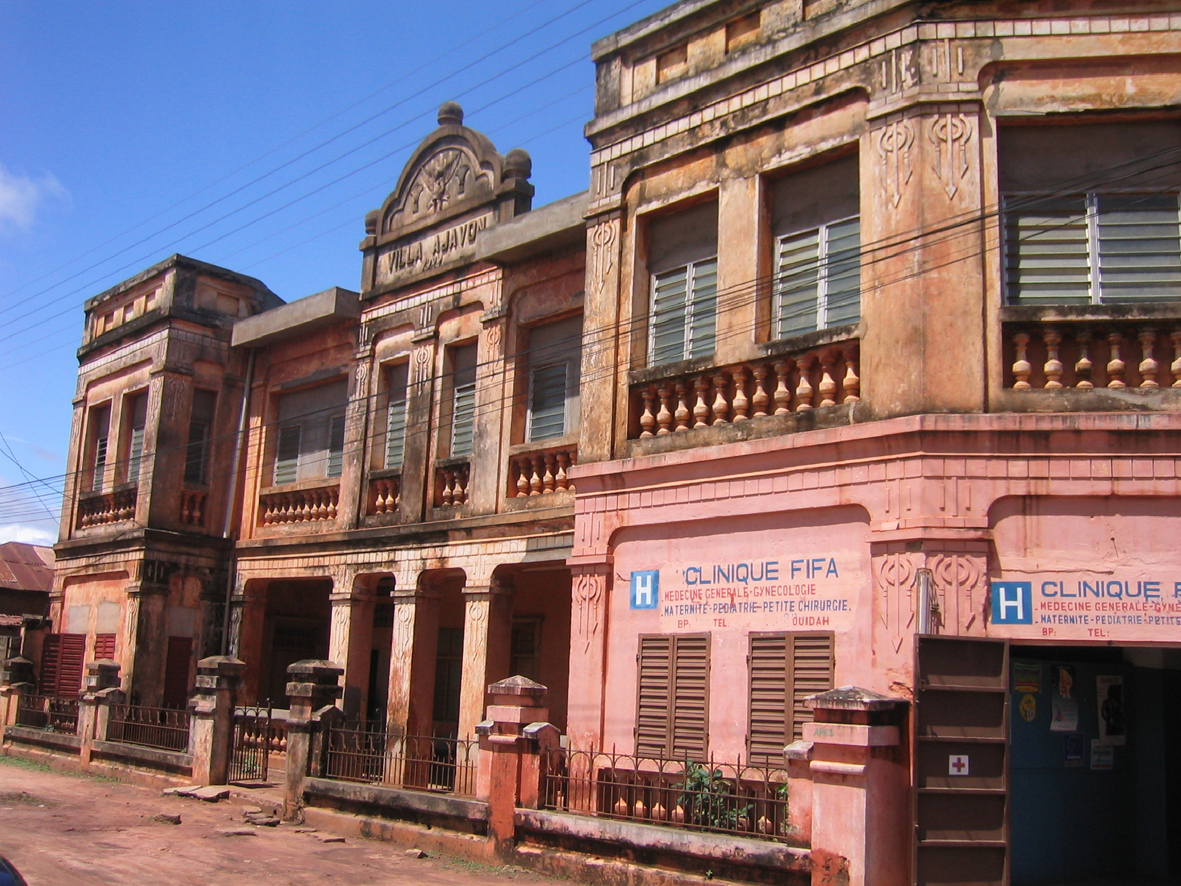
In the Zomaï neighborhood of Ouidah, a two-story building catches the eye. Ochre facade, wrought-iron balustrade, an upper floor over a vaulted ground floor. It is not a Fon house, nor a French colonial villa. It is a sobrado, a townhouse in the style you find in Salvador da Bahia. Locals call it the Maison du Brésil, the Brazil House.
On its own, it tells the story of the Aguda: people who crossed the Atlantic in chains, whose descendants came back free, and rebuilt part of the town that had watched them leave.
This pillar explains who the Aguda were, why they returned, where they settled, what they built, and what remains of their presence in Ouidah today.
Who were the Aguda?
The word Aguda comes from Ajudá, the Portuguese name for Ouidah. According to Wikipedia, from the early eighteenth century it was used among enslaved people in Dahomey to refer to Brazil itself. The name later came to describe the people who returned from that country.
The Aguda were freed slaves and free people of color from Brazil, mostly from Bahia, and to a lesser extent from Cuba. Many had learned skilled trades in Brazil: masons, carpenters, traders, tailors. Once free, they chose to return to the coast their families had been deported from.
The return movement began in 1835, after the Malê revolt, and continued in waves through the late nineteenth century.
They did not come back empty-handed. Many had a trade, savings, sometimes business ties on both sides of the Atlantic. That capital, economic as much as cultural, let them quickly form a recognized merchant and artisan class on the coast.
The waves of return
1835: the Malê revolt
The first wave followed the Malê revolt, in Bahia in 1835, the largest slave uprising in the Americas, led by Muslims, mostly Yoruba and Hausa. The revolt frightened the colonial authorities, who expelled hundreds of free Africans, whether or not they had taken part.
These deportees arrived on the coast with the Portuguese language, the Catholic faith, and the trades they had learned in Bahia.
Francisco de Souza and the trading networks
One figure looms over this history: Francisco Félix de Souza, a merchant born in Bahia on October 5, 1754, who arrived in Ouidah around 1788 and died there on May 8, 1849, at 94. He helped the future King Ghezo seize the throne of Dahomey, which earned him the title of Chacha, from the Portuguese phrase "já, já," "right away, right away," which he used to reassure clients.
De Souza founded a large lineage with several African partners. His descendants, the de Souza family, remain one of Ouidah's most prominent families: the Chacha title still passes down today, held in the early twenty-first century by Moïse de Souza, the ninth of the name. According to Wikipedia, Benin's former first lady Chantal Yayi is a great-great-granddaughter of Francisco de Souza. Our pillar on Francisco de Souza covers his life in full.
1850 and 1888: the end of the trade and of slavery
A second wave followed the end of the transatlantic slave trade in Brazil in 1850, as some merchants and intermediaries redirected their networks toward the African coast. A third, larger wave followed the abolition of slavery in Brazil in 1888. Many of these later returnees relied on the trading networks left by merchants such as Francisco de Souza to settle as traders in Ouidah, Porto-Novo and Lagos.
The Aguda neighborhoods
Contrary to what is sometimes written, there is no Aguda "Singbomey quarter." Singbomey is the name of the de Souza family residence, not a community neighborhood.
The neighborhoods where the Aguda settled in Ouidah are Brésil, Zomaï and Docomè. These are where the Afro-Brazilian style houses are concentrated, with their painted facades, ornamental shutters and interior courtyards.
A coastal network, not one city
The Aguda did not settle only in Ouidah. Their communities form a network running along the old Slave Coast all the way to Nigeria.
In Lagos, returnees from Brazil, often called Saro when they came from Sierra Leone and Aguda when they came from Brazil, founded a neighborhood from the 1830s onward known as Popo Aguda, the "Brazilian Quarter." It has the same cream-colored stucco, the same curved windows, the same blend of Yoruba spatial planning with nineteenth-century Brazilian baroque and neoclassical styles.
That heritage remains fragile. The Ilojo Bar, also known as Olaiya House, built in 1855 in Lagos and listed as a national monument as early as 1956, was demolished in 2016 despite heritage authorities' efforts to save it. The Water House, built for João Esan da Rocha, still stands, but the Ilojo Bar shows how fast this heritage can vanish, in Lagos as elsewhere on the coast.
Architecture from Bahia
Before the Aguda arrived, Ouidah was mostly made up of traditional compounds of mud and thatch. The returnees introduced the sobrado, the Brazilian colonial townhouse, built in durable masonry, in pastel colors recalling the Pelourinho district of Salvador, with interior courtyards where a Catholic altar and a Vodun shrine sometimes coexist.
The Maison du Brésil
The best-known building of this heritage is the Maison du Brésil, in the Zomaï neighborhood. According to Wikipedia, its structure dates from 1930: a de Souza family building, built in the Afro-Brazilian style, with an upper floor over the ground level. It now houses offices and a museum, including a branch of the national tourism heritage agency, and temporarily displays works from Ouidah's history museum during renovation.
The cathedral: a mission project, not the Aguda's
You will sometimes read that the Basilica of the Immaculate Conception was built "under the sponsorship and with the labor of the Aguda." That is not what the sources say.
According to Wikipedia, construction began in 1903 at the initiative of Bishop Louis Dartois, the first apostolic vicar of Dahomey, with the cornerstone laid on August 30, 1903. Bishop Dartois died in 1905; Father François Steinmetz, consecrated bishop in October 1906, sped up the work, completed in 1909. The workers were local Christians, and according to Wikipedia, Vodun believers (vodounsi) helped their Christian neighbors by bringing water and supporting the construction.
During the foundation dig, on the site of the former Agoré, the seat of Dahomey's royal representatives, workers uncovered human remains at the bottom of a well nearly seven meters deep. This is not the discovery of "Vodun shrines" in 1967, as sometimes reported: it is a documented event from the construction itself, in the early twentieth century.
The basilica was elevated to minor basilica status by Pope John Paul II on November 9, 1989. Our pillar on the Afro-Brazilian cathedral covers this in detail.
A heritage under threat
Ouidah's Afro-Brazilian architecture is not immune to the same risk. A 2025 article in an architecture journal, focused on Aguda heritage in the Bight of Benin, notes collapsed ceilings, crumbling minarets and trees growing through the walls of some historic buildings. The researchers argue for preservation models that involve residents and local knowledge holders more directly, rather than purely institutional interventions.
Benin's government has committed funds to restore part of Ouidah's heritage, notably the Portuguese fort. But private Aguda homes largely depend on their owners' upkeep.
The family names
The most lasting marker of Aguda identity remains the Portuguese surname. The de Souza are associated with trade and land ownership. The da Silva became known as photographers and printers. The d'Almeida and Paraíso are present in education and trade. These names are found today in Ouidah, Porto-Novo, Lagos and Lomé.
An identity passed on by more than blood
Over the generations, marriages with the Fon, Yoruba and Gun populations made the community's boundaries more porous. Children of these unions sometimes took the father's Portuguese surname even without direct Aguda ancestry: carrying that name carried a certain social prestige. Conversely, some Aguda descendants lost their original surname through marriage.
The result is that today, a Portuguese surname in Ouidah does not, on its own, guarantee a verifiable Aguda genealogy. What matters most to the community is oral memory and cultural practice: knowing which branch of the family arrived when, which great-grandmother still spoke Portuguese at home, which festivals are still observed. The family councils that still meet today are the keepers of that memory.
A culture you can still taste
Aguda heritage is not limited to facades. Acloui, a fried black-eyed pea fritter, is the Beninese version of the acarajé sold by the baianas of Salvador da Bahia: the same gesture, the same frying technique, thousands of kilometers apart.
The Aguda carnival, more intimate than the country's big national festivals, mixes brass and drums, nineteenth-century Portuguese dress and West African wrappers, songs in Fon, Yoruba and Portuguese. The Burrinha dance is one of its highlights: a satirical figure that mocks the authorities who once enslaved the ancestors of those dancing today.
Catholicism holds a particular place in this identity. Brought back from Brazil, it long served as a marker of social standing and closeness to the colonial administration, and later the independent state. In many Aguda families it coexists with Vodun practice: a Catholic surface and a cult of ancestors and local deities that continue, often in the same courtyard.
The link to Brazil and Cuba
The Aguda return created a network that still spans the Atlantic.
In Bahia, several Candomblé houses of the Jeje tradition, meaning of Fon/Dahomean origin, trace their lineage back to this same coast. The best known is Bogum in Salvador (Zoogodô Bogum Malê Rundó), founded between the late eighteenth and early nineteenth centuries, and its sister house, Seja Hundé in Cachoeira (Zogbodo Male Bogun Seja Unde), founded in 1858. Tradition traces them to a Mahi woman, Ludovina Pessoa, said to have been chosen by the voduns to found these temples. These Jeje houses, not the larger Nagô houses such as Casa Branca do Engenho Velho or Ilê Axé Opô Afonjá (founded in 1910 by Mãe Aninha, of Yoruba origin), keep the direct link to Dahomey.
In Cuba, several families carrying names such as de Souza or da Silva have genealogical ties to the same networks of West African returnees. The Lucumí religious tradition there preserved part of the Yoruba cosmology that traveled the same routes.
That transatlantic network also runs the other way. Researchers and Brazilian descendants regularly travel to Ouidah to trace their ancestors, sometimes as far as the collections of the MIME, which holds documents and objects related to the history of the slave trade and its aftermath. For many, finding a familiar surname, carried by living families in Ouidah, changes how they understand their own history: the diaspora stops being an abstraction and becomes an address, a face, a possible conversation.
A crossroads of languages
One last detail says a great deal about this history: language. In some Aguda households, up to a generation or two ago, families still spoke a Bahian Portuguese passed down at home, alongside Fon and French. This was never the Portuguese of Portugal or of contemporary Brazil: frozen by distance and time, it carries traces of a nineteenth-century Bahia that Brazil itself has since largely forgotten.
That trilingualism, or quadrilingualism with Yoruba in some families, sums up the Aguda's singular position: not quite African in the locally understood sense, not quite Brazilian, but both at once, carried by a history that crossed the ocean twice.
A history more tangled than a simple homecoming
It would be too simple to reduce Aguda history to that of victims who came back to heal. The reality is more tangled. Some returnees, particularly in the waves that came after 1850, arrived not only as formerly enslaved people, but also as participants in the very trading networks born of the slave trade, sometimes related by blood to merchants like Francisco de Souza.
That ambiguity is not hidden in Ouidah: it is part of the community's memory. The Aguda did not build their houses, schools and churches by erasing that history, but alongside it. For many descendants who carry names like de Souza today, a name tied in Brazil to a slave trader, that inheritance remains something to talk about, not a taboo.
What this means for American visitors
The Aguda story is a Brazilian and Cuban one first, but it has a lesson for American travelers too. In the United States, the transatlantic slave trade was banned in 1808, and enslaved African Americans were, for the most part, cut off from any chance of a documented return. In Brazil and Cuba, where the trade continued for decades longer and free communities of color existed alongside slavery, a return like the Aguda's became possible at all.
That difference is worth sitting with. Walking through Zomaï or Brésil, an American visitor is not looking at their own history in the way a Brazilian visitor might; they are looking at a version of return that history made available to some parts of the diaspora and not others. Many African Americans who visit Ouidah come for the Door of No Return and the Slave Route; the Aguda quarter shows what happened when that door, for a few thousand people at least, opened the other way.
Tracing your ancestors
For diaspora visitors who want to establish a legal tie to Benin, the country has set up the 2024 law on citizenship for people of African descent, through the My Afro Origins platform, not a program called "Return Journey," which does not exist under that name. Our dedicated article covers the criteria and the process in detail.
For an Aguda descendant from Brazil, that search often takes a particular shape: Portuguese-language documents, baptism records, land transactions, family correspondence, sometimes exist in both Bahia and Ouidah, including in the collections of the MIME (International Museum of Memory and Slavery).
Visiting Aguda heritage
To discover this heritage, walk through the Brésil, Zomaï and Docomè neighborhoods, starting at the Maison du Brésil. A local guide can explain the genealogies behind certain facades and arrange a meeting with community members.
Look for:
- The pastel facades of the sobrados, with ironwork and wooden shutters.
- The family name plaques on gate pillars (de Souza, da Silva, d'Almeida).
- Interior courtyards visible through gates, where Catholic altars and Vodun shrines sometimes coexist.
- The Maison du Brésil itself, in the Zomaï neighborhood.
Practical notes:
- No fixed entry fee for walking the neighborhoods; the Maison du Brésil, as a museum, may charge admission.
- Always ask permission before photographing the inside of a private home or a shrine.
- A guide makes a big difference in understanding the sites and respecting local customs.
To extend the visit:
- The Afro-Brazilian cathedral, a few streets from the Maison du Brésil, pairs well with this walk.
- Chacha Square and the traces of Francisco de Souza let you trace this history back to its origin.
- For travelers continuing east, Porto-Novo and Lagos also hold significant Afro-Brazilian heritage, with their own networks of Aguda families.
The best time to go
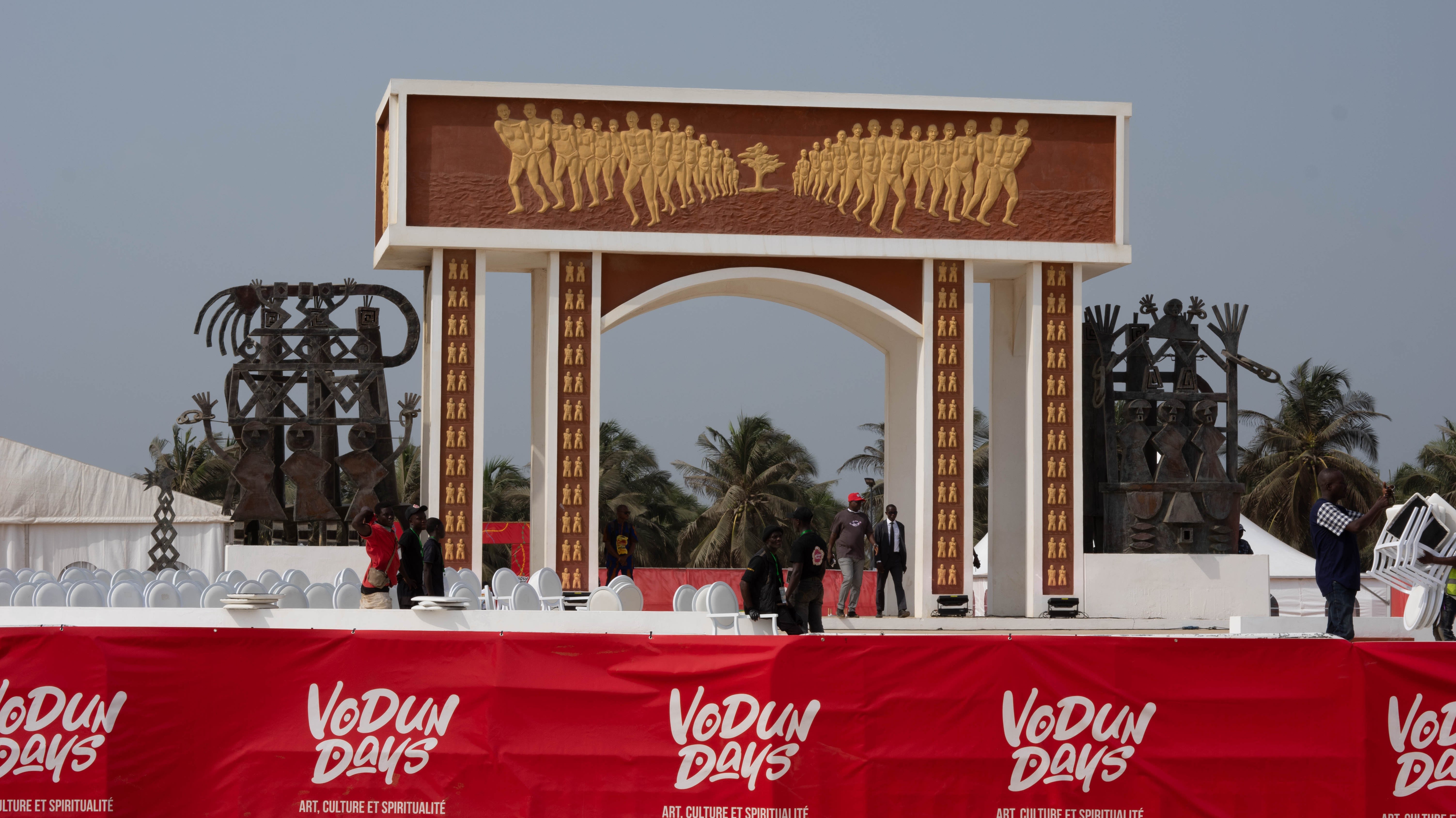
The walk works in any season, but two moments suit it especially well. Sunday morning, around Mass at the basilica, brings together part of the town's Catholic community, Aguda included. During Vodun Days in January, some Aguda families open their courtyards and take part in the processions, in a deliberate blend of Catholicism and Vodun worship that sums up their history rather well.
The rest of the year, a simple walk through the Brésil, Zomaï and Docomè neighborhoods, camera mostly put away, is enough to feel what this community left the town: houses that have stood for a century, and names still spoken, every day, in the streets of Ouidah.
Arrange a guided tour of Aguda heritage →
Sources
- Agouda, Wikipédia: etymology, waves of return, Cuba, Afro-Brazilian architecture.
- Maison du Brésil (Maison de Mémoire), Wikipédia: built 1930, de Souza family, Zomaï neighborhood.
- Basilique de l'Immaculée-Conception de Ouidah, Wikipédia: Bishop Dartois, 1903-1909, human remains in the foundations, vodounsi, minor basilica (1989).
- Terreiro Zoogodô Bogum Malê Rundó, Wikipedia and Terreiro Zogbodo Male Bogun Seja Unde, Wikipedia: Jeje houses of Bahia, Ludovina Pessoa.
- Full article: Aguda/Afro-Brazilian architectural heritage in the bight of Benin, Journal of Architecture, 2025: Brésil, Zomaï, Docomè neighborhoods.
- Francisco Félix de Souza, Wikipedia and De Souza family, Wikipedia: biography, Chacha title, descendants, Chantal Yayi.
- Ilojo Bar, Wikipedia: Lagos Afro-Brazilian architecture, 2016 demolition.
- CSMonitor, "In Porto-Novo's Afro-Brazilian architecture, traces of complex history," 2020.
- Our article My Afro Origins and the 2024 law on citizenship for people of African descent.