Key Takeaways
- Zomachi means 'the fire that will never be extinguished' in Fon — a deliberate inversion of the nearby Zomai enclosure ('where one sees nothing'). The returnees named their flame in answer to the darkness from which their ancestors departed.
- The quarter contains the densest concentration of Luso-Brazilian Baroque Sobrado architecture in West Africa — two-story masonry structures with tiled facades, ornamental balconies, and pastel colors that the Retornados brought directly from the Pelourinho district of Salvador da Bahia.
- Every year on the second Sunday of Epiphany, the Zomachi community celebrates the Feast of Bonfim — replicating Salvador da Bahia's most famous Catholic festival, with the Burrinha performance, a satirical Caribbean-influenced dance that mocks the colonial figures who once enslaved them.
- The Aguda returnees settled Zomachi adjacent to the sacred initiation forest of Zomai rather than in the commercial center of the city — placing themselves at the spiritual heart of Ouidah, not its economic margin. This was a deliberate assertion of identity, not an accommodation.
- For over a century, the quarter was trilingual: Portuguese at home for prayer, Fon in the market, French for official business. Elderly residents still pray in an archaic Brazilian Portuguese frozen in the 1850s — the language of the Middle Passage preserved in the mouths of those who survived it.
The houses don't fit. That's the first thing you notice.
Ouidah's streets - traditional compounds, concrete constructions, the ordinary vernacular of a West African city - give way, in the historic core north of the Slave Route, to something else entirely. Two-story buildings with ornamental balconies facing the street. Facades in pastel pink, mustard yellow, sky blue. Tall arched windows with wooden shutters. Decorative ironwork above the doors. The visual grammar of Salvador da Bahia, transplanted wholesale to the coast of Benin.
You are in the Zomachi Quarter - and you have just felt, in your body before your mind catches up, the single most compressed expression of the African diaspora's return in the world.
The people who built these houses left Africa as enslaved cargo. They arrived in Brazil as property. They survived, freed themselves or were freed, remembered where they came from, and came back - building their new-old home in the exact visual language of the city that had held them.
The quarter's name says everything: Zomachi - "the fire that will never be extinguished."
Zomachi quarter Ouidah history: what this quarter really is
The Zomachi Quarter isn't a heritage zone. It isn't a living museum. It's a neighborhood where people live, where families have lived for nearly two centuries, where the architecture of departure and the architecture of return share the same walls.
It contains the densest concentration of Luso-Brazilian Baroque Sobrado architecture in West Africa - buildings that are, simultaneously, the most elaborate structures in Ouidah and the most personal: every tiled facade is a portrait of a specific family's memory of what home looked like across the ocean.
What makes the Zomachi Quarter globally significant isn't the architecture alone. It's the act the architecture represents: the reversal of a forced departure. The people who built these houses should, by the logic of the Atlantic slave trade, never have existed as a community in Africa. The trade was designed to prevent return. The Zomachi Quarter is the proof that it failed.
The flame the community keeps burning in the central square isn't a symbolic gesture. It's a beacon - lit for the diaspora still expected to come home.
The deep history
The departure and the return (1835–1890s)
To understand Zomachi, you must first understand that it was built by people who made the journey twice.
The Aguda - the Afro-Brazilian returnees - were primarily Yoruba and Fon in origin, enslaved in West Africa, transported across the Atlantic, held on Brazilian plantations, and eventually freed. Most came from Bahia, the Brazilian state that more than any other maintained West African cultural continuity across the centuries of slavery: Yoruba, Fon, and Ewe languages survived in Salvador's streets; Candomblé religious practice maintained the theological architecture of West African Vodun; and specific cultural details - foods, textiles, festivals - persisted with enough precision that the returnees recognized them in the city they came back to.
The first major wave came after the Malê Revolt of January 1835 in Salvador - the largest slave uprising in the Americas, organized by Muslim Africans (primarily Yoruba and Hausa) who had maintained their language, faith, and network across the Atlantic. The revolt was crushed within hours. In its aftermath, Brazilian colonial authorities deported hundreds of free Africans regardless of involvement, and thousands more chose to leave a country that had signaled, with extreme clarity, that it didn't want them.
They arrived in Ouidah not as paupers but as people with savings, skills, and a bilingual commercial advantage: they spoke Portuguese on a coast increasingly involved in commercial relations with Portuguese-speaking Brazil. They had training as craftsmen, builders, architects. They had capital. And they had something the local population didn't yet have: the specific architectural memory of a city - Salvador da Bahia - whose visual vocabulary they intended to recreate.
The choice of location
The Aguda didn't settle in the commercial center of Ouidah. They settled in Zomachi - adjacent to the sacred initiation forest where Vodun initiates underwent their training, at the spiritual rather than the economic heart of the city.
This wasn't random. It was a statement.
The community that had survived the Zomai enclosure's darkness - whose ancestors had been held in that space before being loaded onto ships - chose to build their home of return at the edge of the sacred forest. They placed themselves not in the marketplace but at the threshold of the divine. They announced, through their choice of location, that they had come back not merely to trade but to inhabit the spiritual geography of the city as full members.
The name they chose confirmed the statement: Zomachi - the fire that answers the Zomai's darkness.
The architecture of memory
The Sobrado - the two-story Brazilian colonial townhouse - arrived in Ouidah in the baggage and memories of the returnees. Before the Aguda, Ouidah's construction was predominantly traditional compound architecture: single-story, inward-facing, organized around interior courtyards. The Sobrado introduced the opposite logic.
The balcony: Aguda houses faced outward, toward the street, with ornamental balconies as the primary public face of the building. This reflected a Brazilian social culture centered on public presence and neighborhood visibility. After generations of invisibility as enslaved people, the returnees built homes that were explicitly, assertively seen.
The color palette: Pink, mustard yellow, sky blue - the chromatic vocabulary of the Pelourinho district of Salvador, transplanted to the coast of Benin. The same colors, two continents apart, as a declaration that this isn't a compromise between African and Brazilian identity but a full expression of both simultaneously.
The window logic: Tall, narrow windows with wooden shutters allowed the circulation of coastal sea breezes while maintaining a sense of grandeur and closure. The technical solution is identical on both sides of the Atlantic because the technical problem - tropical heat, coastal humidity - is identical. The builders solved it with what they knew.
The trilingual world
For over a century, Zomachi operated as a trilingual enclave inside a monolingual city.
Portuguese at home: Used within the family for prayer, correspondence, and the preservation of the Bahian Catholic traditions the community had maintained across the Atlantic. The Portuguese spoken in Zomachi wasn't colonial Portuguese - it was the Portuguese of enslaved and freed people, shaped by centuries of creolization and finally frozen at roughly the 1850s, the point at which most families' connection to Brazil effectively ended.
Fon in the marketplace: Used to trade with the local Beninese population, to negotiate, to participate in daily commercial life. The Aguda were commercial intermediaries - their bilingualism was their economic advantage, and Fon was the language of the city they had returned to.
French for official business: After French colonization arrived in the late 19th century, French became the language of administration, legal documents, and formal education. The community adapted, as it had always adapted, without abandoning the other two.
Today, the French is dominant. The Fon persists. The Portuguese survives in one specific form: elderly residents of Zomachi who still recite prayers in an archaic Brazilian Portuguese that hasn't changed since the 1850s. When they are gone, that particular form of Atlantic memory - the language of the Middle Passage, preserved in the mouths of those who survived it - will be gone with them.
The quarter today
Walk through Zomachi in 2026 and you encounter a neighborhood in a complex state: simultaneously protected, deteriorating, being restored, and contested.
The most celebrated structure is the Casa do Brasil - built in 1835, the administrative and social hub of the first returnee community. It's a building of genuine elegance: pink facade, two stories, the proportions of a Bahian merchant's house rendered in the materials available on the Beninese coast. It served for generations as a guesthouse for new arrivals from the Americas - a transitional space where people who had crossed the ocean in one direction crossed it again, in their identities, learning to be African in a city that remembered them but didn't fully recognize them.
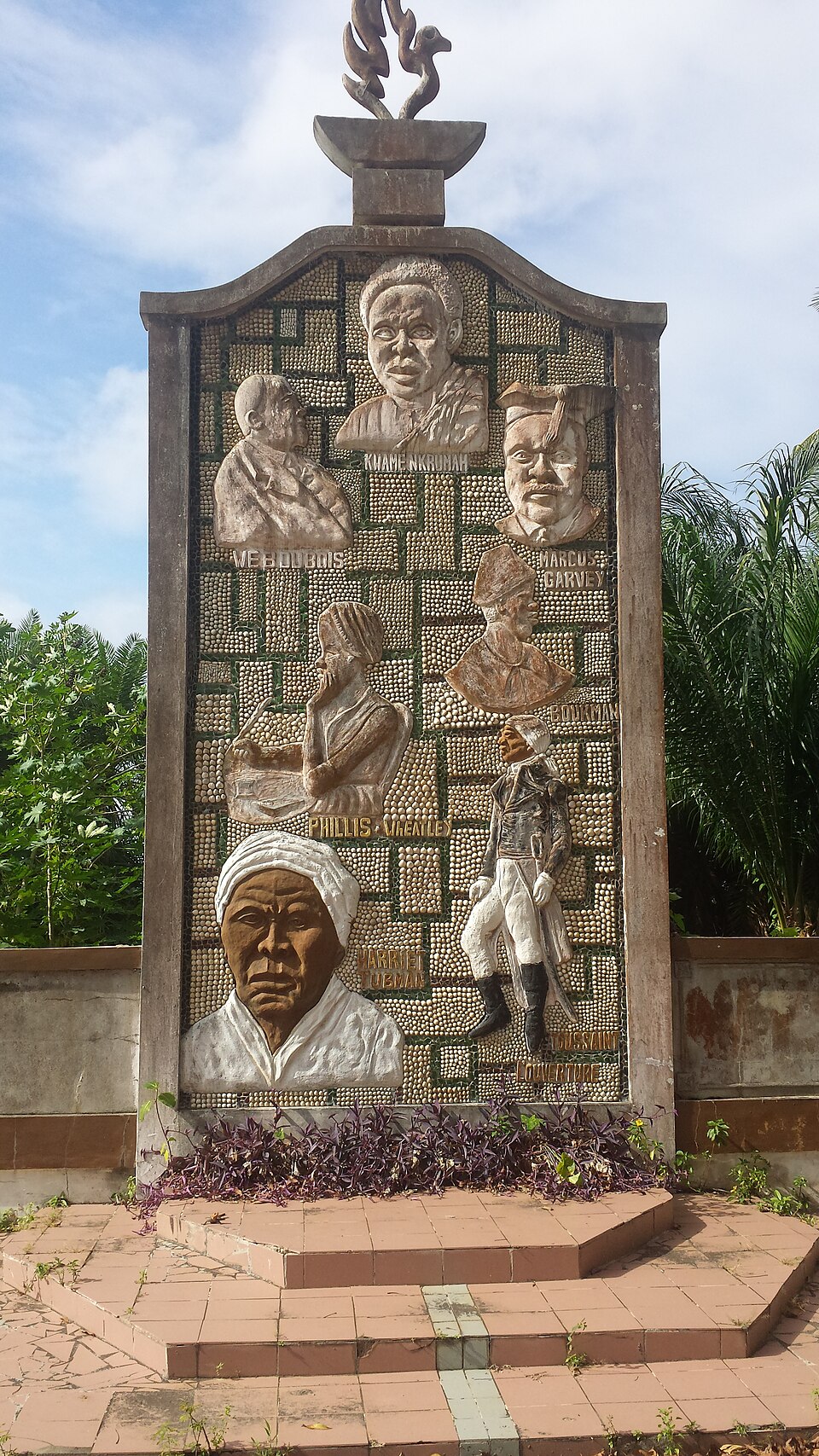
The Casa do Brasil has been undergoing renovation as part of Benin's broader heritage program. The Zomachi Monument at the center of a small square houses the eternal flame zomachi healing diaspora - kept burning continuously, relit publicly every January 10th on Vodun Day, when the high priests carry it to the beach in a ceremony that draws thousands.
Elsewhere in the quarter, the condition of the historic Sobrados varies sharply. Some have been restored. Others show the effects of decades of tropical maintenance costs that outpace the resources of the families living in them: salt air corroding the ironwork, humidity penetrating the plaster, roofs leaking over rooms still inhabited by the grandchildren of the original builders.
The Beninese government has designated the Zomachi Quarter a protected historical zone - a designation that provides legal protection against demolition but doesn't automatically provide the funding needed for conservation. The gap between protection and preservation is real, and it is visible in the facades.
The diaspora connection
The connection between Zomachi and Salvador da Bahia isn't historical - it is alive.
On the second Sunday of Epiphany, the Aguda community of Zomachi celebrates the Feast of Bonfim - the most famous Catholic festival in Bahia, dedicated to Nosso Senhor do Bonfim (Our Lord of Good End), whose church in Salvador was the direct architectural model for Ouidah's Afro-Brazilian Cathedral. The Ouidah version of the feast is conducted with the same ceremonial structure as the Bahian original: a washing of the church steps, music, communal food, the collective reaffirmation of a faith that has survived the Atlantic and all that the Atlantic did.
The feast includes the Burrinha - a carnivalesque dance performance where participants dress as animals and colonial figures, mocking the authorities who once enslaved their ancestors. The dance is satirical, energetic, and specific: each figure being mocked is historically identified, and the mockery is the form through which the community processes what happened to them. To watch the Burrinha in Zomachi is to watch people laugh at a history that tried to break them. The laughter isn't frivolous. It's the hardest form of testimony.
For Afro-Brazilian visitors who arrive in Ouidah on roots journeys - and the number grows every year, particularly during Vodoun Days in January - the Zomachi Quarter is often the most emotionally concentrated encounter of the trip. Not the Door of No Return, whose monument is prepared for their grief. But Zomachi, whose families carry surnames they also carry - de Souza, da Silva, d'Almeida - and whose houses look like streets in Salvador da Bahia, and whose elderly residents still pray in a Portuguese the visitors recognize but can't quite place.
It's the convergence that the diaspora journey builds toward: the proof that the rupture wasn't total, that the connection wasn't completely severed, that something made it across and something stayed and they have now, finally, found each other.
The spiritual dimension
The Zomachi Quarter is the epicenter of Ouidah's signature spiritual phenomenon: the peaceful coexistence - not synthesis, not compromise, but simultaneous full practice - of Catholicism and Vodun.
It is common in Zomachi to see a house with a Catholic cross above the door and a Vodun shrine in the interior courtyard. The cross and the shrine aren't in tension. They serve different functions for the same person: the cross addresses the official world, the sacraments, the relationship with the institutional church. The shrine addresses the ancestral world, the Vodun deities, the relationship with the forces that govern daily life.
The Aguda brought this doubled practice from Brazil, where they had learned to maintain African spirituality beneath the surface of enforced Catholicism. In Ouidah, they found that the Catholic surface was no longer necessary for protection - so the internal architecture became external, the shrine moved from the hidden interior to the visible courtyard, and the doubled faith became public.
The eternal flame of Zomachi Monument is the most concentrated expression of this. It is kept burning by the community for an explicit purpose: to guide the diaspora home. But the flame is also a Vodun object - fire in Vodun cosmology connects the worlds, signals the presence of the divine, and can't be extinguished without ritual consequence.
The Aguda light a Catholic-inflected Vodun fire to call back the children of the Middle Passage. This is precisely what Ouidah is, in one flame.
How to visit
Walking the quarter
Zomachi is best explored on foot, from the neighborhood center outward. The Zomachi Monument is the natural starting point - the small square where the eternal flame burns and where the spatial logic of the quarter can be read from a single standing point.
From there, the streets of historic Sobrados radiate outward. The Casa do Brasil is a ten-minute walk. The facades are best in the late afternoon light, when the pastel colors saturate and the ornamental details catch shadow. Always ask residents before photographing specific houses - these are inhabited family homes, not exhibits.
What to look for:
- Balconies facing the street (unusual in the local architectural tradition)
- The specific color choices - pink, yellow, blue - and their echo of Pelourinho
- Ironwork above doors and windows, some original, some restored
- The occasional shrine in a visible courtyard - if it is visible, it is public
When to go
January 10th (Vodun Day): the eternal flame is publicly relit and carried in procession to the beach. The most significant ceremonial expression of the quarter's identity, drawing thousands.
Second Sunday of Epiphany: The Feast of Bonfim with the Burrinha performance. Smaller and more intimate than January 10th, but arguably more specifically Zomachi - this is the community's own festival, not shared with the whole city.
July - August: Some Aguda family festivals take place in this period, more intimate than the January events.
What few visitors know
The Ajavon house: when a facade replicates a French theatre
Among Zomachi's Sobrados, one building stands apart in its ambition: the Ajavon house, whose facade doesn't replicate a Bahian residential building but the ornamental architecture of a French theatre. The pilasters, the decorative frieze, the theatrical scale of the ornamentation: this is a building that quotes not domestic but performative architecture.
The Ajavon family were among the most prominent Aguda in Ouidah - close allies of Francisco Félix de Souza, holding commercial properties across the city. Their house's theatrical facade is a statement: not the private architecture of a domestic life reconstructed, but the public architecture of a family that intended to be seen as cultural power. They weren't building a house. They were building a statement of arrival.
The Feast of Bonfim in Ouidah is a direct replica
Every second Sunday of Epiphany, a ceremony takes place in Zomachi that most visitors to Ouidah never see - because it doesn't appear on the standard tourist calendar and because its significance requires context to understand.
The Feast of Bonfim is the most important Catholic festival in Salvador da Bahia, dedicated to the church of Nosso Senhor do Bonfim - the same church whose architecture the Afro-Brazilian Cathedral in Ouidah directly replicates. In Salvador, the feast draws hundreds of thousands of people to the Bonfim hill, where the church's steps are ceremonially washed with perfumed water.
In Zomachi, the feast is conducted in structural replication of the Bahian original: the same ceremonial sequence, the same organization of participation, the same Catholic liturgical frame. It's the Zomachi community's most specific act of transatlantic memory - not a general celebration of Afro-Brazilian identity, but a precise reproduction of a specific ceremony from a specific place, performed in the knowledge that the same ceremony is happening simultaneously on the other side of the ocean.
The word "Aguda" has no settled etymology
The word "Aguda" - the name by which the Afro-Brazilian community of Ouidah, Porto-Novo, and Lagos is known - doesn't have a single agreed etymology.
Three explanations circulate in academic and community sources, each with legitimate support:
1. From "Ajudá": The Portuguese name for Ouidah (itself a phonetic rendering of an indigenous place name) - so Aguda = "people of Ajudá," people of this place.
2. From "ajuda": The Portuguese word for "help" - so Aguda = "people who gave help" or "people who received help" (at the Portuguese fort and its protection).
3. From the word for "Catholic": Some community sources describe "Aguda" as originally meaning "Catholic" in the local usage - the community being identified by their faith, not their geography.
None of these etymologies is definitively settled. The community itself carries all three explanations simultaneously, depending on who is speaking. This unresolved etymology is itself a kind of portrait of the community: a people whose identity was formed at the intersection of multiple languages, multiple histories, and multiple continents, and whose name reflects that layering rather than resolving it.
If you want to go deeper
The Zomachi Quarter is one of the most layered sites in Ouidah - a place where every facade carries a story, every family name connects to a specific Atlantic crossing, and every ceremony rehearses a memory that crosses the ocean.
OuidahOrigins' Concierge service offers guided walks of the historic quarter with local cultural guides who know the family histories behind the specific buildings - including the Ajavon house, the Casa do Brasil, and the private Aguda compounds not visible from the street. We can also facilitate visits during the Feast of Bonfim and the January 10th flame ceremony.
Plan your visit with our Concierge →
The Zomachi Quarter is the living proof that the Door of No Return wasn't absolute. It's the architectural expression of what the Aguda community built when they came back. It connects to the Afro-Brazilian Cathedral three streets away and to the Brazilian Legacy that shaped the entire city. And its name answers, directly and deliberately, the darkness of the Zomai enclosure half a kilometer to the south.
Sources & further reading
- Mémorial Zomachi — Wikipédia (FR) - Historical context for the quarter and the memorial.
- The Afro-Brazilian Legacy in the Bight of Benin — Pambazuka News - Broader context of the Aguda community across coastal West Africa.
- Aguda/Afro-Brazilian Architecture in the Bight of Benin — Tandfonline - Academic analysis of the architectural heritage.
- Malê Revolt (1835) — Wikipedia - The event that triggered the first major wave of returnees.
- Historic Centre of Salvador (Pelourinho) — Wikipedia - The Brazilian neighborhood that inspired Zomachi's architecture.
- Afro-Brazilians in West Africa — Oxford Research Encyclopedia - Scholarly overview of the returnee community across the region.