Key Takeaways
- Between 1835 and 1837 alone, approximately 993 people were returned from Brazil to the West African coast — around 200 of them forcibly deported after the Malê Revolt, the rest leaving voluntarily to escape persecution. Francisco Félix de Souza personally organized the Atlantic crossing for the first deportees.
- They arrived with the Portuguese language, Catholic faith, Brazilian colonial architecture (the sobrado), and a syncretic spirituality that had survived the Middle Passage — and they transplanted all of it onto the very coast their ancestors had been taken from.
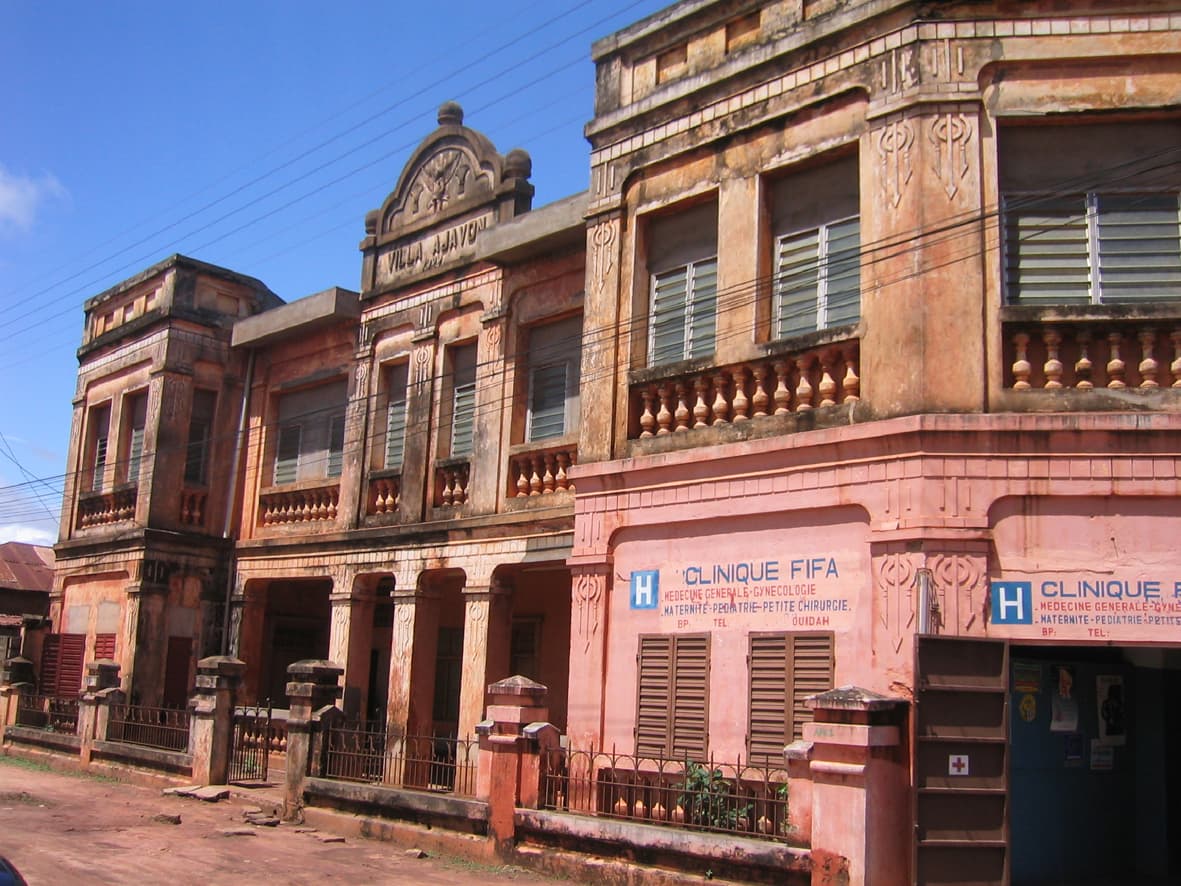
- The Villa Ajavon (1922), now housing the Fondation Zinsou museum of contemporary African art, is Ouidah's most photographed Afro-Brazilian building — a structure that distills the entire aesthetic vocabulary of the return: pagoda roof, tall ceilings, baroque ornament, and African material sensibility.
- Acarajé — the deep-fried black-eyed pea fritter sold by the Baianas de Acarajé in Salvador — is the same dish as the akara/acloui sold on Ouidah's streets today. Same recipe, same technique, 6,000 kilometres of Atlantic between them.
- The de Souza family name — shared by the most powerful slave trader on the Bight of Benin and by generations of returnees who were sometimes his descendants — is still carried today in Ouidah, Porto-Novo, and Lagos by families whose history is the full weight of the Atlantic.
Stand in the Singbomey quarter of Ouidah at seven in the morning and you can hear, if you position yourself correctly, two clocks running simultaneously.
From the Basilique de l'Immaculée Conception, a block away, a Mass is beginning. The language is Portuguese - not contemporary Brazilian Portuguese, but an archaic Bahian variant preserved here, frozen in the dialect of the 1850s, spoken in the interior of this West African city by families whose great-great-grandparents crossed the Atlantic twice. Through a half-open gate in the pink-painted facade of the house across from you, a woman is frying something in a clay pan over a fire - deep-frying small balls of black-eyed pea paste in palm oil, the same technique and the same recipe that has been used in the street markets of Salvador da Bahia for two hundred years.
She is making akara. In Bahia, it is called acarajé. The dish crossed the Atlantic with enslaved Africans from the Dahomey coast, transformed in Brazil, and was carried back to Ouidah by the people who returned. The same hands. The same oil. The same morning light.
This is the Brazilian Legacy of Ouidah: not a historical episode but a living circularity, still turning.
What this legacy really is
Ouidah is frequently described as the most "Brazilian" city in Africa. The description is accurate but potentially misleading - it risks reducing what happened here to an aesthetic curiosity, a charming anomaly of colonial-era cultural mixing.
What happened here is more consequential than that.
For three centuries, the Bight of Benin was one of the primary departure points for the Atlantic slave trade. More than a million human beings left through Ouidah's Slave Route in chains. They carried with them - in their memories, their bodies, their theological knowledge - the cultural DNA of the Fon-Yoruba coast. In Brazil, that DNA didn't disappear. It transformed. It merged with Portuguese colonial culture and produced something new: the Afro-Brazilian civilization of Bahia.
Then, in the 19th century, something historically almost unprecedented happened. The people began to come back - and they brought Bahia with them. The architecture, the food, the music, the syncretic faith, the Portuguese language. A culture that had crossed the Atlantic in the hold of a slave ship returned to its place of origin through the front door, in the hands of free people with money and skills and the memory of two continents.
The Brazilian Legacy of Ouidah is the most complete surviving example of Atlantic cultural return in the world. It isn't nostalgia. It is construction.
The deep history
The Malê revolt and the first wave (1835–1837)
The event that triggered the first large wave of return was the Malê Revolt - the largest slave uprising in the history of the Americas.
On a Sunday in January 1835, during Ramadan, enslaved and freed Muslim Africans in Salvador da Bahia - primarily Yoruba and Hausa, known collectively as Malê - rose up against the Brazilian colonial government. The revolt had been carefully organized; it was timed to exploit the distractions of a Catholic religious festival. Brazilian authorities suppressed it within hours, but the shock was disproportionate to the uprising's duration.
In its aftermath, the colonial government initiated mass deportations. Francisco Félix de Souza - the same man whose name marks the starting point of the Slave Route in Ouidah - personally organized the Atlantic crossing for the first deportees. Approximately 200 leaders and participants were forcibly expelled from Brazil back to the Bight of Benin in 1835. Between 1835 and 1837, approximately 993 people were returned to the West African coast, combining the forcibly deported with those who left voluntarily to escape the persecution that followed the uprising.
These returnees arrived in Ouidah, Porto-Novo, Lagos, and Accra as strangers in a doubled sense: Africans in origin, but shaped by Brazil in language, religion, dress, and social habit. They spoke Portuguese more fluently than Fon or Yoruba. They were Catholic. They wore tailored clothes. And they carried, in their pocket and in their memory, skills and capital that made them valuable to any commercial ecosystem they entered.
The second and third waves (1850–1888)
A second, larger return wave followed Brazil's abolition of the slave trade in 1850, which dramatically reduced opportunities for the African-descended community and increased social instability. Thousands more made the crossing voluntarily - not deported. But choosing to leave a Brazil that remained structurally hostile to people of African descent even as formal slavery wound down.
The largest single wave came after the complete abolition of slavery in Brazil in 1888. Freed people who had nowhere to go, who had accumulated skills but not citizenship, who had family memories of the coast - many of them chose Ouidah and Porto-Novo. They arrived in the closing years of the 19th century and the opening years of the 20th, bringing with them a culture that had been maturing in Bahia for fifty years since the first deportees.
Together, these three waves transformed Ouidah's physical and social landscape in ways that are still visible today.
The architecture of return
The sobrado
The dominant visual legacy of the Aguda return is architectural. The sobrado - the two-storey colonial townhouse that characterized upper-class residential architecture in Salvador de Bahia - was transplanted to Ouidah with deliberate fidelity.
Before the returnees arrived, Ouidah's residential architecture was primarily traditional mud-and-thatch compounds, built for the West African climate and social structure. The Aguda introduced:
- Two-storey masonry construction in brick or cement-plastered mud, built to last generations rather than decades
- Colourful facades in pastel pinks, yellows, and blues - a direct visual echo of the Pelourinho district in Salvador
- Ornamental ironwork on balconies and window frames - an aesthetic inherited from Bahia's Portuguese-influenced decorative tradition
- Shuttered windows (persiennes) designed for tropical ventilation - practical, beautiful, unmistakably Brazilian
- Internal courtyards where the dual life of the household - Catholic at the front door, Vodun in the inner yard - could coexist
A scholarly study published in 2025 in the journal Regional Studies confirmed that the Aguda/Afro-Brazilian architectural style had a measurable impact on the urban morphology of Ouidah and Porto-Novo - changing not just individual buildings but the spatial logic of entire quarters.
The Villa Ajavon and Fondation Zinsou
The most accessible single expression of the Afro-Brazilian architectural vocabulary in Ouidah is the Villa Ajavon - a 1922 building that now houses the Fondation Zinsou, West Africa's leading contemporary art museum.
Built in 1922 by Ayivi Ajavon, a successful merchant of palm oil and textiles originally from Togo who had settled in Ouidah, the villa distills the entire Afro-Brazilian aesthetic in a single structure: a pagoda roof that nods to the decorative eclecticism of Bahia's colonial architecture, tall ceilings that hold the coastal heat at bay, numerous outward-facing windows that allow cross-ventilation, and a baroque ornamental sensibility that combines European motifs with African material intelligence.
The Fondation Zinsou, founded in 2005 by art historian Marie-Cécile Zinsou, repurposed the villa in 2013 as a museum of contemporary African art with free entry - a deliberate curatorial decision to make the building's history as accessible as its collection. To walk through the Villa Ajavon is to move through the full arc of Ouidah's Atlantic story: a building whose aesthetic vocabulary was shaped in Bahia, carried back to this coast, and now used to display the work of 21st-century African artists who are themselves part of a global conversation about heritage and identity.
The religious fusion: cross and cowrie
The Aguda brought to Ouidah a form of Catholicism unlike anything the French missionaries had designed.
In Brazil, enslaved Africans had developed over generations a survival strategy of religious syncretism: covering Vodun deities with Catholic saint identities to maintain their spiritual practice under colonial prohibition. When they returned to Ouidah, they brought this layered faith intact. Their Catholicism was always simultaneously something else - a Vodun cosmology operating in Catholic dress, or a Catholic sacramental life operating over a Vodun foundation.
The most visible expression of this is the Afro-Brazilian Cathedral, which faces the Python Temple across a sandy street. But it is visible throughout the quarter in smaller ways: the interior courtyards of sobrado houses where a crucifix hangs above an altar also dressed with the colors and offerings of a specific Vodun deity; the family prayers that switch between Portuguese and the ritual language of Fon mid-sentence; the Aguda community's celebration of August 15th - the Assumption of Mary - which coincides with ceremonies associated with Ezili Freda, the Vodun goddess of love and beauty.
This isn't confusion. It's the specific theological sophistication of a community that has had two centuries of practice holding both traditions simultaneously.
The carnival
Every year, Ouidah celebrates its own version of Carnival - a world away from the commercial spectacle of Rio de Janeiro or even the elaborate parades of Salvador. It's an intimate community affair, rooted in the specific memory of the Aguda return.
The Banda (musical troupes) dress in costumes that blend 19th-century Portuguese formal wear with West African textiles - velvet and brocade alongside kente, the same garment holding two continents. They parade through the streets of Singbomey and the Zomachi quarter playing brass instruments alongside traditional drums, performing songs in a mixture of Fon, Yoruba, and archaic Portuguese that no Brazilian today would recognize but that every Ouidah resident of the old families understands.
At the center of the Carnival is the Burrinha dance - a satirical performance in which participants dress as animals and colonial figures, mimicking and mocking the authorities who once enslaved their ancestors. It's an act of historical reclamation through joy: the specific pleasure of laughing at the monster that failed to consume you. The Burrinha isn't gentle. It names names and performs recognizable archetypes - the overseer, the slaveholder, the colonial administrator - and it deflates them through collective ridicule. In Bahia, the Burrinha has counterparts in carnival traditions that similarly use humor as historical reckoning. The joke traveled the Atlantic alongside the trauma.
The culinary archive
Food is the most intimate form of cultural memory - too quotidian to suppress, too physical to forget.
The Aguda brought their kitchen with them, and it's still working in Ouidah's streets today.
Acarajé - akara - acloui: The deep-fried black-eyed pea fritter sold by the Baianas de Acarajé in Salvador's Pelourinho district is the same dish sold in Ouidah's morning markets. The recipe traveled to Brazil with enslaved Africans from the Dahomey coast - Yoruba cooks who had been making it for generations - transformed slightly in Bahia (adding shrimp filling, using dendê/palm oil), and came back to Ouidah in the hands of the returnees. When you eat it on the street in Ouidah, you're eating a dish that crossed the Atlantic twice.
Palm oil preparations: The Aguda reconnected Ouidah's culinary tradition with specifically Brazilian uses of palm oil - dendê - that had developed their own character in Bahia. Some preparation techniques present in Ouidah today show Brazilian influences not found in the broader Beninese culinary tradition.
Celebration cakes: Portuguese-Brazilian pão de ló (sponge cake) and similar sweet preparations entered Ouidah's festive calendar through the Aguda community and persist as specialties for Catholic feast days and family celebrations.
The table in the Aguda quarter of Ouidah is a three-continent archive. Every dish tells a route.
The language that survived
The archaic Bahian Portuguese spoken in the interior of some Aguda families today is one of the world's most extraordinary linguistic survivals.
It isn't modern Brazilian Portuguese. It's a 19th-century Bahian dialect, preserved because it was transmitted not through institutions or media but through family prayer, through domestic ceremony, through the specific ritual vocabulary of a Catholic practice shaped by African cosmology. It survived because it was sacred - because the prayers said in this Portuguese weren't interchangeable with prayers said in French or Fon.
The 9am Sunday Mass at the Basilique is now one of the last regular liturgical uses of this specific dialect anywhere. The congregation is small and aging. Linguists from Brazilian universities have documented it; the recordings are archived. But documentation isn't transmission. When the last fluent speakers of this archaic Portuguese are gone, the language will survive only as a recording - and something that was alive will become historical.
Names and lineages
The social architecture the Aguda built in Ouidah is still legible in the city's family names.
De Souza: The most complex name in Ouidah. It was the name of the slave trader who organized the deportation of hundreds of thousands of captives. It's also the name of the families who returned from Brazil through his networks, some of them his own descendants. In Ouidah, to bear this name is to carry a genealogy that contains both the crime and the aftermath - the man who organized the slaveholding and the community that built schools and churches with what came after. The family council still meets; the annual commemorative ceremonies still take place.
Da Silva, Martinez, d'Almeida, Paraíso: Each of these names marks a distinct branch of the Aguda social tree - different families, different trades, different relationships with the Brazilian past and the Beninese present. Together they constitute a genealogical map of Atlantic history that's still being lived, not just studied.
Modern connections: Ouidah and Salvador today
The circuit between Ouidah and Salvador da Bahia didn't close in the 19th century. It continues.
University programs between the University of Abomey-Calavi and Bahian institutions facilitate regular academic exchanges focusing on Afro-Brazilian history. Brazilian photographers and musicians visit Ouidah on residency programs, finding in the city's ceremonies and architecture the original grammar of traditions that mutated into Candomblé in Bahia. Ouidah researchers travel to Itaparica and the terreiros of Salvador and recognize specific ritual protocols - the sequence of invocations, the arrangement of offerings - that both traditions preserved independently across five centuries of separation.
The Fondation Zinsou's programming actively maintains these connections, using the Villa Ajavon as a node in a transatlantic cultural network that links Ouidah with artistic communities in Brazil, the Caribbean, and the African diaspora globally.
What few people know
The Malê deportees of 1835 arrived in Ouidah in a specific social condition: they were Muslim. They had organized the revolt around Islamic identity and Islamic networks. When they returned to the Dahomey coast, they entered a society that was primarily Vodun - and the Islam they brought, already shaped by generations of Brazilian context, was yet another layer added to the city's already layered spiritual life.
Some Aguda families in Ouidah maintain a Muslim practice alongside their Catholic and Vodun identities - a triple religious heritage that is the most compressed expression of the city's full Atlantic history. The mosque, the church, and the Vodun shrine can exist within the same family compound, each serving a different dimension of the household's spiritual life.
This isn't widely discussed in the official narratives of the Brazilian Legacy. It complicates the simple story of Catholic returnees rebuilding a Vodun city. But it's the more honest version of what arrived.
The future of the legacy
The Aguda legacy faces the same generational pressures as every aspect of Ouidah's transatlantic heritage.
The sobrado houses are expensive to maintain. Without formal heritage protection for private residences, some of the most significant buildings in Singbomey and the Zomachi quarter continue to deteriorate. The ornamental facades crack; the ironwork rusts. Several important buildings have already been lost since the 1990s.
The Portuguese language dwindles with each generation. The family councils that once governed the Aguda community's internal life have less formal authority than they did a century ago.
But the legacy isn't dying. It is transforming, as it has always transformed - absorbing new elements, reinterpreting old ones, finding new vessels for an old memory. The Fondation Zinsou's work, the university exchanges, the diaspora tourism, the growing international recognition of Ouidah as a site of global significance - these are the latest forms that the Brazilian Legacy takes in the 21st century.
The ocean still flows in both directions. The culture travels with it.
Visiting the Brazilian quarter
Where: The Singbomey and Zomachi quarters of central Ouidah contain the highest concentration of Afro-Brazilian architecture.
Must-see:
- Villa Ajavon / Fondation Zinsou: Free entry, open daily. The best single introduction to Afro-Brazilian architectural vocabulary and contemporary African art in one building.
- The Cathedral facing the Python Temple: The spatial relationship between these two buildings is the most legible physical expression of the Aguda legacy.
- The "Twelve Aguda Houses": A guided walking circuit through historic Singbomey, each house with a documented history.
Best times to visit:
- Sunday 9am Mass at the Basilique: The last regular liturgical use of archaic Bahian Portuguese
- July - August: Smaller Aguda family festivals, more intimate than the January Vodun Days
- January 10 (Vodun Days): The Aguda community participates visibly in the procession - their altars open, their family ceremonies accessible to guided visitors
Guided access: The buildings themselves don't tell the full story. A guide who knows the family histories behind the facades - which sobrado belonged to which family, which returned in which decade, which name is on which window of the Cathedral - transforms a walk through the quarter from a visual experience into a genealogical one.
Concierge access
The Brazilian Legacy of Ouidah is, at its deepest, a genealogical story - about specific families, specific crossings, specific documents preserved in private archives and the oral memories of elderly community members.
For visitors who want to trace a surname connection, access the Fondation Zinsou's historical archives, attend a private Aguda family ceremony, or connect with researchers working on the Afro-Brazilian heritage of the Bight of Benin - OuidahOrigins can make the introductions that the tourist circuit can't.
The circuit between Ouidah and Bahia is still running. There are people on both ends who are looking for each other.
Further reading
- Wikipedia: Malê revolt - The 1835 uprising that triggered the first major wave of return migration.
- Wikipedia: Aguda people - Overview of the Afro-Brazilian returnee communities across West Africa.
- Wikipedia: Akara - The transatlantic history of the black-eyed pea fritter.
- Tandfonline: Aguda/Afro-Brazilian Architectural Heritage in the Bight of Benin (2025) - Peer-reviewed study of the architectural legacy.
- Fondation Zinsou — Villa Ajavon - The museum housed in Ouidah's most celebrated Afro-Brazilian building.
- Wikipedia: Sobrado (architecture) - The Brazilian architectural form transplanted to West Africa.
- Related articles: The Aguda Community · Francisco de Souza · The Afro-Brazilian Cathedral · The Zomachi Quarter · The Slave Route
Editorial transparency
This content was developed with the assistance of our AI agents.
Frequently Asked Questions
Lire aussi
Ouidah concierge for diaspora and roots travelers
Traveling to Ouidah is not just a getaway. It's a return to your origins, a quest for authenticity, and a deep connection with your roots. Our concierge service is the key to experiencing this unique journey.
Tracing your roots and family history in Ouidah
Ouidah, a port of memory, becomes a place of healing for the diaspora. Genealogical research takes on a spiritual and political dimension, redefining identity.
A guide to the Afro-Brazilian surnames of Ouidah
Da Silva. De Souza. D'Almeida. Olympio. Behind every Aguda surname in Ouidah lies a story of enslavement, return, and identity rebuilt across two continents. This guide traces the names and what they mean.
Reading paths
The Slave Route
From the Atlantic slave trade to contemporary memory
Vodoun & Diaspora
How an African religion crossed the Atlantic
- Step 1· 12 minLe Temple des Pythons
Les origines du vodoun à Ouidah