Key Takeaways
- Built in 1717 by King Huffon of Hueda, the Temple of Pythons predates most colonial structures in Benin and remains a functioning Vodun sanctuary housing 30–60 ball pythons (Python regius) that roam freely in wall alcoves and open courtyards.
- The python (Dan in Fon) is divinity incarnate — not a symbol — representing wealth, transformation, the celestial rainbow bridge between earth and sky, and feminine power paired with creator deity Mawu. In Haiti, Dan became Danbala Wedo; in New Orleans, Damballa — the same deity, carried across the Atlantic in human memory.
- A 600-year-old iroko tree (Milicia excelsa) grows at the temple's center — older than the temple itself. It predates the sanctuary by nearly three centuries, thriving in coastal saline soil where the species should not survive.
- Every seven years, a rare purification ceremony takes place at the temple: 41 virgin girls collect water from a sacred marsh, poured into a clay jar that has remained ritually overturned for more than 200 years. The last ceremony was October 2024. The next is October 2031.
- The annual Festival of Dan on January 10th draws 5,000–8,000 attendees for a midnight vigil, a python procession through Ouidah's streets, and a sacred roof renewal — with diaspora pilgrims arriving from Haiti, Brazil, and Louisiana.
The first thing you notice isn't the snakes.
It is the shade. After twenty minutes walking from central Ouidah through open streets - the sun vertical, the dust coating your throat - you step through a low gateway and the temperature drops by five degrees. The courtyard is small: fifteen meters across, sand floor, white mud-brick walls barely higher than a man. At the center, an ancient iroko tree spreads a canopy so dense it holds the heat at bay.
Then your guide says, quietly: Don't move. Not yet.
And you see it. A python - thick as a man's forearm, half again as long as your arm span - is crossing the courtyard floor at your feet. It doesn't hurry. It doesn't react to your presence. It moves through the sand with the unhurried certainty of something that has never, in three centuries, had a reason to be afraid.
You are standing in the Python Temple of Ouidah. And you have just understood - in your body, before your mind catches up - why this place has survived conquest, colonization, missionary campaigns, and the long grinding pressure of modernity, and still stands. (How to behave here, and at every sacred site in the city, is covered in the vodun ceremony etiquette guide.)
Visit temple of pythons Ouidah: what this place really is
Most visitors arrive at the Python Temple expecting something between a reptile exhibit and a vaguely exotic cultural site. They leave having experienced something they don't have a category for.
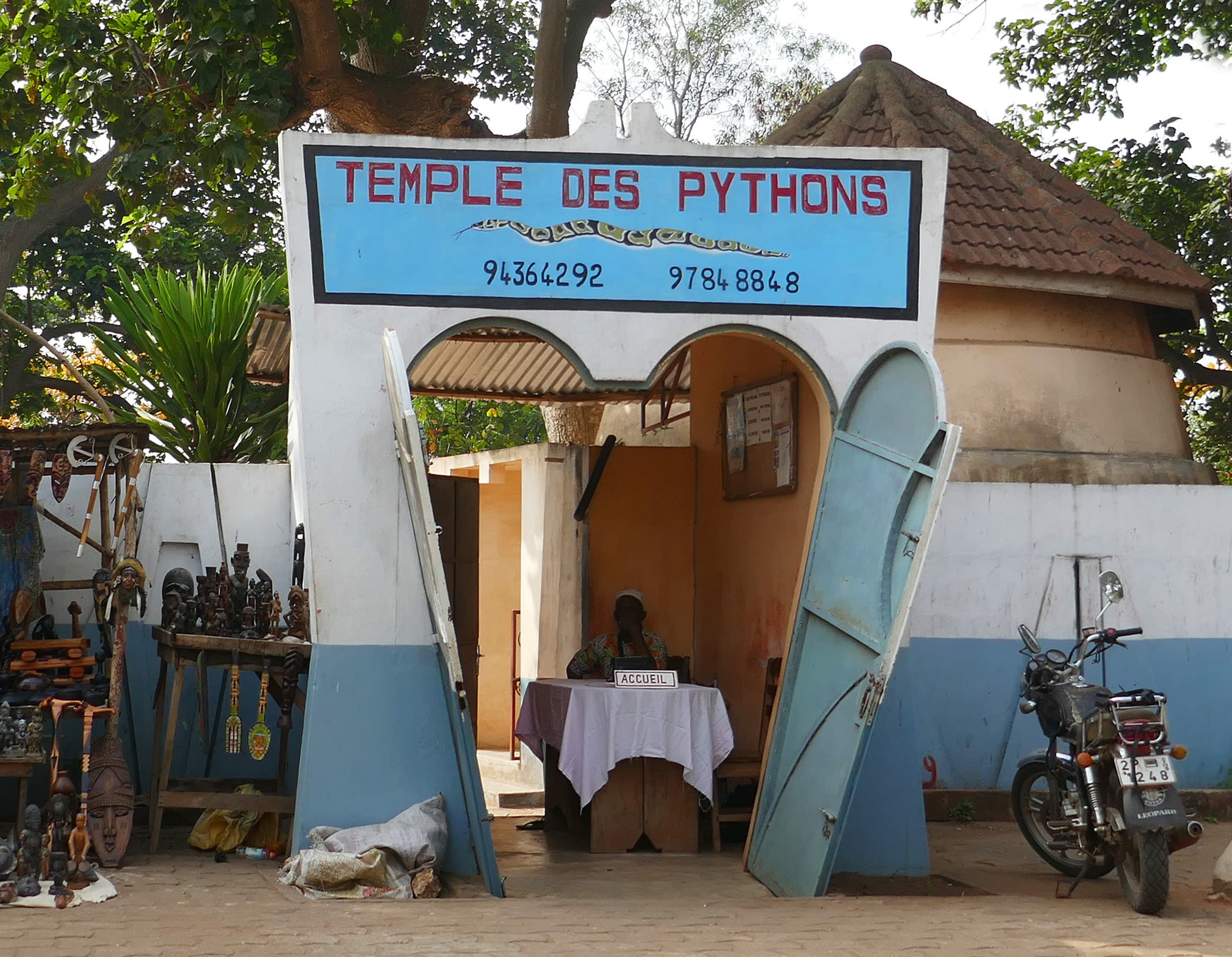
The Temple des Pythons - Aligbonon in Fon - isn't a zoo. It isn't a museum. It isn't, precisely speaking, even a "temple" in the Western architectural sense of a building designed for worship. It's a 307-year-old living sanctuary: an active place of daily prayer, weekly ceremony, and the annual Festival of Dan, where the boundary between the world of the living and the world of the divine isn't a metaphor but a practical reality that the community has maintained continuously since 1717.
The pythons aren't kept here. They live here - by choice, or something close to it. The temple has no enclosed walls. Any python in the courtyard can leave at any time, and occasionally they do, disappearing into the streets and compounds of Ouidah for days or weeks before returning. Priests don't pursue them.
"A god does not ask permission to leave," says Priest Koffi, who has tended this temple for over two decades.
What makes the Python Temple globally significant - not just locally, not just historically, but globally - is what it is the source of. When enslaved Africans were deported from this coast through Ouidah's slave route and across the Atlantic, they didn't arrive in the Americas empty. They carried, in their bodies and their memories, the theology of Dan. In Haiti, that theology became Danbala Wedo. In New Orleans, Damballa. In Brazil's Candomblé, the serpentine energy that governs the sky and the waters. Millions of people practice spiritual traditions today whose deepest root is this fifteen-meter courtyard in Ouidah. Most of them don't know where the source is.
Now you do.
The deep history
The kingdom before Dahomey (before 1727)
To understand the Python Temple, you must first understand the world it was built in - a world that no longer exists, but whose choices shaped everything that followed.
In 1717, when King Huffon of Hueda consecrated this sanctuary to the serpent deity Dan, Ouidah wasn't yet the city that history knows. It was the capital of the Hueda Kingdom (also written Xweda, or Whydah by the European traders who had been sailing its shores since the 1640s). The Hueda were a coastal people, cosmologically tied to water, serpents, and the liminal spaces between worlds. Their settlement - Sahe - sat on a narrow strip of land between the Atlantic and a lagoon, surrounded by the elemental forces they understood as alive and responsive.
The python wasn't a symbol to the Hueda. It was a presence.
In the Fon-Xweda cosmological system, Dan - the great serpent - was understood as the energy that animates all creation: the force that moves through water, through snakes, through the rainbow that bridges sky and earth after rain. To encounter a python in the wild was to receive a message. To house pythons in a consecrated space was to maintain a permanent, open channel to the divine.
King Huffon didn't so much build a temple as designate one. The iroko tree at the courtyard's center - still standing today, over four hundred years old - was already ancient in 1717. The king built around it. The tree had been recognized as a site of spiritual power long before any human structure existed there; the temple was an act of formalization, not of creation. The pythons that moved through the clearing around the iroko were already understood as Dan's messengers. What Huffon did was name that understanding in stone.
The Fon conquest of 1727
Ten years after the Python Temple was consecrated, the Kingdom of Dahomey - expanding aggressively from its capital in Abomey under King Agaja - invaded the Hueda Kingdom and seized control of the coast. The Hueda were defeated; their king killed or forced to flee toward the lagoon. Ouidah became Dahomey's window to the Atlantic: its principal port, its primary point of access to the slave trade with European powers.
The conquest changed the political map overnight. It also posed a theological question: what does a conquering kingdom do with the sacred sites of the people it has just defeated?
The Dahomey kings made a choice that reveals something essential about the Fon approach to spiritual power: they didn't destroy the Python Temple. They absorbed it.
The Fon had their own relationship with Dan - the serpent deity occupied a significant place in the Fon pantheon, though with different local emphases and names. Rather than suppressing the Hueda sanctuary, Dahomey integrated it into the spiritual architecture of the city it now controlled. The temple continued to function. Its priests - drawn from Hueda lineages - continued to maintain it. What had been a Hueda sanctuary became, over the following decades, a site that served the whole of Ouidah's population: Fon, Hueda, Yoruba, and later the Afro-Brazilian community that would begin arriving in the 1830s.
This decision is the reason the Python Temple is the oldest continuously operating sacred site in Ouidah. It survived conquest because the conquerors recognized its power and chose to inherit it rather than erase it.
The Atlantic century (1727–1865)
For the next 140 years, the Python Temple existed alongside one of the most industrialized episodes of human trafficking in recorded history. The slave trade was at its height; Ouidah was its principal port on the Bight of Benin; and four kilometers to the south, hundreds of thousands of human beings were being processed, chained, and loaded onto ships bound for the Americas.
The temple wasn't involved in the trade. It wasn't complicit in it. But it was adjacent to it - spiritually, spatially, and emotionally. When captives from the interior were brought through Ouidah's slave route, they passed through a city where the python deity was housed, venerated, and physically present. Some of those captives came from traditions that recognized Dan by other names. Some had received blessings at this very courtyard before the raids that captured them.
The priests who maintained the temple during this century knew what was happening four kilometers to the south. They continued to pour libations, feed the pythons, and tend the iroko tree. The temple functioned as a form of continuity against rupture - a living proof that not everything on this coast could be captured, bought, or shipped.
The captives who were taken carried Dan with them across the ocean. The priests who remained continued to receive Dan in this courtyard. The same force moved in both directions, split between worlds, waiting for the day the two halves would find each other again.
Missions, suppression, and survival (1865–1960)
When the slave trade ended and French colonization formalized in the late 19th century, the Python Temple faced a new adversary. Evangelical missionaries viewed the temple as an abomination - the worship of animals, the corruption of souls they had been sent to save. The French colonial administration viewed Vodun more broadly as a competing source of social authority, which it was.
The suppression campaigns of the late 19th and early 20th centuries were systematic. Shrines were destroyed. Initiates were pressured or imprisoned. The colonial administration confiscated sacred objects and banned ceremonies across Dahomey.
The Python Temple was threatened repeatedly, and it didn't close.
The community that maintained it was rooted too deeply in the city's social fabric. The priests had allies in the Aguda community - the Afro-Brazilian returnees who had settled in Ouidah from the 1830s and who understood the value of preserving what others tried to erase. They had allies in the Dahomey royal lineages that had absorbed the temple's authority two centuries earlier. And they had the deep logic of a living sanctuary: a place where thirty to sixty pythons coexist daily with a local population, where the animals wander freely into neighboring compounds and are welcomed there, where the boundary between the sacred and the everyday is deliberately porous - this kind of institution can't simply be closed by decree. It isn't a building. It's a relationship.
At Beninese independence in 1960, the Python Temple emerged intact: 243 years old, still housing its pythons, still practicing its ceremonies, still rooted to the same iroko tree that had stood here before any of it began.
The temple today
Walk through the gateway on a Friday morning in 2026 and this is what you encounter.
The courtyard: fifteen meters across, sand floor swept clean before dawn. White mud-brick walls, freshly painted. Seven alcoves set into the walls at waist height, each holding two or three pythons in loose coils, their scales retaining the warmth stored in the brick from the previous day's sun. One python has half-unfurled and is making its way toward a patch of morning light near the tree - no apparent urgency, no particular destination.
The iroko tree: four hundred years old, minimum. Taller than the walls, its canopy spreading wide enough to shade the entire courtyard. Strips of cloth are tied to its lower branches - red, white, black, yellow - dozens of them fluttering in the coastal air. Each one is a prayer made visible by someone who tied it there and left it to hang until it fades.
Priest Koffi arrives at six in the morning, before any visitor. He pours libations - gin and palm wine - at the base of the iroko. He checks the alcoves, notes which pythons are present and which have left during the night. If one is missing, he doesn't worry. The python will return, or it won't. Either outcome is, in his theology, equally valid.
By nine, the tourist gate opens. By ten on a Friday, local families begin arriving for the weekly ceremony: women in white lace, men with offerings of eggs and white cloth. By noon, the priest performs the public invocations in Fon, and the pythons are brought into the courtyard.
The temple today faces pressures Koffi discusses with calm, matter-of-fact gravity. Ouidah is expanding. The streets immediately surrounding the temple, which were open compounds when he began his work, are now a tighter fabric of houses, shops, and roads. Pythons that wander at night - as they always have - now encounter motorcycle traffic. Several have been killed. The buffer of sacred space that once surrounded the temple is narrowing.
There is also the question of succession. Koffi was trained by his predecessor over years of close apprenticeship. He knows the feeding protocols, the ceremony calendar, the specific ritual protocols of each type of blessing. He knows which python to bring forward for a woman seeking to conceive and which for a traveler requesting protection before a journey. This knowledge isn't written anywhere. He isn't young. The question of who carries it next is genuinely open - and it's the kind of question whose answer can't be forced.
The Atlantic thread: Dan, Danbala, Damballa
In January 2022, a man named James - a PhD researcher in African diaspora religions from Atlanta - stood in this courtyard and wept. He had spent years studying Damballa, the serpent spirit central to New Orleans Voodoo. He had read the theological literature, attended ceremonies, and interviewed practitioners across Louisiana. He had studied a deity he had never stood at the origin of.
Then a guide placed a python across his shoulders.
"I held Damballa," he told us afterward. "Not a carved statue. Not a symbol. The actual being my ancestors worshiped. I finally understood what was lost, and what survived."
What survived was this: when the first enslaved Africans were deported from the Bight of Benin, Dan traveled with them. Not in a book or a material object, but in their bodies - in the memory of how the snake moved, how it was held, what it meant when it crossed your path at dawn, what you owed it, and what it might give you in return.
In Haiti, that memory became Danbala Wedo - the white serpent lwa, one of the most important spirits in the entire Vodou pantheon. He is drawn as a white snake on the ground. His wife is Ayida Wedo, the rainbow serpent who bridges heaven and earth. These figures aren't distant relatives of Dan - they are Dan, translated across ocean and time with a precision that can only come from embodied transmission. The sky-rainbow-serpent triad that King Huffon built this courtyard around in 1717 is recognizable, without a glossary, in Port-au-Prince ceremonies today.
In New Orleans, Damballa remains central to Vodou practice. The white serpent, the rainwater offerings left for him, the specific protocol of how to approach and invoke this spirit - all of it descends, in unbroken theological lineage, from this courtyard.
In Brazil's Candomblé Ketu, the serpentine power of Dan moves through the traditions of Bahia. Diaspora practitioners making the ancestral path to Ouidah describe standing in the Python Temple as the experience of finding the grammar beneath a language they already spoke without knowing its source.
Every January 10th - Benin's national Vodun Day - diaspora pilgrims arrive at this temple from Haiti, Louisiana, Bahia, Havana, and Paris. Some come with theological training. Some come with nothing but a feeling that their traditions pointed here. Most describe the Python Temple visit as the moment their journey from abstract history to lived reality becomes complete. The snake that crosses your wrist in this courtyard is the same force that crossed the Atlantic in the memory of the enslaved. That isn't a metaphor. That's the unbroken thread.
The Vodun dimension
To visit the Python Temple as a tourist is to witness something from the outside. To visit it with some understanding of what is actually happening theologically is to participate in it - even as a respectful, non-initiated witness.
In Vodun cosmology, Dan isn't a snake. The snake is Dan's chosen form - the body through which a cosmic force makes itself legible to human perception. Dan represents what can't be represented by a static symbol: movement, continuity, transformation. The snake sheds its skin and is reborn. It moves without limbs - pure kinetic energy, no attachment to the ground it crosses. It coils - wealth accumulated, energy stored in spiral form. It crosses the sky as a rainbow after rain, bridging the dry earth and the wet heavens.
Dan is paired cosmologically with Mawu - the supreme female principle of creation in Fon cosmology. Mawu is the cosmic architect; Dan is the energy that animates what she creates. Together, they form the dual foundation of the universe in Vodun thought. The Python Temple, in this context, isn't a place where an animal is worshiped. It's a place where the animating energy of creation is made physically present, available for contact, accessible to the living.
The theological implications of this are specific and practical.
Contact isn't symbolic. In Vodun, there is no distinction between the sign and the thing it represents. The python IS Dan - not a representation of Dan, not a vessel for Dan's occasional presence, but Dan's permanent embodied form. When a devotee touches a temple python, they are in direct contact with the divine. No priest intermediary required. No prayer recited at a respectful distance. This directness is one of the defining characteristics of Vodun's theological architecture, and it distinguishes the Python Temple from most sacred sites in the world where distance from the divine is considered appropriate or even mandatory.
Different pythons carry different energies. Among the thirty to sixty pythons in residence at any time, initiated priests and long-term devotees distinguish several registers. The large, older females are associated with fertility and birth: women seeking to conceive, or pregnant women seeking a blessing for a safe delivery, are brought to these animals specifically. The rare albino python - when present - is considered to carry extraordinary luck, the power to dissolve obstacles and break patterns that ordinary effort can't shift. And then there is the python that approaches you without invitation: the one that moves across the courtyard floor toward you when you haven't reached toward it. In the theology of this temple, that approach is a message - the deity choosing contact rather than waiting to be approached. What that message means, the priest will help you read.
The temple operates on two time scales simultaneously. There is tourist time - 9 AM to 5 PM, guided visits, the exchange of CFA francs for an hour's encounter with an ancient living practice. And there is ritual time - the lunar calendar, the agricultural seasons, the daily rhythm of dawn libations and dusk closings, the annual cycle of Dan's festival. These two time scales coexist in the same courtyard, managed by the same priest. They require different modes of presence. To visit as a tourist is legitimate and welcome. To visit as something else - as a pilgrim, as a descendant, as someone with a genuine question for the divine - requires a different posture, a different speed, and ideally a local guide who can help you work through the transition. The temple accommodates both without contradiction. The pythons, in any case, don't distinguish.
How to visit
Getting there
The Python Temple sits on the Route des Esclaves in central Ouidah at coordinates 6.35976°N, 2.08536°E - five minutes on foot from the Basilique de l'Immaculée Conception, within easy walking distance of the Sacred Forest of Kpassè. Ouidah is reached from Cotonou by zemidjan (motorcycle taxi, approximately 45 minutes) or shared taxi along the coastal route. There's no formal parking at the temple; drivers typically wait outside.
Entrance
| Item | Cost |
|---|---|
| Admission | 2,000 CFA (~$3 USD) |
| Photography | +1,000 CFA |
| Video | +2,500 CFA |
| Guided orientation | Included in admission |
| Python handling | Included, no additional charge |
The guided orientation isn't optional in the bureaucratic sense. But more importantly: skipping it means missing half the experience. The guide explains the protocol, the significance of what you are about to encounter, and which areas of the courtyard are accessible to visitors versus reserved for active ceremony.
When to go
| Timing | What you experience |
|---|---|
| January 10th | Festival of Dan — midnight vigil, python procession through Ouidah's streets, sacred roof renewal. 5,000–8,000 attendees. The most complete experience available. Book accommodation six months in advance; Ouidah fills completely. |
| Friday mornings | Weekly ceremony at noon. Offerings brought, invocations performed in Fon, pythons brought into the courtyard for blessings. Full local attendance. Arrive by 9 AM to observe the morning care routine. |
| Any weekday morning, 9–10 AM | Pythons most active before midday heat. Fewest crowds. Best for unhurried, contemplative visits. |
| Avoid | Midday in dry season (pythons inactive, sun intense). Sunday afternoons (crowds from the adjacent Basilica can create conditions incompatible with temple practice). |
What to bring
- White cloth - for the iroko tree prayer. Available for purchase outside the gate; bringing your own is a gesture of preparation that priests notice and appreciate.
- Gin or palm wine - optional offering for the tree. Not required, never expected.
- Cash only - no card payments accepted anywhere on the temple grounds.
- Open shoes or willingness to remove them - certain areas are designated for bare feet.
- Patience - the temple runs on a time scale the pythons set, not the clock.
What to leave behind: fear of snakes, if you have it, is a genuine impediment - not because the pythons are dangerous, but because acute distress is legible to the animals and disrupts the atmosphere of the courtyard. If you have significant ophidiophobia, this visit isn't the right one for you. No one will judge that.
What few visitors know
The tree is older than the temple itself
The iroko tree (Milicia excelsa) at the center of the courtyard is estimated at approximately 600 years old - meaning it was already ancient when King Huffon built the temple around it in 1717. The sanctuary wasn't built first and the tree planted inside. The tree was recognized as a site of spiritual power, and the king built around what was already there.
This matters because it changes the theological logic: the Python Temple isn't a place humans consecrated. It's a place where the sacred was already present, and humans organized themselves around that presence. The iroko was the original anchor. The pythons were drawn to it. The walls came last.
Today, the tree grows in coastal saline sandy soil where horticulturists confirm this species shouldn't thrive. Its canopy spreads wider each decade. Its roots buckle the courtyard floor in slow increments. When scientists express their confusion, the priests smile.
"The tree feeds on faith," says Koffi.
A ceremony that happens once every seven years
Hidden in the temple's ritual calendar - invisible to tourists, absent from every travel guide - is the purification ceremony of Ouidah, which takes place here once every seven years.
The ritual requires 41 young virgin women to collect water from a specific sacred marsh at the edge of the city, at an hour determined by the priests. This water is poured into a clay ritual jar that has been held in a specific overturned position - continuously, without interruption - for more than two centuries. The water, mixed with sacred leaves by the Hounon priests, becomes the purification water used to bless the entire city of Ouidah for the seven years that follow.
The last ceremony took place in October 2024. The next will be October 2031.
If you were in Ouidah in October 2024, you may have witnessed something that happens once in a decade. Most visitors walking the Slave Route that same week had no idea it was occurring three streets away.
The python that chooses you
Among all the encounters the temple offers, the one priests watch most carefully isn't the tourist holding a python that a guide has placed across their shoulders. It's the python that moves toward someone unprompted - crossing the courtyard floor, or unfurling from an alcove, specifically toward a visitor who hasn't reached toward it.
In the theology of this temple, that movement isn't coincidence. The python doesn't move at random. When Dan chooses contact with a specific person, it's a message. What that message means, the priest reads in conversation with the visitor: what question did you carry through the gate today? What are you willing to release? What are you ready to receive?
Not every visitor receives this. Most don't. But for those who do, it is, without exception, the moment they carry home.
If you want to go deeper
If you have read this far, you aren't looking for a checked box on a tourist itinerary. You're looking for something harder to find: an encounter with a living tradition, on its own terms, with enough context to understand what you're witnessing.
That's what OuidahOrigins was built for.
Our guide network connects you with local practitioners and cultural translators - people who know the difference between a tourist hour and a genuine encounter, and who can help you work through that difference with the respect it deserves. Whether you're arriving in Ouidah for the first time, returning for the third, or organizing an ancestral journey for your family from Brazil, Haiti, or the United States, we can help you approach the Python Temple - and the rest of Ouidah's living sacred landscape - in a way that honors both your curiosity and the sanctity of what you're entering.
Guided access to the Python Temple through our Concierge service includes advance introduction to the temple priests, access to Friday ceremonies beyond standard visitor hours, and cultural context that transforms observation into understanding.
Plan your visit with our Concierge →
Explore what surrounds the Python Temple: The Sacred Forest of Kpassè is a ten-minute walk - the two sites together form the spiritual core of Ouidah. The Vodoun Days on January 10th are when both come fully alive.
Sources & further reading
- Temple des Pythons — Wikipédia (FR) - Historical record and cultural context of the sanctuary.
- The Temple of Pythons — Atlas Obscura - Documented visitor accounts and architectural notes.
- West African Vodun — Wikipedia - Theological framework for understanding Dan and the Vodun pantheon.
- Damballa — Wikipedia - The Atlantic diaspora manifestation of Dan in Haitian Vodou and New Orleans Voodoo.
- Ball Python (Python regius) — Wikipedia - Species profile of the sacred pythons housed at the temple.
- Iroko (Milicia excelsa) — Wikipedia - The guardian tree species at the temple's spiritual center.
- UNESCO Slave Route Project - The broader heritage context in which the Python Temple stands.
Editorial transparency
This content was developed with the assistance of our AI agents.
Frequently Asked Questions
Lire aussi
The Days of Vodoun
Every January, Ouidah transforms into the spiritual capital of Vodoun. A vibrant gathering where the gods come to life in the community, beyond just a festival.
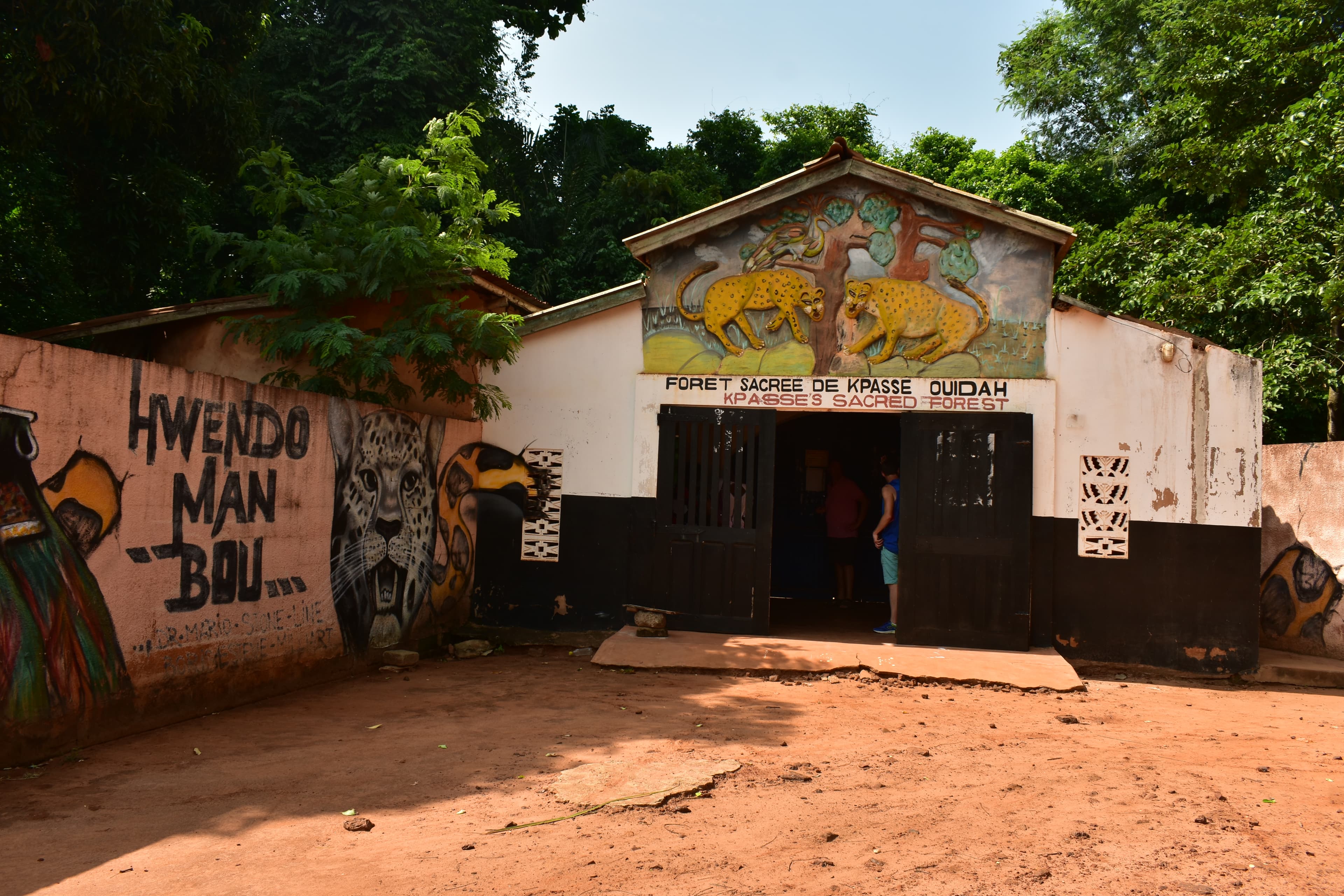
The Sacred Forest of Kpassè
Entering the sacred forest of Kpassè reveals an ancient world. Each tree becomes a witness, each shadow a potential presence. This living sanctuary transcends time and space.
Reading paths
The Slave Route
From the Atlantic slave trade to contemporary memory
Vodoun & Diaspora
How an African religion crossed the Atlantic
- Step 1· 12 minLe Temple des Pythons
Les origines du vodoun à Ouidah