Key Takeaways
- The Kpassè Sacred Forest originally covered 30 hectares — today it covers 4. Ouidah has grown around and consumed 87% of the original forest over three centuries. Visitors see a surviving fragment of what was once a vast sacred wilderness.
- King Kpassè, second sovereign of Savi and founder of the Houéda kingdom, reportedly transformed himself into an iroko tree rather than be captured by the Fon invasion of 1727. In Vodun theology, the forest IS him — still presiding over his city across three centuries.
- The forest contains 36 identified plant and fungi species, many with dual medicinal and ceremonial functions. Priests serve as expert herbalists whose botanical knowledge is transmitted orally and exists nowhere in written form.
- Every new King of Ouidah must enter the Sacred Forest and commune with the spirit of Kpassè before his coronation — a ritual that has been performed without interruption since the 18th century.
- The sculptures visible throughout the forest were created or restored by Cyprien Tokoudagba (1939–2012), Benin's most internationally exhibited Vodun artist, whose work was shown at the Smithsonian's National Museum of African Art and the Centre Georges Pompidou in Paris.
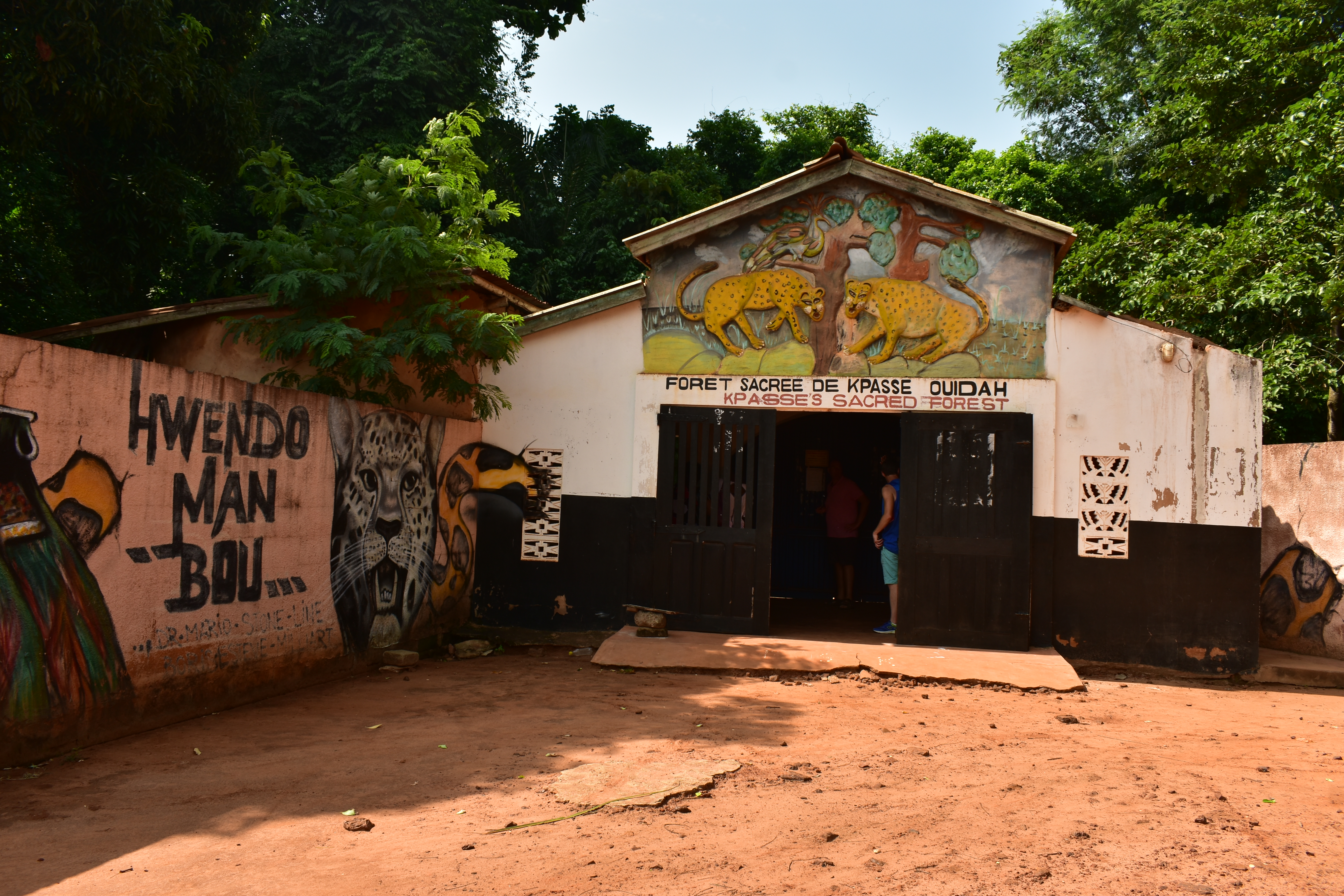
You enter through a low doorway in a concrete wall.
Behind you: Ouidah at midday - motorcycles, vendors, the flat equatorial light that erases shadows. Ahead: a temperature drop of several degrees. The smell of damp earth and centuries-old wood. A darkness that exists in the middle of the afternoon, made by a canopy so dense it has turned the sky into something distant and irrelevant.
The city continues a meter beyond these walls. You can hear it. But the laws of the city - the laws of noise, urgency, rationality, secular time - don't apply here.
You are inside the Sacred Forest of Kpassè. You have four hectares to explore. And you won't understand them by walking quickly. (Visiting protocols are covered in the vodun ceremony etiquette guide.)
Kpassè sacred forest Ouidah Benin: what this forest really is
The word "forest" undersells it, the way "water" undersells the ocean.
This is four hectares of living Vodun theology. Every tree in it is understood as a witness - a consciousness older than the city that grew around it, aware of what has happened in its shade over centuries. Every sculpture is a gate, not a decoration. Every path you're permitted to walk has a boundary beyond which you aren't invited, because the inner forest isn't a heritage site for visitors but an active space of initiation, healing, and governance.
The Kpassè Sacred Forest (Kpassèzoun in Fon, "zoun" meaning grove or sacred wood) was once significantly larger. Three centuries ago, it extended across 30 hectares - a vast coastal woodland at the heart of a city that was itself much smaller. As Ouidah grew, the city absorbed the forest from its edges: first farmland, then compounds, then roads, then the dense urban fabric of a functioning West African city. What remains today - the 4 hectares you can enter - is 13% of the original.
This is the first thing to understand when you walk through the gate: you aren't seeing the Sacred Forest. You're seeing what survived. The rest of it is under streets, houses, and markets that don't know what they were built upon.
The 4 hectares that survived are alive. The iroko trees - species estimated at 300 to 500 years old - rise 50 meters above the forest floor, their canopies creating a world separate from the city beneath them. The forest contains 36 identified plant and fungi species, many with medicinal properties that the priests who tend this space know in molecular detail, transmitted orally from generation to generation. It contains shrines to over 40 Vodun deities. It contains a secret initiation zone. And at its holiest center, draped in white cloth and enclosed by a low fence, stands the tree that's the king.
The deep history
The Houéda kingdom and the founder (before 1727)
To understand the Sacred Forest, you must first understand who Kpassè was - and why his choice to become a tree wasn't a defeat but an act of supreme power.
Kpassè was the second sovereign of Savi and the founder of the Houéda kingdom - the people who built Ouidah before the Fon conquest. The Houéda were a coastal people whose civilization was built around water, the Atlantic, and the spiritual forces that animated both. Their relationship with the forest - the land behind the beach, the space between human settlement and the wild - was constitutive of their identity.
The forest that bears Kpassè's name was sacred long before he arrived. The iroko trees that dominate it were already ancient when the kingdom was founded. But it was Kpassè who formalized the relationship between the human city and the wild forest, designating this grove as the spiritual center of Ouidah: the place where the gods lived, where initiates were formed, where the boundary between the visible and the invisible was kept thin enough for communication.
His wasn't a distant, administrative relationship with the sacred. He was its custodian and, eventually, its inhabitant.
The transformation of 1727
The Fon invasion came in 1727. The Kingdom of Dahomey - expanding aggressively from its capital in Abomey under King Agaja - overwhelmed the Houéda defenses and seized the coast. The Houéda kingdom, with its port, its trade networks, and its Atlantic access, became Dahomey's commercial gateway to the world.
Kpassè was cornered. The Fon forces had advanced to the edge of the forest. There was nowhere to go.
Legend - which in Vodun theology describes events that are spiritually true even when they exceed what Western frameworks call "historical" - says that rather than be captured or killed, Kpassè transformed himself into an iroko tree. Through the spiritual mastery that his role as sacred custodian of the forest had given him, he dissolved the boundary between human and plant, between mortal and sacred, and became the thing he had always protected.
His body disappeared. His presence didn't.
The original transformation tree still stands at the forest's holiest interior point, fenced with low stones and draped in white cloth. It's the axis around which everything in the forest is organized: the oldest, most concentrated node of spiritual power in Ouidah. To approach it is to approach the king. The forest doesn't commemorate him. The forest is him - still present, still governing, still receiving the prayers of the city he founded across three centuries of change.
Why the forest survived every conquest
The Fon decision not to destroy or desacralize the forest reveals something essential about how power operates in West African spiritual politics.
The Fon had their own relationship with trees, with spirits, with the animated natural world that Vodun theology describes. They conquered the Houéda. They absorbed their port and their trade. But they didn't try to erase the sacred forest, because doing so would have been theologically incoherent. You don't destroy a forest that's a king. You inherit the obligation to respect it.
Dahomey integrated the forest into the spiritual architecture of the city it now controlled. The covenant that requires every new King of Ouidah to enter the forest and commune with Kpassè before his coronation dates from this period - a ritual acknowledging that Fon authority over Ouidah rests on a prior, deeper authority that can't be superseded, only respected.
That covenant has never been broken. It continues today.
French colonial administrators in the late 19th century had little theological interest in the forest. Agricultural expansion and settlement encroached steadily on its edges. Evangelical missionaries periodically petitioned for its destruction, correctly identifying it as a source of authority outside colonial control. The community held the boundary. Every tree still standing inside these walls is there because someone, at some point, stood in front of it and didn't move.
By independence in 1960, the forest had contracted to roughly its current 4 hectares - down from 30. But alive, still functioning, still holding the presence of the king who became a tree two and a half centuries earlier.
The forest today
Walk the outer groves on a Tuesday afternoon and this is what you find.
The sculptures are distributed through the forest at intervals that feel neither random nor designed - placed where they need to be, according to the logic of the deities they represent. Most were created or restored by Cyprien Tokoudagba (1939 - 2012), Benin's most internationally exhibited Vodun artist. His style is unmistakable: flat perspectives, bold primary colors - red, blue, yellow, white - figures rendered in a register that is simultaneously naive and monumental. His work was exhibited at the Smithsonian's National Museum of African Art in Washington and the Centre Georges Pompidou in Paris. In Ouidah, it isn't exhibited. It lives outdoors, in the forest where it belongs, weathering and being renewed.
The canopy rises above everything else. The great irokos - whose roots buckle the forest paths in slow, patient increments - block the sky so thoroughly that the light reaching the forest floor is filtered, green-tinged, ancient-feeling. Under the largest iroko, the temperature is noticeably cooler than outside the walls.
The pharmacy is the forest's least visible and most consequential dimension. The 36 plant species identified here include a dozen with specific medicinal and ceremonial applications. The priests who tend the forest are also its pharmacists: they know which leaf, harvested under which moon, addresses which condition. None of this knowledge is written down. All of it exists inside living human beings who received it from human beings before them. When a tree falls in this forest, a recipe is lost.
The Zomachi - the initiation area in the forest's interior - is beyond the paths where tourists walk. Young people sent here during their initiation period learn the secret language of Vodun, the medicinal properties of the forest's plants, and the histories of their ancestors. They emerge with new names, subtle scarifications, and the knowledge of what their community needs them to carry. The forest produces the next generation of its own guardians.
The forest was added to UNESCO's World Heritage Tentative List on October 31, 1996. Formal inscription remains pending - caught between heritage bureaucracies and a living community that manages its sacred space on its own terms.
The diaspora connection
Every major deity in the Sacred Forest has a living counterpart in the Americas.
Legba - the Master of Crossroads who guards the entrance gate - arrived in Haiti as Papa Legba, the old man who must be greeted before any ceremony can proceed. He crossed to Cuba as Eshu/Elegba in Santería and to Brazil as Exu in Candomblé. In New Orleans, he is still called Legba. The figure at the forest's entrance is the source point of every one of these Atlantic manifestations.
Sakpata - lord of the earth and of infectious disease, his shrine covered in textured bumps symbolizing the physical eruptions of illness he controls - crossed the Atlantic as Babalú Ayé in Cuban Santería (the deity whose song became a global hit through Desi Arnaz) and as Omolu in Brazilian Candomblé. The fear and reverence with which Sakpata is approached in Ouidah is the same fear and reverence his diaspora counterparts command in Havana and Salvador.
Hevioso - the thunder deity whose double-axe symbol stands throughout the forest - is the ancestor of Shango across Yoruba-derived Atlantic traditions: the fierce lightning god venerated across Cuba, Brazil, Trinidad, and the African-American spiritual community.
When diaspora pilgrims visit the Sacred Forest on January 10th - which hundreds do, arriving from Bahia, from Port-au-Prince, from Miami, from Paris - many describe the experience of meeting the forest's deities as meeting the originals of portraits they have always known. Legba at the gate is the grandfather of the Legba they pray to at home. The recognition is theological, genealogical, and physical all at once.
The Vodun dimension
Experienced practitioners describe entering the Sacred Forest as encountering Aze - a quality of charged silence, a feeling of being observed by an intelligence older than human observation, a vibration in the air that isn't wind and not sound but is perceptible nonetheless.
Aze doesn't translate cleanly. It is something like what physicists might call a field - a distributed property of the space rather than a quality of any individual object in it. The forest carries Aze because it has been held as sacred for centuries, because the intentions and energies of every initiation, every libation, every prayer conducted within it have accumulated in its soil and wood and air.
Legba stands at the entrance because that is where he must stand: at every boundary between the ordinary world and the sacred. To enter the forest without acknowledging Legba is structurally incorrect - like entering a house without opening the door. He is the key. Everything begins with him.
Hevioso represents justice in its most elemental form: the justice of the sky, sudden and final. Lightning is his verdict. His presence in the forest isn't gentle. He is the deity whose power makes the others coherent - the guarantor that the world has moral structure.
Sakpata is the most intimate and the most feared. As lord of the earth, he controls the ground beneath every foot in Ouidah. As lord of disease, he controls what the body does when it fails. To honor Sakpata is to acknowledge that the earth gives life and also takes it, and that this duality isn't a flaw in the world's design but its foundation.
The forest's protocol reflects its theology precisely. You remove your shoes because the earth here is sacred and contact with it isn't casual. You point with a closed fist because the finger sends energy where it points, and sending unbidden energy at a deity's shrine is inadvisable. You speak quietly because this is a space of listening, not performance.
How to visit
Getting there
The Sacred Forest is at Boulevard de la Forêt Sacrée in central Ouidah (coordinates: 6.35280°N, 2.08430°E) - a ten-minute walk from the Python Temple, within easy walking distance of the Afro-Brazilian Cathedral and Place Chacha.
Entrance
| Item | Cost |
|---|---|
| Admission | 1,000 CFA (~$1.50 USD) |
| Guided tour | 5,000 CFA — strongly recommended |
| Photography (outer groves) | Included in guided fee |
| Photography (inner areas) | Restricted — ask guide |
When to visit
Late afternoon is best: the light through the iroko canopy turns golden and filtered, the temperature drops, and the forest takes on a quality that rewards slow presence. January 10th brings thousands outside the walls for re-consecration ceremonies - the best opportunity to witness the community's living relationship with the forest.
Protocol
- No shouting; no raised voices
- Point with a closed fist or nod - never with a finger
- Remove shoes when asked
- Respect all photography-prohibited zones
- Don't enter any restricted area without your guide
- Move slowly - the forest punishes hurry
What few visitors know
You are seeing 13% of the original forest
The Sacred Forest you walk through today is a fragment. It originally covered 30 hectares. Urban expansion over three centuries has consumed 26 of them. Streets, houses, and markets now occupy what was once the same sacred grove.
The 4 hectares that survive did so because the community that maintained them refused to yield - one tree at a time, one confrontation at a time, across 300 years. Every iroko still standing inside these walls is there because someone stood in front of it and didn't move. That resistance isn't history. It's the forest's present condition.
Every king of Ouidah enters this forest before his coronation
This is a living ritual, not a historical tradition.
When a new King of Ouidah is crowned, he must first enter the Sacred Forest and commune with Kpassè's spirit before his investiture can proceed. The ritual acknowledges that all subsequent political authority over Ouidah rests on a prior, deeper authority - the founder-king who became the forest itself. No legitimacy is complete without his recognition.
This covenant has been honored through French colonialism, through Marxist-Leninist government, through every political transformation Benin has undergone. The forest has outlasted every government that tried to ignore it or suppress it.
The boundary tree that does two things at once
Among the 36 plant species in the forest, the Newbouldia laevis - called the "boundary tree" - occupies a position that is simultaneously medicinal and ceremonial.
Its powdered leaves treat physical conditions - inflammations, infections, respiratory ailments. The same preparation serves as a ceremonial ingredient in specific Vodun rites. The boundary between medicine and ritual isn't a boundary here but a continuum: one plant, two registers, the same knowledge system serving both.
The name itself is significant. Trees that mark boundaries - between the cultivated and the wild, the human and the sacred - hold specific spiritual authority in Vodun geography. In the Sacred Forest, the Newbouldia laevis grows at the edge of the areas reserved for initiation, at the threshold between what visitors may see and what only initiates may enter.
If you want to go deeper
The Sacred Forest rewards return visits. A first visit gives you the outer structure. A second visit, with a guide who can translate the specific shrines, gives you the theology. A third visit - if you are present during a ceremony - gives you the forest as it is meant to be experienced: alive, populated, in direct relationship with the community that holds it.
OuidahOrigins' Concierge service offers access beyond the standard visitor experience - botanical walks with an herbalist guide, introduction to the forest's priests, and possible presence at ceremonies during the Vodun Day season.
Plan your visit with our Concierge →
The Sacred Forest is at the spiritual center of Ouidah. The Python Temple is a ten-minute walk - together the two sites form the most concentrated zone of Vodun practice in the city. Vodoun Days on January 10th is when the forest opens fully to the city it has always presided over.
Sources & further reading
- Forêt sacrée de Kpassè — Wikipédia (FR) - History, legend, and contemporary status.
- Sacred Forest of Kpassè — Explanders - Botanical documentation including the 36 plant species.
- UNESCO Tentative List — Sites marquants du Bénin - Official UNESCO documentation of the tentative inscription since 1996.
- Les statues de la forêt sacrée expliquées — Cultures & Patrimoines - Identification of the forest's sculptures and their Vodun meanings.
- Cyprien Tokoudagba — Wikipedia - Biography and international exhibition history of the forest's primary sculptor.
- West African Vodun — Wikipedia - Theological framework for the forest's cosmological function.
- Iroko (Milicia excelsa) — Wikipedia - The sacred tree species at the forest's spiritual center.