

Key Takeaways
- The Tree of Forgetfulness stands at Station 2 of the Slave Route, 1.2 kilometers south of Place Chacha — at this point alone, between 1671 and 1865, over one million Africans were subjected to the ritual before being shipped across the Atlantic.
- The ritual was initiated by King Agadja of Dahomey — not by European slave merchants. It was a deliberate Dahomean political instrument designed to make captives more docile before embarkation. African political authority was as complicit in the psychological dimension of the trade as in its commercial one.
- Men circled the iroko tree 9 times, women 7 times, children 5 — a calculated perversion of Vodun numerology where 9 represents masculine energy and cycle completion, 7 represents feminine creative mystery. The trade weaponized the captives' own spiritual framework against them.
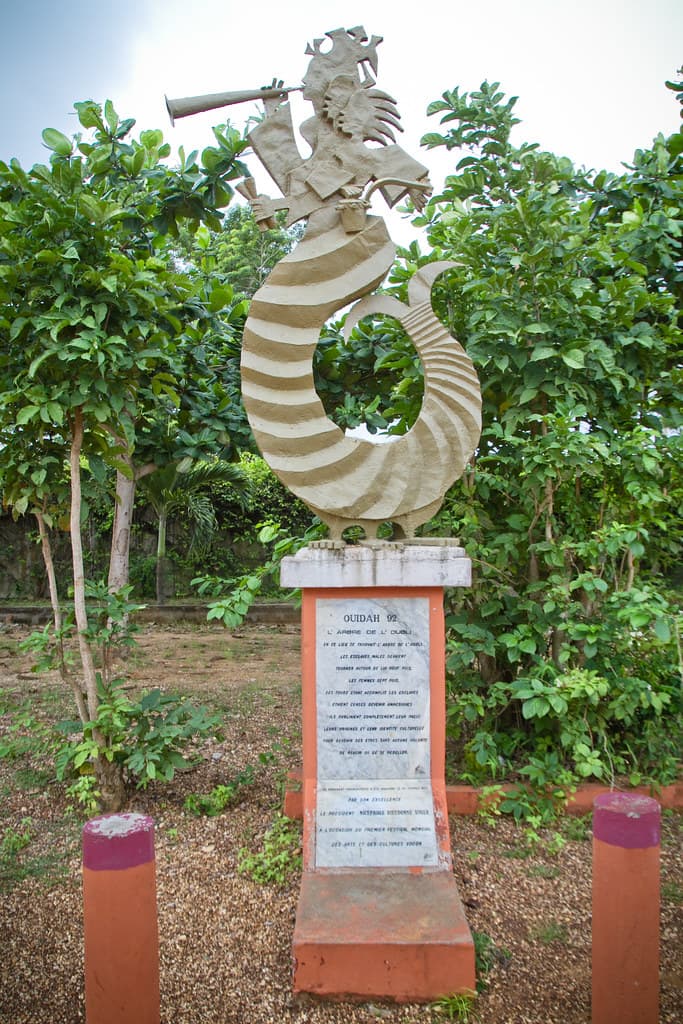
- The monument inaugurated by President Soglo during the 1993 Festival of Vodun Culture is topped with a sculpture of Mami Wata — the water deity who governs boundaries between worlds. The site of forced forgetting is watched over by the goddess of dangerous thresholds.
- The ultimate proof the ritual failed: Vodun survived in Haiti as Haitian Vodou, persisted in Brazil as Candomblé, and its musical and spiritual memory echoes in the Blues, jazz, and spiritual traditions of North America.
The monument doesn't look threatening. A low stone wall, enclosing a tree. A plaque. The kind of thing you might walk past without stopping, thinking it a minor historical marker on the way to something more dramatic.
Stop.
You're standing at the site where, for nearly 200 years, the most deliberate and systematic attempt in the history of the Atlantic slave trade was made to destroy individual human identity - at scale, using the captives' own spiritual framework as the instrument of their undoing.
And it failed. Completely. The proof is in every Candomblé terreiro in Salvador da Bahia, every Santería ceremony in Havana, every time someone in Port-au-Prince calls on Legba at the crossroads. The people who were forced to walk around this tree forgot nothing. Their descendants are still remembering.
That is the full story of the Tree of Forgetfulness. The failure is the point.
What this site really is
The Tree of Forgetfulness isn't the most dramatic site on the Slave Route. The Door of No Return has the ocean. The Zomai enclosure has its oppressive darkness. The barracoon site has its forensic horror.
What the Tree of Forgetfulness has is something more unsettling: calculated intelligence. The people who designed this ritual understood psychology, spirituality, and the architecture of identity well enough to attempt an erasure that was meant to be permanent. They weren't blunt. They were precise.
They chose the captives' own sacred numbers. They chose the most spiritually charged tree in the local landscape. They forced repetition until disorientation set in. They were attempting something more ambitious than physical capture: they were attempting to manufacture a category of human being - the slave - who had no self from before the trade to return to.
They failed because human memory is more durable than any system designed to erase it. But the attempt was serious. Understanding what was tried here - in full - is the only honest way to understand what the diaspora's survival actually means.
The deep history
King Agadja's instrument (early 18th century)
Here is the fact that most accounts of the Tree of Forgetfulness omit: the ritual wasn't invented by European slave merchants. It was initiated by King Agadja of Dahomey - a Fon king, an African ruler, the political leader whose kingdom controlled the coast through which this trade ran.
The Tree of Forgetfulness was a Dahomean political instrument, administered by the same state whose Agojie warriors supplied the captives and whose commercial alliance with Francisco Félix de Souza monetized them. The psychological preparation of captives for the Atlantic crossing was as African in its origins as it was European in its commercial beneficiaries.
This doesn't diminish European culpability. It complicates the moral world of the trade in ways that honest history requires. The psychological violence of the Tree of Forgetfulness was African authority deploying African spiritual knowledge against African people - in service of a commercial system that enriched both African and European elites at the expense of the millions who crossed this road.
Ouidah carries this complexity without resolving it. The Tree of Forgetfulness is part of that carrying.
The arithmetic of erasure
The ritual's mechanism was precise. Captives were forced to walk around the iroko tree a specific number of times - not at random, but according to a system.
Men: 9 circles. Women: 7. Children: 5.
In Vodun and Fon spiritual tradition:
- 9 is the number of masculine energy - the completion of a cycle, the full harvest, the closing of a journey. A man who has walked nine circles has, in the symbolic logic of the tradition, completed the arc of his life.
- 7 is the number of feminine creative energy - the mystery of generation, the seven sacred waters, the seven days of creation. A woman who has walked seven circles has, symbolically, exhausted her creative origin.
- 5 in some traditions represents the living body - the five senses, the five limbs extended. A child of five circles has been severed from embodied presence.
The designers of this ritual knew these numbers. They chose them deliberately. They weren't imposing an alien torture - they were commandeering the captives' own cosmological framework and turning it against them. With each circle, a specific layer of the person's identity was supposed to dissolve: one for the name, one for the village, one for the ancestor's face, one for the language of prayer, one for the god who protected the family compound.
By the final circuit, the captive was meant to arrive at the ships as a tabula rasa - a blank slate, a unit of labor without history, without lineage, without gods. Ready to be renamed, branded, and sold.
Standing under the equatorial sun, starved and dehydrated, shackled to dozens of other terrified people, the repetitive circling created what modern psychology would recognize as ritualistic dissociation - a trauma response that fragments coherent thought and memory. The designers of the ritual understood this intuitively. They understood that a person with a memory is a person with a reason to resist.
The counter-ritual: what the captives built
Recognizing what was being done to them, captives and sympathetic local Vodun priests established a secret counter-ritual at a second tree further along the route, nearer the beach.
This was the Tree of Return (L'Arbre du Retour) - and it was entirely the property of the enslaved. No slaver designed it. No king authorized it. It was a clandestine act of spiritual insurgency.
The logic: walk around the Tree of Return three times - the number of the soul's journey in Vodun cosmology, the three realms through which the spirit travels between life and death and return. The belief: even if your body dies on the other side of the ocean, your soul will travel back under the Atlantic through the tree's roots and re-emerge in the Sacred Forest of Kpassè in Ouidah.
The Tree of Forgetfulness was imposed. The Tree of Return was chosen. Between them lies the full moral architecture of the Slave Route: the broad violence of those who organized the trade, and the astonishing resilience of those who walked through it.
Today, visitors tie white ribbons to the replacement Tree of Return near the beach. The ritual of return has never stopped.
The monument (1993)
The memorial at the Tree of Forgetfulness site was inaugurated by President Nicéphore Soglo during the 1993 Festival of Vodun Culture - the same political moment that had, the year before, established January 10th as Benin's national Vodun Day. The memorial was part of a deliberate political program of historical reclamation.
The original iroko tree that witnessed the ritual had died before the end of the 20th century - as if, local oral tradition holds, it could no longer carry what it had witnessed. The replacement tree was planted in the same soil, at the same coordinates, in the understanding that the ground itself remembered even when the tree that stood in it was gone.
The monument that was placed at the site carries a detail that most visitors miss: its apex is crowned with a sculpture of Mami Wata - the water deity, goddess of boundaries between worlds, of thresholds and crossings, of what is lost and what returns. The architect of the memorial placed the guardian of dangerous passages at the top of the monument to forced erasure. The symbolism is precise: the goddess who watches over the sea crossing watches also over the last moment on land where a person was still, formally, themselves.
The site today
Walk 1.2 kilometers south from Place Chacha and you reach the memorial enclosure.
It is deceptively simple: a low stone wall surrounding the replacement iroko tree, a plaque mounted on the enclosure, the tree itself now of moderate age - decades old, not centuries. The bark is frequently draped in white cloth, placed by local families who come here for what they call "Memory Healings" - private, unannounced ceremonies conducted for descendants who feel severed from their roots, whether those descendants are Beninese, Haitian, Brazilian, or American.
These aren't tourist ceremonies. They aren't organized for visitors. They happen because the need they address is real and ongoing: the need to reconnect with something that was specifically and deliberately cut.
The site sits in a strange quiet zone of the Slave Route - past the noise of central Ouidah, not yet within hearing of the Atlantic. You are, precisely, in the middle: between the world that was and the ocean that was coming. The psychological weight of that in-between-ness is the memorial's most powerful feature, and it requires no signage.
The monthly libations performed by Hounon priests - on the first Friday of each month - are the most regular ceremonial expression of the site's ongoing spiritual significance. The libations are poured for those who were forced to circle this tree and never came back. They're also poured for those who, in circling it, refused in their hearts to forget.
The diaspora dimension
The Tree of Forgetfulness ritual failed. The magnitude of that failure is the most important fact about it.
Vodun didn't die in the Middle Passage. It arrived in Haiti as Haitian Vodou, where Legba still guards every crossroads and Mami Wata still claims her devotees from the sea. It arrived in Brazil as Candomblé, where the same 256 odù of the Fa oracle are recognized and read. It arrived in Cuba as Santería, where Shango still speaks in thunder and Yemayá still rules the waters.
The specific survival of the Fa oracle - 256 mathematical patterns held in memory across the ocean - is the clearest proof of the ritual's failure. The designers of the Tree of Forgetfulness ritual chose the captives' spiritual numbers precisely because they understood those numbers had power. What they failed to understand was that the system those numbers anchored was more resilient than any physical instrument of forgetting.
When diaspora visitors come to Ouidah and walk around the Tree of Forgetfulness in reverse - starting at 9 and counting down to 1 - they are performing what many describe as the most personally meaningful act of their entire roots journey. Un-forgetting. One step at a time. At the site where the forgetting was ordered.
For Afro-Brazilian visitors whose DNA traces to this coast, the walk is something specific: the reversal of a ritual that was intended to be permanent, performed at the exact spot where it was administered to an ancestor who might have been their own. The gesture is private, unhurried, and doesn't require an audience.
The spiritual dimension
The iroko tree (Milicia excelsa) wasn't chosen at random. In Vodun and West African spiritual traditions across a wide geographic range, the iroko is considered one of the most spiritually charged trees in existence - a species understood to be inhabited by powerful spirits and used to anchor significant ceremonial spaces.
The Sacred Forest of Kpassè is defined by its iroko trees. The Python Temple has its ancient iroko at the center of the courtyard. The Tree of Return is an iroko. The presence of an iroko at the site of forced spiritual erasure wasn't accidental - it was the selection of the most spiritually authoritative tree available, turned to a purpose that inverted its usual function.
The iroko is normally a tree of memory, of ancestors, of spiritual continuity. The Tree of Forgetfulness was an iroko used to break all three.
The counter-ritual of the Tree of Return - which was also an iroko - restored the original function. The enslaved found another iroko, one that wasn't contaminated by the slavers' ritual, and used it to do what the iroko was meant to do: to connect the living with their dead, to maintain the thread between departure and return.
The two trees aren't opposites. They are the same spiritual technology, used by opposite parties with opposite intentions. One of those intentions failed. The other is still bearing fruit.
How to visit
Approach
The Tree of Forgetfulness is at the 1.2-kilometer mark of the Slave Route, approximately 15 minutes' walk south of Place Chacha. Don't drive to it. The walk is the context.
The road from Place Chacha southward is laterite - red, dusty in dry season, muddy in rainy season. By the time you reach the memorial enclosure, the city has receded enough that the site feels genuinely transitional: the noise of Ouidah behind you, the silence of what comes next ahead.
What to do
Most visitors stop, read the plaque, and move on. This is a valid visit. A deeper engagement involves two things:
Walking the circles in reverse. Many visitors choose to walk around the tree from 9 down to 1 - a gesture of un-forgetting, performed at the exact site where forgetting was ordered. The gesture is personal, not theatrical. It doesn't require narration.
Staying still. The memorial's most powerful quality is the quality of the silence at the 1.2-kilometer mark of the route - the specific silence of the in-between. The city is behind you. The ocean isn't yet audible. You're standing in the space where millions of people made the psychological crossing from one world to another before the physical crossing had even begun. Staying still in that space, without hurry, is the site's most honest use.
Practical notes
- Location: 6.3589°N, 2.0867°E - 1.2km south of Place Chacha on the Slave Route
- Monument: Low stone enclosure around the replacement iroko tree
- Access: Open, no entrance fee
- Monthly ceremony: First Friday of each month - Hounon priests pour libations at the site
- Context: Best experienced as part of the full Slave Route walk, not as an isolated stop
What few visitors know
King Agadja initiated the ritual
The Tree of Forgetfulness is almost universally presented as a European invention - a torture device of the slave trade. The historical record is more precise and more uncomfortable.
The ritual was designed and initiated by King Agadja of Dahomey. It was a Dahomean political instrument. The state that sold captives also prepared them psychologically for sale. The commercial partnership between the Kingdom of Dahomey and European slave merchants wasn't limited to the transfer of human beings - it extended to the architecture of their psychological preparation.
This means the Tree of Forgetfulness isn't a site where African victims encountered European violence. It's a site where Dahomean political authority - the same authority that organized the Agojie warriors, the same authority that allied with Francisco Félix de Souza - deployed African spiritual knowledge against African people. The collaboration between Dahomey and the Atlantic slave trade was total. The Tree of Forgetfulness is its most intimate expression.
The monument is crowned with Mami Wata
Most visitors to the memorial site notice the plaque and the tree. Few look at the top of the monument, where the architect placed a sculpture of Mami Wata - the water goddess, guardian of boundaries and dangerous crossings.
This placement was deliberate. Mami Wata governs the threshold between the world of the living and the world of the dead - which is, in Vodun cosmology, the same threshold as the surface of the sea. The monument to the last moment of African identity before the Atlantic crossing is watched over by the goddess who governs what lies on the other side of that crossing.
The monument's architect was saying something specific: the people who crossed this threshold weren't simply lost. They entered the domain of the water goddess. She was watching when they left. She is watching still.
The bark is used for private healings
The most active ongoing use of the Tree of Forgetfulness memorial is one that almost no visitor to Ouidah ever sees.
Local families - Beninese, and increasingly diaspora visitors from Brazil, Haiti, and the United States - come to the memorial at night or early morning, outside tourist hours, and drape white cloth on the bark of the replacement tree. These aren't decorative offerings. They are the material trace of what the community calls "Memory Healings" - private ceremonies conducted for individuals or families who experience a specific kind of disorientation: the feeling of being severed from their roots, of not knowing where they come from, of carrying an unexplained sense of loss.
The healing isn't performed by the tree. It is performed at the tree - which is understood as a site where the specific form of violence that causes this disconnection was administered, and therefore as the site with the specific authority to help undo it.
The white cloth on the bark is correspondence. Letters to ancestors who were made to forget. The replies come in the form of people who remember.
If you want to go deeper
The Tree of Forgetfulness is the philosophical center of the Slave Route - the site where the trade's deepest ambition, and the diaspora's deepest triumph, are most precisely concentrated.
OuidahOrigins' Concierge service offers guided walks of the complete Slave Route with the historical and spiritual depth the Tree of Forgetfulness specifically requires - including access to the oral tradition around the monthly libations and, when appropriate, private introductions to families who maintain the Memory Healing practice at this site.
Plan your walk with our Concierge →
The Tree of Forgetfulness is Station 2 of the Slave Route. It follows Place Chacha and precedes the barracoons, the Zomai enclosure, the Tree of Return, and the Door of No Return. Walk the full route to understand the complete sequence of what was attempted - and what survived.
Sources & further reading
- Arbre de l'oubli — Wikipédia (FR) - Historical context and memorial documentation.
- UNESCO Slave Route Project - Full documentation of the six stations and their designation.
- SlaveVoyages Database - Primary vessel-by-vessel records; search "Ouidah" for the scale of the trade this site served.
- West African Vodun — Wikipedia - The spiritual tradition whose numerology the ritual perverted.
- Milicia excelsa (Iroko) — Wikipedia - The sacred tree species at the center of the memorial.
- Haitian Vodou — Wikipedia - The diaspora tradition that proves the ritual's failure.
Editorial transparency
This content was developed with the assistance of our AI agents.
Frequently Asked Questions
Lire aussi
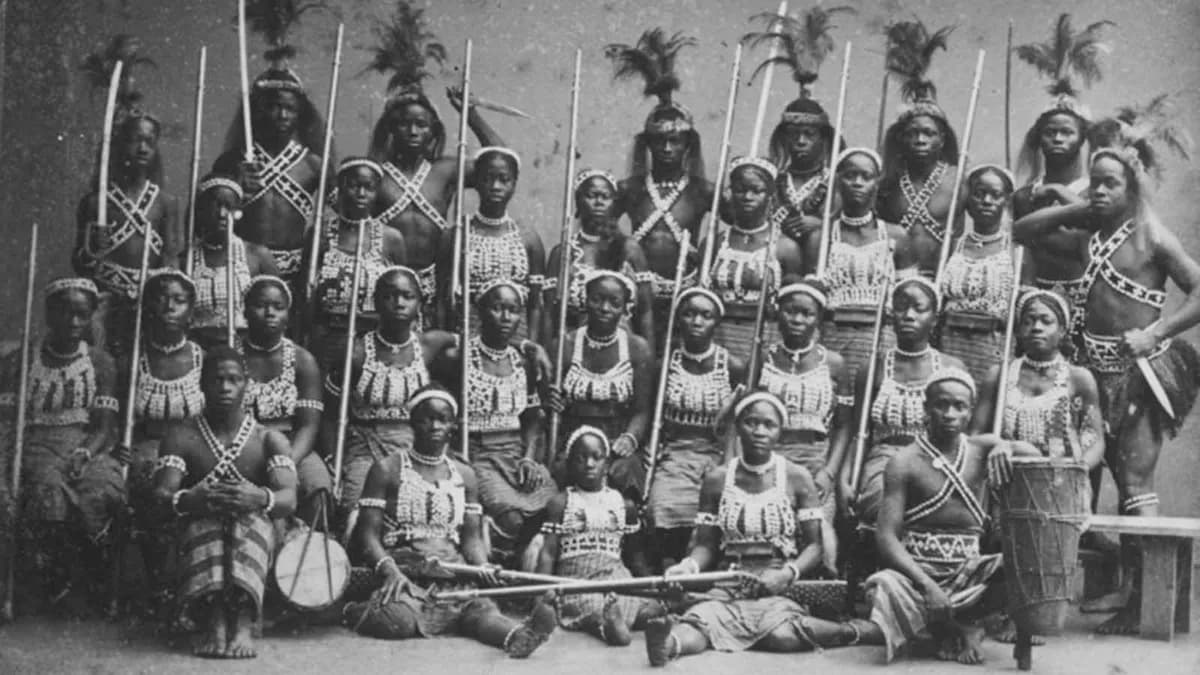
The Agojie
Encountering the Agojie in 1892, the French Foreign Legion met a formidable force. These women were not just warriors; they were a documented army that defied norms and shaped history.

Amulets of the Amazons
The amulets of the Amazons of Ouidah transcend their status as museum artifacts. They testify to a struggle for restitution and an identity renaissance.
Places of Memory and Vodun
Far from being mere attractions, the memory sites in Ouidah are witnesses to a poignant history, where vodun and memory intertwine.
Reading paths
The Slave Route
From the Atlantic slave trade to contemporary memory
Vodoun & Diaspora
How an African religion crossed the Atlantic
- Step 1· 12 minLe Temple des Pythons
Les origines du vodoun à Ouidah