Key Takeaways
- Fort São João Batista de Ajudá was built in 1721 — the only Portuguese fort on the entire Slave Route — primarily as a commercial processing facility, not a military stronghold. Its function was the logistical export of enslaved human beings to Brazil.
- Until 1961, the fort was sovereign Portuguese territory inside the independent Republic of Benin — the world's smallest recognized colony. At the time of the final ultimatum, Portugal's sovereign presence consisted of exactly 2 people.
- On 1 August 1961, the last Portuguese administrators set the fort on fire before fleeing — destroying 240 years of slave trade records on the explicit orders of dictator António de Oliveira Salazar. It was not a spontaneous act: it was a state-ordered erasure.
- The fort's barracoons had an estimated mortality rate of 1 in 5: captives died of dysentery, starvation, or despair in windowless stone rooms while waiting for slave ships to anchor offshore.
- Restored in 1987 with funding from the Calouste Gulbenkian Foundation — a Portuguese cultural institution — the fort became the Ouidah Museum of History, inaugurated on September 6, 1967. The country that burned it funded its rebuilding.
Walk through the gate of the Portuguese Fort and you're walking into the only piece of sovereign Portuguese territory that ever existed on the Slave Route.
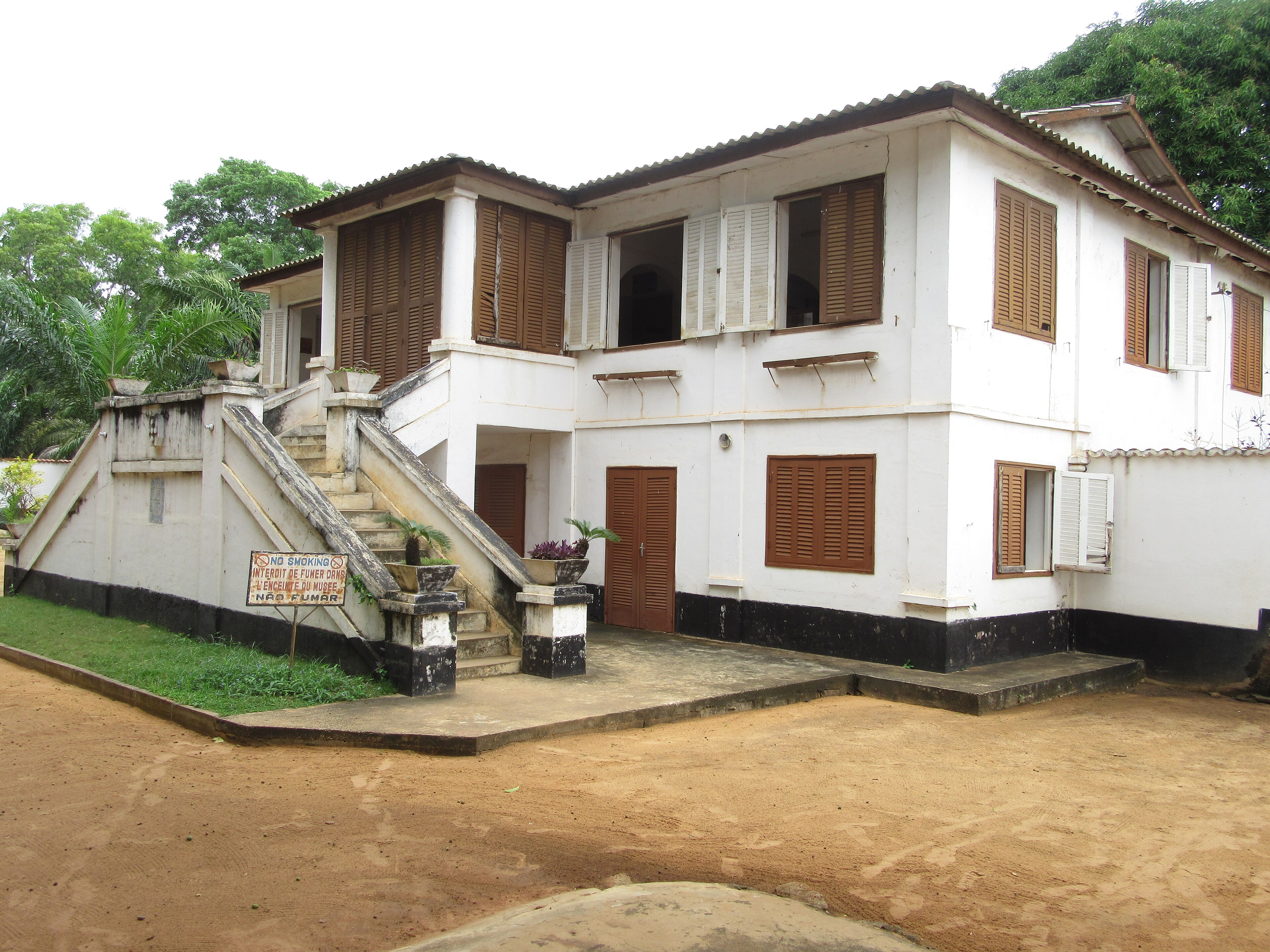
The fort is small. That surprises most visitors. There's nothing grand or intimidating about its exterior - a square perimeter of thick mud-and-stone walls, four defensive bastions at the corners, a central courtyard. It looks like what it was: not a military installation designed to withstand a siege, but a commercial facility designed to process a specific kind of cargo efficiently. The cargo was human beings.
For 240 years, this enclosure operated as the logistical brain of the transatlantic slave trade along the Bight of Benin. Then, on 1 August 1961, its last administrators poured gasoline over the archives and the buildings and set them on fire - not out of desperation or madness, but on the explicit orders of a dictator in Lisbon who preferred to destroy the evidence rather than hand it over intact.
The stone walls survived. The records didn't.
Today the fort houses the Ouidah Museum of History. It's the natural first stop for any serious visit to Ouidah - the place where the documentary context for the Slave Route is established before you walk it.
Visit Portuguese fort Ouidah Benin: what this fort really was
The Fort São João Batista de Ajudá was never designed for war. No European power was going to besiege it. The Xweda and Fon kingdoms that controlled the surrounding territory weren't colonial threats - they were commercial partners. The forts of West Africa - this one, the great castles at Elmina and Cape Coast in Ghana, the installations at Gorée in Senegal - weren't military presences in any meaningful sense. They were warehouses with flags.
The flag in this case was Portuguese. The warehouse processed human beings.
What made the Fort of Ajudá unique among the slave-trade forts of West Africa was its legal status. While the forts of the Gold Coast were trading posts that operated under local sufferance and could be - and often were - seized, expelled, or transferred between European powers, the Portuguese fort at Ajudá was formally constituted as sovereign Portuguese territory. A person who crossed through its gates stepped, technically, into the Kingdom of Portugal.
For nearly 240 years, in the middle of a West African city, this fiction was maintained. It is one of the most extraordinary geopolitical anomalies in modern history - and one of the least examined.
The deep history
Construction and purpose (1721)
Construction of the fort began in 1721, in the closing years of the Hueda Kingdom - before the Fon conquest of 1727 that would transform the entire political world of the region. Portugal had been trading from Ouidah since the 1640s, operating from temporary commercial posts. The fort formalized that presence into a permanent sovereign structure.
The Portuguese name for Ouidah was Ajudá - "help" in Portuguese, a phonetic rendering of an indigenous place name. The name stuck: the fort became Fort of Ajudá, its garrison were the garrison of Ajudá, and Portugal's territorial claim to this small enclave was called São João Baptista de Ajudá for the next two and a half centuries.
"Help." It is almost too easy an irony. This was where Europeans came to be helped to a supply of enslaved people. The name wasn't chosen for its meaning - it was purely phonetic - but history didn't fail to notice.
The fort's layout reflected its purpose with cold precision. Unlike the massive fortifications of the Gold Coast, which needed to defend against both African kingdoms and rival European powers, the Ajudá fort was built to a more modest specification: 3-meter-thick walls of mud and stone, four corner bastions, a central courtyard, and the structures necessary to run a commercial slave-trading operation. Each element had a function in the supply chain.
The architecture of the trade
The barracoons were the fort's central functional element - long, narrow, windowless holding cells, partially submerged in the earth for coolness, built to confine hundreds of captives in absolute darkness while ships assembled offshore. Captives arrived at the fort after being processed at Place Chacha: inspected by company surgeons, branded with hot irons, and priced. They were then walked to the barracoons and confined, sometimes for days, sometimes for weeks or months, depending on shipping conditions.
The mortality rate in the barracoons was staggering. Historians estimate that approximately 1 in 5 captives died in the holding cells before ever boarding a ship - from dysentery, from starvation used as use to break resistance, from despair, from the simple physical catastrophe of overcrowding in a tropical climate without ventilation, sanitation, or adequate water. These people never crossed the Atlantic. They died on the same continent where they were born - in these walls - and were discarded into mass graves.
The chapel stood directly adjacent to the barracoons. Every Sunday, the Portuguese governor and his officers attended Mass - with the sounds of the captives audible through the walls a few meters away. The juxtaposition wasn't considered a contradiction. Captives were often baptised in mass ceremonies before boarding ships - not to save their souls, but to "purify" the cargo and increase its market value in the Catholic colonies of Brazil and Cuba. Faith and commerce were in partnership here, not in tension.
The governor's quarters occupied the most comfortable position in the fort - shaded, ventilated, furnished with the amenities of a minor Portuguese colonial official. The governor of Ajudá wasn't a powerful man in Lisbon's hierarchy. He was a distant posting, managing a small operation in a hot climate. But within the logic of the fort, he was sovereign Portuguese authority - his word was Portugal's word, his flag was Portugal's flag, and the territory he stood on was legally part of the same kingdom that ran Brazil, Mozambique, Angola, and Goa.
The extraterritorial enclave
The geopolitical reality of the fort for most of its operating life was this: a person could walk five minutes from the Ouidah market, pass through the fort's wooden gates, and be technically in the Kingdom of Portugal.
After the Fon conquest of Ouidah in 1727, the fort's relationship changed from coexistence with the Hueda to commercial partnership with Dahomey. The Kingdom of Dahomey, which now controlled the coast, had no interest in expelling the Portuguese - the fort was a commercial asset, a buyer for the captives Dahomey's military produced. The extraterritorial status that protected Portuguese traders from local jurisdiction was maintained by mutual convenience.
The fort's political representative on the Dahomey side was the Yovogan - the "Viceroy of the Whites," a Dahomean official whose specific function was to manage the relationship between the foreign forts and the kingdom's commercial administration. The Yovogan and the Portuguese governor were commercial counterparts, each representing a different side of the same transaction. This collaboration between European traders and Dahomean political authority is what the museum now inside the fort documents without flinching.
The long twilight (1865–1961)
When the transatlantic slave trade was finally suppressed in the mid-19th century, the fort's economic rationale evaporated. The barracoons had no cargo. The ships had stopped coming. The commercial infrastructure that had justified 140 years of Portuguese presence in Ouidah was dismantled.
Portugal kept the fort anyway.
For the next century, Portugal maintained a tiny nominal "garrison" - shrinking year by year as the imperial logic that had justified the presence eroded around it. By the 1921 census, the fort had exactly five inhabitants. Its annual budget was negligible. It produced nothing, exported nothing, generated no revenue, and served no military or economic purpose. It was an imperial habit - the residue of prestige that refused to acknowledge its own obsolescence.
But the Portuguese flag flew. And that, apparently, was enough.
The smallest colony in the world
By the time the independent Republic of Dahomey formally demanded Portuguese withdrawal in 1961 - exactly one year after Beninese independence - Portugal's sovereign presence in Ouidah had dwindled to two people: the governor and his assistant. These two individuals were the physical embodiment of Portugal's claim to this territory.
The ultimatum was delivered. The Dahomean military surrounded the fort's gates. Portugal was given a deadline.
What happened on 1 August 1961 wasn't a spontaneous act of defiance by a cornered colonial official. It was an act of state. Dictator António de Oliveira Salazar, from Lisbon, explicitly ordered that the fort be set on fire before abandonment rather than surrendered intact to the Beninese government. The last administrators carried out the order on the deadline date: they poured gasoline over the furniture, the archives, and the buildings and set the fort on fire before fleeing toward the Nigerian border.
The flames destroyed 240 years of records - shipping logs, transaction registers, correspondence between the fort's successive governors and Lisbon, documents that would have constituted the most detailed account of the transatlantic slave trade from a single port in existence. Every transaction. Every captain's name. Every ship. Every departure date.
Salazar didn't burn the fort in panic. He burned it in calculation. A government that had already decided to refuse decolonization - that would hold its African colonies by military force for another 13 years, until the Carnation Revolution of 1974 - destroyed the evidence of the trade that had originally justified the colonial enterprise. It was a final act of imperial logic: if you can't keep the territory, at least deny the historians their material.
The fort today
From museum to MIME (2026)
In 2026, the Portuguese Fort isn't open to visitors as it previously was.
The fort is under active renovation - one of the most significant cultural infrastructure projects in West African history is being built inside its walls. The MIME - the Musée International de la Mémoire et de l'Esclavage, the International Museum of Memory and Slavery - is expected to open in 2027, transforming this historic site into one of the largest dedicated museums of the transatlantic slave trade in the world.
The project is part of the Beninese government's cultural investment program that has committed over one trillion CFA francs to heritage infrastructure since 2016. The MIME won't be a simple expansion of what existed before. It's a conceptual reinvention: a museum narrated from African and diaspora perspectives, built on the same ground where the people it commemorates were held.
The MIME will include:
- A chronological journey through 400 years of history - from the Kingdom of Xwéda through the Kingdom of Dahomey, the Middle Passage, and the diaspora communities that formed across the Americas
- A section dedicated to Vodun resilience - the spiritual systems that survived the crossing and continue to shape religious life across four continents
- A reconstruction of a slave ship, making the scale and conditions of the Middle Passage physically inhabitable rather than merely described
- A 130-room tourist complex anchoring the site as a destination for diaspora return visits
The decision to build the MIME inside the Portuguese Fort rather than in a purpose-built new structure isn't logistical. It is deliberate. The building already carries meaning. The MIME inherits that meaning and adds to it.
Read our full journal article: The MIME: Ouidah's New International Museum of Slavery Memory
What was here before
For decades before the renovation, the fort housed the Ouidah Museum of History, inaugurated on September 6, 1967, under the young Republic of Benin. For visitors who encountered it in its previous state, the museum was one of the most intellectually honest slavery-related sites in West Africa - notable above all for what it put in front of you rather than what it abstracted away.
Iron shackles - heavy, corroded chains used to bind necks, wrists, and ankles. Some were visibly sized for children. The scale made the abstraction collapse.
Trade ledger replicas - lists showing the assigned "value" of human beings in tobacco rolls, cowrie shells, and textiles. The bureaucratic language of the trade, precise and dehumanizing.
Vodun sculpture by Cyprien Tokoudagba - the deities who were venerated by the people the fort processed, now housed inside the fort's walls. An intentional juxtaposition.
These elements - and much of what the Museum of History represented - will be integrated and expanded inside the MIME. The institutional continuity is the point: Ouidah's engagement with this history doesn't pause. It deepens.
Portugal's formal acknowledgment
Portugal formally recognized Beninese sovereignty over the fort only in 1985 - twenty-four years after the takeover. The diplomatic delay wasn't administrative inconvenience but political posturing.
In 1987, the Calouste Gulbenkian Foundation - a major Portuguese cultural institution funded by the fortune of the Armenian-Portuguese oil magnate Calouste Sarkis Gulbenkian - funded the restoration and conservation works on the fort. The building was formally re-inaugurated on August 10, 1990.
The irony is precise: the country whose government ordered the fort burned in 1961 was the country whose cultural foundation paid to rebuild it in 1987. Portugal's relationship with this history isn't one of clean acknowledgment - but it isn't one of complete silence either.
The diaspora dimension
For Afro-Brazilian visitors - and thousands come each year - the Portuguese Fort occupies a specific and disorienting position in the geography of ancestral reckoning.
The fort was the bureaucratic heart of the system that organized their ancestors' deportation. The Portuguese language that the Aguda community of Ouidah still prays in - the archaic Brazilian Portuguese frozen in the 1850s that elderly residents recite in the 9am Mass at the cathedral - was the operational language of this fort. The ledgers that recorded human beings as tobacco-roll equivalents were written in the same language that the cathedral across town still uses for Sunday Mass.
For diaspora visitors from Brazil, standing in the fort is standing inside the machinery of their own history - not the emotional, memorial history of the Slave Route's stations, but the administrative, bureaucratic, ledger-entry history. The fort is where the trade was organized on paper. The Slave Route is where it was enacted in bodies.
Both are necessary for understanding what happened here.
The name "Ajudá" - "help" - has followed the diaspora across the Atlantic. In Brazil, the indigenous name for Ouidah that became the fort's Portuguese designation is still used by religious communities to refer to this specific coastal geography, this specific point of origin. When Candomblé practitioners in Bahia speak of "Ajudá," they're speaking of this fort, this coast, this city.
The name of a place that meant "help" to those who came to take became the name by which the taken remembered where they came from.
The moral dimension
The fort embodies a specific kind of historical complicity that neither the dramatic violence of the Slave Route nor the commercial cunning of Francisco Félix de Souza quite captures: institutional complicity.
The chapel next to the barracoons wasn't an anomaly. It was a statement of the Catholic Church's relationship to the trade - a relationship of active participation, theological rationalization, and bureaucratic facilitation. Captives were baptised before boarding ships not in defiance of the trade but in service of it. The sacrament was an economic instrument.
The fort's extraterritorial status - its existence as sovereign Portuguese territory inside an African kingdom - was itself a form of impunity. The laws that governed ordinary European commerce didn't fully apply here. The oversight that might have constrained the trade in metropolitan Portugal was deliberately absent. The flag protected the practice.
And then, when the practice became indefensible and the territory untenable, Portugal destroyed the records. The final act of the colonial presence was to prevent accounting. Not to apologize, not to acknowledge, not to hand over the documentation that would have allowed historians and descendants to understand the trade's full scope. To burn it.
This is the specific crime that the fort's history adds to the longer list of the trade's crimes: the deliberate destruction of the evidentiary record. The people taken from this coast have no individual documentation of their departures. Their names were never the point - they were cargo, and cargo doesn't need names. What the archives might have held was the scale, the chronology, the names of those who organized it from the European side. Salazar took that too.
How to visit
The fort as starting point
The Portuguese Fort is the natural first stop for any historically-focused visit to Ouidah. The museum inside provides the documentary context - the logistical, commercial, and legal architecture of the trade - that makes the Slave Route's stations legible when you walk them afterward.
The sequence: fort - ' Slave Route - ' Door of No Return is the sequence of the trade's own logic. Processed here, marched south, departed at the beach. Walking it in order allows each site to build on the last.
Practical information
The museum is open during standard hours; a small entrance fee applies. Allow at least 90 minutes to engage with the exhibits properly - the shackles and the ledger replicas in particular deserve unhurried attention. Certified guides from the museum staff are available and significantly enrich the visit.
The fort is located at 6.35909°N, 2.09023°E in central Ouidah, near Place Chacha and within walking distance of the Python Temple and the Cathedral.
What to pay attention to
- The scale of the shackles: Look at the smaller ones. Let the specificity of the size register.
- The chapel placement: Stand in the courtyard and locate both the chapel and the barracoon sites. The proximity is the statement.
- The cannons: Still pointing toward the sea. They never needed to fire. Symbolic authority was enough.
- The Tokoudagba sculptures: The gods of the people the fort processed, now housed inside its walls. Ask the guide to explain each one.
What few visitors know
Salazar personally ordered the burning
Most accounts of the 1961 burning present it as the desperate act of a cornered colonial administrator. The historical record is more precise and more damning.
The burning was carried out on the explicit orders of António de Oliveira Salazar, Portugal's dictator. The last administrators weren't acting on initiative - they were executing a directive from Lisbon. The destruction of 240 years of slave trade records was a deliberate state decision, made at the highest level of Portuguese government, with full awareness of what was being destroyed and why.
Salazar's government was, in 1961, already engaged in armed suppression of independence movements in Angola, Mozambique, and Guinea-Bissau. The destruction of the Ajudá archives was consistent with a broader policy of denying that Portuguese colonialism had produced anything that required accounting for. It wasn't madness. It was policy.
Two people
At the moment of the final ultimatum in 1961, Portugal's sovereign presence in Ouidah - its claim to one of the oldest colonial territories in West Africa - was represented by exactly two people: the governor and his assistant.
Two people. A flag. A claim that dated to 1721.
This is what 240 years of imperial prestige declines to at the end: two men in a small building in a city that no longer needed them, burning papers while the army waited at the gate.
The Gulbenkian Foundation rebuilt what Portugal burned
In 1987 - twenty-six years after Salazar's government ordered the fort burned - the Calouste Gulbenkian Foundation, a Portuguese cultural institution, funded the restoration and conservation of the fort. The work was inaugurated on August 10, 1990.
The Gulbenkian Foundation had no role in the burning. It wasn't the Portuguese state. But it was Portuguese money - the fortune of an Armenian-Portuguese oil tycoon, administered by a cultural foundation that operates as one of Portugal's most important cultural institutions internationally - that paid to rebuild what the Portuguese state had destroyed.
The fort that Portugal burned, Portugal's culture rebuilt. The records that Salazar ordered destroyed remain destroyed. The stones the foundation paid to restore still stand.
If you want to go deeper
The Portuguese Fort is the administrative origin point of Ouidah's most difficult history - the place where the trade's logistical, legal, and commercial dimensions are most directly documented. To understand it fully is to understand what the Slave Route was built to serve.
OuidahOrigins' Concierge service offers guided visits to the fort and museum with the historical depth the site requires - connecting the exhibits to the broader commercial and political system of which the fort was a part, and situating the museum's artifacts within the full arc of Ouidah's history.
Plan your visit with our Concierge →
The fort is the documentary origin of the history the Slave Route enacts physically. The commercial system it processed ran through Francisco Félix de Souza at Place Chacha. It ends at the Door of No Return and the beach where Mami Wata still watches.
Sources & further reading
- Fort of São João Baptista de Ajudá — Wikipedia - broad historical documentation including the 1961 incident and Portuguese recognition.
- São João Baptista de Ajudá — Britannica - Historical overview of the colonial enclave.
- Odd Moments in Decolonization — Arsenal for Democracy - Analysis of the 1961 incident and its geopolitical context.
- Fort of São João Baptista — HPIP (Portuguese Heritage) - Architectural and heritage documentation of the fort.
- Ouidah Museum of History — Wikipedia - Documentation of the museum established in the fort's ruins.
- SlaveVoyages Database - Primary vessel-by-vessel records of the trade the fort administered.
- Kingdom of Dahomey — Wikipedia - The political partner that supplied the trade the fort processed.